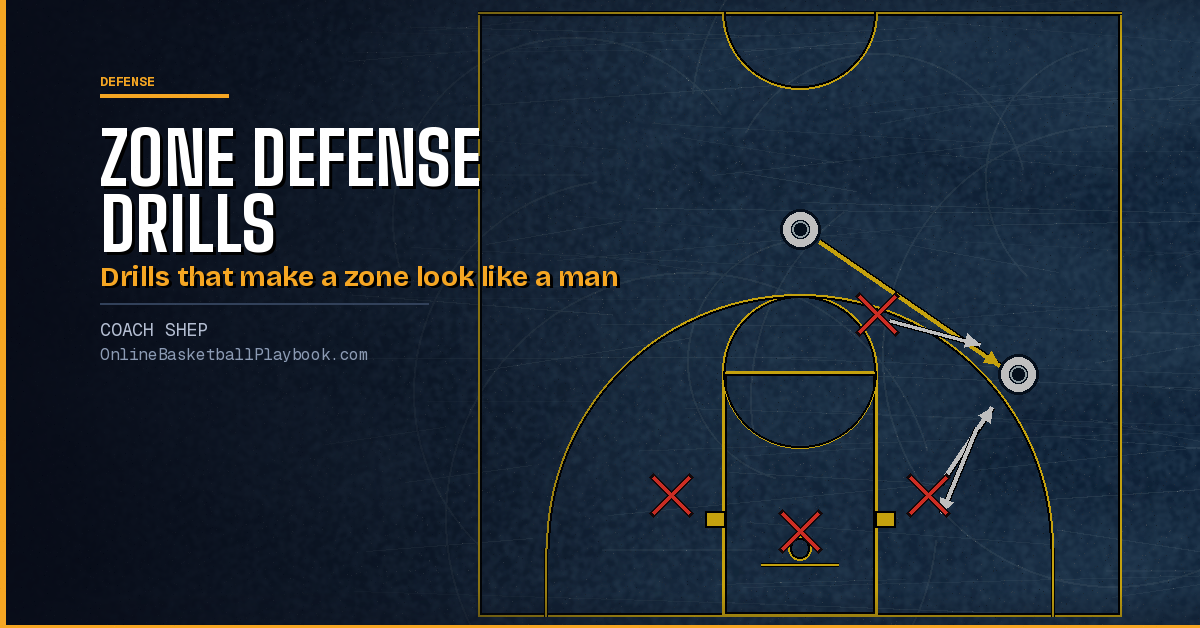
Zone defense drills teach five players to move together on every pass, close out from a zone spot, trap and rotate behind a trap, and rebound without man assignments. This page collects the zone defense drills that carry from one zone to the next, in the order they are usually built: individual skills, the closeout and bump, rotation drills, build-up ladders, traps and competition, then rebounding. Each zone's own drill set stays on its page, and those are linked below rather than repeated. The zones themselves are compared on types of defense in basketball.
Why Zone Drills Start With Man Skills
The foundation comes before any rotation. Ettore Messina teaches zone fundamentals as man fundamentals applied to areas: ball pressure, help-side position, defending cuts and blocking out. His order is that a team cannot build a solid zone before it can defend man to man. The man-zone version of the 1-1-3 warns that a team which drills only the rotation diagrams loses the zone, and the 1-2-2 match-up begins with the rule that zone does not mean rest.
So the first block of zone practice looks like man practice. The stance, slide, ball-pressure and contain drills that open a 2-3 install are on 2-3 zone defense drills, and the full man ladder is on basketball defense drills. The drills below add what a zone needs on top.
Individual Zone Defense Drills
Triangle deflection. Groups of four: three passers stand in a triangle around one defender. The defender reads the passer's eyes and body and jumps toward each pass to deflect it. It trains reading the passer, reaction time and quickness.

1-on-1 zig-zag. Partners of similar size and quickness stay in one half of the floor. The defender turns the dribbler as many times as he can, then defends him 1-on-1 at the rim. One version keeps the defender's hands behind his back so he cannot reach in.
Zig-zag into a closeout. The same drill extends into a full sprint back and a closeout once the ball is passed to a coach on the sideline, and it ends live 1-on-1.
Punching at the ball. The man-zone version of the 1-1-3 runs 1-on-1 inside the three-point line, with the defender hopping into the ball and hunting deflections with high hands.
Closeout technique itself is on closeout and recover.
Closeout and Bump Drills
A 2-3 guards three perimeter spots with two top defenders by letting a back defender take the first wing catch and then "bump" back down when the guard arrives. One version calls it "on and off." These drills isolate it.
On-off drill. A coach at the top of the key passes to the wing. The low outside defender closes out with high hands (on). When the top defender arrives to take the ball, the low defender retreats back inside (off).

Skip pass to the corner. The same forward learns the exception: once the ball reaches the corner, he goes out and stays attached to it. He does not retreat.
Forward's wing and corner rotations. The ball goes wing to corner and back so the forward learns when to retreat and when to hold. The final stage runs both forwards together as the ball moves point to wing to wing: the ball-side forward closes out and the weak-side forward tucks inside the paint.

Three-on-two from a tandem. This is a man-to-man drill that carries over. The offense starts in a triangle with the point guard in charge. The two defenders line up one behind the other: one on the ball, one splitting the distance to protect the paint. On the wing pass the back defender takes the wing and the top defender drops between the point and the opposite wing. It doubles as help-side and skip-pass closeout work.
One 2-3 coach runs a drill in which the first pass to the wing is always taken by a back-line defender, X3, X4 or X5. The bump itself is drawn in a zone on the tandem 2-3 zone page, where the high wing stunts and the guard recovers.
Rotation Drills With No Shot
Slides with a pass fake. Six offensive players set up in the alignment the zone will face (1-3-1, 2-3 or 3-2). They pass slowly and fake inside before each pass so the coach can check every slide. Only when the slides are right does the offense speed up and look for a shot after eight or ten passes.
Perimeter passing, then two posts. Jim Boeheim starts with five offensive players on the perimeter passing for 25 to 30 seconds, about the time he says most teams take to attack a zone, while the defense moves on every pass. Then he adds two post players and plays 5 against 7. Another of his notes runs zone rotation for thirty seconds with no shots.

Direction calls. A point-zone install has the defense react to the coach's direction call.
Shell work for the help and recovery underneath these rotations is on drills to teach help and rotation and the shell drill.
Get the next coaching guide in your inbox
One email when a new guide or diagram set goes up. Free.
Build-Up Ladders
The ladders differ:
| Version | Rungs |
|---|---|
| Point zone | 5 offense against 4 defense, 6 against 5, reacting to the coach's direction call, then 3-on-3 working baseline-drive rotations |
| Temple match-up, part method | 2-on-2 with the guards, 3-on-4 with a guard and a forward, 4-on-4, 4-on-3 defending a flash with the center occupied, then 5-on-5 weak-side rotation |
| Temple match-up, whole method | Roles first, then all five walk the roles 5-on-0, then 5-on-5 against 1-2-2, 1-3-1, 2-1-2, motion and 1-4 offenses |
| Man-zone 1-1-3 | 1-on-1 work on feet and hands, then 2-on-2, plus advantage and disadvantage drilling |
John Chaney's Temple match-up rests on one idea: a defender always pressures or denies at the point, the offense must declare a side, and the ball never goes back to the point once it reaches a wing. More match-up drills are on how to coach a match-up zone.
Five against six. Five against six appears in the point-zone ladder, and the 2-3 page uses it too.
Trap and Overload Drills
Trap drills with and without the dribble. The man-zone 1-1-3 traps with the offense allowed no dribble, then with a mandatory dribble. Its rule for every drill is to make it harder than the game.
4 on 2, no pass. Four offensive players against two defenders with no passing, from the same man-zone drill list.
5 on 4 overload, no dribble. Five against four with no dribble. When the defense is down a man, it must force five or more passes.
Daily trap time. Boeheim runs his short-corner and corner traps for 3 to 4 minutes every day. His baseline auto-trap drill has the second defender drop and cover as deep as the ball. On a drive the opposite wing must rotate over, and a skip to the far side is answered by trapping on that side.
Defensive cut throat. Three teams of three. The first team to three stops wins, and a charge wins automatically. Hands stay at waist, shoulder or contest level, never at the knees, and every defender jumps in the direction of the pass.
Trap footwork and angles are on trapping in basketball, and scored drill formats are on competitive basketball drills.
Zone Rebounding Drills
A zone has no box-out assignments, so offensive players slide into its gaps, especially against an overload. The rebounding triangle is one rule for it:
- The on-ball defender always boxes out the shooter, in any zone.
- One rebounder goes on each side of the rim and one in front, not so far under the basket that the offense can seal them under it.
- One perimeter player sits near the free-throw line for the long rebound, sometimes shaded to the weak side.
- Long shots from the wing or corner need a weak-side rebounder. One rule of thumb says about 70 percent of missed corner shots come off on the opposite side, and some coaches send both the weak-side forward and the weak-side guard there.
In a 2-3 on a corner shot, the ball-side post defender closes out, X5 slides over to the ball-side block, the weak-side low defender holds the weak-side rebound, the opposite top defender drops in to the triangle, and the ball-side top defender stays out to deny the pass back to the wing.

Zone war drill. Take a standard war drill and put the defenders in the zone. Shoot from set spots (the top of the key, the wings, the corners and the high post). Or run your usual 5-on-5 zone work with an assistant watching only the box-outs.
Coaches split on how much to teach. One answer is no specific block-outs: players rebound their area and the weak-side forward gets position at the edge. Another is to get the first block-out. The man-zone 1-1-3 drills a daily "cap the rim," fills every triangle spot, and adds a player at the weak-side elbow. More box-out drills are on box out drills and box out basketball.
Fitting Zone Work Into Practice
Boeheim's practice gives 10 to 15 minutes to teaching the zone in the half court, with 10 minutes of breakdowns and 10 of 5-on-5 zone, then scrimmage, with 20 minutes of individual skill work every day all season. The man-zone 1-1-3 coach adds a general rule for any drill: do not chase drills, chase the five or six ingredients that make a drill work, such as time, score and the rotation of groups. His teaching order is to praise, tell, show, run a dry run, correct and repeat.
Drills for Each Zone
Each zone page keeps the drills specific to its shape:
- 2-3 zone defense: the half-second reversal drill, 4-on-3 and 5-on-3 for the back line, 5-on-6 and baseline out of bounds.
- 3-2 zone defense: skip-pass closeouts, the post-to-corner run and overload 3-on-2.
- 1-3-1 zone defense: corner-to-corner skips for the baseline runner, the baseline screen drill and trap and rotate.
- 1-2-2 zone defense: post flash, baseline to baseline, post-trap 4-on-4 and the down-screen closeout.
- 1-1-3 zone defense: closeouts into 2-on-2, the 4-on-5 rotation drill and trap drills.
Questions Coaches Ask About Zone Defense Drills
What are the best drills for zone defense?
Start with man skills from zone spots: deflection, closeouts and the on-off bump. Then add rotation drills with no shot, build-up ladders, trap drills and zone rebounding.
How do you teach zone defense rotations?
Slowly first. Offensive players fake before each pass so the coach can check every slide, then the passing speeds up. One version passes for 25 to 30 seconds with no shot, then adds two posts.
How do you practice rebounding out of a zone?
Teach the rebounding triangle, then run a war drill with the defense in its zone and shots from set spots. Or run your usual 5-on-5 zone work with one coach watching only the box-outs.
How long should zone defense practice be?
Boeheim's plan uses 10 minutes of zone breakdowns and 10 minutes of 5-on-5 zone, then a scrimmage.
What is the on-off drill in a 2-3 zone?
The low outside defender closes out on the wing pass, then retreats inside when the top defender arrives. On a pass to the corner he stays attached instead.
Want every diagram on the site?
OBP Pro members get the full diagram files for every guide on the site, ready for a practice binder or a scouting report. $9 a month. Or draw your own version free in the play drawer.
See what OBP Pro includesMore Coaching Guides From This Batch
- Tandem 2-3 Zone: Rules, Rotations and the Tandem Front
- How to Defend Cutters in Basketball: Every Cut, Every Rule
- Taking a Charge in Basketball: Technique, Falls and Drills
- Post Defense in Basketball: Front, Three-Quarter or Behind
Back to Types of Defense in Basketball and every Defense page.
Keep Building
Related breakdowns
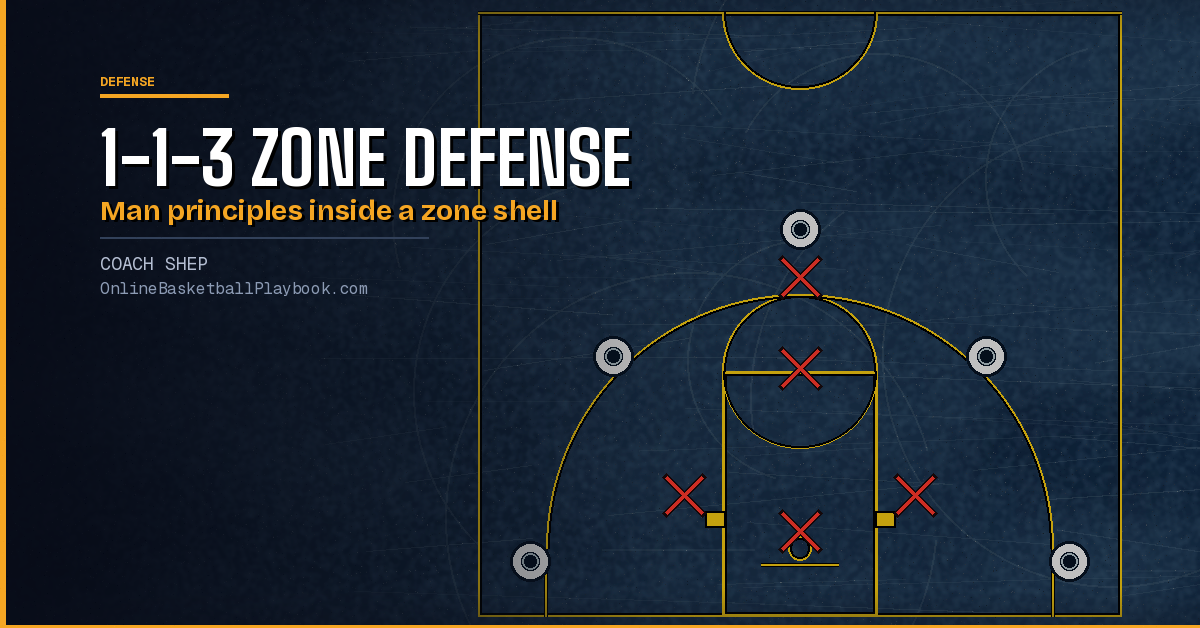
1-1-3 Zone Defense: Man-Zone Rules, Slides and Traps
The 1-1-3 zone defense explained: the alignment, the roles, the sideline pin, who takes the wing pass, the elbows, corner traps, rebounding and when to use it.
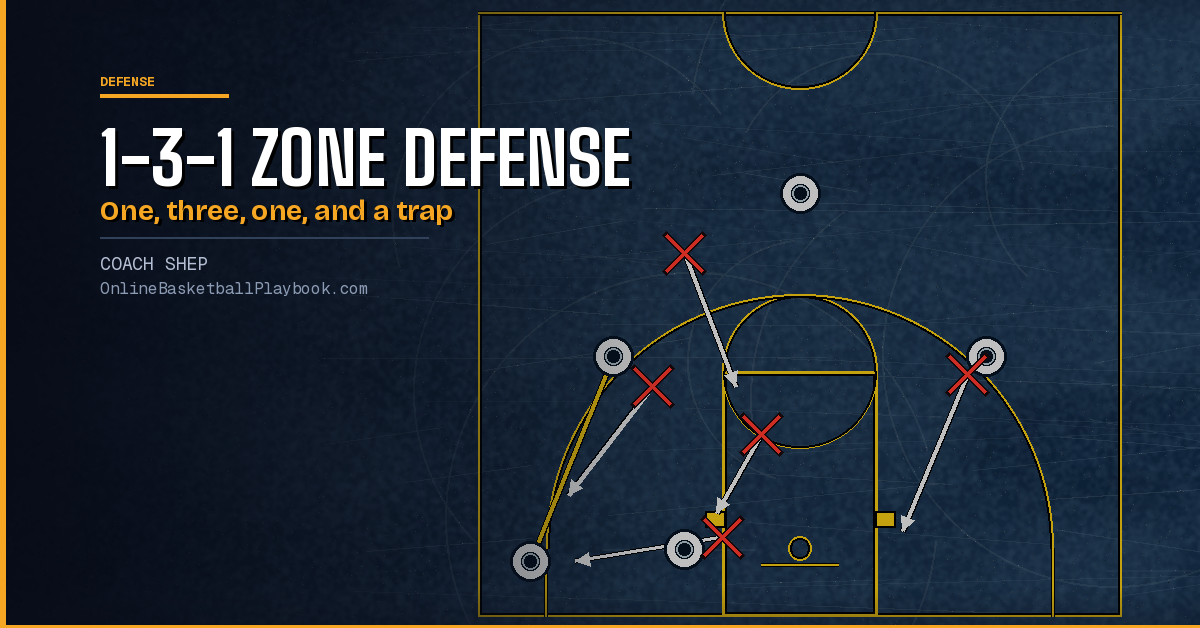
1-3-1 Zone Defense: Traps, Rotations and Drills
How to run the 1-3-1 zone defense: the five roles, the corner and wing traps, the skip pass that beats it, loose and tight depth, and the drills to install it.
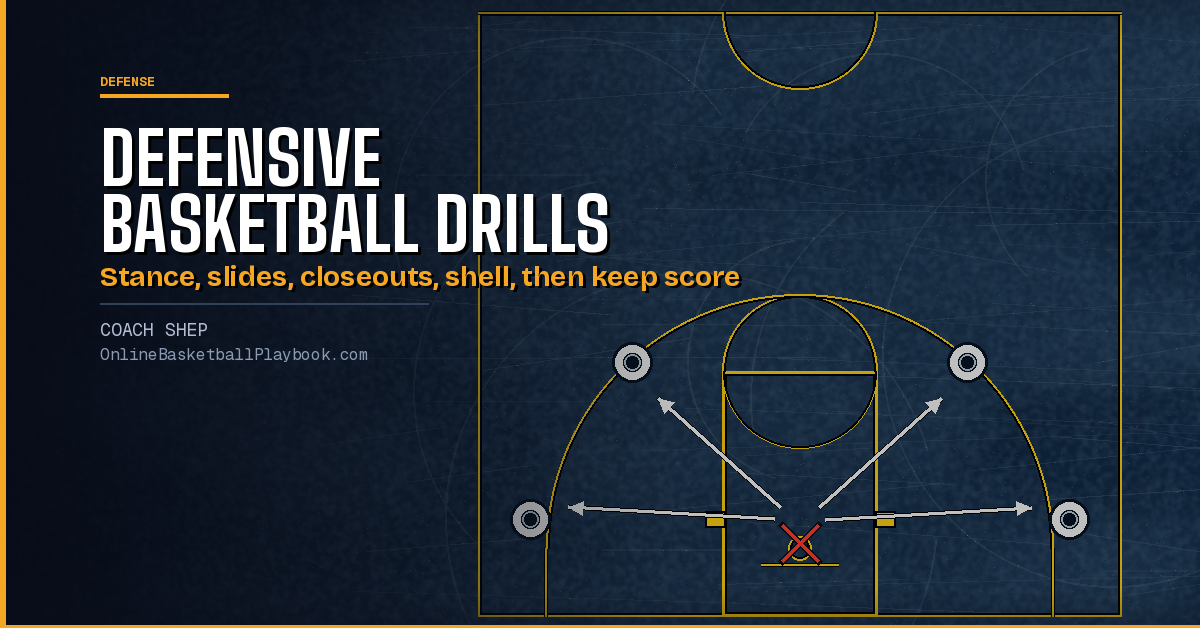
Defensive Basketball Drills: Slides, Closeouts, Shell and Games
Defensive basketball drills in teaching order, from stance and defensive slide drills to closeouts, pass denial, shell and scored games, with the versions coaches split on.