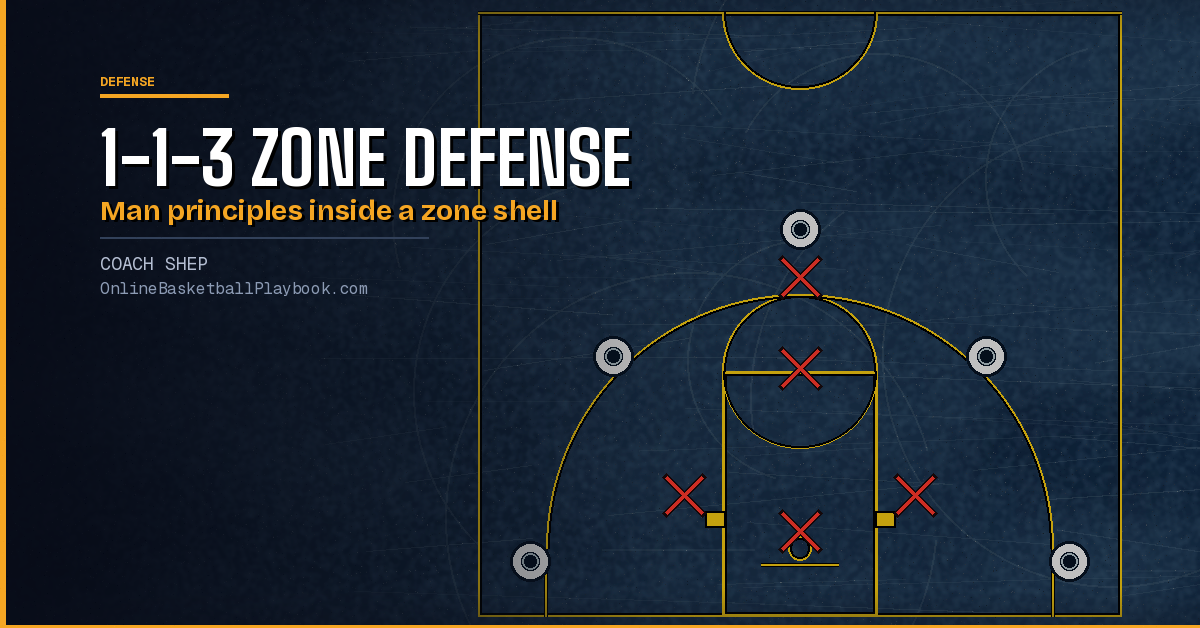
The 1-1-3 zone defense puts one defender on the ball, a second on the high post and the elbows, and three across the paint and the baseline. Coaches run it three ways: as a man-zone that plays man-to-man rules inside a zone shell, as a match-up zone with fixed roles and slides by pass, and as a trapping change-up. Its pitch is ball pressure, a denied middle and a look most opponents rarely practice against. This page covers the alignment, the roles, the slides each version teaches, the traps, the rebounding cost and the drills. The family of zones is on types of defense in basketball, and other match-up shapes are on how to coach the match-up zone.
What the 1-1-3 Zone Defense Is
The shape is in the name. One defender pressures the ball. A second sits at the free-throw line and guards the high post and both elbows. Three line up across the paint and the baseline, with the middle one protecting the rim.

Mike Dunlap is the coach most tied to the 1-1-3. He taught it as a man-zone and says the work is mostly man principles and that any defense rests on stance and hands. Pat Summitt's call sheet used "13" for a 1-1-3 match-up, and European terminology lists it among the standard half-court zones.
It differs from its neighbors in where the extra players stand. The 1-3-1 zone is also a trapping zone but keeps three across the middle, while the 1-1-3 keeps three across the baseline. One version runs a 1-1-3 tandem as a form of the 2-3 zone, with the top guard playing the point deep and the second guard behind him taking the first wing pass.
Roles by Version
Each version fills the five spots in its own way:
| Version | How the spots are filled |
|---|---|
| By trait | X1 the quickest, X2 the smartest (usually the point guard), X3 and X4 the longest, X5 the biggest. X1 and X2 can switch within a possession |
| By name | A ball hawk, a rover, a strong forward, a weak forward and a center. The ball hawk and rover are interchangeable and call "I'm in" or "I'm out" when they swap |
| By area | The two guards cover everything above the free-throw line, and three interchangeable bigs cover everything below it |
| Quarterback and back line | Jerry Tarkanian's trapping form names a quarterback on the ball, a partner on the high post and a back line of ball, post and hoop |
Ball Pressure and the Sideline Pin
Extreme pressure on the top man. In the man-zone version the on-ball defender hops into the ball, chases deflections with high hands and keeps his left hand in the shot pocket of a right-handed shooter. Early in teaching it is fine to get beaten. In the role-name version the ball hawk picks the ball up full court to disguise the zone and keeps it on one side. In the trait version X1 forces the handler to pick a side.
Pin the ball to a sideline. On the wing pass the man-zone defender closes out hard on the ball's high hip, feet square to the sideline, hands high, with four players in the box behind him and the next man ready to stunt. The reasons given are slower ball movement, a forced baseline dribble and a baseline trap. The area version says the same thing. Stay on the high hip so the offense cannot reverse the ball or dribble back to the other side. The man-zone version calls the sideline area an alley and says the pin starts as a press.
Who Takes the Wing Pass
This is the biggest split between versions:
| Version | Rule |
|---|---|
| Count the alley | One offensive player in the roughly six-foot sideline alley, and the low outside defender closes out. Two in the alley, and a guard closes out instead. In the man-zone form the first man there calls "ball," and two arriving at once is fixed with a trap or a bump |
| Closest man | The first defender to the ball takes it and stays until a teammate calls him off |
| Fixed role | A named guard, X2, takes the first wing pass and X1 drops to the high post |
| Forward takes it | X3 or X4 takes any pass at or below the wing and forces the next pass to the corner |


Every player moves on the pass. The man-zone version demands that all five move as one with hands up or out, jumping in the direction of the pass. The cue in another version is to move while the ball is in the air. Its one exception is a great shooter, whom a forward may stay with. The general zone rules are on the best zone defense.
Get the next coaching guide in your inbox
One email when a new guide or diagram set goes up. Free.
The Elbows and the High Post
Every version guards the elbows. In the man-zone version the ball-side elbow must always have a defender. The guards cover the wing and the ball-side elbow, or both elbows, and the help-side forward takes the other elbow when needed. The elbows are arm-fronted, not dead-fronted. Another version warns that a 1-4 or horns alignment has to be covered the same way, because free entries there break the defense. The area version always keeps a player on the high post and one on the low post.
When the ball does reach the high post, the versions answer three ways:
- Jam and double. X5 jams the high post with hands high, X2 doubles it and X3 and X4 drop to the blocks.
- Trap every high-post pass. The man-zone version traps all of them.
- Invite it, then triple it. Against a two-guard front, the trapping form lets the ball into the high post and then traps it with three.

Trapping there has a second purpose. One version says the traps teach the offense not to attack the high post, the elbows or the short corners at all.
The Corner and the Traps
Coverage of the corner varies more than anything else in the 1-1-3:
| Version | Corner pass |
|---|---|
| Center out, wing to the block | X5 closes out the corner and the wing defender sprints back to the block to deflect post entries |
| Wing out, center under | X4 closes out to the corner, X5 battles beneath the post and X2 sags to stop the entry from above |
| Low man, optional trap | The ball-side low defender pressures the corner, and the defense may trap with a low hole and a high hole behind it |
| X-cut | X5 goes out and the wing drops to front the post and steal the entry |
| Trap every corner pass | Part of the man-zone trap list |
| Cutter options | The role-name version has four ways to handle corner and short-corner cutters, plus a call that traps a short-corner catch |
High hole and low hole. Behind every trap, the man-zone version keeps a basket protector, the low hole, and a partner 15 to 30 feet directly above him, the high hole. If the low man leaves, the high man replaces him, and the coach decides how often the low man may leave.

Trap triggers. One man-zone trap list includes dribble penetration, the ball to the elbow, post entries, the short corner, short wing-to-corner passes, offensive rebounds, ball screens, hand-offs and skips. Another list adds corner passes, low-post passes, diagonal skips and all high-post passes, with quick traps on ball screens by the two closest men. The same version says the defense destroys the pick and roll.
Post Defense and the Middle Drive
The post. Post defense scales to the threat. One version full-fronts and doubles a dominant scorer and plays behind or half-fronts an average post. In the role-name version the rover doubles every low-post pass, the center slamming the baseline shoulder and the rover the middle shoulder, so the only pass left is the kick-out on the strong side. The area version full-fronts the low post. The man-zone warning is that when post defense is poor in a 1-1-3, the perimeter defense gets worse too, because the ball moves too fast.
The middle drive. The answers differ, and two of them come from two man-zone documents. One rejects help and recover and wants a trap, or a cut and replace, big on big and quick on quick. The other lists soft traps, help and recover, and two-man closeouts (one contests, one controls the drive) among the stunts. Other versions run and double or run and jump when a wing is beaten middle, let the rover stop or double the drive, or have the two guards trap fast while X5 sprints opposite to tip passes.
The Rebounding Cost
The man-zone version names rebounding as the price. It lists no rebound accountability, giving up threes, fouling and no transition accountability as the disadvantages. It demands triangle spots even when a player cannot see the ball, a weak-side wedge and a daily "cap the rim" drill, and calls rebounding the dirty work. A shot through the middle alley rebounds through the boxes and the elbows, so it adds a rat man at the weak-side elbow. Another version sends one player to the weak side for long rebounds off wing and corner misses. Box-out technique is on box out basketball.
When to Use It
The man-zone version's listed advantages are that it can hide a player in foul trouble, gives rest on defense and catches opponents who practice man offense more than zone. Another version adds that one guard can pick up the ball in the backcourt while the other still patrols the free-throw line, which a 2-3 cannot do without opening the high post. The listed weak spots are the wings and the short corners.
Full court. The trait version runs the same roles as a full-court trap (ball, front, two wings and a safety) with three trap spots: just over half court using the timeline, just before half court to force a slow reversal, and the offensive wing.
Junk forms. The same version closes with a 1-3-and-1, where X2 face-guards the best perimeter player and X5 is the safety. Tarkanian's Amoeba is a gambling trap zone that several versions start from a 1-1-3, though others draw it from a diamond-and-1 look, and it is usually used as a change-up. Both are covered with the rest of the family on junk defenses, and the offensive side is on how to beat junk defenses and how to attack a zone defense.
Teaching It
Four absolutes first. The man-zone version's four absolutes are stance, high hands, jumping to the ball and blocking off, and it says hands matter more than feet on defense.
Ball pressure daily. It builds pressure with daily 1-on-1 closeout work on feet and hands, then 2-on-2, along with capping the rim and advantage and disadvantage drilling.
Rotation and trap drills. It names a 4-on-5 rotation drill and trapping drills run with no dribble and with a mandatory dribble for the offense. Its drill rule is to make drills harder than the game. Scored drill habits are on competitive basketball drills.
Questions Coaches Ask About the 1-1-3 Zone
What is a 1-1-3 zone defense?
A half-court zone with one defender on the ball, one on the high post and elbows, and three across the paint and baseline. It is often played with man-to-man rules inside the zone shape.
Who invented the 1-1-3 zone?
Mike Dunlap is the coach most tied to it. He taught it as a man-zone that plays man principles inside the zone shape.
What are the weaknesses of the 1-1-3 zone?
Rebounding, open threes, fouls, the wings and the short corners. A free catch at the elbow or high post also breaks it.
How do you rotate on the wing pass in a 1-1-3?
Versions differ. One counts the offensive players in the sideline alley, one sends the closest man, one gives the pass to a fixed guard, and one sends a forward.
Is the 1-1-3 the same as the Amoeba defense?
Not exactly. Some versions start the Amoeba from a 1-1-3, but others draw it from a diamond-and-1 look, and it is usually used as a trapping change-up.
Want every diagram on the site?
OBP Pro members get the full diagram files for every guide on the site, ready for a practice binder or a scouting report. $9 a month. Or draw your own version free in the play drawer.
See what OBP Pro includesMore Coaching Guides From This Batch
- Pick and Roll Reads: Reading Ball Screens by Coverage
- Basketball Play Calling and Signals: How Coaches Call Sets
- Tagging Up in Basketball: Crash the Glass or Get Back
- Secondary Break Basketball: Lanes, Options and Trailers
Back to Types of Defense in Basketball and every Defense page.
Keep Building
Related breakdowns
1-3-1 Zone Defense: Traps, Rotations and Drills
How to run the 1-3-1 zone defense: the five roles, the corner and wing traps, the skip pass that beats it, loose and tight depth, and the drills to install it.
Is Zone Defense Allowed in the NBA? Rules and History
Is zone defense allowed in the NBA? Yes, since the 2001-02 season. The defensive three-second rule, what it allows, its penalty and how zone compares by level.
Pack Line Defense: Rules, Post Coverage and How to Install It
Pack line defense as coaches run it: where the line sits, on-ball and gap rules, post doubles, screens, dead balls, the costs and an install order.