Is zone defense allowed in the NBA? Yes. NBA teams have been allowed to play zone since the 2001-02 season, when the league dropped its illegal defense guidelines. What the NBA has that the NCAA and FIBA books do not is a defensive three-second rule: a defender may not stand in the lane for more than three seconds unless he is actively guarding someone. So a zone is legal, but a defender who stands in the lane guarding nobody for more than three seconds is not. This page covers the current rule word by word, the penalty, when the change happened, how much zone NBA teams actually play and how the other levels compare. What a zone is and how it differs from man-to-man is on man to man vs zone defense.
The Short Answer by Level
| Level | Zone allowed? | Defensive three-second rule? | Where it is written |
|---|---|---|---|
| NBA | Yes, since 2001-02 | Yes. A technical foul (one free throw) and the offense keeps the ball | Rule 10 Sec. VII |
| NCAA men | Yes, no rule against it | No. The three-second rule applies to the team with the ball | Rule 9 Sec. 9 |
| NCAA women | Yes, no rule against it | No. The three-second rule applies to the team with the ball | Rule 9 Sec. 9 |
| FIBA | Yes, no rule against it | No. The three-second rule applies to the team in control | Art. 26 |
| High school | Check your state association rulebook | Check your state association rulebook | NFHS rules as adopted by each state |
None of the college or FIBA books has a rule against zone defense. Their three-second rules count only the offense: a player may not stay in the lane more than three seconds while his own team controls the ball in its frontcourt. The level-by-level rulebooks are compared on basketball rules and regulations.
The NBA Defensive Three-Second Rule
The rule is Rule 10, Section VII, in the 2025-26 Official Rules of the NBA. In plain words, it has five parts.
- When the count starts. When the offense has control of the ball in its frontcourt (Sec. VII(a)).
- Where it applies. In the 16-foot lane, and in the area that extends 4 feet past the lane's end line (Sec. VII(b)).
- What the defender must do. Be actively guarding an opponent within three seconds. The book defines actively guarding as being within arm's length of an offensive player and in a guarding position (Sec. VII(b)).
- Who may guard whom. Any defensive player may play any offensive player, and the defenders may double-team any player (Sec. VII(c)). The section does not tie a defender to one man.
- The ball handler's defender. A defender guarding the player with the ball may be in the lane and does not have to be within arm's length. If another defender takes over the ball, the first one must actively guard someone or leave the lane, and once the ball is passed he must do the same (Sec. VII(e)).

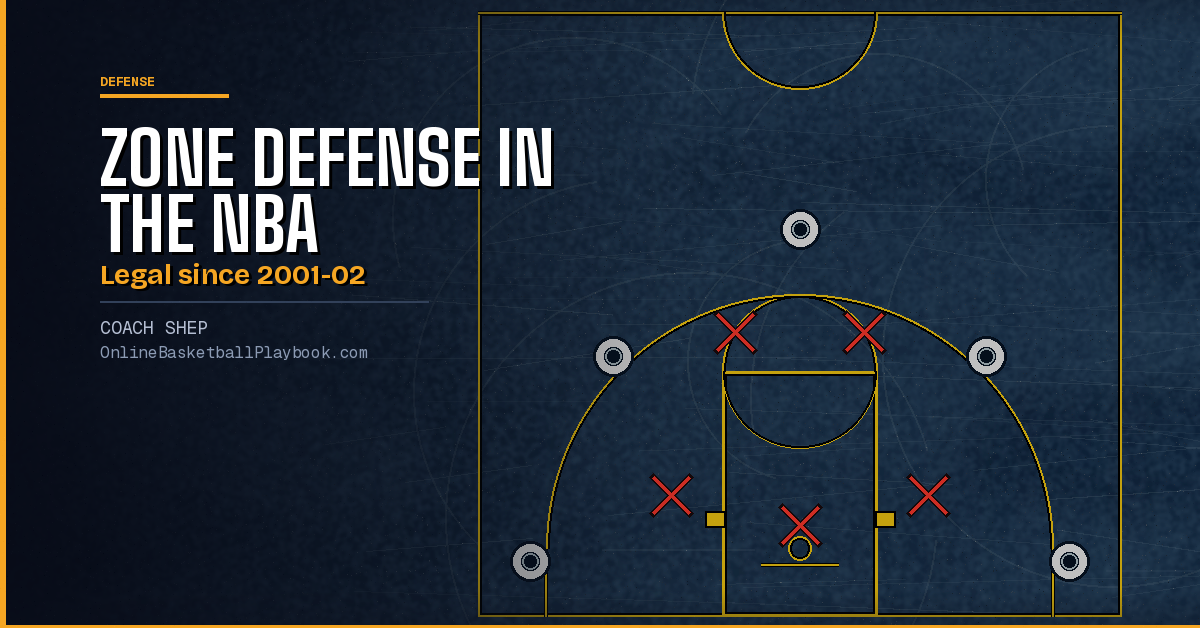
Think of the 2-3 above. In this picture the two guards and the two forwards stand outside the lane, so the count does not apply to them. Only the middle defender stands inside it. With no offensive player near him, he has three seconds to get within arm's length of someone or step out. The other alignments a team might play are on types of defense in basketball and best zone defense in basketball, and the 2-3 itself is on 2-3 zone defense.

When the Count Stops
Section VII(d) lists five times the defensive three-second count is suspended:
- A player is in the act of shooting.
- There is a loss of team control.
- The defender is actively guarding an opponent.
- The defender completely clears the 16-foot lane.
- It is imminent that the defender will become legal.

The ball handler's defender is the other exception. When a driver gets into the lane, the defender who steps up to guard him is guarding the player with the ball, and Section VII(e) lets him be there.

Section VII(c) also allows double teams on any player, which is what lets an NBA zone trap the ball.

The Penalty
A defensive three-second violation is a technical foul (Rule 10 Sec. VII PENALTY), which is one free throw (Rule 12A Sec. V(n)). The offense also keeps the ball and throws it in on the sideline at the free-throw line extended nearest where play stopped. The shot clock stays where it was or resets to 14 seconds, whichever is greater. If the violation is whistled during a made field goal, the violation is ignored and play resumes as after any made basket.
Rule 12A Sec. V(c) lists defensive three seconds among the technical fouls that are not unsportsmanlike, next to delay of game, coaches box violations and flopping. The offensive side of the rule, a player on the team with the ball who stays in the lane more than three seconds, is Rule 10 Sec. VI, and it costs the offense the ball. Both are explained in plain words on the 3 seconds rule in basketball.
Get the next coaching guide in your inbox
One email when a new guide or diagram set goes up. Free.
When Zone Defense Was Allowed in the NBA
Was zone defense illegal in the NBA? For years the league had illegal defense guidelines, and NBA.com describes them as complicated rules that had coaches shouting "Illegal!" at the referees from the bench when they thought the other team's defense broke them.
That ended in 2001. On April 12, 2001, the NBA Board of Governors approved four rule changes recommended by a committee on playing rules, according to NBA.com's history of the league:
- The illegal defense guidelines were eliminated.
- A defensive three-second call was added.
- The time to bring the ball into the frontcourt went from 10 seconds to 8.
- The rules against hand-checking were relaxed.
All four were set to take effect for the 2001-02 season. So when people ask when zone defense started in the NBA, the answer is the 2001-02 season, and the trade the league made was the defensive three-second rule. NBA.com's own wording is that the league legislated in zone play around the turn of the century. Hand-checking is covered on hand checking in basketball and the backcourt count on the 10-second rule.
How Much Zone NBA Teams Play
An NBA.com notebook from March 6, 2020, using play-type tracking data, gives these numbers for that season through early March:
- 18 of the 30 teams had played at least 100 possessions of zone, up from 10 teams the season before and two in 2017-18.
- The league averaged about five possessions of zone per game, more than six times as many as in 2017-18.
- Offenses scored 0.99 points per possession against zone and 0.96 against man-to-man.
- The Miami Heat led the league with 764 zone possessions, 12.3 per game.
- The Dallas Mavericks played almost 800 possessions of zone in the regular season the year they won the 2011 championship.
In the same piece, Warriors coach Steve Kerr described zone as a way to expose a couple of weaknesses or change the tempo of a game, not a way to shut teams down. Those figures are from the 2019-20 season.
Zone Rules in College, High School and FIBA
- NCAA men. Rule 9 Sec. 9 Art. 2 makes it a violation for a player to have any part of his body in the lane more than three seconds in a row while his team controls the ball in its frontcourt. There is no defensive version. The count is suspended for a player who dribbles or moves in to try for a goal (Art. 3).
- NCAA women. The same offensive rule, and to be outside the lane a player must place both feet on the floor outside it (Rule 9 Sec. 9 Art. 2).
- FIBA. Art. 26.1.1 says a player shall not stay in the opponents' restricted area more than three seconds in a row while his team controls a live ball in the frontcourt and the game clock is running. Both feet must be outside the area to be out of it (Art. 26.1.3). There is no defensive version.
- High school. The NCAA's published chart of NFHS and NCAA rules differences has a three-second row on how a player gets out of the lane, and no defensive three-second row. The national high school book is sold, not posted, so check your state association rulebook.
Under the NCAA and FIBA books, a defender may stand in the middle of a 2-3 for a whole possession. In the NBA he may not. That is the rules difference between an NBA zone and a college or FIBA zone.
What It Means for a Coach
The NCAA and FIBA books put no limit on a zone, so at those levels choosing zone or man comes down to coaching. The case for each is on man to man vs zone defense. Each common zone has its own guide: the 2-3, the 1-3-1, the 1-2-2 and the 3-2, and the zone that guards men inside areas is on how to coach a matchup zone.
From the offense's side, every zone has gaps, and the plans for each are on how to attack a zone defense, how to beat a 2-3 zone and how to break a 1-2-2 zone. How the modern NBA spaces the floor is on modern NBA offense.
Questions Coaches Ask
Is zone defense allowed in the NBA?
Yes. Zone has been legal since the 2001-02 season. The limit is the defensive three-second rule, Rule 10 Sec. VII.
When was zone defense allowed in the NBA?
The NBA Board of Governors approved the change on April 12, 2001, and it was set to take effect for the 2001-02 season.
Was zone defense illegal in the NBA?
Before 2001-02 the NBA had illegal defense guidelines that limited how teams could defend. The league eliminated them in 2001 and added the defensive three-second call.
What is defensive three seconds in the NBA?
A defender in the lane, or the area 4 feet past its end line, must be actively guarding an opponent within three seconds, which means within arm's length and in a guarding position. Otherwise he must leave the lane. The penalty is a technical foul, which is one free throw, and the offense keeps the ball.
Can a defender stand in the paint in the NBA?
Yes, while he is actively guarding someone, guarding the ball handler, or for less than three seconds. A defender with no one within arm's length has to leave the lane before his three seconds are up.
Is there a defensive three-second rule in college basketball?
No. The NCAA men's and women's three-second rules apply only to a player whose team has the ball in its frontcourt.
Can you play zone in high school basketball?
The national high school book is sold rather than posted, so check your state association rulebook. The NCAA's published chart of NFHS and NCAA rules differences has no row on zone defense or defensive three seconds.
Want every diagram, printable?
OBP Pro members get the full diagram files for every shot, rule and zone attack on this page, ready for a practice binder or a team meeting. $9 a month. Or draw your own version free in the play drawer.
See what OBP Pro includesMore Guides From This Batch
- Jump Shot Basketball: Footwork, Release and the Step-Back Jumper
- How to Break a 1-2-2 Zone Defense in Basketball: Sets and Reads
Back to Types of Defense and every Defense page.
Keep Building
Related breakdowns
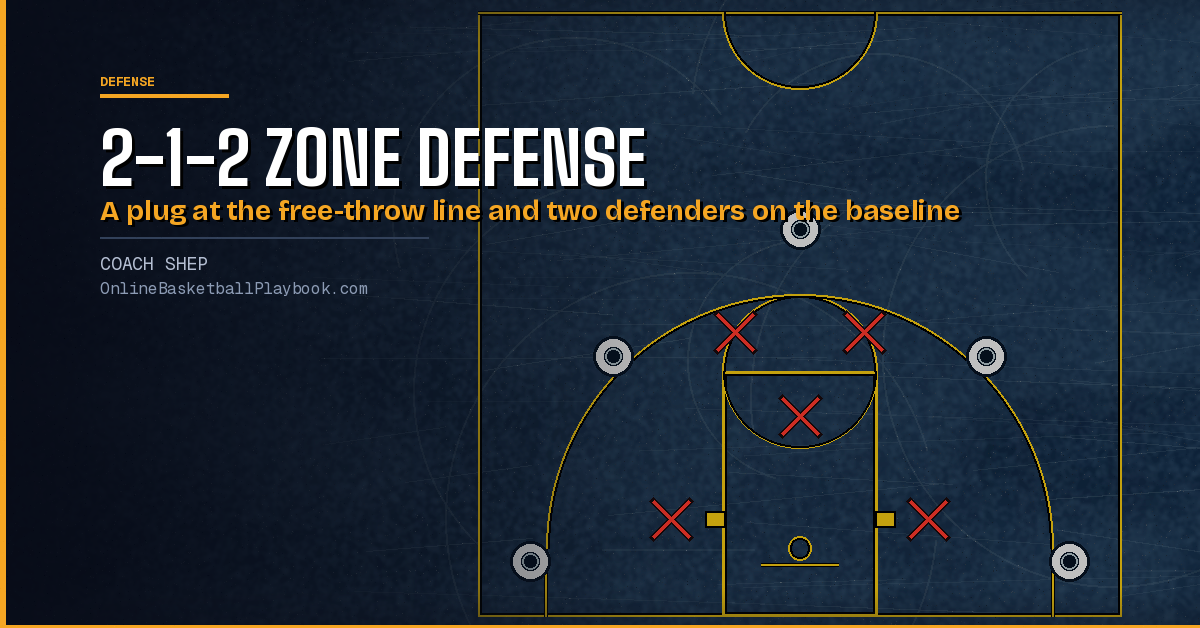
2-1-2 Zone Defense: Rotations, Weak Spots and Personnel
2-1-2 zone defense guide with the alignment, rotations by ball location, how it differs from the 2-3, who plays the middle and its weak spots.
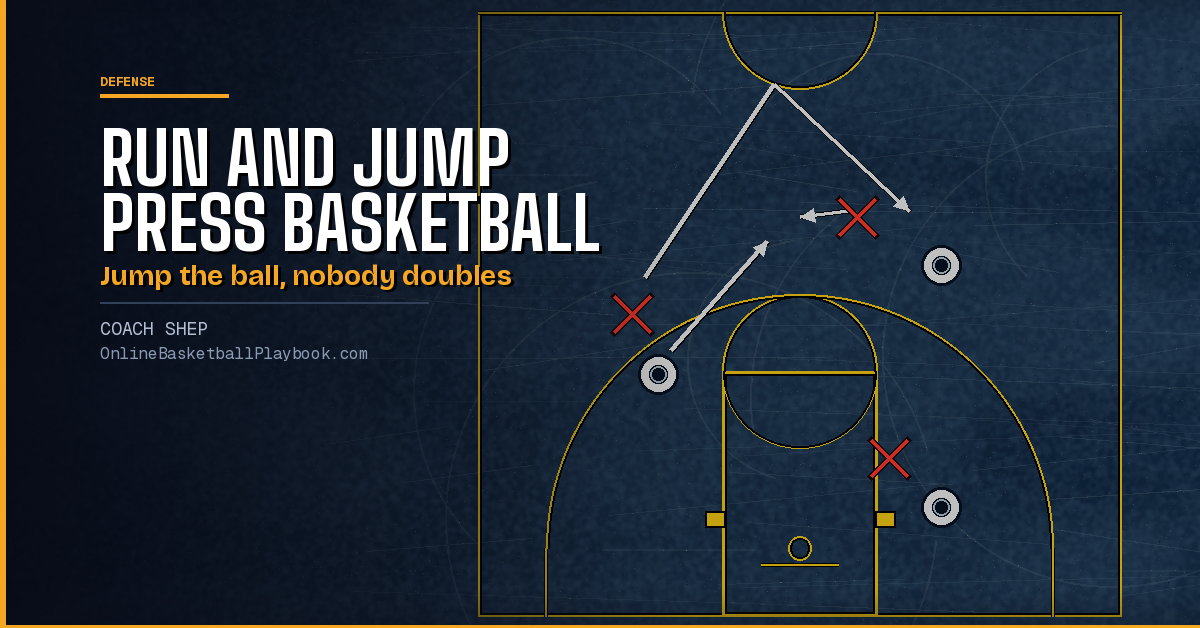
Run and Jump Press Basketball: Rules, Rotations and Drills
Run and jump press basketball explained: the jump switch, when to jump, middle or sideline, the rotation, when to call it, how offenses beat it and the drills.
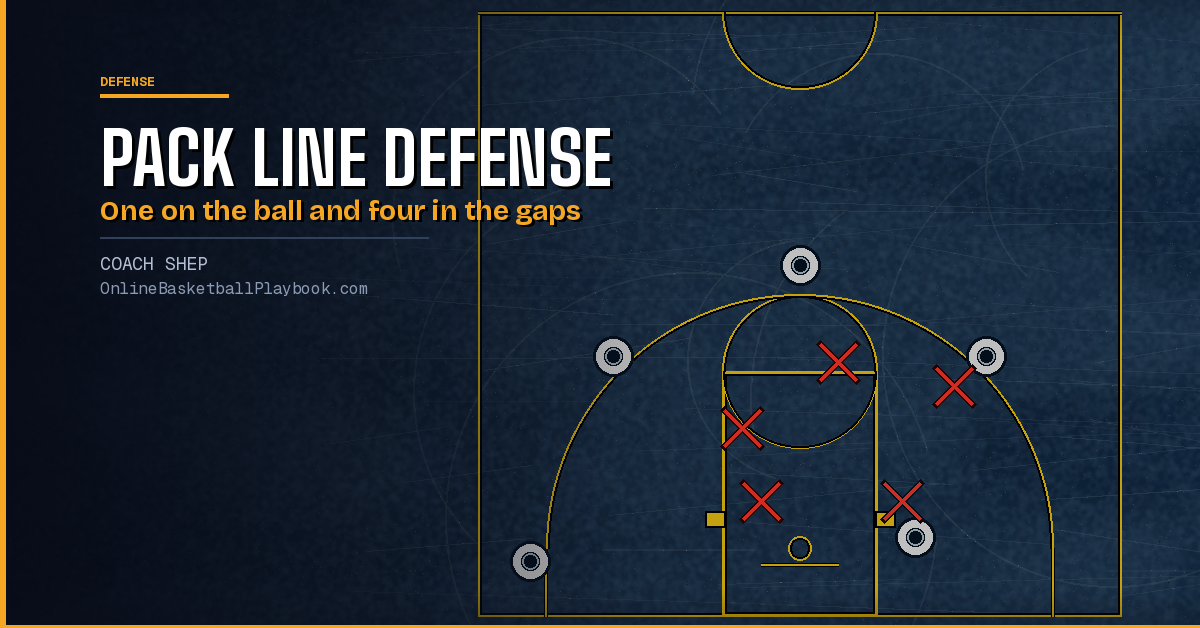
Pack Line Defense: Rules, Post Coverage and How to Install It
Pack line defense as coaches run it: where the line sits, on-ball and gap rules, post doubles, screens, dead balls, the costs and an install order.