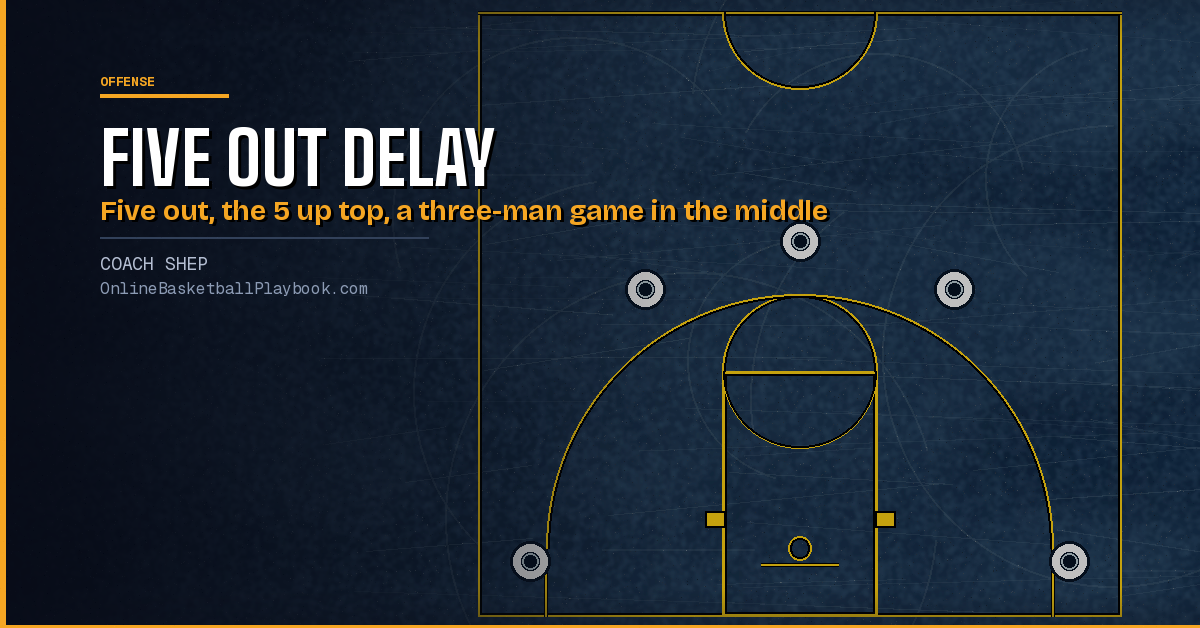
The five-out delay claim, made about the 2025 NBA preseason, is that every team in the league was running the same offense. That NBA offense starts in a five-out front called delay, with the center high at the top of the key, the guards on either side as the playmakers and two shooters waiting in the corners. From there the team runs a fast three-man game in the middle third of the floor inside the first 8 to 10 seconds of the clock, reacting to the defense instead of running plays. This guide treats it as a claim to check and sets it beside what else is on record: a 2019 clinic history of 20 years of league offense, pro and international set sheets, a college delay catalogue and clinic notes. It covers the delay front, the away trigger, the main action families, the two outcomes every action is after, the history behind the shift, how pace fits, how the same names mean different things, and what a high school or college coach can borrow.
The Claim: One NBA Offense
The case is that NBA teams no longer differ much in how they start possessions. They share an alignment, a set of action names and a goal for each action. The offense is not running plays, it is reacting to what the defense gives. The actions happen in the first 8 to 10 seconds and the ball never sticks, which the claim calls lag-free. It ends by saying America is waking up to what Europe has known for a long time about ball and player movement.
Two cautions come with the claim. It is a reading of game film, not a statement by the coaches whose teams appear in it, and some action names are spelled as heard. It is also dated to one preseason, so it needs checking against a later season. The rest of this guide sets the vocabulary beside other records. How the parts of an offense fit together, systems, actions and sets, is on the basketball offense guide.
The Five-Out Delay Front

In the delay front all five players are spread to the arc. The center sits high at the top of the key. The guards on either side of him are the main playmakers. The two corners are called dead: those players catch and shoot, and they do not start actions. A college catalogue of delay sets from 29 programs draws the same front, five players spread to the arc with the center receiving up top. The spacing itself is the 5 out offense shape.
Not every pro library starts here. The 2022-23 Lakers book uses a 4-out 1-in flow offense as its base, with the center at the dunker spot, and labels its sets by alignment: about 35 horns sets, 28 4-out 1-in sets and 8 five-out sets.
The Away Trigger

The away screen is the number one way into early action in the delay. The trailing center screens away for the guard at the opposite top spot, and several of the families below grow out of it. It is the most common entry, not the only one. The others are a throw straight to the center, a stack, a Ram and horns. When a defense blows up the away screen, the guard cuts through the paint and a big turns into a ball screen.
The Action Families
The actions fall into eight families. The grouping into eight is this guide's own count.
| Family | How it runs |
|---|---|
| 77, or double drag | The guard cuts over the top of the away screen and the team gets into two drag ball screens. In one wrinkle the first screener slips out or ghosts the screen, and the second screen creates a double gap for the guard. |
| Touch | The guard comes over the top of the away screen, gets the ball from the point guard and gets it back off a touch action. A switch gives a speed and a size mismatch. If the defense rotates fully, the ball is skipped to the dead corner for a three. |
| Twist or flip into step-up | The guard catches coming off the away screen, and the center twists back into a step-up ball screen. The handler reads how the other center covers it. |
| Gut zoom | When the away screen is taken away, the guard rejects it and cuts into the paint, the ball goes to the center, and the team runs zoom, a down screen into a handoff, in the middle of the floor instead of on the side. |
| Zoom with a zero cut | The ball goes straight to the center and a player cuts over the top of him into zoom. If the defender chases over the top, the cutter goes straight to the rim. |
| Stack into veer | The guard and the center set up at the free-throw line. The guard comes off a down screen either way. In veer, the center fakes a step-up ball screen and then sets the down screen. |
| Ram into Spain | A guard down-screens for the center, who sprints into a ball screen. After the center sets it and rolls, a shooter back-screens the other center and then pops. |
| Horns into a handoff | From horns, a back screen for a layup, or the back screener sprints off an uphill handoff. The second option is called Peja, spelled as heard. |

Location matters. Zoom used to be a three-man action on one side with two players spaced away. In the delay it has moved into the middle third, inside the lane lines extended, and in the zero-cut version the two corner players leave the paint clear. Handoffs are covered on DHO basketball and down screens on down screen basketball.


Slips are reads inside these actions, not separate sets. Two defenders covering a flare screen are very open to a slip, and a screener can slip to the rim as soon as he has the angle on his man during an away screen. The zero cut works the same way. Neither needs a new play. Ball screen actions that recycle into each other, Spain, Ram and double drag among them, are laid out on ball screen continuity offense.
Two Outcomes Every Action Hunts
Every action in the delay is built to force one of two things.
- One defender guards two. The quick action leaves one defender trying to cover two players, and the advantage shows up on the back side.
- An early switch. A switch gives a speed mismatch, where the guard drives the big, help comes and the ball goes out for a three, or a size mismatch, where the offense goes right at the smaller defender or wins the offensive rebound.
The shots it hunts are rhythm catch-and-shoot threes, drives against bad closeouts and layups. Two other records state the same aim. Alvin Gentry's 2015 notes call it a single side bump: make one defender guard two, and time the shooter's lift to the moment his defender pulls in to tag the roller. The off-ball form of the rule: the moment one defender can guard two, the offense reacts with a cut, a perimeter slide, a pin away or a flare. How offenses attack each ball screen coverage is on how to attack every ball screen coverage.
How the NBA Got Here
A 2019 clinic history of NBA offense traces 20 years through four head coaches.
| Coach | How the offense played |
|---|---|
| Paul Silas (2000-01) | A UCLA half-court grind where everybody posts up |
| Don Nelson | Horn screens at the three-point line for downhill driving, early pick and roll, slices and pin downs, and playing off the elbow, attacking a switch from there instead of in the post, which is too easy to double |
| Steve Clifford | Post Al Jefferson and run Kemba Walker in the high pick and roll |
| Rick Carlisle | Full five-out spaced to 30 feet to free a drive-and-kick game |
Shot value drove the change. Carlisle's staff called the post-up one of the worst shots in the league and the mid-range a poor one, and named rim finishes, free throws and rhythm threes as the targets. Carlisle's three ways into drive-and-kick coming up the floor were to pass ahead and rip to the baseline if there is an advantage, to skip the ball in transition when the defense loads to the ball, and to slip the screen to the rim to open the driving gap. The same history's pistol rule is that every screener is a receiver first.
The NBA added the three-point line for the 1979-80 season, and the 2010s to today run on high-volume threes, driving lanes, switching defenses and more use of statistics. That arc is told in full on basketball offense evolution, and shot choice on basketball shot selection.
The post-up question is not settled. The 2019 clinic calls it one of the worst NBA shots. Dan Hurley wants to start a half with something at the paint and goes to a deep post-up against a smaller switch. Gentry's notes split the post to give more room for one-on-one post play. In 2013, one NBA team's first play of the game looked for a post touch for its center.
Get the next coaching guide in your inbox
One email when a new guide or diagram set goes up. Free.
Pace, Drag and the Open Floor
The time window differs. The delay claim puts the action in the first 8 to 10 seconds. Gentry's notes push on a five-second count instead of eight. Hurley's three-on-three transition drill gives seven seconds on the shot clock, threes and layups only.
Whether the break should lean on a drag screen is a real split.
- Drag as the base. In 2013, one NBA team called the drag more than any other action, 9 to 14 times a game, and ran 58 pick-and-roll possessions in one game. Gentry's notes say drag screens in transition were 60 percent of Golden State's offense the year before, set at an angle so the handler comes downhill. Against an iced drag, they flip it into a step-up and snake the dribble back to the middle, which Golden State called Ginobili. Spain's national team opens its early offense with double drag and drag-slip.
- No ball screen on a miss. In Hurley's drill there is no ball screen at all off a miss or a turnover. He says guards lean on the drag as a crutch and stop winning one-on-one ahead of the ball, so they blast it ahead, attack the paint and drive and kick. On a made basket they get structure: a pistol, a wide pin, a key catch, then a handoff game.
Gentry's notes also say the wings must run deep to the corners, because stopping at the wing blocks the point guard's drive. Early offense as a whole is on early offense basketball and the drag itself on pick and roll.
Set Libraries From Europe, the NBA and College
Set sheets show the same names in use and show how big a library can get.
| Library | What it shows |
|---|---|
| 2017 EuroBasket, 24 national teams | Horns-titled sets in 22 of the 24 team sections, Spain action across many teams, double drag for Spain, Slovenia, Latvia and Finland. Most teams draw on the same action names, common but not universal. |
| Slovenia, 2017 champion | About 40 titled sets |
| Lithuania | An away-then-ball-screen series: an away screen frees the point guard, then an Iverson cut leads into a ball screen, in at least six variants |
| Serbia | A slice series, a base and four variants, and one zone set |
| Spain | Built on horns and rip, with a rip series in four variants (base, slip, get, lob) |
| CSKA Moscow 2018-19 | 69 named sets, 23 of them horns sets that each name a counter (ghost, gut, flare, lift, Nash, twist, backdoor). Its sideline and baseline inbounds sets end in a zipper into Spain. |
| 2022-23 Lakers | 83-plus half-court sets labeled by alignment. Thirteen snap sets all open with an elbow cross-screen from horns and flow into a named action. |
| Minnesota Timberwolves sheet | A handoff before the ball screen in nearly every jungle and horns set, and suffixes for horns counters |
| College delay catalogue | 86 entries from 29 programs off one five-out front. The most repeated finish, at 11 entries, is a UCLA cut, a flex screen and then a pin-down or handoff. An 8-entry backdoor group answers denial of the high player. |
Library size runs from one horns entry with a named counter for each coverage, to about 40 titled sets, to more than 80 across several alignments. International actions are collected on international basketball offense actions.
Same Name, Different Action
The same word can mean different movements to different teams. Check the meaning before a name goes on a whiteboard.
| Term | Versions on record |
|---|---|
| Ram | A guard down-screens for the center, who comes up into a ball screen. Or a guard appears to be screened first and then set the ball screen himself. |
| Spain | The center screens and rolls and a shooter back-screens the other center and pops. Or a third player screens the screener's defender from behind as the handler attacks. A set the college delay catalogue calls Kansas appears to use the same screen-the-screener idea. The Lakers book has the shape in two sets but never uses the word. |
| Gut | A down screen into a handoff in the middle (gut zoom). Or the center slips the screen instead of setting it (horns-gut). Or a down screen after a hand-back. |
| Pistol | Every screener a receiver first, with the wing reading over, under or stuck. Or horns into a point-to-wing handoff that triggers a downhill ball screen. Or an early-offense call with pistol action and a pass ahead. |
| Step-up | The center flips back off the away screen. Or the screener slips out as he arrives and the ball attacks the gap. Or the answer to an iced drag. |
| Delay | Five-out with the center high. Or one of Nate Oats's family calls at Alabama, not defined in his practice recording. |
What a High School or College Coach Can Borrow
What travels below the pro level, by the records above:
- The front. Five out with the center high at the top of the key and shooters in the corners, the same front the college delay catalogue draws for 29 programs.
- Reads inside actions. The slip against two defenders on a flare and the zero cut over the top of the center both come off actions a team already runs.
- A transition entry. Gentry's floor spots with an angled drag, Hurley's no-screen blast on misses, or Carlisle's pass ahead, skip or slip.
- Simple numbers. Effective field goal percentage, 1 point for a made two and 1.5 for a made three, divided by attempts, with 51 percent or better reported as decent among NBA evaluators.
The same vocabulary shows up in college. Nate Oats teaches Alabama's half-court offense as named families and calls which family a group plays, and Hurley names pistol, wide pin, key catch and handoff as made-basket actions. Neither coach ties his actions to the NBA trend. The college form of playing fast with five out is on the 5 out offense page, and how to study film of any of it is on how to use game film effectively.
Questions Coaches Ask About Modern NBA Offense
Do all NBA teams run the same offense?
The five-out delay claim, made about the 2025 preseason, is that every team ran a five-out delay front with a fast three-man game in the middle of the floor. Set sheets show many shared action names, but not every library starts from five out, so treat it as a claim to check.
What is the five-out delay offense?
An alignment with all five players spread to the arc, the center at the top of the key, guards on either side as playmakers and shooters in both corners.
What is the away screen in basketball?
A screen set away from the ball. In the delay front, the trailing center screens for the guard at the opposite top spot, and several actions start from it.
What is Spain pick and roll?
A ball screen in which, as the screener rolls, a shooter back-screens the screener's defender and then pops. Teams also use the name for a few related screen-the-screener actions.
What is a zero cut in basketball?
A cut over the top of the center after the ball goes to him. If the cutter's defender chases over the top, the cutter goes straight to the rim.
Why did the NBA stop posting up?
A 2019 clinic history of NBA offense, quoting Rick Carlisle's staff, called the post-up one of the worst shots in the league and named rim finishes, free throws and rhythm threes as the targets. Some coaches still post up against a smaller switch.
Want every diagram on the site?
OBP Pro members get the full diagram files for every offense guide on the site, ready for a practice binder or a scouting report. $9 a month. Or draw your own version free in the play drawer.
See what OBP Pro includesMore Offense System Guides
- Pace and Space Offense: Threes, Layups and Playing Fast
- Drive and Space Offense: Gaps, Pitches and the Rim Runner
- Concept Based Offense: Principles Instead of Plays
- Two Guard Motion Offense: Chin, Shuffle and Motion Series
Back to Basketball Offense and every Offense page.
Keep Building
Related breakdowns
Basketball Screens: Every Type of Screen and How to Read It
Basketball screens explained by type: on-ball, down, flare, back, pin down, cross, stagger, elevator, screen the screener and hand-off, with each read and counter.
How to Beat a Zone Defense: Every Zone and Where to Attack It
How to beat a zone defense, one zone at a time: what the 2-3, 3-2, 1-3-1, 1-2-2, 2-1-2, matchup and junk zones take away, give up and where to attack.
International Basketball Offense Actions Every Coach Should Know
International Basketball Offense Actions Every Coach Should Know