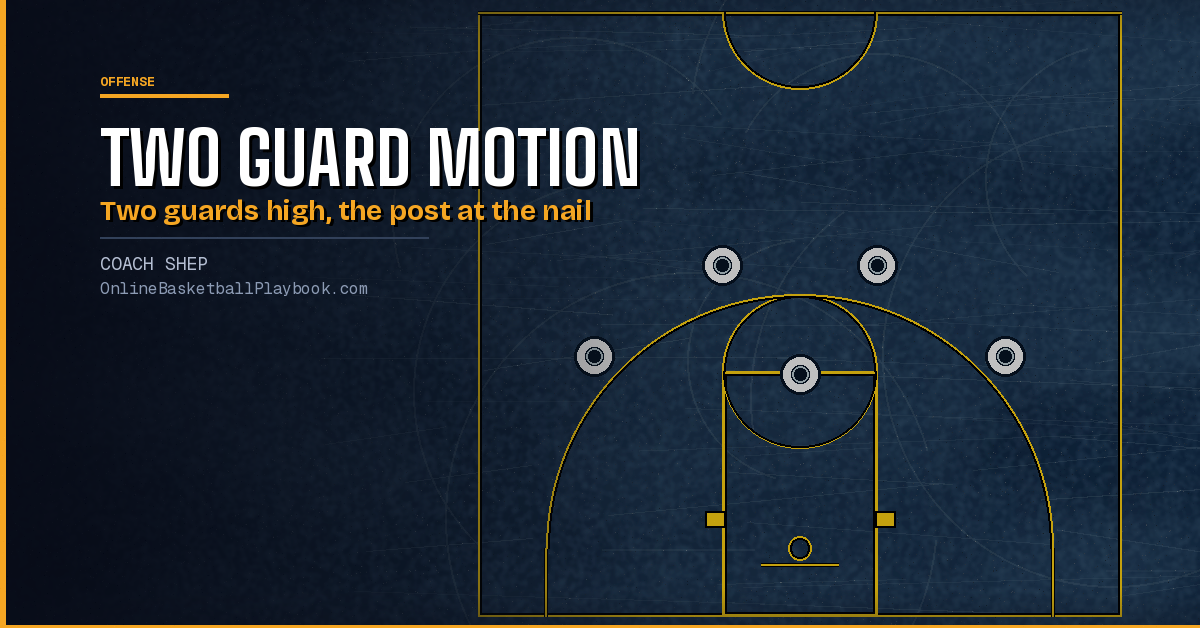
The two guard motion offense is John Beilein's offense, run at West Virginia and then at Michigan. It starts in a high 2-3: two guards up top, two wings out at the wing spots, and a post who flashes to the nail. Three series, Chin, Shuffle and Basic Motion, start from that same look and flow into each other, so a defense cannot tell which is coming. Every series comes back to one read off the post: a flare screen, then a high ball screen, then a backdoor cut. This guide covers the set and its spacing rules, the post's job, the Chin entries, the three-option read, the Shuffle and Motion series, the counters by pass number, the backdoor and cutting rules, the practice standards, where the offense came from, and what it costs.
What Is the Two Guard Motion Offense?
It is a read-based continuity, a family of three series that share one starting look. Chin, Shuffle and Basic Motion each have their own cuts, but every one of them ends in the same reads off the post and then resets into the high set, so the offense can run possession after possession without a new call. All four perimeter spots are interchangeable, so every perimeter player has to shoot, pass and cut.
The Michigan version calls itself a Princeton-style offense, and like the Princeton offense it starts high and stays high. It sits among the continuities on continuity offense basketball and among the systems on the basketball offense guide.
The High Set and Its Spacing Rules

In the numbering used on this page, the post, 5, sits at the nail, the two guards up top are 1 and 4, and the wings are 2 and 3. Versions number the spots differently, which is shown in the table further down.
- Start high, stay high. The wings stay out at the wing spots, outside the arc. If they drop lower, the cuts bunch up and the offense stalls.
- Interchangeable spots. The point and the trailer can trade, and so can the two wings, so every perimeter player cycles through every spot.
The general case for spacing is on what is spacing in basketball.
The Post at the Nail
The post is the hub of the offense, not its main scorer. In the Michigan version he must make a 15-foot shot so his defender has to come out and guard him, screen hard, pass well, and return to the nail after every action. Another version gives the post more scoring: a post feed is a second-pass option, and one of its quick hitters ends in a lob to him.
The post also controls the timing of his flash. The cue is "whoever says go wins the race": the post picks the moment, so his defender is always a step late. This is a different job from a high-low offense, where two posts work as a scoring pair.
The Chin Series and Its Entries
The Chin is the heart of the offense, and it has several doors. A coach teaches one pattern and many ways into it. The Michigan version lists four entries.
| Entry | How it starts |
|---|---|
| 1. Point to post | 1 passes to 5 flashing above the free-throw line, and 1 and 4 sprint backdoor to the blocks. If neither is open, the guards fill, the ball is reversed, and the weak-side guard cuts hard off 5 for a layup look before the three-option read. |
| 2. Reversal to the trailer | Used when 5 is denied the flash. 1 reverses to 4, who relays the ball to 3, and 1 times a hard backdoor cut off the catch. |
| 3. Point to wing | 1 passes to 2. The backdoor off the first cut comes less often here, but the set resets cleanly. |
| 4. Guard to guard handoff | A disguise with the same footprint, starting the same three-option read. |

The pass-number version lists three entries instead, including a guard-to-center pass with both guards cutting hard and a guard-to-guard pass that skips the post. Handoffs in general are on DHO basketball. The Chin as Princeton runs it, and as a backdoor set, is on the Princeton page and on drills to teach the Princeton offense.
The Three-Option Read
After the wing catches, the lone guard up top has three options off the post at the nail, in this order. This is the read that repeats through the whole system.

- Flare. 5 sets a flare screen for the guard up top, who catches for a three or a drive. Flare screens in general are on flare screen basketball.
- High ball screen. Once his defender has seen the flare a few times and plays off him, the wing passes up to the guard and 5 sets a hard high ball screen for him. He drives looking for a layup, a kick-out three or a dish to the post.
- Backdoor. If the guard up top is denied, he cuts hard backdoor off 5, as close to him as he can get.


When all three are gone, the reset comes: the wing dribbles up to the point, the wings fill, and 5 goes back to the nail. Two other versions run this read differently. In the flare-or-cut version, the far guard comes off the post's flare for a three or cuts hard to the rim off it, then the wing dribbles up and hits the guard cutting up. In the pass-number version, the 5 banana-cuts to screen the popper's defender and pops out himself to relieve pressure if the popper is covered. Ball screens that recycle like this are on ball screen continuity offense.
The Shuffle Series

The Shuffle starts from the same set, which is part of the disguise. In the Michigan version, a point-to-wing pass sends the passer to the corner and the other guard to the strong-side block. The post pops high and the ball is reversed through him. A wing then cuts off a shuffle screen, under it by preference, and the post down-screens for the shuffle screener, who gets a shot. After that the post can slip for a lob or pop to the elbow, and the team runs a high ball screen and either goes back to Chin or stays in Shuffle.
The pass-number version triggers it differently: any time the 2 cuts to the block, the team is in Shuffle. The 5 pops to the top of the key, the 2 back-screens for the 3, and the 5 down-screens for the 2. The classic shuffle continuity, with its five rotating spots, is a different offense built on the same cut, laid out on shuffle offense basketball.
Basic Motion and the Motion Set
Basic Motion in the Michigan version starts with a point-to-wing entry, then ball reversals and down screens. Then 5 sets a hard back screen for the wing, who is open because 5's defender has to help on the lob. The post catches and two cutters X-cut off him, the first high and the second low, and he can hand off to either. A down screen by the 2 for the 3 follows, and the team flows back into Chin. Down screens are covered on down screen basketball.
The Motion Set in the pass-number version opens with the 1 passing to the 3 and cutting to the block and then the corner, the 2 v-cutting to the top, the 4 coming off the 5's screen for a three, a reversal, a back screen by the 5 for the 3, and an elbow pass to the 5 with a backdoor. Its counters are listed by pass number: three on the first pass, nine on the second, and three each on the third through sixth.
- First pass. The 2 can fake the v-cut and cut hard to the basket.
- Second pass. Options include a post feed, a backdoor, a slip, a curl or a screen and roll, and a down screen for the 1.
- Fifth pass. The 2 v-cuts off the 5 for a handoff and can drive, pull up, play screen and roll with the 5, or pass to the 3 for a three.
The same version adds 20 numbered quick hitters, most starting with the 1 passing to the 3, the Motion Set's first pass. One is labeled a Beilein favorite. It also has 12 breakdown drills that mirror the sets, and marks one, three lines with a v-cut, a pop and a pass to the 4, as an every-day drill.
Get the next coaching guide in your inbox
One email when a new guide or diagram set goes up. Free.
Backdoors and Cuts
Every series carries a backdoor, so a defender who locks onto a shooter gives up a layup. Beilein installs two kinds of backdoor as separate skills.
- Sudden. The cutter reads the overplay and goes, with no call.
- Signaled. The play is called, and the passer dribbles away and spins back to make the angle.
His rule is "Do not fake a backdoor cut." The cutter commits or stays. Two cutting rules go with it. Cut late: the Michigan version says it is always better to cut late than early, and the flare-or-cut version says to wait until the pass travels up the side. Cut close: cuts go chest to chest with the post, leaving the defender no room to follow. How to read a denial is on cut or backdoor.
Where the Versions Differ
| Topic | High-post three-option version | Pass-number version |
|---|---|---|
| Numbering | 1 and the trailer (4) up top, 2 and 3 on the wings, 5 at the nail | Guards 1 and 2, forwards 3 and 4, center 5, first pass 1 to 3 |
| Chin entries | Four | Three |
| Backdoor on the post catch | The 1 and 4 sprint backdoor the moment 5 catches | The 1 hits 5 at the elbow, takes two hard steps at 5, then v-cuts for the backdoor pass |
| Shuffle trigger | Point-to-wing pass, passer to the corner, the other guard to the strong-side block | Any time the 2 cuts to the block |
| Post as scorer | A 15-foot shooter, screener and passer, not the main scorer | A post feed on the second pass, and a quick hitter ending in a lob to 5 |
A third version, the flare-or-cut version, also lists four Chin entries, uses the same two-guard look with the post at the high post, and answers a denied guard-to-guard pass with a back cut by the receiver while the high post steps out to the guard spot to take the entry. The word "banana" also has two meanings. In the pass-number version it is the 5's path to screen a popper's defender, and Beilein used it in practice for a cutter going too deep under the basket.
The Practice Standards Behind It
Beilein's practice standards are timed, and some decide who gets to shoot in games.
| Standard | What it asks |
|---|---|
| Michigan Passing | Catch on two feet, land on the hot foot (the shooting-hand foot first), pass with the outside hand and "blast to the ball" on every catch. In the four-player box version, the passer moves back in after each pass to rebuild 15 to 18 feet of passing space. |
| Perfect Passing | 10 passes in 30 seconds, and a miss means a run |
| Qualifying runs | Players qualify with timed runs in order to practice, and re-qualify with a run if they miss their times |
| Conditioning | 17 sidelines in one minute |
| Circle ball | 120 a minute for guards, 110 for forwards, 100 for bigs |
| Clinic shooting test | 7 makes in 10 shots in 30 seconds off a down screen and a flare |
| Green-light test | 7 of 10 from midrange around a screen, plus 12 of 20 threes in 59 seconds. Missing it means no green light in games. |
| Free throws | Make 20, and run for every miss |
In Beilein's practices, every drill is about shooting, passing or rebounding, everything has a pivot foot, and drills run 10 to 12 minutes. At his 2007 clinic he said a coach can do anything in practice but not everything, so simplify. A set of gun drills fills out the shooting work. More shooting work is on three-point shooting drills.
Where It Came From
Beilein's two-guard idea is credited to a talk with an athletic director at a time when he had no point guard. His last West Virginia team took 989 three-point attempts in 2006-07, against 495 for Michigan the same season, the year before he arrived there. A handwritten West Virginia call sheet numbers continuity calls such as a down screen for the 3 with a back cut, a re-screen, a curl and pop, and a ball screen for the 1 with the 5 rolling.
The two-guard offense is Beilein's, from his West Virginia and Michigan years.
Who It Fits and What It Costs
It fits shooters and a post who can make a 15-foot shot. The Michigan version says it needs confident, aggressive players with a scorer's mentality, and that passive teams do not run it well.
The costs on record:
- Faking the backdoor. Against Beilein's rule. Commit or stay.
- Cutting early. It tips the play and closes the passing lane before the cutter gets there.
- Wings sinking low. The cuts bunch and the offense dies.
- Leaving room on the cut. A cutter who does not go chest to chest with the post gives his defender a lane to follow.
- The glass. West Virginia gave up heavy rebounding deficits while holding a strong assist to turnover edge.
For other read-based offenses with a different post structure, see motion offense.
Questions Coaches Ask About the Two Guard Motion Offense
What is the two guard offense in basketball?
John Beilein's high 2-3 continuity: two guards up top, two wings, and a post at the nail, with Chin, Shuffle and Basic Motion series that all come back to a flare, a high ball screen and a backdoor.
What is the Chin series?
The core series of the two guard offense, entered four ways in the Michigan version: a pass to the post, a reversal to the trailer, a pass to the wing, or a guard-to-guard handoff, each leading to the same three-option read.
Who created the two guard offense?
John Beilein. It is his offense from his West Virginia and Michigan years.
What does the post do in the two guard offense?
He flashes to the nail, makes a 15-foot shot so his defender must guard him, sets the flare and the high ball screen, passes, and returns to the nail after every action.
What are the three options in Beilein's offense?
A flare screen by the post for the guard up top, then a hard high ball screen for him, then a backdoor cut off the post by a denied guard, followed by a reset.
Want every diagram on the site?
OBP Pro members get the full diagram files for every offense guide on the site, ready for a practice binder or a scouting report. $9 a month. Or draw your own version free in the play drawer.
See what OBP Pro includesMore Offense System Guides
- Pace and Space Offense: Threes, Layups and Playing Fast
- Drive and Space Offense: Gaps, Pitches and the Rim Runner
- Concept Based Offense: Principles Instead of Plays
- Why Every NBA Team Runs the Same Offense: Five Out Delay
Back to Basketball Offense and every Offense page.
Keep Building
Related breakdowns
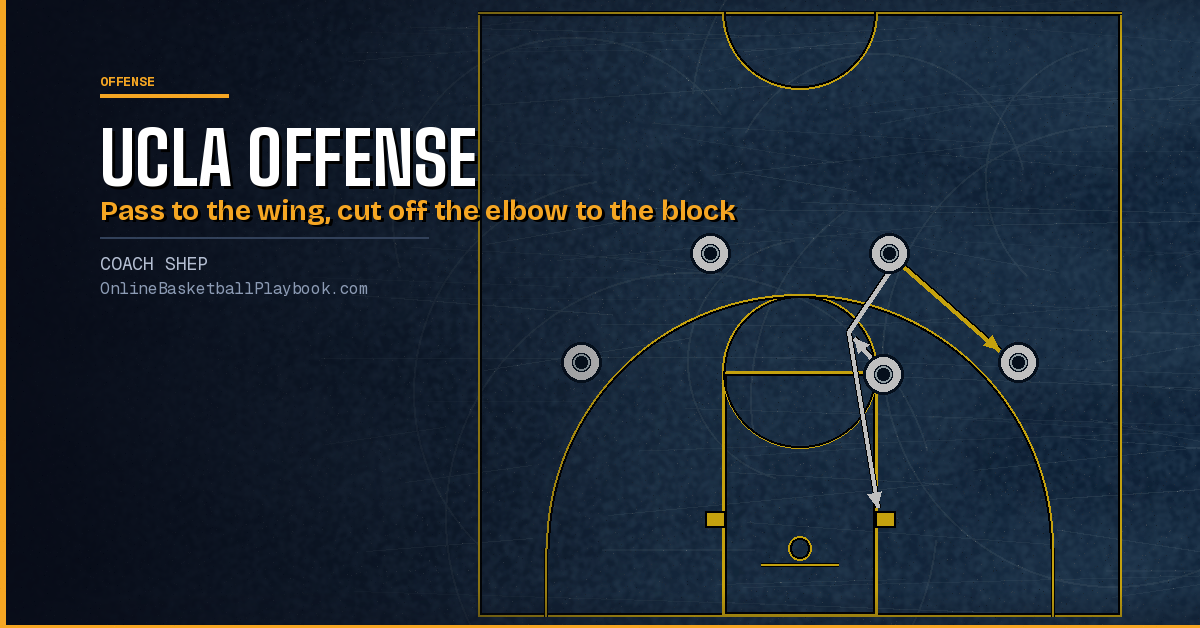
UCLA Offense Basketball: UCLA Cut, High Post Series and Counters
UCLA offense basketball in full: what a UCLA cut is, the 2-3 high and 1-4 high starts, reads off the cut, denial counters and the high-low version.
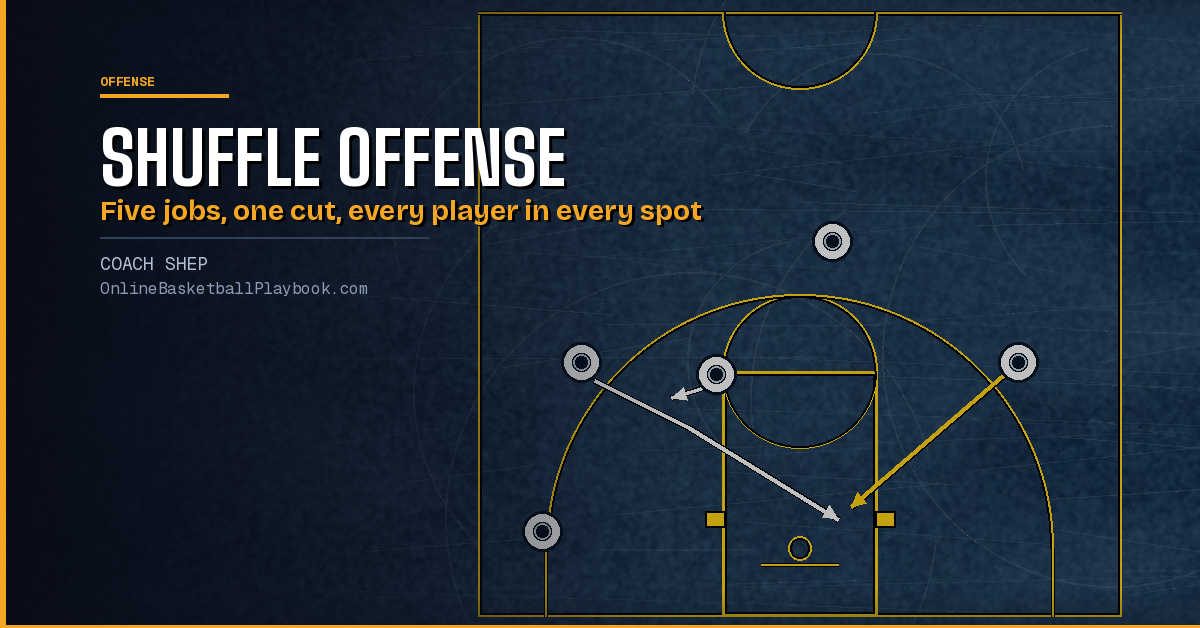
Shuffle Offense Basketball: Shuffle Cut, Rotation and Counters
Shuffle offense basketball in full: the five spots and their jobs, the shuffle cut, the rotation, counters for denial and fronting, zone versions and drills.
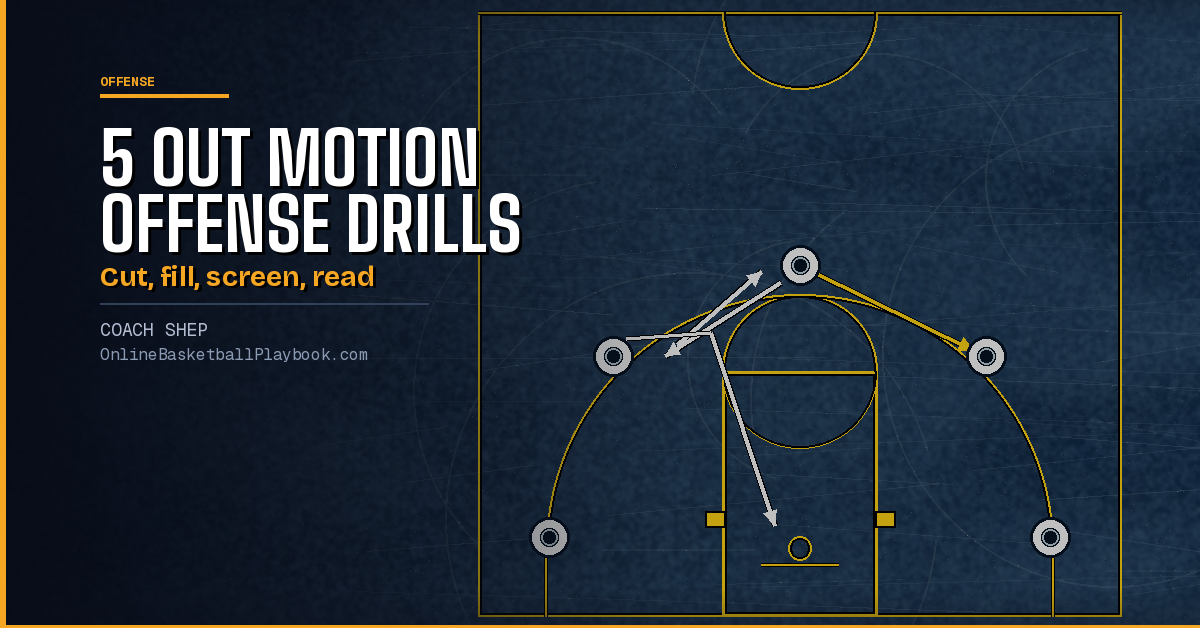
5 Out Motion Offense Drills: Install Steps and Live Games
5 out motion offense drills from 5 on 0 pass and cut through back cuts, screen away, dribble at, ball screens, quick post-ups and no-dribble live games.