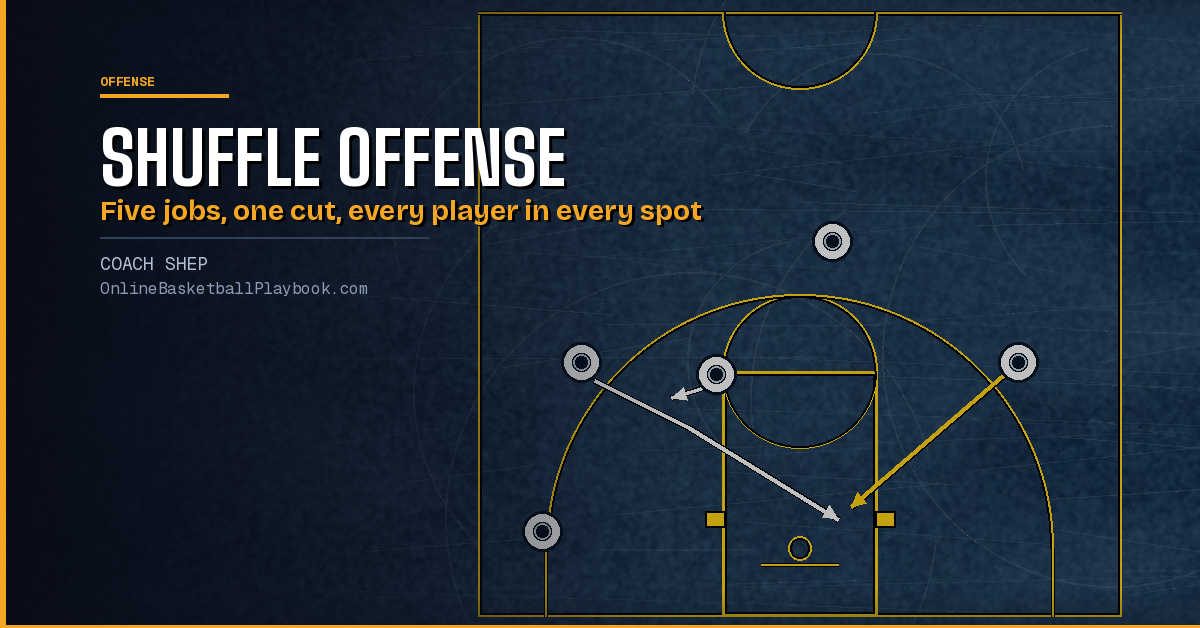
Shuffle offense basketball is a continuity built on one action, the shuffle cut: a player runs his defender into a screen set by the post at the high post and cuts to the basket. Behind that first cutter, the same post screens again for a second cutter, the point screens down for the post, and every player moves one spot along. Run long enough, all five players play all five spots, which is why several versions recommend it for a team without a dominant big man. This guide lays out the five spots, the shuffle cut and its reads, the rotation, the counters for a defense that denies or fronts, the zone versions, how defenses guard it, and the drills, version by version.
What Is the Shuffle Offense in Basketball?
The shuffle is a continuity offense, a fixed series of passes, cuts and screens that flows from one side of the floor to the other and repeats without a reset. Instead of numbering players by position, the version credited to Bruce Drake names the five spots by their jobs: first cutter, point, feeder, second cutter and post. The cuts and screens move each player into a new job, so a center may play the point on one trip and make the shuffle cut on another.
It is a pass-and-cut offense. The post-pop version says very little dribbling is involved, so every player must be sound at passing, catching, spacing, screening and rebounding, and must treat each turnover as costly. The shuffle is listed with the flex as one of the two clearest examples of a patterned offense, and both are compared with the swing, the wheel and other systems on continuity offense basketball. It differs from motion offense because the cut on each pass is scripted, where motion gives players rules and lets them choose.

| Piece | What happens | Shot it looks for |
|---|---|---|
| Entry | The ball goes from the first cutter to the point to the feeder, who has cut out to the wing on the far side | A drive or a shot by the feeder |
| Shuffle cut | The first cutter runs off the post's screen at the high post to the basket | A layup |
| Second cut | The post screens again and the second cutter comes to the ball-side elbow | A catch-and-shoot jumper |
| Rotation | The point screens down for the post and every player takes the next job | The same series on the other side |
| Counters | A pass into the post, a corner pass, back cuts, dribble entries and exchanges | Answers to denial and fronting |
The Five Spots and Their Jobs
Where each job starts is spelled out in two ways. The five-role version is the one credited to Bruce Drake, and the three-chance version runs the same continuity with exact spots and numbered scoring chances. The pass-direction version numbers the spots differently, but its five jobs line up with the same names.
| Job | Five-role and three-chance versions: where he starts | Pass-direction version: who plays it |
|---|---|---|
| First cutter | Brings the ball up to the wing, about 6 feet in from the sideline and above the three-point line. He keeps his dribble alive to open a passing lane. | Usually the playmaking guard who can also post up |
| Point | At the top of the key. V-cuts at his defender to get open, using an arm bar if he is guarded closely. | Called the guard, set up in line with the basket |
| Feeder | On the low block on the side away from the ball. Steps into the lane, then cuts out to the wing at the free-throw line extended. | Sets up at the free-throw line extended with his inside foot near the three-point line |
| Second cutter | In the corner on the ball side, on the three-point line | Usually a strong outside shooter who can drive and pull up |
| Post | At the elbow on the ball side | A good screener and a post target |
The three-chance version points out that the set leaves nobody standing in the lane. Versions disagree on who belongs at the post spot. The post-pop version says the best shooter should start there, and in that version the post pops out for a shot off a down screen. The high-post zone version says a mobile big man is the ideal post.
The Shuffle Cut

The shuffle cut is the cut that names the offense. The first cutter has given up the ball, the ball is on its way to the far wing, and he takes his defender into the post's screen and cuts for the rim. Sources describe the same cut from several angles.
| Version | How the cut is described |
|---|---|
| Five-role continuity | Off the post's screen at the high post, either around the top of the screen or backdoor, looking for a layup pass from the feeder |
| Post-pop version | Walk the defender into the post's screen, then break to the basket by whichever side the defense gives. This version calls the cut the heart of the offense. |
| Elbow-flash version | A vertical cut, one of the hardest to guard because it takes at least two defenders to stop it, and most effective run early on the ball reversal |
| Princeton cut names | A cut off a high-post screen to the opposite block. The UCLA cut, by contrast, goes to the block on the same side. |
| Pete Carril's Chin series | Guards swing the ball and cut off the high post, ideally over the screener's outside shoulder, because the defender tends to jump to the middle to help |
Two versions spell out the timing. The pass-direction version says the first cutter must not leave until the pass is in the air to the feeder or already caught, so he and an overplayed feeder going backdoor do not arrive in the same spot. The elbow-flash version tells cutters to wait for the screen to be set and then sprint, and to catch every pass on the inside foot, squared up. Footwork and timing for cuts in general are on cutting in basketball.
The Basic Sequence, Step by Step
The five-role version runs three scoring chances before anyone rotates. The three-chance version numbers them in order, the feeder's drive, the first cutter's layup and the second cutter's shot.

- The first pass. The first cutter dribbles the ball up to the wing. The point v-cuts and takes the pass, and he can shoot from there.
- The feeder gets the ball. As the feeder sees the first pass, he fakes inside and cuts hard out to the wing. The point passes quickly, and the three-chance version suggests an overhead pass. The feeder faces up in triple threat and can shoot, drive or look for the cutter. That is the first scoring chance.
- The shuffle cut. The post screens for the first cutter, who cuts over the top or backdoor for a layup pass from the feeder. If he is not open he keeps going to the corner on the ball side. That is the second chance.
- The second cut. The post then screens for the second cutter. In the five-role version he cuts to the high post or the ball-side elbow for the pass and a jump shot. In the three-chance version he cuts to the basket first for a pass or a drive and goes on to the high post if he is not open. That is the third chance.
- The reset. If nothing has come, the point screens down for the post and the next trip starts on the other side, covered in the next section.

The post sets two screens in a row. The five-role version has the second cutter drift out level with the post before that screen comes.
The Rotation

The point's down screen for the post is the hinge. The post pops out to become the next point, and the point drops to the low block to become the next feeder. The five-role, three-chance and post-pop versions all use the same order.
| This trip | Next trip |
|---|---|
| First cutter | Second cutter |
| Second cutter | Post |
| Post | Point |
| Point | Feeder |
| Feeder | First cutter |
After the rotation the set is the mirror of the first one, and the feeder who caught the ball on the wing is now the first cutter, with the ball. The five-role version shows the same cuts from the new side and has the next first cutter go backdoor around the new post to show that either path off the screen is open.
Versions of the Basic Continuity
The shuffle cut is the same in every version. What happens around it changes.
| Version | How it runs |
|---|---|
| Five-role rotation (the version credited to Bruce Drake and taught by Bob Spear and Dean Smith) | Point v-cut, feeder cuts out, shuffle cut, second cut to the ball-side elbow, then the point screens down for the post and everyone rotates one job |
| Post-pop version | The first cutter reverses the ball to the point, who relays it to the feeder. The feeder looks for the shuffle cut first, then for the post popping out off the point's down screen, then for the corner player flashing into the middle as the first cutter clears to the corner. If the flash is not open, the corner player goes on to screen for the feeder's own shuffle cut, and the post steps out to take the reversal and start the same series on the other side. |
| Pass-direction version | The first cutter's first pass picks the option. On a pass to the guard, the ball goes on to the feeder for the shuffle cut, and if the feeder does not hit the cutter, the post and the guard screen for the second cutter's jumper around the free-throw line. On a pass to the second cutter instead, the first cutter cuts off the post looking for a return pass, then the post sets an inside screen for a drive or a screen and roll. In both, the post pivots toward the first pass and screens with his back to the cutter. Once the post catches the ball, the side he passes to decides which option comes next. |
| Elbow-flash version | After screening, the post flashes straight to the ball-side elbow for a shot. If he is not open, a down screen frees a shooter. If the shooter has no shot, he dribbles to make an angle and feeds the down screener ducking in. As a continuation, two players set a staggered down screen for a third while the shooter and the screener play two-man game. |
| High-post zone version | A rebuilt shuffle for zone defenses, covered in the zone section |
The pass-direction version adds a timing rule to the option that starts with a pass to the second cutter. The guard who helps set a double screen for the returning first cutter stays on it until the pass is in the air to that cutter, then crosses the lane to screen for the post, and the post must wait for the screen to arrive. If the post cuts early, the version says, the defense can zone the inside and take away the good looks.
John Beilein's two-guard offense runs a Shuffle series from its high 2-3 look. A wing cuts off a shuffle screen, under it by preference, and the post then screens down for the shuffle screener, who gets a shot. The team can stay in Shuffle or flow back into its Chin series.
Reading the Shuffle Cut
Because any player can be the cutter, the post-pop version says every player must know every read. It lists five, each tied to what one defender does.
| What the defense does | Counter |
|---|---|
| The cutter's defender plays outside and trails over the screen | Cut over: the cutter goes hard over the top of the screen straight to the basket |
| The cutter's defender plays inside in a denial position | Cut under: the cutter goes under the screen to the basket |
| The defense switches | The post sets the screen facing the basket, the cutter goes over, and the feeder looks to hit the post cutting straight to the rim |
| The cutter's defender cheats under the screen early | Bump: the cutter bumps back out off a double screen by the post and the point for a shot |
| The post's defender shows to help and recovers | Post up: the post pops out off the point's down screen for a shot |
Other versions add their own reads. Pete Carril's Chin series has the other guard ready for a skip pass and a three if his defender jumps in to help on the cutter, and a cutter who gets nothing fills the opposite corner. The pass-direction version gives the first cutter a call when his defender cheats into the lane to clog it: he calls for a shot off a screen by the post instead of cutting, and the post rolls to the basket on every one of those calls. How to read a defender who overplays or sags is covered on cut or backdoor.
Counters When a Pass Is Denied
Several counters answer a denied pass from the first cutter to the point. The post-pop version says the shuffle's spacing and overload let a back cut answer any overplay, and that the back cut gives an easier shot than the play it replaced. The counters below are drawn from the five-role numbering.
Pass into the post and split

With the point denied, the first cutter passes into the post at the elbow. That pass triggers two down screens: the point screens for the feeder and they trade spots, and the first cutter screens for the second cutter, who comes around the post for a shot. If no shot comes, the new players start the basic cut again. The five-role version says this post pass is usually open because defenders tend to play behind a post at the elbow. The three-chance version runs the same split with the first cutter screening for the second cutter as the feeder and point trade places to pull the point's defender away from the cut.
Lob to a fronted post

If the post is fronted, the feeder moves up to the far elbow for spacing and the post pins his defender and cuts inside for the pass over the top. The three-chance version has the feeder cut hard to the free-throw line to draw his defender out. The post-pop version has the post seal his defender and release for the ball only once the pass is directly over his head.
Corner option

The second cutter reads the denial and gets open in the corner for the pass. The post then screens for the first cutter, who goes over or under for the pass from the corner. The corner player can also shoot. If neither look is there, the post steps out to become the new first cutter and takes the pass, the point drops into the post spot, the feeder comes out to the point and the old first cutter becomes the feeder.
Feeder to the top of the key for a handoff

When the point's defender follows him high and outside, the feeder reads it, cuts up to the top of the key underneath that defender and takes the pass. The point then cuts hard around him, and the feeder screens the point's defender and hands the ball off for a drive to the rim.
Feeder back cut

Against defenders who play on the passing line, the feeder may be denied the pass from the point. He plants his outside foot and back-cuts to the rim. The pass-direction version runs a fuller answer to the same denial: the feeder goes backdoor, and if that is not open the guard looks back to the first cutter, which tells him to cut, then drives hard off the post's screen to hand off to the second cutter, who can shoot or pass back.
Dribble entry

The first cutter dribbles out to the point spot and the point trades places with him, becoming the first cutter. The pass then goes to the feeder and the new first cutter runs the shuffle cut. The same dribble exchange works toward the corner, where the first cutter and second cutter trade places, and toward the far wing, where the point dribbles to the feeder's spot and the feeder moves out to the point. The three-chance version adds a dribble at the second cutter when both the point and the post are closed: they exchange, the ball goes to the post, and the passer screens for the second cutter.
More answers to pressure
- Pass fake to the feeder. A called option when the second cutter's defender sags into the lane on the help side. The point fakes the pass to the feeder hard to shift the defense, the second cutter cuts out to the wing for the pass and the shot, and the post drops just above the block for a two-man game with him.
- Exchanges away from the ball. The post screens for the feeder and they trade spots, the point screens down for the post and they trade spots, or the second cutter screens for the feeder and they trade spots. Each opens a passing lane against pressure.
- Wing back cut. In the post-pop version, an overplayed feeder back-cuts and the point feeds him.
- Dribble clear. In the post-pop version, the ball handler can also dribble at the overplayed wing to clear him, and the cutter takes a hard step toward the dribbler with his outside foot and back-cuts. If the back cut is not open, he fills the point spot and rotates out to the cutter spot.
- Point backdoor. If the pass out to the point is denied, the feeder breaks to the free-throw line, takes the pass from the first cutter and looks for the point back-cutting behind him, while the first cutter and the post set a double screen for the corner player.
- Guards and forwards swap. In the pass-direction version, when both forwards are overplayed, the guards look to the post, who steps out to the top of the lane, and the guards and forwards trade spots. The guard who made the first pass is the only backdoor cutter, so the two guards do not crowd the low post.
- Penalty points. The elbow-flash version names back cuts, dribble entries and on-ball screens in the middle as the "penalty points" a team should build for a denial defense.
The flex, the swing and other continuities answer a denied pass the same way, usually with a back cut that refills the spot so the pattern can resume. The same idea runs through the flex offense and the swing offense, and the flex's own named calls are on flex basketball plays.
Get the next coaching guide in your inbox
One email when a new guide or diagram set goes up. Free.
Shuffle Offense Against a Zone
Sources split on how well the shuffle works against a zone.
| Version | What it says about zones |
|---|---|
| Five-role rotation | Most effective against man-to-man, but could help against some zones, especially a matchup zone |
| Pass-direction version | The same principles worked against a 2-3 zone, a box-and-one, a triangle-and-two and defenses that switched between man and zone, with only small changes to the timing of the cuts and to when to drive |
| High-post zone version | The traditional shuffle has trouble breaking down a good zone, so this version is built for zones and differs from the traditional form |
The high-post zone version starts with two forwards on the wings at the free-throw line extended, the center at the high post on the ball side and the point guard in line with the basket. On its first option, the point guard passes to the wing, then cuts through to the rim and on out to the ball-side corner, trying to drag the low defender in the zone out with him. The wing can pass back to him, pass to the center stepping out from the high post to the three-point line, or drive a gap. After passing, the wing cuts hard into a gap and through to the far corner while a shooter spots up on the far wing to stretch the zone. If the first pass is denied, the point guard dribbles at the wing to push him to the corner and runs the same option. Another option reverses the ball through the middle to the far wing as the point guard cuts behind the defense to the corner again. Its main target is the second cutter, and that catch sends the center diving down the middle of the lane. This version says these two are only two of many options. More on attacking zones is on how to beat the matchup zone.
One box-and-one answer starts with a shuffle cut. The high post back-screens for the star while the ball handler drives and a post steps out, opening a hole in the middle of the box. If the star is not fed, the offense flows into a single-double continuity. The rest of that plan is on how to beat a box and 1 defense.
Getting Into the Shuffle From the Break
The elbow-flash version builds the offense from the moment the team gets the ball. Its first breakdown is a three-man weave up the floor with a fast-break shape on the way back: rebound and outlet, the wing sprints the lane, the guard pushes the ball up the sideline and the rebounder runs rim to rim for a deep catch. It wants about 15 feet between perimeter players. In the five-man early offense, a pass into the post sends the trailing post hard to the rim, and if the post-to-post pass is not there the look goes to the shooter on the far side. From there the team moves into the shuffle and sprints the shuffle cut on the ball reversal.
A hit-ahead secondary break used in the NBA makes the shuffle cut the link between the break and the half court. The point hits ahead to the wing, shuffle-cuts to the opposite wing, the ball reverses, and the possession ends in a side pick and roll. Other ways to build a secondary break are on drills to teach transition offense.
How Defenses Guard the Shuffle Cut
The over-under coverage treats the shuffle cut and the UCLA cut as the same problem, a give-and-go cut off a back screen at the high post, and uses one technique with two branches.
| The cutter goes | The defense |
|---|---|
| Over the screen | The screener's defender steps out to force the cutter wide, the cutter's defender keeps strong denial on the cut, and the ball defender pressures the ball toward a corner |
| Under the screen | The cutter's defender chases under with an outside-inside V-step, and the screener's defender zones the lane and covers the passing lane until the chaser catches up |
That coverage names three mistakes and what each gives up. Chasing over the screen gives up a layup. Showing and recovering lets the screener fake the screen and slip to the rim. Cheating under early leaves a shooter open on the pop or lets the cutter beat a late recovery to the basket. Against the Hawk, a set built on a high-post shuffle cut and a post-up, the answers include show and recover with three-quarter denial on the cutter's post-up, a wing trap that switches the high-post screener and fronts the post, and a straight contact switch.
The offense has answers ready for each choice. A defense that switches gets the post rolling to the rim and, as players rotate, finds its big men guarding on the perimeter. A defense that cheats under gets the bump, and a defense that shows gets the post-up. More on guarding cutters and screens is on defending screens in basketball and drills to teach defending cutters.
How Teams Teach It
- Whole method. The elbow-flash version teaches most drills whole, 4-on-4 and 5-on-5, and puts adversity into practice on purpose. It demands that players fill the right spots and corrects any player who runs to the wrong one. It says to build counters for teams that deny, and to keep stressing the fundamentals under any system, since players get good at what the coach emphasizes.
- Walk it, then add the bump. A backdoor-cut progression starts the shuffle cut offense with no defense for five minutes. Guards cut through hard to the far side, the wings dribble up and reverse the ball, and the center follows the ball along the high post. Later the second guard fakes the cut, bumps to the top of the key and cuts backdoor, and later still he bumps, takes the ball and cuts on a give and go.
- Count the chances. The three-chance version numbers the scoring chances in order, so players know there are three looks, the feeder's drive, the first cutter and the second cutter, before the rotation.
- Few options, done well. The pass-direction version warns that too many options lead to confusion and poor execution, and too few invite strong pressure. It says the structure matters less than how it is run.
- Every job, every player. The five-role version says the offense takes time to install because each player must learn all five spots and the options from each.
Shuffle Offense Drills
The drills below come from two versions: a backdoor-cut offense taught in three-player teams, and the elbow-flash version, which builds the shuffle from the break.
| Version | Drill | How it runs |
|---|---|---|
| Backdoor-cut breakdowns | Shuffle cut guard cuts | A guard and two wings. The guard passes to a wing, bumps off an imaginary center screen and runs one of six options, a fade and then a jump shot, a drive, a backdoor cut, a reversal into a give-and-go cut, a drive and kick, or a skip pass. The guard always rebounds and kicks the ball back to the top of the key, then becomes the weak-side wing, the wing who threw the pass moves up to the top, and the weak-side wing stays put, so the drill works both sides. It is one of eight three-player drills run by assigned teams of a guard, a wing and a center at an assigned basket, 24 minutes with a new drill every four minutes, because assigned teams cut down on wasted time. |
| Backdoor-cut breakdowns | Corner to corner ball reversal | Guards cut as they would in the shuffle cut and the center rebounds every shot. It trains quick reversal and corner threes. |
| Backdoor-cut breakdowns | 5 on 5 on 5 recognition | Three teams rotate: offense, defense and a team waiting at the other end. A made basket keeps the ball, a foul counts two points, and a rebound or turnover flips the teams. One idea is to play to 11. |
| Elbow-flash version | Three-man weave into early offense | A weave up the floor, then fast-break organization coming back: rebound, outlet, wing sprints the lane, guard pushes the ball, rebounder runs rim to rim. It adds a post feed with a jump hook and the wing cutting to the short corner for a jumper. |
Ways to change the three-player drills: put a manager under the basket as a defender, work on one post move, count layups made in a row without a dropped pass, shoot only threes with the first team to 10 winning, or pair two teams for 3-on-3 with a 15-second shot limit. Screening drills that fit any continuity are on drills to teach off-ball screens.
Who It Fits and What It Costs
The case for it, as the sources state it:
- A team without size. Several versions say the shuffle suits a team that has good ball handlers but no dominant post. The pass-direction version was chosen because its teams gave away size to nearly every opponent.
- Mismatches. In the five-role version, as players rotate, the defense's tall post players end up guarding on the perimeter and its guards get caught near the basket. In the pass-direction version it is not unusual for power forwards and centers to play guard roles, which troubles opponents who rarely defend on the perimeter, and its guards are developed into post-up threats.
- Easy substitution. Any player off the bench can go into any spot, so a coach can sub his best bench player instead of a guard for a guard.
- Hard to scout. A player's job keeps changing from one trip to the next, which leaves an opponent's basketball scouting report little to say about any one player's role.
- Pulls big defenders out. The post-pop version says the constant movement takes away help and double teams and draws tall defenders away from the basket.
And the costs:
- Every player must play every spot. The pass-direction version says it is almost impossible to hide a weak player and the offense is not easy to teach. The zone version adds that all five must be adequate at every position.
- Time. The five-role version says it takes time to install because every player learns five spots and their options.
- Patience. The same version says it favors a ball-control, smart team willing to wait for a good shot.
- Zones. The traditional shuffle has trouble breaking down a good zone, according to the zone version.
The pass-direction version adds one more result: when everyone contributes, morale usually stays high.
Origins and Offenses That Grew From It
The shuffle is credited to Bruce Drake at Oklahoma, in the early 1950s by one account and the 1950s by another. Bob Spear taught it at the Air Force Academy, where height limits on players often left the team without a dominant post. The high-post zone version ties the offense's success there to that height limit. Dean Smith also taught it at North Carolina.
One account calls the shuffle the forerunner of four offenses: the Princeton offense, the flex, the Hawk and Reverse Action. Its descendants show up in several places:
- Flex. One account of the flex's origin calls it a variation of the shuffle. The flex offense guide lists every origin version side by side.
- Princeton Chin. Pete Carril's Chin series runs the shuffle cut off a high post who flashes and holds, swings the ball and runs a new shuffle cut with different players, and falls back to the UCLA cut.
- Princeton side phase. A Princeton side-post entry runs a shuffle cut off the side post on a guard to guard entry, followed by a flare cut for the second guard.
- Hawk. One account calls the Hawk a derivative of the shuffle introduced to the NBA by Hubie Brown in Atlanta, with a high-post shuffle cut for the off guard and seven named reads.
The shuffle cut also turns up as one option in a three-option continuity, where the post steps out, pivots and back-picks on a quick reversal, then flashes to the ball.
For the rest of the continuity family, see continuity offense basketball, and every system on the site is listed under offense.
Questions Coaches Ask About the Shuffle Offense
What is the shuffle offense in basketball?
A continuity offense in which all five players rotate through five named spots, first cutter, point, feeder, second cutter and post, on a shuffle cut off the high post, a second cut and a down screen that resets the set on the other side.
What is a shuffle cut?
A cut by a player who runs his defender into a screen at the high post and cuts to the basket, over the top of the screen or backdoor depending on how he is guarded. In Princeton terms it goes to the opposite block, where a UCLA cut goes to the same-side block.
Who invented the shuffle offense?
Sources credit Bruce Drake at Oklahoma in the early 1950s. Bob Spear ran it at the Air Force Academy and Dean Smith taught it at North Carolina.
Does the shuffle offense work against a zone?
Sources disagree. One calls it best against man-to-man with some use against a matchup zone, one used the same principles against several zones with small timing changes, and one says the traditional form struggles against a good zone and built a high-post zone version.
What is the difference between the shuffle and the flex?
The shuffle cut comes off a screen at the high post, and the flex cut comes off a baseline screen. One account of the flex's origin calls it a variation of the shuffle.
What kind of team fits the shuffle offense?
A team with good ball handlers and no dominant post, whose five players can each pass, screen, cut and shoot, and that is patient enough to wait for a good shot.
Want every diagram on the site?
OBP Pro members get the full diagram files for every guide on the site, ready for a practice binder or a scouting report. $9 a month. Or draw your own version free in the play drawer.
See what OBP Pro includesMore Continuity Offense Guides
- Flex Offense Basketball: Cuts, Sets, Counters and Drills
- Flex Basketball Plays: Specials, Counters and Named Sets
Back to Continuity Offense and every Offense page.
Keep Building
Related breakdowns
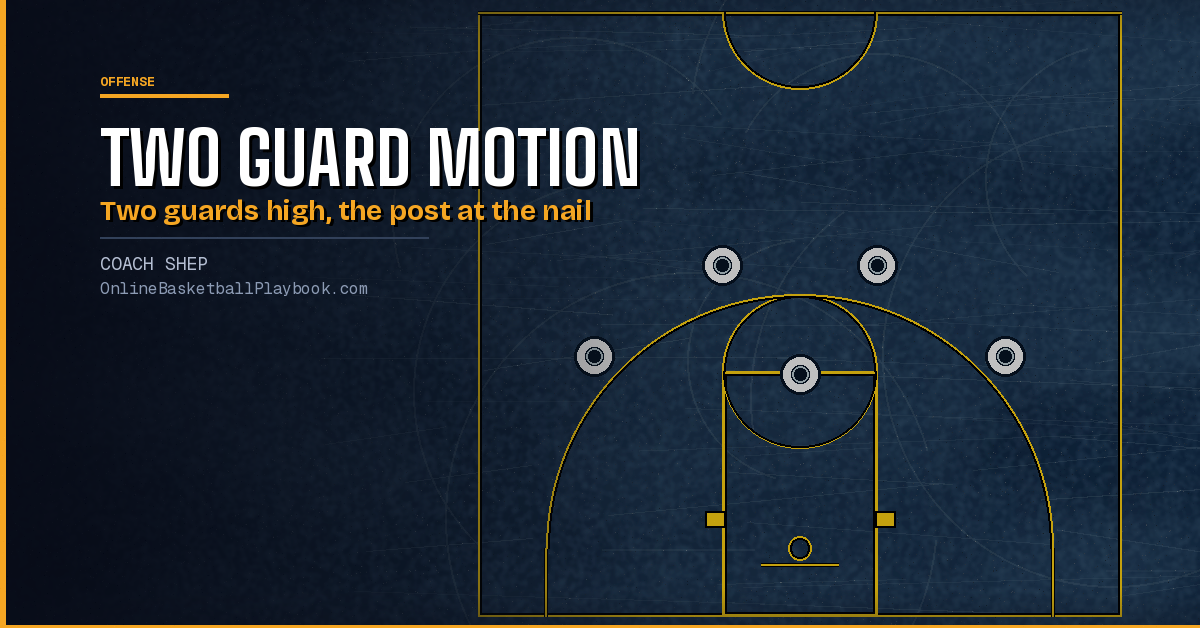
Two Guard Motion Offense: Chin, Shuffle and Motion Series
John Beilein's two guard motion offense: the high 2-3 set, the post at the nail, Chin entries, the flare, ball screen and backdoor read, and the Shuffle series.
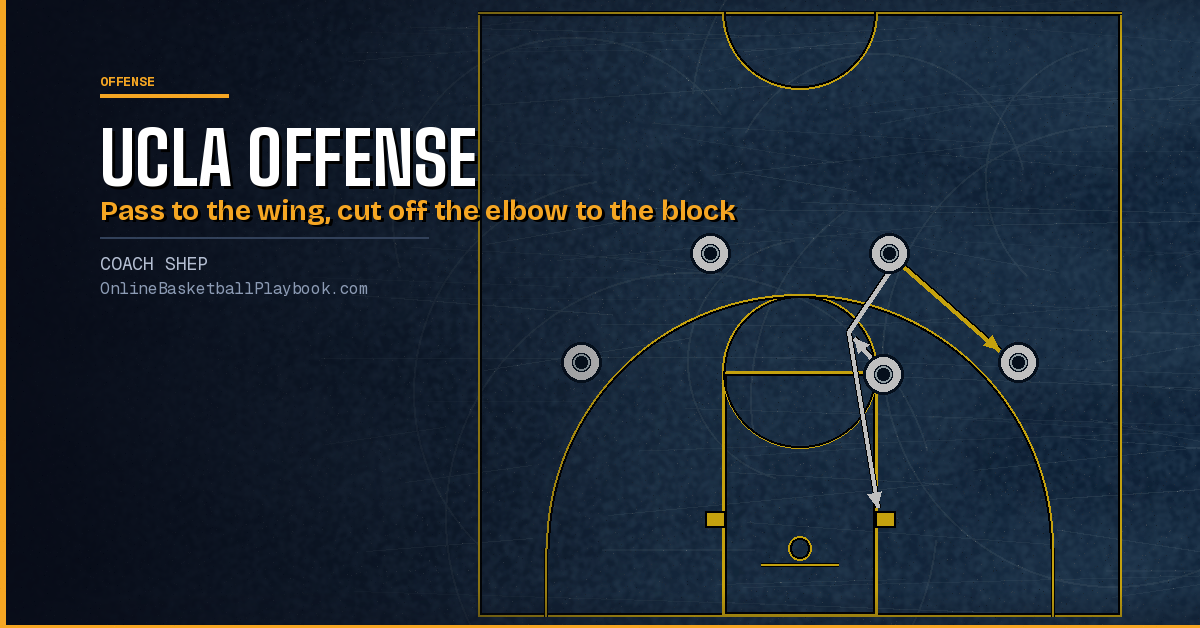
UCLA Offense Basketball: UCLA Cut, High Post Series and Counters
UCLA offense basketball in full: what a UCLA cut is, the 2-3 high and 1-4 high starts, reads off the cut, denial counters and the high-low version.
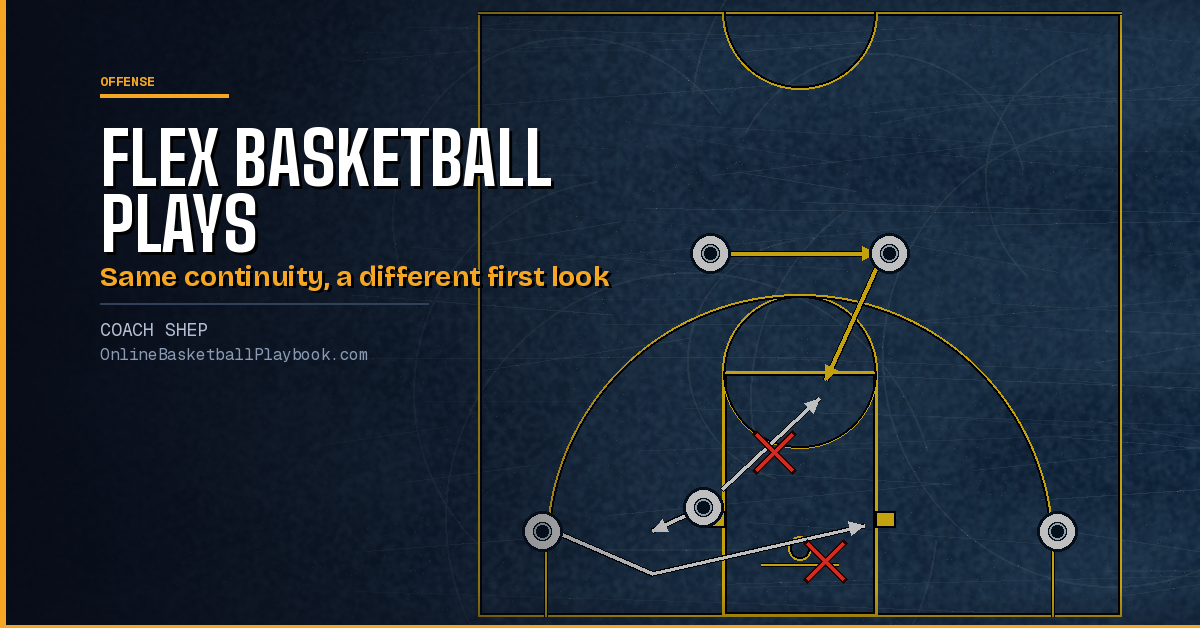
Flex Basketball Plays: Specials, Counters and Named Sets
Flex basketball plays drawn and explained: the eleven specials, Push, Go and Bump in each version, read counters, personnel swaps and flex actions in other offenses.