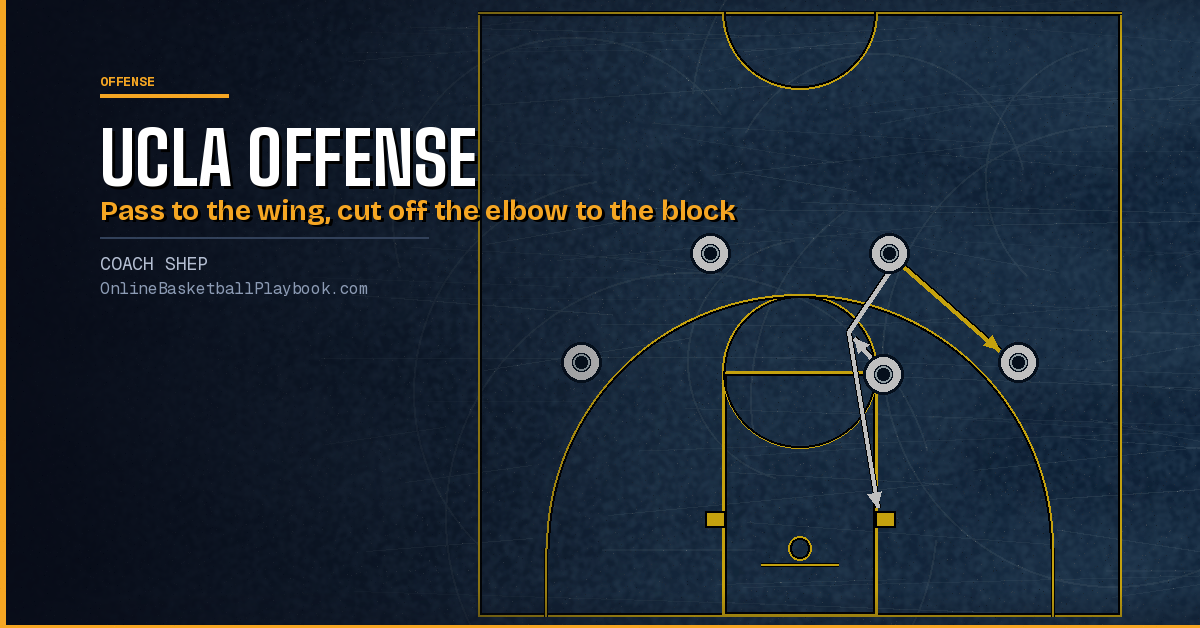
UCLA offense basketball starts with one action, the UCLA cut. A guard in the slot passes to the wing, the post at the ball-side elbow sets a screen like a back screen, and the passer cuts off it to the ball-side block. The cut was popularized by John Wooden, and the high post offense his UCLA teams ran is built around it, with a step-out and down screens behind it and a set counter for the passes a defense tries to take away. This guide answers what a UCLA cut is, then lays out the 2-3 high and 1-4 high starts, the reads off the cut, the ball reversal, the denial counters, the high-low version and the other offenses that borrowed the cut.
What Is a UCLA Cut in Basketball?
A UCLA cut is a pass from the guard slot to the wing, followed by a cut from the slot to the ball-side block off a screen by the post at the ball-side elbow. The screen is set like a back screen, on the cutter's defender, and the cutter looks for the return pass from the wing and a layup. The name comes from UCLA, where John Wooden popularized it, and it is a popular cut far beyond UCLA.

Three features define it. The pass goes first, so the cutter is the passer. The screen comes from a post at the high post, not from a player on the baseline. And the cut ends on the same side as the ball. Sources describe the same cut from slightly different starting spots.
| Version | Where the cutter starts | The screen | Where the cut goes |
|---|---|---|---|
| Slot-to-wing (the plain definition) | A guard slot, after passing to the wing | The post at the ball-side elbow, set like a back screen | The ball-side block |
| Top-of-the-key version | A player at the top of the key who passes to a perimeter player | A high post screen | Straight to the block, often for an open layup |
| 2-3 high wing entry | The guard who caught the guard to guard pass and hit the wing | The post, who has moved to the ball-side elbow | To the basket, up the same side of the lane |
| 1-4 high start | The point guard at the top of the key, after the pass to the wing | The high post at the elbow on that side | To the basket on the ball side, or inside the screen if the outside path is blocked |
| Princeton cut names | A perimeter player | A high post center's screen | The low block on the same side. A shuffle cut off the same screen goes to the opposite block. |
| Bo Ryan's swing | The ball handler, when the post entry is not open | The post cuts up and back-screens at the elbow | Whichever side of the screen the defense gives |
Small technique points come with the cut. One coaching point has the cutter put a forearm on his defender and walk him up the lane line. The back-screen, flare and flex swing version recommends a hook bounce pass to feed the cutter as a safe pass, and says the cutter picks his side of the back screen by reading how his defender plays the pass. If the cutter is not open, the screener does not stand still. In the versions on this page he steps out or pops out for the next pass. General cutting footwork is on cutting in basketball, and the back screen itself is on basketball screens.
| Cut | The screen | Where it goes |
|---|---|---|
| UCLA cut | A post at the elbow or high post | The same-side block |
| Shuffle cut | A post at the high post | The opposite block, or the basket by whichever side the defense gives |
| Flex cut | A baseline screen near the block | The ball-side block, along the baseline |
The shuffle cut has its own guide on shuffle offense, and the flex cut on how to coach the flex offense.
What Is the UCLA Offense in Basketball?
The UCLA offense is the high post offense John Wooden used at UCLA, where his teams won ten NCAA titles in the last twelve seasons of his career, across the 1960s and early 1970s. It is a man-to-man offense. One account says the high post attack was central to many of those championship teams and is still run at every level, the NBA included. It has a pattern, but its many options and counters break that pattern, which makes it hard to defend. The continuity offense hub places it between a fixed continuity and free motion offense, as a pattern that answers each denial with a named counter.
Wooden's stated keys to the offense were these:
- Spacing
- Triangles
- Penetration
- Passing
- Strong-side and weak-side balance
- Flexibility
- Timing
- Equal scoring opportunity
- Rebounding balance: when the shot goes up there is usually a rebounding triangle under the basket, a long rebounder and a safety
His full material covers a high post version and a high-low version, both from a two-guard front. Most of this page is the high post version, and the high-low version has its own section.
The Two Starting Sets
The sources run the UCLA high post offense from two alignments.

| Version | Alignment | Why it is chosen |
|---|---|---|
| 2-3 high (two-guard front) | Guards in both slots, forwards on the wings, the post starting low and flashing to the high post | Like the 1-4 high it draws defenders away from the basket. Tall guards can post up, and with two guards out front the point guard sees less pressure because the offense runs to either side. |
| 1-4 high | The point guard at the top of the key, a wing on each side and a post at each elbow | Favored against pressure defense. The 4 and 5 can trade spots easily, and so can the 2 and 3, and it starts to either side. |
A separate 2-1-2 spread offense that also carries the UCLA name opens from a high set, a triple post look or a stack, and its foul-line set runs a UCLA or shuffle cut.

The 1-4 high version calls the cut the high post rub and treats the offense as a sequence: the early push, the rub cut, a post-up for the cutter, the down screens on the reversal, then a second post-up, and back into the continuity.
The 2-3 High Series, Step by Step
Both 2-3 high versions start with a guard to guard pass, and the guard-around version has the receiving guard sit a little behind the passer so the pass is not picked off. In the UCLA-cut version the ball then goes to the wing for the UCLA cut, and in both it can go into the high post.

- Wing entry. The forward on the ball side makes an L-cut to get open and takes the pass on the wing. The post moves to the ball-side elbow.
- The UCLA cut. The passer cuts off the post to the basket for a pass and a drive. On the weak side the other guard slides across and the far forward drops inside. The same series runs to the left with the roles flipped.
- Step-out and down screen. If the cutter is not open, the post steps out and takes the pass from the wing. The wing then screens down for the cutter, who comes back out to the perimeter.
- High-low and reversal. The weak-side forward tries a duck-in move for a high-low pass from the post. If that is not there, the post reverses the ball quickly to the guard on the far side while that forward seals inside for a pass from the guard.

A low post split is the other option after the step-out. The cutter and the weak-side forward cut around the down screener near the block for passes and scoring chances. The cutter can go low, or walk his defender toward the corner and then cut high over the screener, depending on how his defender plays him. More on the post's role in feeding from the high post is on high-low offense basketball.
Passing Into the High Post
In both 2-3 high versions the guard can pass straight into the post at the high post instead. The guard-around version runs these options off that pass.

On the catch, both forwards back-cut hard to the rim for a pass and a layup, and the two guards v-cut toward the middle and out to the wings. If the post passes to a guard on the wing, that guard looks inside to the forward posting up. The post cuts inside for a pass from that forward, and if nothing comes he screens down for the opposite forward, who cuts into the lane for a pass and a shot. Any wing who passes into the low post relocates to the ball-side corner for a kick-out three.
Because a defense may come to expect the guards to v-cut to the wings, the same entry has several changes of pattern:
- Criss-cross. The guards cross to the opposite wings.
- Scissors into down screens. The guards scissor-cut around the post and both screen down for the forwards, and the post can hit either forward for a jumper.
- One out, one in. One guard goes to the wing and the other cuts inside to screen down. The post can hit the forward using the screen or the guard on the wing, who looks into the low post as before.
- Curls. Both guards cut inside and curl around the forwards for an outside jumper. A guard who catches also looks inside to a forward posting up, and on that pass the post screens down for the other forward. If the ball then goes to the high post, the post ducks in for a high-low look.

The UCLA-cut version runs an X-cut instead. Either guard can pass to the high post, and both guards then cross around the post. The guard who made the pass goes first, while the wing on his side empties across to the other side. Each guard cutting by is a chance for a hand-off and a drive, and if the post keeps the ball he can shot-fake and drive himself as the second cutter clears to the corner.
The Guard-Around Outside Cut
Not every version sends the passer through the middle. The guard-around 2-3 high version has the guard who passes to the wing cut outside and around the wing instead.

The wing first cuts inside, then back out for the pass, and the opposite forward cuts to the far block. After the outside cut, the options branch:
- Double screen for the far forward. The passer and the post set a double screen inside, the wing passes back out to the other guard, who has moved over, and that guard hits the forward coming under the double screen for a jumper.
- Down screen for the passer. The post stays high and takes the pass from the wing, the wing screens down for the passer, and the post hits him for a jumper.
- Hand-off. The wing passes to the post and cuts around him for a hand-off and a jumper.
The UCLA-cut 2-3 high version also uses an outside cut, as its answer to a defender who bumps the UCLA cutter. Instead of cutting through, the guard passes to the wing and loops outside him for a hand-off while the opposite wing runs through to the corner on the ball side and takes his defender out of the lane. The post back-screens for the wing, who cuts for a lob from the guard. If the lob is not there, the post back-screens for the guard, who drives around him for a shot, a dump pass to the wing or a kick-out to the other guard, who has dropped to the corner.
Get the next coaching guide in your inbox
One email when a new guide or diagram set goes up. Free.
Reading the Defender on the UCLA Cut
The 1-4 high version lists the reads off the rub cut and says every player needs to know all of them, though in a game a defense mostly uses just one.
| What the defense does | Counter |
|---|---|
| The cutter's defender trails over the screen | The cutter walks him into the screen and cuts ball side to the basket for the return pass, or posts him up |
| The defender blocks the outside path with an outside denial | The cutter goes inside, off the other side of the screen, for the return pass or a post-up |
| The defender cheats behind the screen | The bump: the cutter pops back out for an open shot, or passes to the weak-side guard coming off a down screen |
| The post's defender steps out to show and recovers | The post slips the screen and cuts to the basket for a quick pass from the wing |
| The defense switches | Post roll: the cutter clears to the corner and the post rolls to the rim against the smaller defender. Or a corner isolation for the guard against the bigger defender, with the post diving when that shot is not there. |
| The defense expects the switch and zones it | The post slips to the basket |


A back screen option sits on top. If the wing cannot hit the cutter, the cutter screens back for the post, and the wing looks for a lob to the post rolling to the rim, or feeds him posting a smaller defender after a switch. The back-screen, flare and flex swing version adds its own bump. When defenders start to cheat the cut and beat the cutter to the block, he bumps back out to the three-point line for a three. It also notes that many teams either jam the cutter or have the screener's defender sag to help, and that either one leaves the screener open on his step-out for a jumper or a rip and drive. How to read a defender who overplays is on cut or backdoor.
Ball Reversal and Down Screens
When the rub cut gives nothing, the 1-4 high version flows straight into a quick ball reversal with down screens. The wing reverses the ball to the post stepping out, and on the far side the other post screens down for a shooter. The reversal keeps the offense moving, answers overplays and double teams, and keeps players in place for offensive rebounds.

| What the shooter's defender does | Counter |
|---|---|
| Chases out and trails | Curl off the screen for a quick jumper |
| Chases out late | Curl all the way to the basket |
| Cheats over the screen | Fade to the baseline for the jumper |
| Cheats over early | Change direction and back-cut to the basket |
| The defense switches | The shooter pops to the wing and the screener seals and rolls. Or the post isolates the smaller defender, or the screener clears out and leaves the shooter one on one with a bigger defender. |
| The screener's defender shows and recovers | The screener slips the screen to the basket |
Two more reversal options appear in the same version. In the weak-side low post split, a cutter who did not get the ball goes to the weak side and splits with the other guard off the post's down screen, one cutting baseline and one popping out, and a guard whose defender sits low cuts over the top of the screen instead. The version notes that several NBA teams have run this. In the back screen option the cutter back-screens for the post. Down screen technique and drills are on drills to teach off-ball screens.
Counters When a Pass Is Denied
The 1-4 high version calls these automatic counters, because any time the defense denies a passing lane it opens a set answer that often ends in an easy basket. The 2-3 high and 1-4 high versions answer different denials.
Guard to guard pass denied

The forward on the denied side reads it, cuts inside, then flashes hard up above the free-throw line for the pass. The denied guard then cuts around him for a hand-off and a layup or a drive. Both 2-3 high versions run it this way.
Wing pass denied

| Version | Counter |
|---|---|
| 1-4 high, dribble clear | The point guard dribbles toward the wing and the wing back-cuts for the pass |
| 1-4 high, high post feed | The point guard passes straight to the high post, and the denied wing back-cuts for a feed from the post |
| UCLA-cut 2-3 high, both wings back-cut | The guard dribbles to the wing and both forwards back-cut to the blocks, with a quick pass possible on the cut. The guard can feed the forward posting inside. If not, that forward screens away for the other forward, who cuts to the ball-side block, and the post screens down for the screener, who comes around for a shot. |
High post denied

| Version | What is denied | Counter |
|---|---|---|
| 1-4 high, high post lob | The pass into the post at the elbow | The post seals, waits until the ball is right over his head, then releases on a back cut for the lob. If the lob is not there, the point guard enters to the other post. |
| 1-4 high, weak-side post entry | Both the wing and the high post | The point guard passes to the other post. The denied post dives to the basket, the wings spot up in the corners, and the post with the ball can also go one on one. |
| 1-4 high, post back cut | The wing's reversal pass to the post stepping out | The cutter clears to the corner and the post back-cuts for a quick feed from the wing. Or the post sets a diagonal screen for the other post. |
| UCLA-cut 2-3 high, lob and double down | The step-out pass after the UCLA cut | The post back-cuts for a lob from the wing, which is more likely open if the cutter moves toward the corner and takes his defender away. The other guard cuts high to the top of the key for the pass instead, and the far forward rotates back out to his wing. On that pass, the wing and the post set a double down screen for the cutter, who curls for the shot. The far forward L-cuts to the weak-side elbow for a two-player game with the guard: pass and cut around for a hand-off, or dribble at him into a pick and roll if the pass is denied. |
| Guard-around 2-3 high, post to the block | The guard's pass into the high post | The post cuts down to the block and the team runs the guard-around outside cut. The wing feeds the post, or the wing and the guard split around him. The wing can also pass back out to the guard while the far forward flashes to the high post, then the wing and the post double-screen for the passing guard, who catches on the wing from the high post for a shot. Another option has the far forward come up to ball-screen for the guard. |
| Guard-around 2-3 high, dribble at | The wing's pass back out to the guard | The wing dribbles straight at the guard, which tells the guard to back-cut for a bounce pass. The far forward clears around a double screen by the guard and the post, and can catch for a jumper off it. |
The two-player game after the double down screen looks much like the weak-side two-player game of the triangle offense, and one version counts twelve options in it, six off the pass and six off the dribble. Pick and roll reads for the ball screen options are on pick and roll.
Posting Up After the Cut
The cutter can post up on the block after the rub cut, and the post can post a smaller defender after a switch. The 1-4 high version says size alone is not enough for that and treats posting up as its own part of the offense. It credits Tex Winter's phrase "line of deployment" for reading where the post defender plays.
| Where the post defender plays | Counter |
|---|---|
| High side, three-quarter denial | Cheat up the lane, seal, show a target with the baseline hand, and finish with a power layup. The wing can also pass to the corner for a better angle. |
| Baseline side, three-quarter denial | Cheat down the lane, seal, show the top hand, and finish with a baby hook off a long lead step into the middle. The wing can reverse to the top of the key for a better angle. |
| Behind | Seal low with both hands up, catch, pivot and face up in triple threat for a jump shot, a pump fake and drive, or a step back |
| Fronting | Push the defender away from the basket, seal and hold until the lob is over the head |
| Double team | Release to the elbow when help comes along the baseline, or to the short corner when it comes from above |
The same version adds post splits, where whoever feeds the post cuts first, and both cutters clear if they do not get the ball so the post can play one on one. Post footwork for each read is on basketball post moves.
The UCLA High-Low Offense
When Wooden had dominant centers such as Kareem Abdul-Jabbar and Bill Walton, he wanted the big man catching near the basket rather than at the high post. The high-low offense does that while avoiding double and triple teams on the low post.

It starts with the same guard to guard pass, and the receiving guard dribbles to the wing. The post cuts to the opposite block and a forward cuts inside, then back up to the high post. The ball goes back out to the other guard at the top of the key and in to the high post, and the low post ducks into the lane for the high-low pass. If the low post is fronted, the high post passes to a wing, who feeds the low post sealing his defender high. The set has shifted from a 2-3 to a 1-3-1 along the way. The high-low offense guide covers the same two-post idea in other systems.
The High Post Split Offense
Another high post offense runs from the same 2-3 high alignment, but the guards split the high post and the wings screen down for them. The alignment leaves the baseline open for basket cuts and back cuts, and with all five players able to score the defense cannot help off the weak side.
- Split. A guard passes to the high post and cuts first, and the other guard cuts tight off him like a moving screen. The post can feed either one.
- Down screens. If no one is fed, the wings screen down for the guards. The post hits the shooter, feeds the rolling screener on a switch, or plays himself.
- High post isolation. The post faces up in triple threat with no help near him, because the ball is in the middle of the floor. This version says the high post spot goes to the best triple-threat player, not only to the post.
- Strong post-ups. When the defense guards the shooters, the ball goes to a post sealing a smaller defender.
| What the defenders on the split do | Counter |
|---|---|
| Play tight and do not switch | Hand off on the split |
| Drop off and switch | Fake the split and cut on the same side |
| Collapse on the post | The guards back-cut to the basket |
| Switch every time | Both cutters go to the same side for a two-on-one on one defender |
Its down screens use the same six reads as the UCLA reversal table above.
Where Else the UCLA Cut Shows Up
Other offenses and sets use the UCLA cut as an action of their own.
| Offense or set | How it uses the UCLA cut |
|---|---|
| Swing offense | Bo Ryan's continuity combines pieces of the UCLA offense, the flex and the triangle. On the wing entry, a post who is not open cuts up to back-screen at the elbow for the ball handler's UCLA cut. |
| Flex corner options | When the guard to guard pass is denied, a UCLA cut off the post is one of the corner options, and a flex special called UCLA follows the cut with a pick and roll. Details are on flex basketball plays. |
| Princeton offense | Pete Carril's Chin series uses it when the ball cannot be swung and has to go to a forward on the same side. The high post pops out after the screen and, if overplayed, goes back door for a lob. Another Chin version, keyed by a pass to the strong-side wing, has the passer UCLA-cut off the post, who then steps out above the elbow for the return pass. |
| Secondary break | The passer cuts off the post's UCLA screen for a layup look, clears to the corner if not open, and the post sets a ball screen on the wing |
| UCLA cut into a pin-down | A UCLA cut followed by a flex screen and a pin-down or hand-off to the cutter, often called Chicago. It ends eleven delay sets from different college programs, more than any other finish in that group. |
| Hawk action | In Tom Izzo's 1-4 sets, the entry man cuts off a UCLA screen, the screener turns it into a ball screen and rolls, and the cutter comes off a base double screen |
| UCLA cut into a rip screen | The cutter turns and screens for the post, then pops back out to get the ball |
| Triangle entries | A UCLA cut is one of seven entries from a two-guard front |
The secondary break and the Hawk action both follow the cut with a ball screen. Offenses built entirely on repeated ball screens are on ball screen continuity offense.
How Defenses Guard the UCLA Cut
The sources give several ways to guard the cut.
- Show and recover. The NBA method in one version has the cutter's defender deny the direct cut and push the cutter behind the high post screen, while the screener's defender steps out and bumps to force him wide. The cutter's defender goes over the top of the pick, catches up into three-quarter denial on the cutter in the low post, and the weak-side defenders pack the lane. On the reversal, the down screener's defender shows and recovers while the shooter's defender chases.
- Trap the first pass. The same version also traps the wing on the first pass, because with the point guard cutting to the low post the wing has a hard time reversing the ball out of the double team. Rotations for that kind of trap are on SOS pressure defense.
- Force him high. Hubie Brown's rule on a back screen is to force the UCLA cutter high and right into the screen so the cut gets longer, and to open up on the back screen in man and zone alike, or the lob is right in front of the defense.
- Drill every screen. Rick Pitino's rule is not to let the screen happen. His players drill against down screens, back screens and UCLA cuts, using the arm nearest their man to force him high and wide.
- Over or under. One coverage treats the UCLA cut and the shuffle cut as the same problem and splits on which way the cutter goes. It is set out on the shuffle offense page.
The offense has an answer ready for each choice. A switch gets the post roll or the corner isolation, a defender cheating behind gets the bump, and a show gets the slip. More on guarding cutters is on defending screens in basketball and drills to teach defending cutters.
Installing and Teaching It
- Execution over the call. The 1-4 high version opens its teaching by putting execution ahead of the play call. The post has to set a solid screen and the guard has to set up and use it, and the ball handler, screener and receiver work as one unit.
- Whole, part, whole. The same version breaks the offense into a 2-on-2 entries drill, a 3-on-3 drill combining the high post rub, the down screen and side screen action, then half-court and full-court scrimmages. Each player also gets one or two individual skills to work on in practice, written on a 3 by 5 card.
- Teach the reads. The guard-around 2-3 high version stresses that players must be drilled in fundamentals and taught to read the defense to choose the right option or counter.
- Scout and change looks. The 1-4 high version says to tell players which reads to expect, watch for defensive changes after timeouts and substitutions, move players around to attack the weakest defenders, and use different alignments and entries so defenders cannot focus on one set.
- Called or chosen. The 2-1-2 spread offense picks its secondary set before the game or season, from a dead ball, or lets the post call it when he catches the ball on an experienced team.
- Be patient. The back-screen, flare and flex swing version notes that UCLA-cut scoring chances usually start to appear after a couple of ball reversals.
Who It Fits
- No true low post. The 1-4 high version calls it a good choice for a team without a real low post scorer, because it uses a post who can pass and shoot from the high post and a point guard who can post up.
- Tall guards. Both 2-3 high versions let a team post up their guards.
- Pressure on the point guard. With two guards out front and an offense that runs to either side, the 2-3 high takes pressure off the point guard. The 1-4 high is favored against pressure defenses.
- A dominant center. The high-low version is the one built for him.
The UCLA-cut 2-3 high version calls the offense relatively simple, with good answers to a pressuring, denying defense. What it asks for is reading, since each counter only works if the player sees the denial and knows the answer. For the rest of the continuity family, see continuity offense basketball, and every system on the site is listed under offense.
Questions Coaches Ask About the UCLA Offense
What is a UCLA cut in basketball?
A pass from the guard slot to the wing, then a cut by the passer from the slot to the ball-side block off a screen by the post at the ball-side elbow, set like a back screen. It was popularized by John Wooden at UCLA, which is where the name comes from.
Why is it called a UCLA cut?
Because John Wooden's UCLA teams made it famous. It is the main action of the high post offense he ran.
What is the difference between a UCLA cut and a shuffle cut?
Both come off a screen at the high post. In Princeton terms the UCLA cut goes to the block on the same side as the ball, and the shuffle cut goes to the opposite block.
What is the UCLA offense?
John Wooden's high post offense against man-to-man, run from a 2-3 high set, and in other versions from a 1-4 high set. A UCLA cut off the high post is followed by a step-out, down screens on the reversal and a set counter for each denied pass. A separate high-low version gets a dominant center the ball near the basket.
What is a high post offense?
An offense that runs through a post at the free-throw line, who screens, receives entry passes and feeds cutters. The UCLA offense and the high post split offense are two examples on this page.
How do you stop the UCLA cut?
Deny the direct cut and force the cutter high and behind the screen, have the screener's defender show to push him wide, and open up on the back screen so the lob is not open. The offense answers each choice with a bump, a slip or a post roll.
Want every diagram on the site?
OBP Pro members get the full diagram files for every guide on the site, ready for a practice binder or a scouting report. $9 a month. Or draw your own version free in the play drawer.
See what OBP Pro includesMore Continuity Offense Guides
- Flex Offense Basketball: Cuts, Sets, Counters and Drills
- Flex Basketball Plays: Specials, Counters and Named Sets
- Shuffle Offense Basketball: Shuffle Cut, Rotation and Counters
- Ball Screen Continuity Offense: Pick and Roll Rules and Reads
Back to Continuity Offense and every Offense page.
Keep Building
Related breakdowns
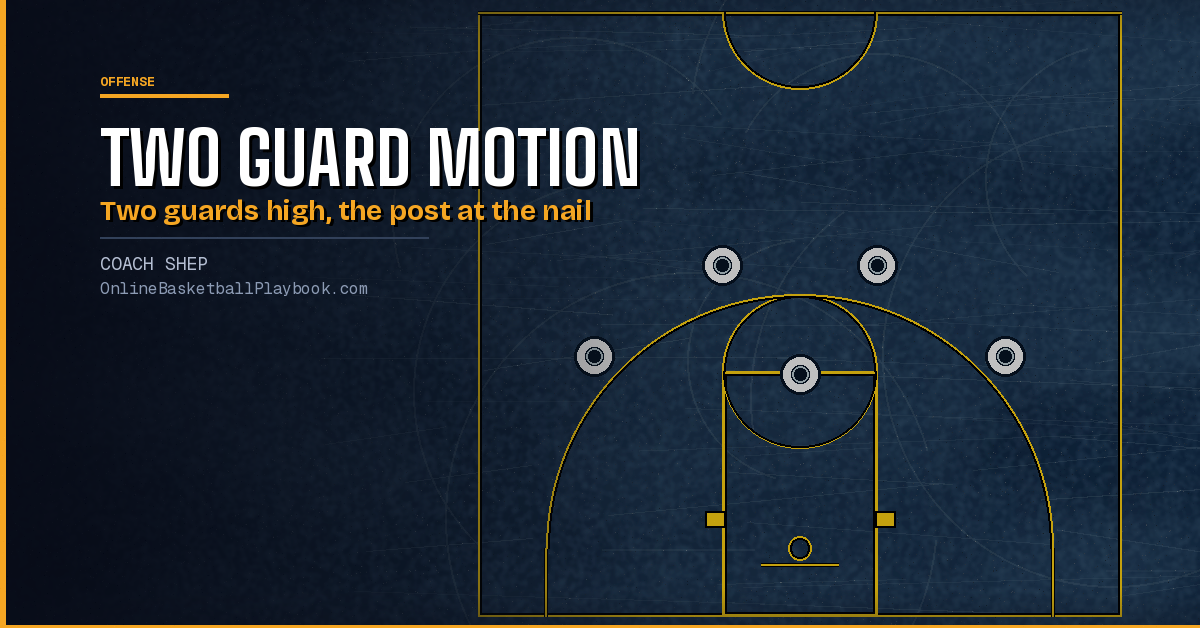
Two Guard Motion Offense: Chin, Shuffle and Motion Series
John Beilein's two guard motion offense: the high 2-3 set, the post at the nail, Chin entries, the flare, ball screen and backdoor read, and the Shuffle series.
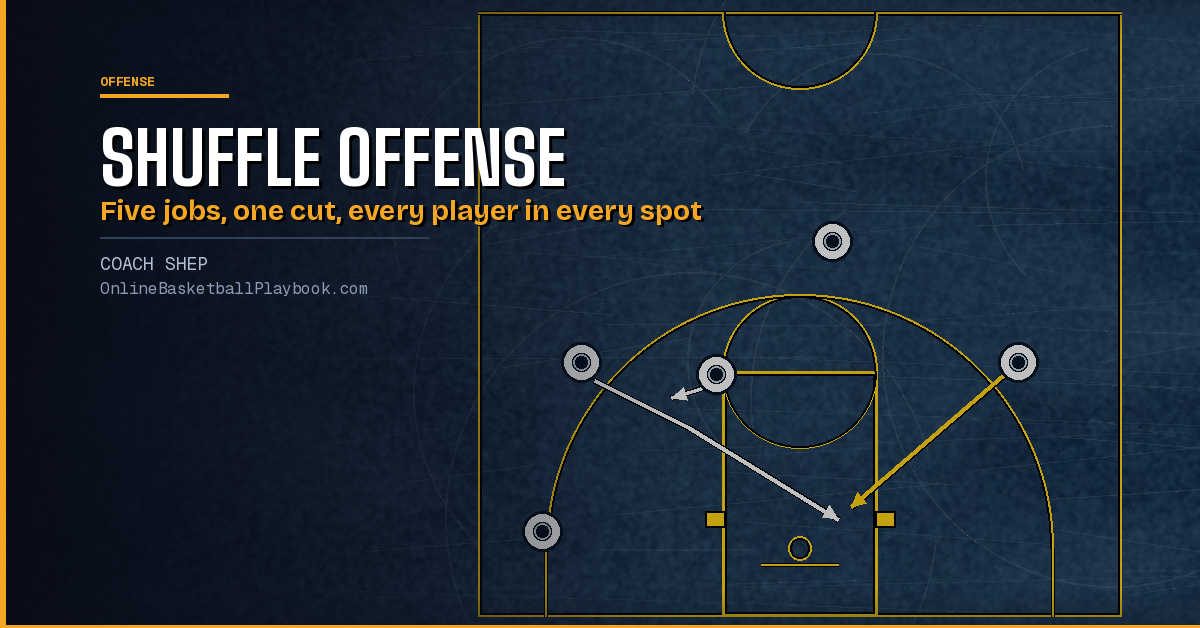
Shuffle Offense Basketball: Shuffle Cut, Rotation and Counters
Shuffle offense basketball in full: the five spots and their jobs, the shuffle cut, the rotation, counters for denial and fronting, zone versions and drills.
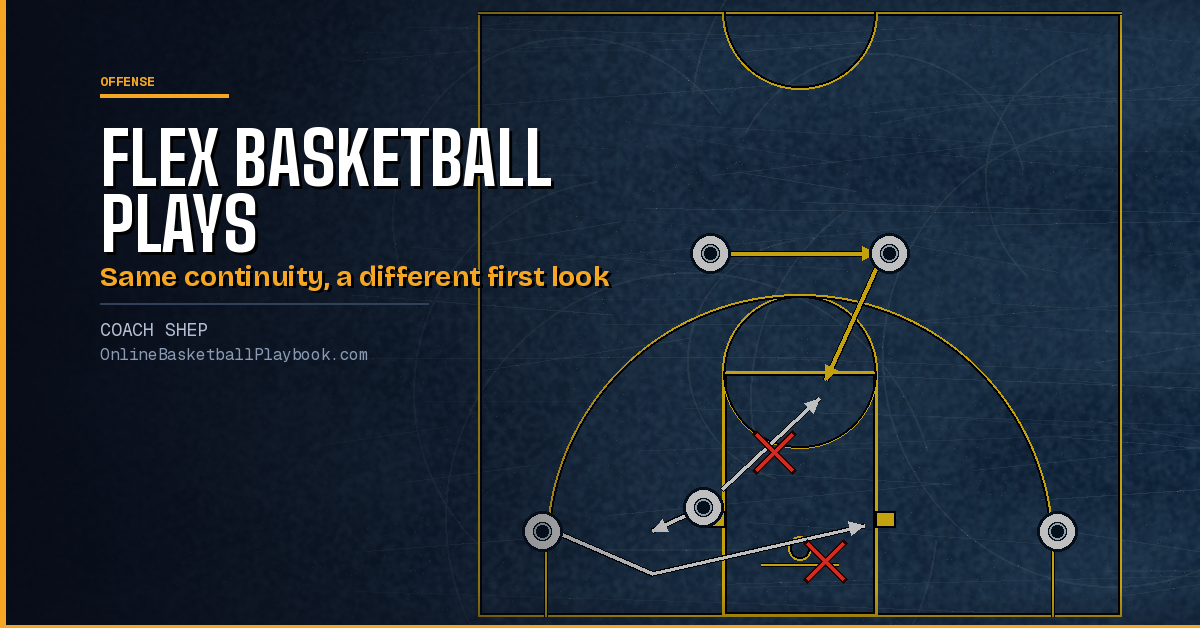
Flex Basketball Plays: Specials, Counters and Named Sets
Flex basketball plays drawn and explained: the eleven specials, Push, Go and Bump in each version, read counters, personnel swaps and flex actions in other offenses.