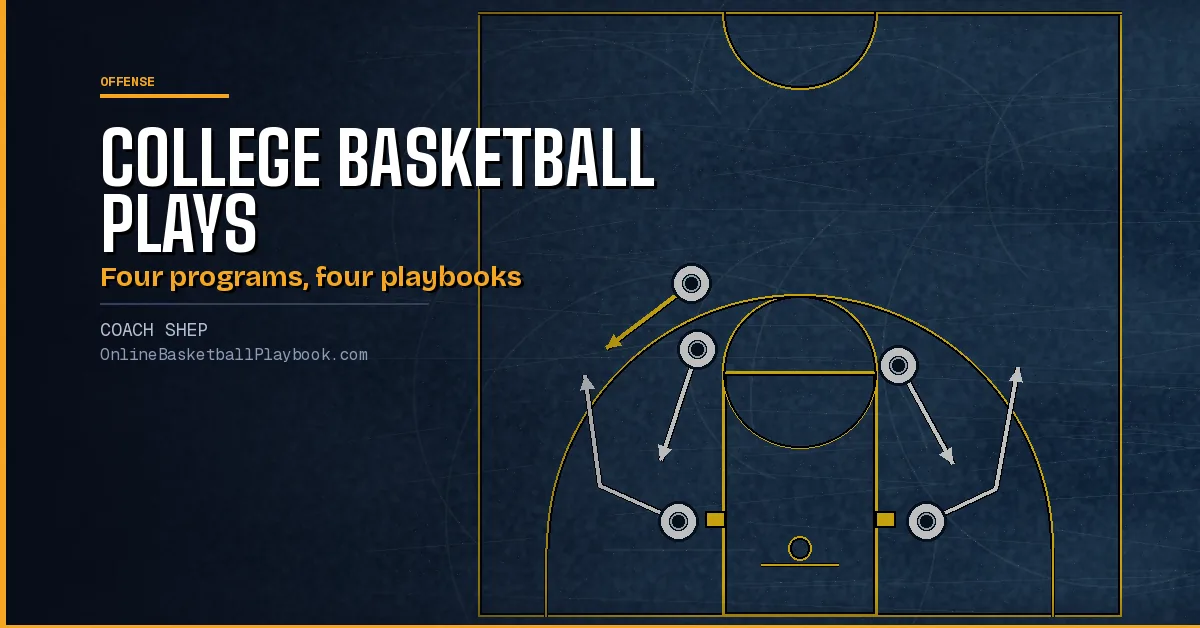
College basketball plays make the most sense when you study them program by program. Some programs are known for a whole system, some for a library of named sets, and some for both. This guide lines up four college playbooks, Butler, Gonzaga, Kansas and Michigan State, with 55 plays drawn across 181 frames on their own pages. It also points to the college systems that already have full guides here, such as the UCLA high post offense and the swing offense.
College Basketball Plays by Program
| Program | Coach | The material | Plays drawn | Page |
|---|---|---|---|---|
| Butler | Brad Stevens era | A ball screen package with named sets | 27 sets, 73 frames | Butler basketball plays |
| Gonzaga | Not named in the material | Named entries into the flex | 11 plays, 52 frames | Gonzaga basketball plays |
| Kansas | Bill Self | Zone offense rules plus numbered zone plays | 6 sections, 25 frames | Kansas basketball plays |
| Michigan State | Tom Izzo | A menu of half-court and out-of-bounds sets | 11 sets, 31 frames | Michigan State basketball plays |
| UCLA | John Wooden | A high post system | On its own page | UCLA offense |
College Basketball Plays: Systems, Actions and Sets
- Systems are whole offenses. The UCLA high post offense and Kansas's stationary zone offense are systems.
- Actions are reusable pieces such as ball screens, down screens, back screens and hand-offs. The UCLA cut is an action other offenses borrow.
- Sets are named plays. Michigan State's Detroit and Gonzaga's Crackdown are sets.
Butler sits between the layers, with a ball screen continuity and named sets that feed it. Gonzaga's sets all feed one system, the flex. The basketball plays guide explains the three layers in more depth.
Butler: Two Bigs and a Ball Screen Continuity
Butler's package from the Brad Stevens era starts from a spread pick and roll. One big screens, the other lifts to the top of the key and pulls his defender away from the rim, and the two bigs keep trading jobs so the screens keep coming.

1 passes from the top of the key to 2 on the left wing and speed-cuts to the right corner. 4, the ball-side big, sprints from the left block to ball-screen for 2. 5, the weak-side big, sprints from the right block to his lift spot at the top of the key. 3 stays on the right wing.
The Butler basketball plays page draws every set in the package. The continuity itself is covered in ball screen continuity offense.
Gonzaga: Quick Hitters Into the Flex
The Gonzaga material is a set library of eleven named entries, and every one of them drops into the flex. Three come straight off the break. The simplest, Crackdown, starts from a box with the bigs at the elbows, and it is the entry the team ran the most.

Box set: 4 at the left elbow, 5 at the right elbow, 3 on the left block, 2 on the right block, 1 with the ball in the right slot. 4 screens down for 3 and 3 pops to the left wing. 5 screens down for 2 and 2 pops to the right wing, where 1 hits him.
The Gonzaga basketball plays page draws all eleven. The flex itself lives in how to coach the flex offense, and flex basketball plays compares the special plays different flex teams carry.
Get the next coaching guide in your inbox
One email when a new guide or diagram set goes up. Free.
Kansas: Getting Inside a 2-3 Zone
Bill Self's starting point is that a 2-3 zone is built to stop the inside game, so living outside plays into its hands. His zone offense puts three players out and both posts low. The perimeter moves the ball fast, the posts do most of the moving, and each pass tells the posts where to go. He expects the good shots on the second or third side.

Pass to the wing. 1 passes to 2 on the right wing and 5, the post on the far side, flashes from the left block to the elbow on the ball side. If his defender denies the flash, 5 seals him and 2 throws the lob to the rim. 4 holds the right block and 3 the left wing.
The Kansas basketball plays page draws the post rule for every pass and five numbered plays. For a wider set of answers to the same defense, see 2-3 zone offense.
Michigan State: Sets With a Rule Built In
The Michigan State material, credited to Tom Izzo, is a menu of sets: 1-4 high plays, box plays, isolation plays, ball screen plays, 2-3 zone plays and out-of-bounds plays. Detroit shows the style. After a hand-off exchange, two bigs set a double ball screen, the non-shooter always rolls and the shooter always pops.

1 hands the ball back with a pass to 2 on the right wing and goes to the left wing, and 3 drops to the left corner. 5 comes from the left block and 4 from the right block to set a double ball screen for 2. 2 can come off it toward the top, or turn the corner toward the baseline.
The Michigan State basketball plays page draws every set. The program's culture has its own page, Michigan State basketball program.
College Systems With Their Own Pages
- UCLA. John Wooden's high post offense, the UCLA cut and the counter for each denied pass are in UCLA offense basketball.
- Wisconsin. Bo Ryan's 4-out, 1-in continuity, where each kind of pass triggers one screen, is in swing offense.
- Princeton. Pete Carril's offense is in Princeton offense.
- Flex. The continuity Gonzaga's entries feed is in the flex offense guide.
Two single-play pages also come from college staffs: the Pitt transition side ball screen and a Providence 2-3 zone play with a post flash.
Borrowing From a College Playbook
Each playbook here carries its own lesson for a coach who wants to borrow from it.
- Personnel. Butler's spread pick and roll is built for two bigs. Detroit needs one big who pops and one who rolls. Crackdown wants the best big near the elbow.
- The simplest entry. Crackdown is the simplest of the Gonzaga entries and the one the team ran the most.
- Counters. Michigan State's 14-Circle has a slip if the defense switches, and Butler's spread pick and roll has several reads from one look.
- One base, many entries. Gonzaga's entries give a scout different looks while the same flex sits underneath.
- Rules tied to passes. Kansas ties each post move to a pass, and Detroit gives the double screen one rule for who rolls and who pops.
These pages sit under the Offense hub. For a short menu of plays to install, see how to run quick hitters. Pick one idea, rep it until it is automatic, then add the next.
Questions Coaches Ask About College Basketball Plays
What is the difference between a system and a set?
A system is a whole offense. A set is a named play called out of it or run on its own.
How does Kansas attack a 2-3 zone?
Bill Self puts three players out and two posts low, ties each post move to a pass and looks for the good shots on the second or third side.
What is the Detroit play in basketball?
A Michigan State set credited to Tom Izzo. After a hand-off exchange, two bigs set a double ball screen. The non-shooter rolls and the shooter pops.
Which college plays fit a team with two bigs?
Butler's spread pick and roll, where one big screens, the other lifts, and they trade jobs on the next screen.
Where is the UCLA cut covered?
On the UCLA offense page, with the high post series and its counters.
Want the printable playbook packs?
OBP Pro members get the premium playbook packs: the zone attack, out of bounds and practice plan PDFs, plus each new pack as it is finished. The membership page lists what is in each one. Or draw your own version free in PlayDraw.
See what OBP Pro includesMore College Basketball Plays
- Butler Basketball Plays: Brad Stevens Ball Screen Sets
- Gonzaga Basketball Plays: Flex Quick Hitters
- Kansas Basketball Plays: Bill Self 2-3 Zone Offense
- Michigan State Basketball Plays: Tom Izzo Sets
Back to Basketball Plays and every Offense page.
Keep Building
Related breakdowns
Basketball Offense: Systems, Actions and Sets Explained
Basketball offense explained as three layers, systems, actions and sets, with the formations, spacing numbers and a map of the major offenses and their pages.
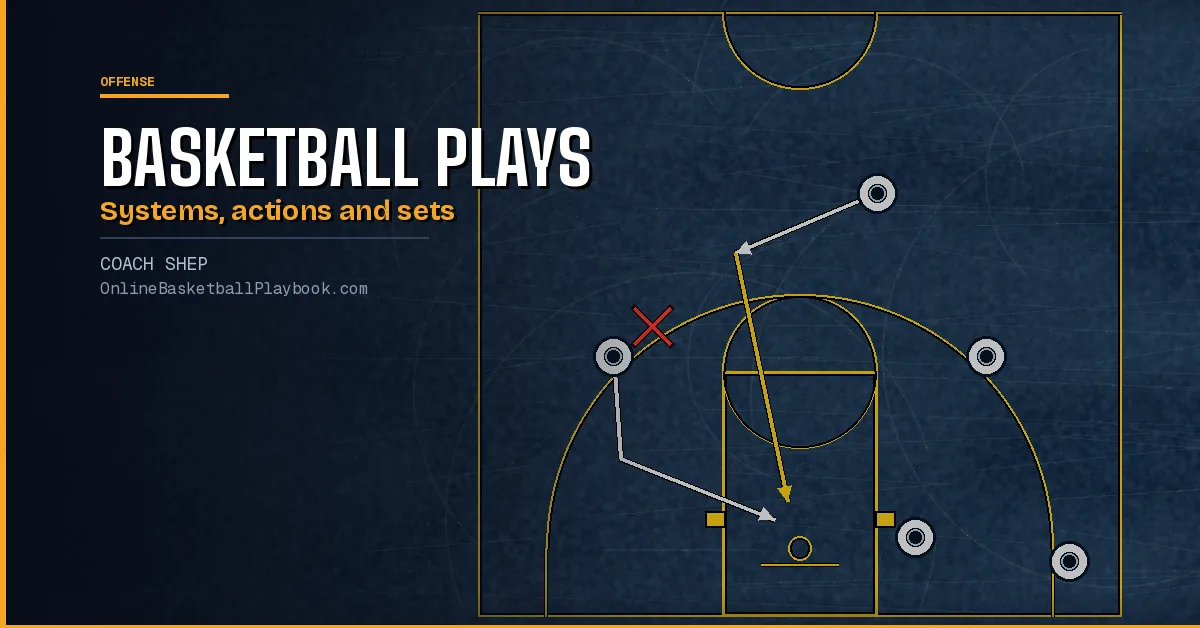
Basketball Plays: Sets, Quick Hitters and Diagrams
Basketball plays explained for coaches. Systems, actions and sets, the types of plays, when to call one, how many to carry, and three diagrammed plays.
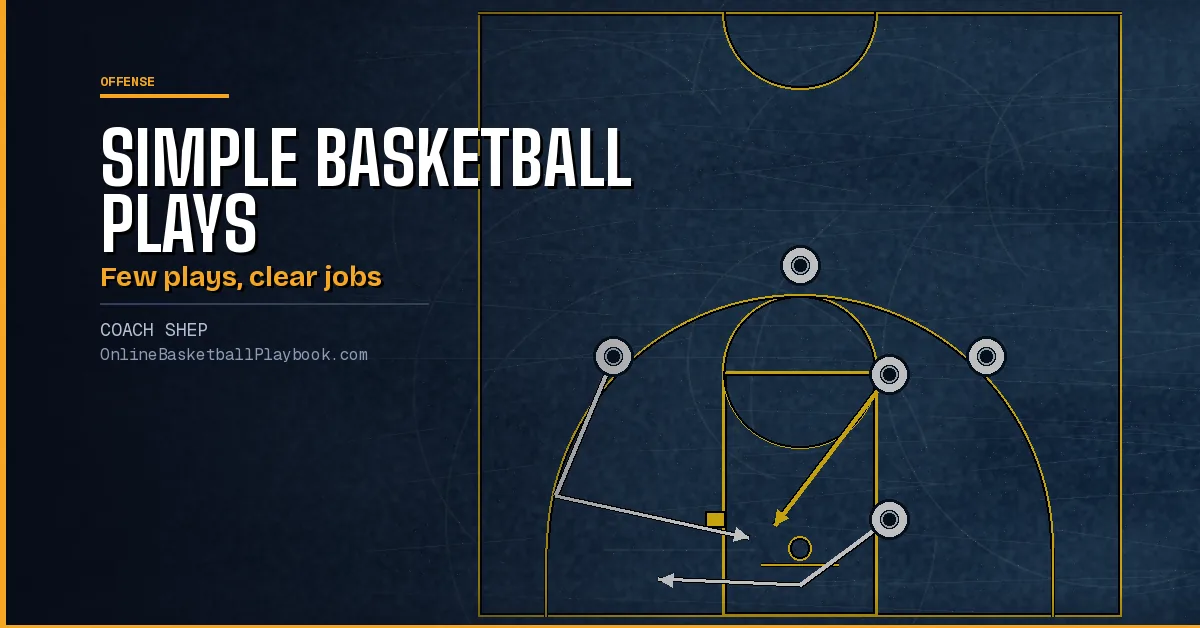
Simple and Easy Basketball Plays for Youth and Beginner Teams
Simple and easy basketball plays for youth and beginner teams. Six basic plays with diagrams and plain steps, an inbounds play, and how to build a small play menu.