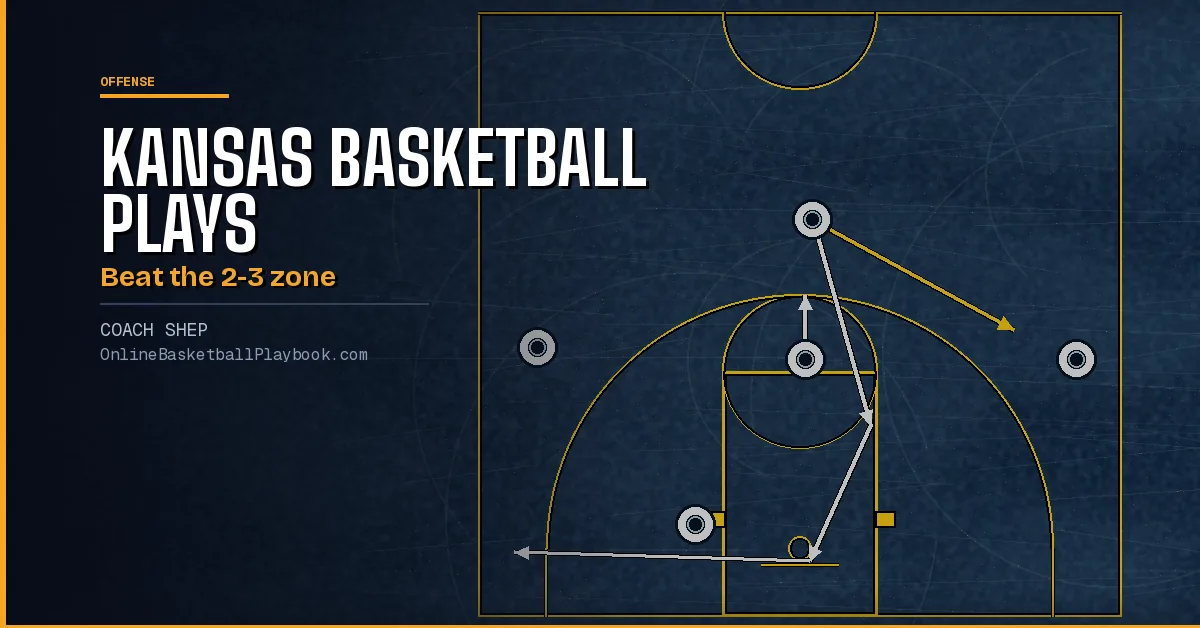
Kansas basketball plays against a 2-3 zone start from a simple diagnosis by Bill Self: the 2-3 is built to stop the inside game. A team that settles for outside shots is doing what the zone wants. Shooters can beat it on a good night, yet Self still wants a way inside, above all late in a game or when the outside shots are not going down. This page draws the stationary zone offense and five numbered plays, 6 sections across 25 frames, with every player placed in every frame.
Kansas Basketball Plays at a Glance
Everything starts with three players outside and two posts low on the blocks. In the stationary version the guards and wings move the ball fast and the two posts do nearly all of the moving. Plays 5, 6 and 7 are not in the material this page is built from.
| Play | Family | Frames | What it does |
|---|---|---|---|
| The Stationary Rules, Pass by Pass | The Stationary Zone Offense | 12 | Each pass tells the two posts where to go. The perimeter moves the ball fast and the posts do the moving. |
| Play 1 | The Numbered Zone Plays | 3 | A cut off the high post to the far corner, a reversal around the floor, then a post look at the elbow or the block. |
| Play 2 | The Numbered Zone Plays | 3 | A corner catch and a skip pull both low defenders out, then 5 screens across for 2 coming from the corner. |
| Play 3 | The Numbered Zone Plays | 2 | 5 flashes to hold the middle defender, 3 screens a low defender, and 4 runs to the far side for a quick catch. |
| Play 4 | The Numbered Zone Plays | 2 | 1 cuts to the corner and gets the ball back, which pulls the low defender out, then 4 runs the baseline behind a screen. |
| Play 8 | The Numbered Zone Plays | 3 | Two screens at the same moment, one on a top defender and one on the inside low defender, and 4 slips to the rim. |
How to Read These Diagrams
Every play is drawn frame by frame, one diagram for each frame of the original, and the text under each diagram says where every player starts and where he goes. The basket is at the bottom of each diagram. Sides are named as a player sees them facing the basket, so the left wing is on the right side of the picture. A solid arrow is a cut, a dashed arrow is a pass, a wavy line is a dribble and a line ending in a short bar is a screen. The diagram guide covers the symbols in full. No offensive player starts a frame standing in the lane. Where a source frame had someone there, he is drawn on the nearest lane line or block.
Get the next coaching guide in your inbox
One email when a new guide or diagram set goes up. Free.
The Stationary Zone Offense
The Stationary Rules, Pass by Pass
Each pass tells the two posts where to go. The perimeter moves the ball fast and the posts do the moving.

Frame 1. Pass to the wing. 1 passes to 2 on the right wing and 5, the post on the far side, flashes from the left block to the elbow on the ball side. If his defender denies the flash, 5 seals him and 2 throws the lob to the rim. 4 holds the right block and 3 the left wing.

Frame 2. Wing to the low post. 2 passes from the right wing to 4 on the right block. 5 dives down the lane from the elbow, and 4 can pass to him, then 5 keeps going to the far block. 1 holds the top of the key and 3 the left wing.

Frame 3. Skip pass from wing to wing. 2 skips the ball from the right wing to 3 on the left wing. Both posts cross to the new ball side: 4 runs along the baseline from the right block to the left block, and 5 moves from the right elbow to the left elbow. 1 holds the top of the key.

Frame 4. Skip from the low post to the far wing. 4 skips the ball from the right block to 3 on the left wing. 5 comes down from the free-throw line and sets a crack-back screen on X4, the defender on the far post. X3 and X2 shift toward the ball. 1 holds the top of the key and 2 the right wing.

Frame 5. 4, the far post, cuts off the crack-back screen into the lane and 3 passes to him. X5 drops to help. 5 holds his screen on the right side of the lane, 1 holds the top of the key and 2 the right wing.

Frame 6. If the cutter is covered, the screener is next. 5 pins his man and steps to the block on the ball side, and 3 can hit him there. 4 is at the free-throw line, 1 at the top of the key and 2 on the right wing.

Frame 7. Pass to the wing with a post already high. 1 passes to 3 on the left wing, and 5, who is at the free-throw line, cuts to the ball-side block and posts up once 3 has the ball. X3 and X2 shift out toward 3. 4 holds the right block and 2 the right wing.

Frame 8. The short corner. 3 takes one dribble from the left wing toward the top. That sends 5 from the left block out to the left short corner and 4 from the right block up to the elbow on the ball side. 1 holds the top of the key and 2 the right wing.

Frame 9. 3 passes to 5 in the left short corner and X5 comes out to him. 4 dives from the free-throw line to the rim and 5 passes to him. 1 holds the top of the key and 2 the right wing.

Frame 10. Skip from the short corner to the top. 5 passes from the left short corner out to 1 at the top of the key. 4 sets a crack-back screen on X5, and 5 cuts off it across the lane toward the right block, where 1 can hit him. 3 holds the left wing and 2 the right wing.

Frame 11. If the cutter is not open, 4, the screener, seals and steps toward the rim for a pass from 1 at the top of the key. 5 seals out on the right side. 3 holds the left wing and 2 the right wing.

Frame 12. If the defense takes away the flash to the elbow, the post turns and screens the outside low defender from behind. 5 screens X4, 2 slides from the right wing to the right corner, and 3 skips the ball from the left wing to 2 for a three. 4 holds the left block and 1 the top of the key.
The Numbered Zone Plays
Play 1
A cut off the high post to the far corner, a reversal around the floor, then a post look at the elbow or the block.

Frame 1. 1 passes from the top of the key to 3 on the left wing and cuts through, past 5 at the high post, to the right corner. 5 steps out from the free-throw line to the top of the key. 4 holds the right block and 2 the right wing.

Frame 2. The ball goes around: 3 passes to 5 at the top of the key, 5 passes to 2 on the right wing, and 2 passes to 1 in the right corner. 3 cuts into the lane after his pass and back out toward the left slot. 5 then works to the ball-side elbow for a catch, and 4 seals his defender on the right block. 1 can pass to 4 directly, or hit 5 at the elbow, and 5 passes down to 4 (high-low).

Frame 3. Once 4 has the ball on the right block, 5 dives across the lane from the right elbow to the far block as the second option, and 4 can hit him. 1 is in the right corner, 3 on the left wing and 2 on the right wing.
Play 2
A corner catch and a skip pull both low defenders out, then 5 screens across for 2 coming from the corner.

Frame 1. 1 dribbles from the top of the key toward the right wing and 2 slides down to the right corner for the catch, which pulls the outside low defender out. 5 is on the left block, 4 on the right block and 3 on the left wing.

Frame 2. 2 skips the ball from the right corner to 3 on the left wing, and the low defender on that side has to come up. 4 moves from the right block up to the free-throw line to hold the middle defender. 5 is on the left block and 1 in the right slot.

Frame 3. 5 screens across the lane from the left block on the low defender who went out to 2. 2 cuts along the baseline from the right corner behind the screen and 3 passes to him inside. A big team can throw it as a lob. 4 holds the free-throw line and 1 the right wing.
Play 3
5 flashes to hold the middle defender, 3 screens a low defender, and 4 runs to the far side for a quick catch.

Frame 1. 1 passes from the top of the key to 2 on the right wing. 5 flashes from the left block to the elbow on the ball side to hold the middle defender, and 3 drops in from the left wing to get ready to screen. 4 holds the right block.

Frame 2. 2 passes back to 1, who has moved to the left slot even with the lane line (the spot Self wants for a clean passing angle). 3 screens a low defender across the lane and 4 runs from the right block to the far side for a quick pass from 1. 5 holds the right elbow.
Play 4
1 cuts to the corner and gets the ball back, which pulls the low defender out, then 4 runs the baseline behind a screen.

Frame 1. 1 passes from the top of the key to 3 on the left wing and cuts through the lane to the left corner. 3 passes the ball back to him in the corner, which pulls the outside low defender out. 5 is on the left block, 4 on the right block and 2 on the right wing.

Frame 2. 5 screens the middle low defender from the left block and 4 runs the baseline from the right block to the ball side. 1 passes to him from the left corner for a layup. If the defense collapses, 1 skips the ball to 2 on the right wing instead. 3 holds the left wing.
Play 8
Two screens at the same moment, one on a top defender and one on the inside low defender, and 4 slips to the rim.

Frame 1. 1 passes from the right slot to 3 in the left slot and slides to the right wing. At the same moment 4 screens X2, a top defender, from the right elbow, and 5 screens X5, the inside low defender, from the right block. 2 waits in the right corner.

Frame 2. 3 dribbles right and passes back to 1 on the right wing. 4 slips his screen and goes down the lane line, and 1 hits him for the layup, with 5 still holding the inside low defender. 2 waits in the right corner.

Frame 3. If X4, the low defender on that side, drops to help on 4's drive, 4 kicks the ball out to 2 in the right corner for an open three. 5 holds his screen, 1 is on the right wing and 3 at the top of the key.
Coach Cheatsheet
- Three out, two posts low on the blocks.
- Move the ball fast on the perimeter and let the posts do the moving.
- Reverse the ball. The best shots come after it has changed sides.
- Tie each post move to a pass, so the rotations become rules.
- Use corner catches and skip passes to pull the low defenders out of position.
- On Play 3, keep 1 even with the lane line so the passing angle stays clean.
- Do not settle for the outside shots a 2-3 offers. Inside looks and trips to the line open better outside shots later.
To learn the defense you are attacking, read 2-3 zone defense. More answers to the same zone are in 2-3 zone offense, how to beat a 2-3 zone and zone offense quick hitters, and drills to teach zone offense covers practice. The elbow-to-block post moves are a version of high-low offense. Kansas is one of four programs on the college basketball plays page under the Offense hub. Rep the post rules until both posts move on the pass without being told.
Questions Coaches Ask About Kansas Basketball Plays
What zone offense does Kansas run?
Against a 2-3 zone, a stationary offense with three players out and both posts low. The perimeter players move the ball fast and the posts move on every pass.
What is a crack-back screen?
After a skip pass, the post at the free-throw line comes back and screens the defender guarding the far post, who cuts into the lane for the pass. The screener then seals for the next pass.
Why do the good shots come on the second or third side?
That is Self's rule. The best shots come after the ball has been reversed, and the post moves are tied to each pass so the zone keeps shifting.
How do you score inside against a 2-3 zone?
In this offense: flashes to the elbow, dives to the rim, short-corner catches, crack-back screens and screens on the low defenders.
Can good shooters beat a 2-3 zone on their own?
They can, but a zone gives up threes on purpose. Self still wants inside looks, most of all late in a game or on a night the threes are missing.
School profile: Kansas Jayhawks on College Basketball Recruit.
Want the printable playbook packs?
OBP Pro members get the premium playbook packs: the zone attack, out of bounds and practice plan PDFs, plus each new pack as it is finished. The membership page lists what is in each one. Or draw your own version free in PlayDraw.
See what OBP Pro includesMore College Basketball Plays
- College Basketball Plays: Sets and Systems by Program
- Butler Basketball Plays: Brad Stevens Ball Screen Sets
- Gonzaga Basketball Plays: Flex Quick Hitters
- Michigan State Basketball Plays: Tom Izzo Sets
Back to College Basketball Plays and every Offense page.
Keep Building
Related breakdowns
High Low Offense Basketball: Reads, Counters and Zone Rules
High low offense basketball explained: the two-post shell, the lob and bounce reads, answers to a front, down-screen reads, 1-4 low sets and the hi-lo against zones.
2-3 Zone Offense: Sets, Plays and Continuities to Run
2-3 zone offense with the fronts coaches start from, the continuities they run, quick-hitter plays for a basket, how to choose and where coaches disagree.
Strategies for Coaching Against Zone Press Defenses
How to coach against zone press defenses: what the 1-2-1-1, 2-2-1, 2-1-2 and 1-3-1 take away, the spacing that beats them, how to break the trap and the drills.