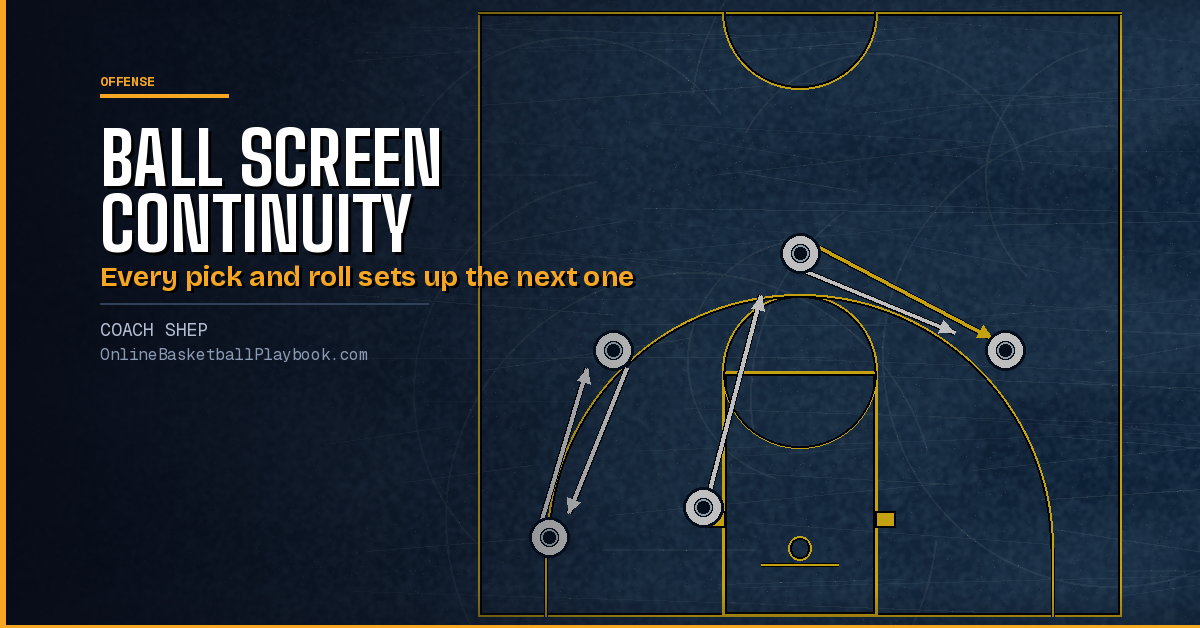
A ball screen continuity offense is a pick and roll offense in which one ball screen leads into the next by rule. The screener, the big who lifted, or the player who just passed goes straight into the next screen instead of the team resetting, and a few spacing rules keep the lane open every time. Coaches use it as a half-court base when they have a big who can roll or pop and a guard who reads coverages, as the half-court landing spot for a secondary break, and as a repeatable way to screen a zone. This guide lays out the main continuities, the rules that reload the next screen, spacing and screening angles, the handler's and screener's reads, counters by coverage, the Spain, Ram and double drag layers, transition and zone versions, the teaching orders and drills, and where coaches disagree.
What Is a Ball Screen Continuity Offense?
A pick and roll play is a single action. One screen, a read, and then a new call if nothing comes. A continuity keeps going. When the first screen produces nothing, a rule tells the players who screens next and where everyone else goes, so the defense has to guard a second and third pick and roll before it can reset. Billy Donovan's spread at Florida is built on the pick and roll, which his notes call the hardest thing in basketball to guard, and it sets ball screens in transition before the defense can set up.
There is a simpler case for building on ball screens too. Everyone knows where a ball screen will be set, which makes it easier to use than an away screen. The general vocabulary, from the roll and the pop to the slip, is on pick and roll and pick and pop. This page is about the chain.
| Piece | What it does |
|---|---|
| Base continuity | A fixed rule for who screens next: the passer follows, the lifted big sprints in, or the post follows his own pass |
| Spacing rules | Corner lifts, weak-side exchanges and a lifted big, which set where the other three players stand on each screen |
| Reads | The handler and the screener each read the coverage of this screen, not a script |
| Counters | Answers to a hedge, a trap, a switch, a defender going under, and a denied entry |
| Second-screen layers | Spain, Ram, double drag and step-up screens added on top of the base |
Spacing Rules That Keep the Lane Open
Every version treats spacing as the precondition. Donovan's spread says plainly that everything it does is based on spacing, and it gives two spacing rules.
- The double side rule. When two players are on the same side, one stays in the corner and the high one holds the sideline.
- The corner lift. When the handler uses a wing ball screen with a guard in the corner, that guard lifts into the spot the handler left and replaces him for a shot.
Its entries include 1-4 high, where the wings cross over the bigs and the point chooses a side, and 4 flat, where the 4 sets a flat ball screen to put two defenders on the ball and then pops for a shot. Other versions add their own rules.
| Version | Spacing rule |
|---|---|
| Location and spacing grid | Every ball screen is defined by where it is set (corner, wing, 45, high elbow or middle) and by how many shooters sit opposite it (an empty side, or a single, double or triple side). In EuroLeague data for 2018-19, 14.1 percent of half-court possessions were used to create shots for players not directly in the action, such as cutters and spot-up shooters. |
| Side screen version | On a wing screen the other three space in a triangle on the weak side, for the roller, a popper, a post ducking in or a kick-out |
| Mark Few | Ball screens need spacing and corners, the bigs sprint to the screen, and the player filling behind the action is as important as the handler and the screener |
| Željko Obradović | Against a switching defense, keep the 4 and 5 on the same side so the defense cannot switch big for big, and keep the corners near the line |
Spacing in general is on what is spacing in basketball.
The 4-Out Side-to-Side Continuity
The plainest chain on paper runs from a 4-out set with one post. Three things happen on every screen, and they repeat from side to side as long as the possession lasts: the passer follows his pass and sets the ball screen, the two weak-side perimeter players trade spots, and the post lifts up the lane line to the arc.

- Entry. The guard brings the ball to a wing and hits the teammate at the top of the key, who swings it on to the far wing and follows his pass to set the ball screen.
- The weak-side rule. At the same time the wing and the corner on the far side interchange, and the post lifts up the lane line to the arc.
- The screen. The handler comes off it to shoot or to hit the screener on the roll. If neither is there, he passes to the post who lifted.
- The reload. The post fakes a pass to the near wing, who cuts through to the opposite corner. The corner player comes up to fill the empty wing and takes the pass.
- The next screen. The post follows his pass and ball-screens for the new wing. The weak side interchanges again and the last screener, who rolled, lifts to the arc.


The one coaching point this version stresses is the roll. The screener pivots and opens to the ball as he rolls, rather than rolling with his back to it. It is meant to repeat until the defense makes a mistake, and the good shot can come off the very first screen. The continuity offense hub draws the same first screen beside the flex, the shuffle and the swing.
The two-post top version
Another version runs the same side-to-side idea with the posts as the passers. The guard brings the ball up, passes to a wing and cuts through to the far corner. One post slides over to the top of the key and keeps going to the wing to ball-screen for the receiver, while the other post steps out to the top of the key behind him. The handler attacks hard toward the free-throw elbow, shoots or gets to the rim if it is there, and otherwise passes to the second post at the top, who looks for the roller. If the roll is not there, that post dribbles at the opposite wing, the wing cuts backdoor on eye contact, and then the post passes to the wing and the same screen and roll runs on that side. A team with only one post runs it as a pick and pop. The screener who is not a post pops to the wing for the three instead of rolling.
The Two-Big Lift Engine
Brad Stevens's Butler package built a spread pick and roll around two bigs who keep trading jobs. On the pass to the wing, the ball-side big sprints to set the ball screen and the weak-side big sprints to a lift spot at the top of the key.

The handler comes off the screen and throws ahead to the lifted big. That big's first look is the roller. Lifting high pulls his own defender away from the rim, which can leave the rim open for a moment, especially when the roller's defender hedged.

If the roller is not open, the lifted big dribbles at the wing, throws ahead and sprints into the next ball screen, while the big who just rolled sprints out to the lift spot. The bigs have swapped jobs and the same action runs again down the floor.

Four reads share that skeleton. In the first the weak-side big lifts, as drawn. In the second he ducks in hard in front of the rim on the catch side and the screener pops. In the third the bigs mix the two jobs, one ducking in hard on a screen while the other sprints to the lift spot. The fourth is drawn with no text. The same package also runs a chain of two dribble hand-offs, covered below.
In a 1-4 high version the base action is simple. The handler dribbles to a wing, the ball-side big sprints up to screen and rolls, and the opposite big lifts to replace him. That version uses its bigs as screeners first, setting flare, back, down and ball screens, not as stationary post targets, and its 1-4 wing set reverses the ball through three passes before the next ball screen and roll.
Reload Rules: Count, Hold or Follow
The base continuities above reload by where players stand. Other versions give the screener a timing rule or a habit instead.
| Version | What reloads the next screen |
|---|---|
| Two-second count version | As the handler comes off and the ball is reversed, the screener has a two-second count to get the ball. If it does not come, he sprints into the next ball screen. A reversal to the corner triggers a shuffle screen into another ball screen. |
| Two-second count, slip variation | The screener slips the first screen, a second big comes from behind with a ball screen, and the slipper can come back to make it a double ball screen |
| One-second hold version | In the Princeton side-post version, from a side post at the elbow, the guard holds the ball for a one-second count instead of reversing it, which keys the post to sprint into a ball screen. The guard drives or pulls up, the post rolls or pins and posts low, and a switch usually leaves a size mismatch. |
| Follow-your-pass version | After any pass into the post, the post follows his own pass out and sets a ball screen, so the offense never resets. After an offensive rebound with no shot, the post kicks it out and follows to screen. |
| Wing-entry version | A wing entry leads to a sprint into a wing ball screen with a roll and a duck-in, and a kick to the spacer if nothing is there. Several entries lead into it. |

The follow-your-pass version adds two rules around the screen. On a post entry the high post dives to the block, and on a drive across the lane line the other post ducks in. Its reads then hang on that duck-in. If the screener's defender hedges hard and the other big's defender stays with the duck-in, the handler throws to the roller, and if that defender drops to the roller, the handler finds the post ducking in. The Princeton side-post version is on Princeton offense.
Re-screen rules
Sometimes the next screen is the same screen again. Stevens's rule is that the handler takes a full dribble past the first screen, using a behind-the-back dribble to change direction, so the screener has room to set it again. A quick-hitter version has the screener turn and re-screen when the defender ducks under, and the read-by-coverage version names the same idea as under and re-screen. Bad timing here has its own pitfall, covered under mistakes.
Flare, High Ball Screen, Backdoor
John Beilein's two-guard offense has a three-option unit that repeats in every series. The guards start and stay high, the wings sit at the free-throw line extended outside the arc, and the post works from the nail. The post needs at least 15-foot range so his defender has to guard him, must hit bodies on screens, and must be a good passer, but he is not expected to be a major scorer at the basket.

- Flare screen. The post sets a flare screen for the guard away from the ball, who can shoot the three or drive.
- High ball screen. This option usually comes once the defender has seen the flare several times and plays off. The ball goes to that guard and the post sets a hard high ball screen. The guard drives hard for the layup, the kick-out to the wing, or a dish to a guard who is still posting.
- Backdoor. A denied player cuts hard backdoor off the post, as close to him as possible so the defender has no room to follow. If he is not open he clears to the corner.

When all three are gone, the ball is dribbled up to the point, the wings fill and the post resets to the nail, and it starts over. The same offense runs a Shuffle series in which, after the shuffle screen and the down screen for the screener, the post sets a high ball screen and the team either resets into its Chin series or stays in Shuffle. The shuffle cut itself is on shuffle offense, and flare screen technique is on flare screen basketball.
Hand-Off Chains
Several versions get to the ball screen through a dribble hand-off, or treat the hand-off as the screen. The hand-off chain version of the 4-out continuity enters through two hand-offs before the post screens.

- The first guard passes to the other slot, who dribbles at the near wing for a hand-off while the weak side exchanges.
- The receiver comes off the hand-off and, with no shot, passes back to the far slot, who dribbles at the other wing for a second hand-off as the post lifts up the lane line.
- The post ball-screens for that player. The handler can shoot, hit the roller, or kick back to the slot for a three, while the other side exchanges.
- If nothing opens, the ball goes back out and the hand-off and ball screen sequence repeats.
| Version | How the chain runs |
|---|---|
| Pistol motion, 5-out | One player hands off to a wing and the 5 steps up to ball-screen him. If nothing opens, the ball reverses to the other side for a second hand-off, and the 5 follows into the next screen. It carries a set of named tags (backdoor, chase, down, keep, twist and others), and the first look is always to attack off the first ball screen. |
| Two-big lift package | Two dribble hand-offs in a row, then the 4 lifts. One variation has the passer screen for a guard, who comes off it for a hand-off from the big. |
| Hand-off as the screen | The dribble hand-off is treated as a faster pick and roll that is harder to switch |
More on the action itself is on DHO basketball and on 5-out spacing on 5-out motion offense.
Screen Angle and Footwork
A chain is only as good as each screen in it. Coaches describe the angle in several ways.
| Version | Angle rule |
|---|---|
| Brad Stevens | Set the screen east and west, a flat surface that gives the handler room to come off. A north and south angle narrows the handler's path and helps the defender recover. |
| Back-hip version | Screen the on-ball defender's back hip with the screener's back to the corner, not the sideline, so the defender cannot slide under. This version calls the angle the most overlooked detail. |
| Late-angle version | The screener sprints in starting with his head under the rim and changes the angle late, so the defense cannot tell which side the screen will be on. A flat high screen is set outside the three-point line, a traditional one with the foot touching it, a banana screen comes through the elbow, and a hat pick is a side screen with the screener's back to the baseline. |
| Mark Few | Run both the regular screen, chest to the sideline, and the flat screen |
| Billy Donovan's Florida staff | On the flat screen the screener's shoulders face half court, and which big sets it is chosen from the matchups. If a big has poor feet against ball screens, the player he guards sets the screen. |
Screening fundamentals add that a screen set too high lets the defender slide behind it and one set too low lets him fight over. The handler's footwork rules line up across versions.
- Wait for the screen. Impatience is named as the main cause of illegal screens, a moving-screen call and a dead action at once.
- Set the defender up. Fake one way to go the other, and come off shoulder to shoulder with the screener.
- Two dribbles. The side screen version makes it the rule for every play. At least two dribbles past the screen, or the help defender can guard both the handler and the pass back to the screener. The late-angle version wants those two dribbles north and south, chest to the basket.
- The first pass. Few says the first pass off the screen is a catch-and-shoot or a quick swing, not a dribble.
- The screener after contact. One version has the screener seal his defender and end facing the ball, and another says he must pop, roll or screen again rather than stand still.
Screening technique in general is on basketball screening technique.
Handler and Screener Reads
Donovan's spread gives the handler a progression and the screener one automatic read.
| Player | Read |
|---|---|
| Handler, first | Attack the rim north and south |
| Handler, second | Hit the open man off the screen, reading whether the screener's defender is showing or back |
| Handler, third | If the far post's defender hugs his man, the roll is open. If he cheats toward the roll, hit the duck-in. |
| Screener | If his defender goes high to hedge and he loses sight of him, slip automatically |
The slip is automatic when the screener's defender goes high to hedge. The Princeton side-post version puts the screener's reads in one line, screen and read. Slip if the defender hedges, pop if he goes under, back-cut if he fights over. The handler's side is covered in depth on reading ball screens in basketball.
Roller or popper first?
Versions disagree on where the ball should go after the screen. In the two-big lift engine and the two-post top version, the lifted big at the top looks for the roller first. Donovan's Florida staff rarely wants the guard passing to the roller because it is a hard pass, and prefers the post who sprints out to make a high-low pass. On that staff certain players always roll and certain players always pop, chosen by their skills, and the roller waits until the guard is completely off the screen, opens up, and rolls diagonally to the low block without taking his eyes off the ball.
Counters by Coverage
A continuity keeps attacking the same coverage, so it needs an answer for each. The rows below show each version's answer. More detail on each coverage is on how to attack every ball screen coverage.
| Coverage | Version | Answer |
|---|---|---|
| Hard hedge | Donovan spread, screen-and-read version, two-post top version | The screener slips |
| Hard hedge | Željko Obradović | Short roll, then a cutter must cut |
| Hard hedge | Brad Stevens | Split by firing the dribble back toward the screener, or hesitate and go to freeze the hedger. Against a dragging hedge, attack the hedge man's outside shoulder, drag him, then rip and pass back as the screener opens to the ball. |
| Hard hedge | Slip-the-second-screen counter | The second screener slips instead of rolling and cuts to the rim for a lob off the handler's hesitation dribble |
| Trap | Retreat-dribble version | The handler takes two retreat dribbles and the screener short-rolls one step to play 4 on 3 |
| Trap | Two-post top version | The handler takes two or three dribbles to make space while one post steps in behind the ball and the other steps to the middle near the free-throw line |
| Full blitz | Billy Donovan's Florida staff | Keep the dribble alive to draw both defenders while the low big flashes to the free-throw line for a 4 on 3 |
| Switch | Željko Obradović | Attack the mismatch. Run the pick and roll at the smaller defender, or post the small one |
| Switch | Donovan spread | On a switch the 4 posts up the smaller defender and the 5 goes high for a high-low pass. If that fails, the 5 sets the pick and roll so the switched guard stays on the 4 all possession. |
| Switch | Read-by-coverage version | The handler attacks the screener's defender off the dribble, and on a high screen the screener rolls to the post for spacing, not to catch |
| Under | Željko Obradović | Keep attacking and run it again until they guard it |
| Under | Billy Donovan's Florida staff | The guard steps back for the open three while the big sets the screen straddling the three-point line |
| Under | Read-by-coverage version | Race to the rim with no more than two dribbles, or have the screener re-screen |
| Early jump under | Brad Stevens | The screener loops behind the handler to the wing for a kick-out |
| Denied entry | Two-post top version | A denied pass to the wing becomes a dribble hand-off, and a denied pass at the top lets the post slide down and set the screen |
| Sag on the roll | Two-post top version | A skip pass to the corner for a three |
Two points stay disputed. On splitting a hard hedge, the read-by-coverage version and an early-hedge version both split when the handler sees daylight between the hedger and the screener, while Mark Few teaches a pivot instead of splitting a high hedge. And the read-by-coverage version lists separate reads for a defense that forces the ball to one side, from a split to a pocket jumper. Splitting is on how to split a ball screen, and the hedge itself on hedge basketball.
Get the next coaching guide in your inbox
One email when a new guide or diagram set goes up. Free.
Second-Screen Layers: Spain, Ram, Double Drag
Once the base chain runs, a second screen can be stacked into the same possession. Four layers are below.
Spain

A big sets the ball screen in the middle of the floor and rolls. Only as he rolls does a shooter back-screen the roller's defender and then pop to the arc, so the defense has to solve the ball screen and the screen on the screener at the same time. If the screener's defender leaves to help on the ball, the shooter skips the back screen and just pops for the catch and shoot. The handler can pull up, go all the way, hit the roller, hit the popping shooter or throw to the corner. National teams at the Paris Olympics ran Spain in out-of-bounds packages, and one of those Spain sets is noted as too complex for less experienced teams.
Ram

A guard screens down on the big, who comes up with a step on his man to set the ball screen. An NBA Ram High set runs it plainly after a guard to guard pass. The Paris Olympic sets use the Ram screen to stop the defense from hedging or blitzing as easily, set by a wing in one team's set, by a post in another, and off a down screen in a third. A related set pairs a down screen with a decoy cross screen so the defense cannot hard-hedge the ball screen.
Double drag and step-up

Two bigs set staggered drag screens for the handler crossing the floor. The roles are fixed. In one version the first drag screener rolls and the second pops, and in a Horns-family early-offense set the 5 rolls and the 4 pops while the wings drop to the corners. Six of the twelve national teams in one collection of Paris Olympic sets ran double drag in their half-court sets.
Larry Brown's SMU shooting drills run the drag screen and the step-up screen as separate drills. In the drag drill the handler hits the roller for a layup and the coach passes back to the handler for a midrange shot. In the step-up drill the handler hits the screener on the short roll for a shot and the coach passes back to the handler for a three. One version sets the step-up from the ball-side post to send the handler toward the baseline.
Other stacks name the second screen in the sequence. Geno Auriemma's Strong set runs a high ball screen, then a corner ball screen when the ball goes down to the relocated corner. Elbow pick and rolls can put a big at each elbow so the handler can go either way, then swing to a high-low read once the popping post catches on top.
Getting Into It From the Break
Several versions make the secondary break the on-ramp, so the first ball screen comes before the defense is set.
| Version | How the break flows into the screen |
|---|---|
| Billy Donovan | A ball screen or a double ball screen comes in transition before the defense can set up. If the point has nothing, he hits the trailing 4, who can shoot, drive or kick, and if nothing is open the half-court pick and roll motion starts. |
| Hit-ahead version | The point hits ahead to the wing and shuffle-cuts to the far wing, the ball reverses, a cross screen and a down screen follow, and the 5 sprints into a side pick and roll. The 5 rolls and a shooter lifts behind the roll. Each denial has a counter: a dribble at the wing that flips the action to the other side, a backdoor, or a dribble hand-off. |
| Ettore Messina | Lanes are assigned before the ball screen. One pattern has the guard drive while the 5 sets a trail ball screen and rolls, and another frees the guard with a down screen and a back screen into the ball screen. |
| Middle-screen version | Transition screens come in go, drag and double versions, and this team prefers to set them in the middle of the floor and not on the wing |
| Early drag version | Early drag, early dribble-drag with a hand-off first, and early double drag with one screener rolling and one popping to the elbow |
The hit-ahead version leans on a Larry Brown question for its counters. What is the counter to this, and what if they take it away? More on early offense is on secondary break basketball and early offense basketball.
The dissent: no ball screen off a miss
Dan Hurley runs a three-on-three transition drill with the opposite rule. On a miss or a turnover the offense may not screen. It blasts the ball ahead, attacks the paint, drives and kicks, with seven seconds on the clock and only threes and layups counting. His stated reason is that guards now lean on the drag ball screen so much that they are not winning one on one ahead of the ball, and he calls it a crutch. Structure comes only after a made basket: a pistol, a wide pin, a key catch and a dribble hand-off game. He also mentions a pitch back into a step-up in the same drill.
Ball Screen Continuity Against a Zone
Jamie Dixon's Pitt teams attacked a 2-3 zone by ball-screening one of the top two defenders, sealing him and cutting inside for the pass.

- From a 1-3-1 with a post at the high post, the ball swings to a wing and the top defender closes out. The high post ball-screens him.
- The ball goes back to the top, and the screener seals the screened defender and cuts inside for the pass. He can shoot, take one dribble for a jumper, pass inside to the low post, or kick out to the far wing.
- If the pass does not come, he floats down the ball-side lane line to the block as the ball swings, and the opposite post X-cuts up to the ball-side elbow.
- That post now ball-screens and seals on the other side, and the action cycles from side to side.
The stated purpose is getting the ball inside: higher-percentage shots, foul trouble for the zone's bigs and trips to the free-throw line, instead of settling for outside shots all game. Other zone versions keep the ball screen too.
- Željko Obradović runs the same pick and roll actions against a 2-3, a 3-2, a matchup zone or man, and names the player at the free-throw line as the key man, who must be looked for.
- Two screens in a row. A 2-3 zone version has the ball handler use high screens from two bigs in a row and drive hard off the second to draw the forward, while the first screener rolls to the short corner.
- Ettore Messina has a zone pattern that moves the ball into a cut through the middle of the lane and then ball-screens the zone.
More zone attacks are on how to beat a 2-3 zone.
How Teams Teach It
Four sources give an order or a routine for installing ball screen play.
- The decision ladder. One progression runs four steps at each player count: the skill with no defense, then a coach stepping in as the defender, then a controlled advantage (2 on 1, 3 on 2, 4 on 3), then a full game situation. It repeats the loop from one player up to four, then runs the whole unit 5 on 5. Its standard for the handler is the fewest dribbles before a pass or a shot, and it argues that the three players away from the ball are part of the action because they keep help defenders from helping.
- Same reads, same order, every day. The read-by-coverage version drills its named reads in the same order with the same short verbal commands each day, with defense in the drill, and uses the first weeks to explain the whole philosophy.
- Build the parts. The follow-your-pass version splits its offense into build-up drills: a screen and a duck-in, a down screen and a slip, a screen and pop into a duck-in, a continuous pick and pop, and a post feed drill.
- Breakdown drills from the base. The two-post top version breaks its continuity into a post to wing backdoor, a dribble hand-off, a pick and roll, a pick and pop, a flare slip screen, a perimeter flare screen and a skip pass against a sagging defense. The first two double as pregame warm-ups in that version.
Ball Screen Continuity Drills
| Drill | How it runs |
|---|---|
| Five-finish progression (Jamie Dixon) | A post on each block and a guard on each wing, sides alternating every rep. The post passes to the far wing, follows his pass, screens and rolls straight to the rim. Then the same action four more ways: a short roll with a step-through, a short roll with a jump shot, a fake screen and slip, and a pick and pop for a three. |
| Team ball screen drill | Guards with balls in a line on the wing, posts on the opposite block and a coach at the top of the key. A post sprints up to set an angled screen, the guard shoots, drives or hits the post rolling or spacing, the coach passes to whoever did not shoot, and both rebound. The coach can call the screen type and roll or pop in advance, and two groups can run it at both ends. |
| 2 on 2 ball screen game | Quarter court, every possession starts with a ball screen, no switching, make it take it |
| Ball-screen practice | Two lines and one on-ball defender. The dribbler reads with no help and the screener pops for a second ball from the coach, then a second defender is added. |
| Drag and step-up shooting (Larry Brown) | A handler pushes and a screener sets a drag screen. The handler hits the roller for a layup, then takes his own midrange shot off the coach's pass. Then a step-up screen, with the short roll shot and then the three back to the handler. |
The team ball screen drill comes with a practice-planning rule that keeps skill segments to 15 to 20 minutes at game speed. More drills are on pick and roll basketball drills and drills to teach ball screen continuity offense.
Mistakes That Stall the Chain
- A north and south screen. Stevens says it narrows the handler's path and lets the defender recover.
- Using the screen early or leaving it early. A handler who goes before the screen is set, or a screener who leaves before the guard turns the corner, gets a moving-screen call and a broken action. Another version adds teammates who fail to clear, so their defenders slide over.
- Too few dribbles. Fewer than two past the screen lets one help defender guard two players.
- Re-screening too soon. Stevens wants a full dribble past the first screen before the screener sets it again.
- Starting late. A callable-play version says never to start a high ball-screen play with less than 7 to 8 seconds on the clock.
- Leaning on it. Dan Hurley calls the drag screen a crutch for guards who stop winning one on one.
Who It Fits and Where Coaches Disagree
The personnel each version asks for:
- Donovan spread. A 4 who can shoot, which Donovan says creates many offensive chances, and screeners who sprint back into the play after every screen.
- Two-big lift engine. Two bigs who can both screen, roll and lift.
- Beilein unit. A post with at least 15-foot range who hits bodies on screens and passes.
- Two-post top version. A team that can pass, dribble and shoot, and a pick and pop answer for a roster with one post.
- Obradović spread. Every perimeter player must shoot the three.
- Florida staff. A big who shoots well or puts the ball down suits the pick and pop, and a big who scores only in the paint suits the pick and roll.
Not everyone wants more ball screens. Pablo Laso argues the game has become too pick-and-roll centered, says the pick and roll is the easiest thing for a coach, and wants young players to learn screening, moving without the ball and posting up before they learn it. The drive-and-space view holds that once a flare screen gives you the advantage, you need space, not more screens. Obradović runs the same action again until the defense guards it, and the continuities on this page keep screening. Both views are on the site. Off-ball screening is on drills to teach off-ball screens, and the other continuities, from the flex offense to the shuffle, are on the continuity offense hub. The defensive side of this page is on how to defend ball screen continuity and how to defend pick and roll.
Questions Coaches Ask About Ball Screen Continuity Offense
What is a ball screen continuity offense?
A pick and roll offense in which one ball screen leads into the next by rule. The passer, the lifted big or the post who just passed sets the next screen, and spacing rules such as a weak-side exchange and a post lift keep the lane open, so the team does not reset after each screen.
What is the difference between a pick and roll play and a pick and roll offense?
A play is one screen and a read. A pick and roll offense, or continuity, has a rule for what happens after that screen, so a second and third screen follow without a new call.
How do you run a ball screen offense with only one big?
The 4-out side-to-side version uses one post who lifts and screens in turn with the perimeter passers. The two-post top version can run as a pick and pop, with the screener who is not a post popping to the wing for a three instead of rolling.
Does a ball screen continuity work against a zone?
Yes, in several versions. Jamie Dixon's Pitt teams ball-screened a top defender of a 2-3 zone, sealed him and cut inside, then repeated it from the other elbow. Željko Obradović runs the same actions against zone and man.
What is a Spain pick and roll?
A ball screen in the middle of the floor where, as the screener rolls, a shooter back-screens the roller's defender and then pops to the arc. If the screener's defender hedges, the shooter skips the back screen and pops.
What is a Ram screen?
A screen for the screener before the ball screen. A guard screens down on the big, who comes up with a step on his defender to set the ball screen.
Should you use a ball screen in transition after a miss?
Coaches disagree. Billy Donovan, Ettore Messina and the hit-ahead version get into a ball screen early, while Dan Hurley's transition drill bans screens after a miss or a turnover and allows structure only after a made basket.
Want every diagram on the site?
OBP Pro members get the full diagram files for every guide on the site, ready for a practice binder or a scouting report. $9 a month. Or draw your own version free in the play drawer.
See what OBP Pro includesMore Continuity Offense Guides
- Flex Offense Basketball: Cuts, Sets, Counters and Drills
- Flex Basketball Plays: Specials, Counters and Named Sets
- Shuffle Offense Basketball: Shuffle Cut, Rotation and Counters
- UCLA Offense Basketball: UCLA Cut, High Post Series and Counters
Back to Continuity Offense and every Offense page.
Keep Building
Related breakdowns
Pick and Roll Basketball Drills: From 2 on 0 to Live Reads
Pick and roll basketball drills that teach the action in order: a 2 on 0 screener series, chair reads, advantage drills, live coverage drills and youth steps.
Continuity Offense Basketball: Types, Rules and How They Work
Continuity offense basketball explained: what a continuity is, how it differs from motion and set plays, the main continuities, shared rules and trade-offs.
High Low Offense Basketball: Reads, Counters and Zone Rules
High low offense basketball explained: the two-post shell, the lob and bounce reads, answers to a front, down-screen reads, 1-4 low sets and the hi-lo against zones.