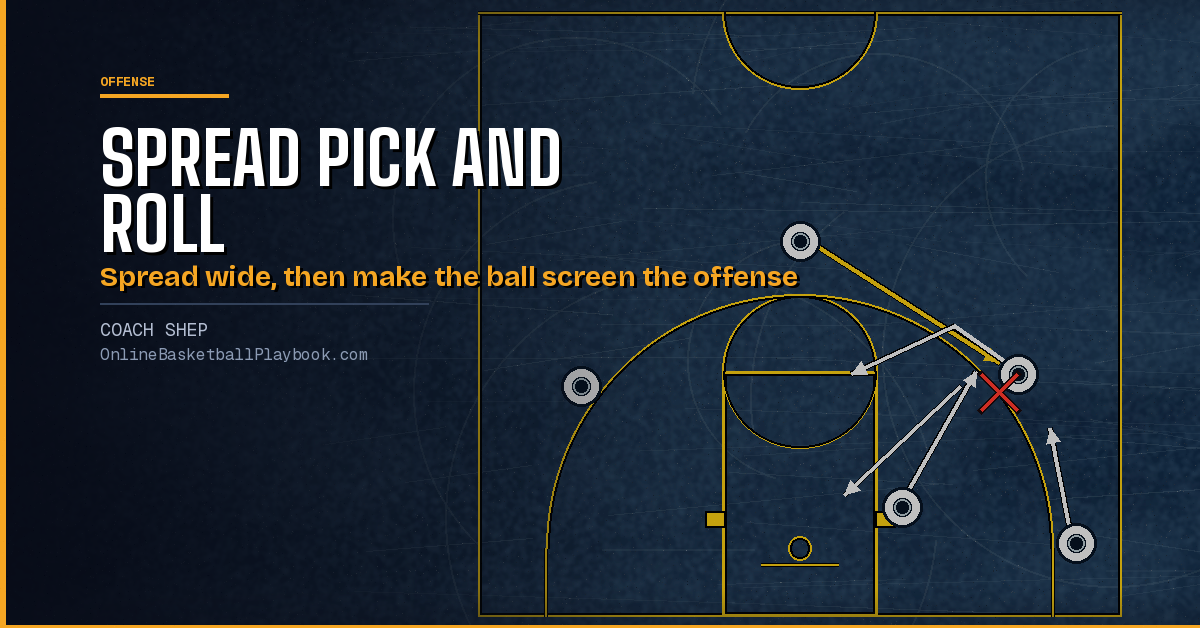
The spread pick and roll offense is Billy Donovan's Florida offense run as a continuity: the floor is spread as wide as it goes, and the ball screen keeps coming until the defense breaks. The alignments, the spacing rules and the other offenses that share the word spread are laid out on spread offense basketball, and the general screen-and-roll reads are on pick and roll. This page stays on the ball-screen system itself: how a possession gets from the break into the first screen, how the screen is angled, what happens on the second side, how the flat screen works, and the counters Florida drew for traps, switches and blitzes.
What the Spread Pick and Roll Offense Is
Donovan calls the pick and roll the hardest thing in basketball to guard, and he says everything Florida does is based on spacing and on how its pick and rolls are spaced. He also says he gives up a lot of control on purpose. He wants freedom, creativity and an offense that is hard to scout, so once the ball crosses half court and transition is over, the players flow and play.
The structure under that freedom is short. The ball reverses, a big sprints out and sets a ball screen, the corner lifts, and if nothing comes the ball swings to the other side for the next screen. The broader picture of offenses that repeat ball screens is on ball screen continuity offense.
From the Break to the Trail Pass
The offense starts on the break, and Donovan's transition rules set up the first screen.
- The 4 inbounds. He takes the ball out of the net and gets it in quickly.
- The wings run wide. The 2 and the 3 sprint wide and get at least to the first lane marker extended. If both end up on the same side, the second one yells push and sends the first wing through to the other side.
- The 5 runs the middle. He sprints to the middle of the lane and seals his man.
- The middle stays open. The point guard needs the lane to attack off the dribble.
Florida wants the ball over half court fast after a make. In practice, a ball that is not across half court in four seconds is an automatic turnover. Notes from his 2009 clinic talk give three seconds.

The point guard attacks early. If he has nothing, he hits the 4 trailing the play, and the 4 can shoot, drive or kick. Florida's rule is that transition is over when the 1 passes to the 4, and the 1 always clears to the opposite corner. Early-offense actions in general are on early offense basketball.
The Wing Ball Screen on the Reversal
The 4 looks to pass to the 2 on the wing. If the 2 is denied, he cuts through backdoor and fills the corner on the same side. If he is not denied, the ball reverses from the 4 to the 2, and the reversal is the trigger for the screen.

- The angle. The 5 sprints out from the post and sets the screen on X2, and Donovan says the angle is the key. He wants it set almost like a back screen on X2, so the defense is forced to go over the top.
- The lift. Any time the ball is screened on the wing with a guard in the corner, that guard lifts into the spot the ball handler left and is ready to shoot.
- The roll. The 5 sprints to the rim and never loses sight of the ball. He does not turn his back on it.
- The 4's choices. Usually by flow, not by call, the 4 can follow the 5 for a double ball screen, dive to the short corner, or space to the opposite wing so the screen has a spread side to attack.
The roller's and popper's footwork, the second big's post-up and Florida's preference for the high-low pass over the hard pass to the roller are covered on spread offense basketball.
The Second Side: Standard, Slip or Shallow
If the first screen gives nothing, the ball swings across to the 4 and he reverses it to the 3 on the other wing. Now the 4 has three choices off his own screen for the 3.
| Choice | What the 4 does | When |
|---|---|---|
| Standard | Sets the ball screen and plays the pick and roll | The base option |
| Slip | Slips to the rim before the screen lands | Automatic if he loses sight of his defender and his defender went high to hedge |
| Shallow cut | Takes one step toward the 3, then sprints to the short corner, and the 3 dribbles hard off his back | Option 3 |

On a slip or a shallow cut, X5 will most likely show, so on the reversal the 5 hard-ducks and seals his man inside. The 1, in the corner on the far side, looks to shoot or dump the ball inside. Donovan's rule is that the 1 never gets a wing ball screen in this sequence. If nothing is open, he passes to the corner and cuts through to the opposite corner, the 2 dribbles up, and the 5 steps up to set a ball screen. The key there is the 4 replacing underneath to the wing. Most big men switch big to big on that action, and the replace puts them in a hard spot.
The Flat Screen and Two on the Ball
The second way Florida runs it starts high. The players start extremely spread out, and the 4 comes out as a flat screener for the 1. Donovan likes the flat ball screen for two reasons he gives himself: the defense has to go a long way under it to get through, and if the defense overplays the screen it is easy to change the angle on them.

- How far the 4 comes out. Where the 1's defender is decides it. The 4 must give the 1 at least one step to make a move off the screen.
- Why it helps. The flat screener is a pressure release for the point guard.
- The goal. The 4 picks where to screen so the 1 gets two defenders on the ball, then the ball is pitched back to the 4.
- The 4 attacks. He attacks the three-point line in a pick and pop or attacks the basket. Someone will stop him, and he passes to where the help came from.
The two bans that go with the pitch back, the alley between the elbows, the flat-screen setup and its first read are on the spread offense guide. Two more reads come off the same setup. If the screener's defender backs into the lane, the ball goes back to the big stepping out and straight into a wing ball screen, and on a switch the offense attacks inside where a big has a smaller man on him.
Entries That Start the Same Screen
Florida's sets give several ways into the same two-man game. Each is named by how it lines up.
| Entry | How it runs |
|---|---|
| Drag | A ball screen in transition before the defense can set up |
| Double drag | Two ball screens in transition before the defense can set up |
| Trail man | The 1 attacks early, then hits the 4 trailing, who can shoot, drive or kick. If nothing is open, the half-court pick and roll motion starts |
| 4 Flat, flat screen | The 4 sets a flat screen for the 1 to get two defenders on the ball and pops for a shot |
| 4 Flat, step-up | The 5 steps up and sets the flat screen, rolls, and the 4 replaces. Florida calls it one of the hardest actions to guard |
| 1-4 High | The 2 and 3 cross and sprint over the 4 and 5 to the wings, the 1 picks a side, the 5 screens for the 2 on the wing and rolls, and the 4 pops to the middle |
| 1-4 High, second side | On the reversal the 1 cuts through, the 3 dribbles up, and the 4 screens for him with the same three choices: screen, slip to the baseline or shallow cut |
| Wing | The spread pick and roll on the wing with the 4 lifted to the opposite wing |
| Double high | The 4 screens the 5's man, then the two set a double high ball screen. The 5 dives and the 4 pops to the top of the key |
Donovan adds one personnel note. If a team has two forwards who are not skilled, he runs a lot of ball screens into a pin down for a shooter. The drag and step-up screens are drawn on pace and space offense, which runs from the same early looks.
Get the next coaching guide in your inbox
One email when a new guide or diagram set goes up. Free.
Counters by Coverage
Donovan names three ways teams defend the pick and roll: a hard show or trap, a switch, or backing off and going under to keep the ball out of the lane. Teams that scout Florida see at least two ways it screens, and his point is that the offense needs actions inside the pick and roll that punish whatever coverage it gets.

| Coverage | Florida's counter |
|---|---|
| Switch on the 1 and 4 | The 4 posts up. To keep help off the back side, the 5 goes high for a high-low pass. If that does not work, the 5 sets the pick and roll and the offense keeps X3 on the 4 for the whole possession to hold the mismatch |
| Trap or hard show | The easiest way to get a show is to know it is coming, so run the action to draw it. The 5 has two options: screen the inside man for the 2, or come behind the 4 for a slip and a reversal. The bigs must know when to slip and when to set the screen |
| Hard jump-out (blitz) | Make the opponent's big guard a screen before the pick and roll. Look for the 1 on the lob. Run roll and replace |
| The 4's defender stays home | Still run it. The 1 hits the 4, and the 4 hits the ball-side guard straight into a wing pick and roll |
Florida's wing reads against the half blitz, the full blitz and the switch are laid out on spread offense basketball. Two more complete the set. When the defender goes under, the guard steps back for the open three while the big sets the screen straddling the three-point line. Against a flat big, the guard goes right at him to force him to contain.
Donovan's rule once someone is open is that the defense does not get back into the play. Make them pay. How defenses choose a coverage is on how to defend the pick and roll, and every coverage answer side by side is on how to attack every ball screen coverage.
The Guard's Order Off the Screen
The point guard's progression coming off the screen is short:
- Attack the rim, north and south.
- Hit the open man off the screen. Read the screener's defender: is he showing or is he back?
- Read the opposite post's defender. If he hugs his man, the roll is open. If he cheats toward the roll, look at the duck-in.
Donovan wants the guard to take two dribbles to clear the screen, then either throw back or penetrate and pitch. The point guard must also use the screen well and rub his man off it. Florida's general guard rules off the ball screen are on the same spread offense page. Two rules cover the screener after his job is done: he sprints into an area so he is part of the next action, and he gets back into the play fast. Guard drills for these reads are on pick and roll drills for guards.
Building It in Practice
Florida's ball-screen teaching ends with a shooting drill built on the same action. Players 1, 2, 3 and 5 work with a coach. The 1 comes off a ball screen from the 5 and can attack the basket, hit the 5 rolling, or hit the 2 on the loop, and the 1 spots in the opposite corner for a pass from the 3. It is run again against a hard hedge, a switch and a double trap.
Donovan practices transition offense every day, and his teaching points for the offense are shot selection, individual improvement and spacing technique. He asks his offense one question: how do we create closeouts? The more the defense has to close out, the better the chance of getting to the paint. He adds that a 4 who can shoot creates a lot of chances for a team. More team drills for the two-man game are on drills to teach ball screen offense.
Who It Fits
Donovan's notes call for versatile bigs who can screen and shoot. Donovan lists what makes it hard to guard: getting back in transition and matching up, closing out again and again, getting broken down off the dribble, and paying for every scramble. He says it is a point A to point B offense, so players have to read and play, and the coach has to know his personnel and how each one performs in it. Good shooting teams create good spacing, in his words, and a shooting team has to get the ball going toward the basket to draw two defenders.
He gives players freedom, and he says the freedom comes with responsibility. Close relatives with the same empty middle are dribble drive motion offense, which starts with a drive instead of a screen, and drive and space offense. Every system is on the basketball offense guide.
Questions Coaches Ask About the Spread Pick and Roll Offense
What is a spread pick and roll offense?
An offense that spreads all five players wide and runs the ball screen as the system, not as a called play. Billy Donovan's Florida version reverses the ball into a wing screen, swings to a second screen on the other side, and uses a flat screen up top to put two defenders on the ball.
When does the pick and roll start in Donovan's offense?
Transition is over when the point guard passes to the trailing 4 and clears to the opposite corner. The first screen comes on the reversal, when the 5 sprints out from the post to screen for the wing.
What is a flat ball screen?
A screen set with the screener's shoulders facing half court, so the guard can come off either way. In Donovan's offense the 4 sets it for the point guard, gives him at least one step, and gets the ball back on a pitch when two defenders go to the ball.
What is a shallow cut off a ball screen?
The screener takes one step toward the ball handler as if to screen, then sprints to the short corner, and the ball handler dribbles hard off his back. It is one of three choices the 4 has on the second-side screen.
Want every diagram on the site?
OBP Pro members get the full diagram files for every offense guide on the site, ready for a practice binder or a scouting report. $9 a month. Or draw your own version free in the play drawer.
See what OBP Pro includesMore Offense System Guides
- Princeton Chin Series: 4 Ways Coaches Run the Chin Offense
- Princeton Point Series: Over, Away and Under Reads
- Princeton Low Post Series: Splits, Screens and the Laker Cut
- Backdoor Triggers and Backdoor Plays in Basketball
Back to Basketball Offense and every Offense page.
Keep Building
Related breakdowns
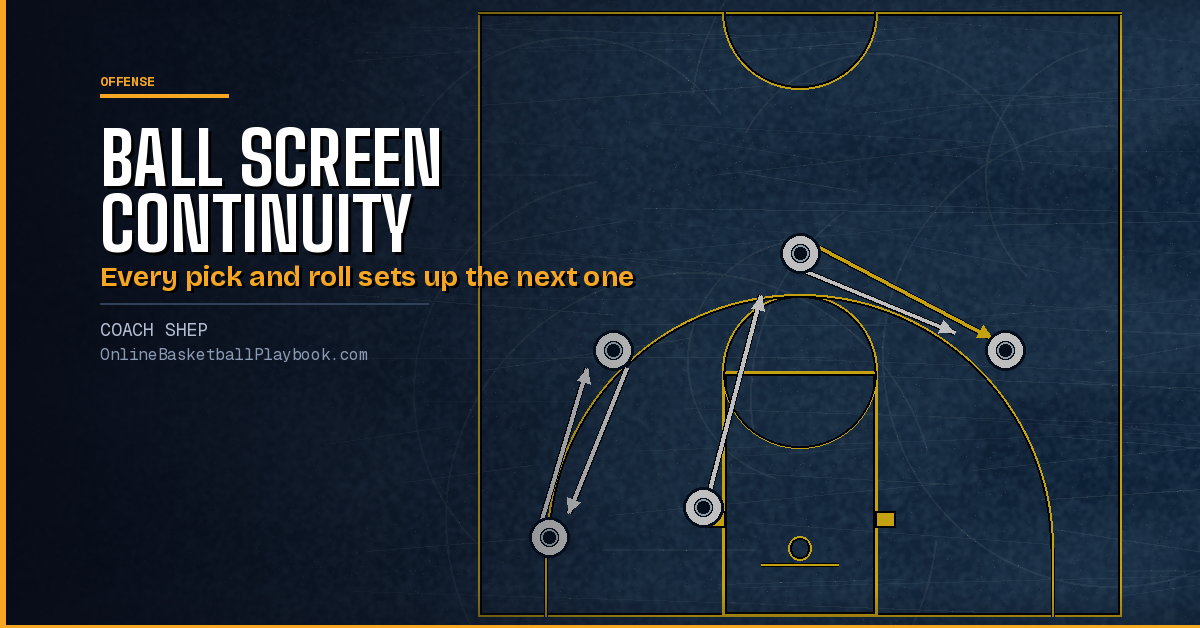
Ball Screen Continuity Offense: Pick and Roll Rules and Reads
Ball screen continuity offense in full: the 4-out and two-big engines, reload rules, spacing, angles, reads, counters, Spain, Ram, double drag and zone versions.
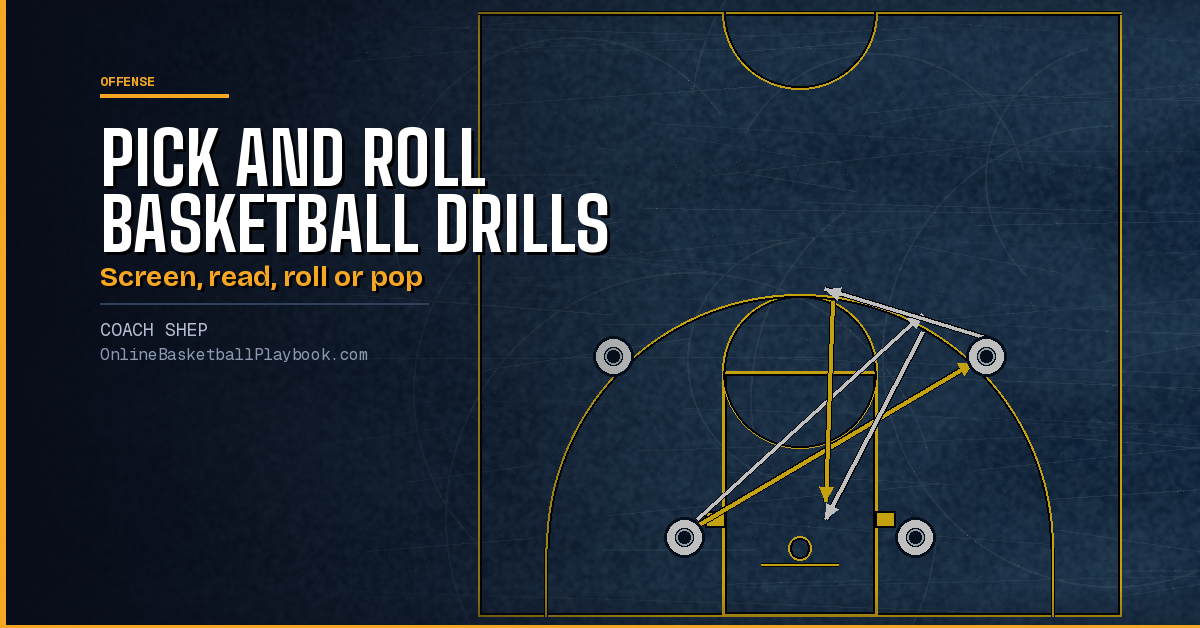
Pick and Roll Basketball Drills: From 2 on 0 to Live Reads
Pick and roll basketball drills that teach the action in order: a 2 on 0 screener series, chair reads, advantage drills, live coverage drills and youth steps.
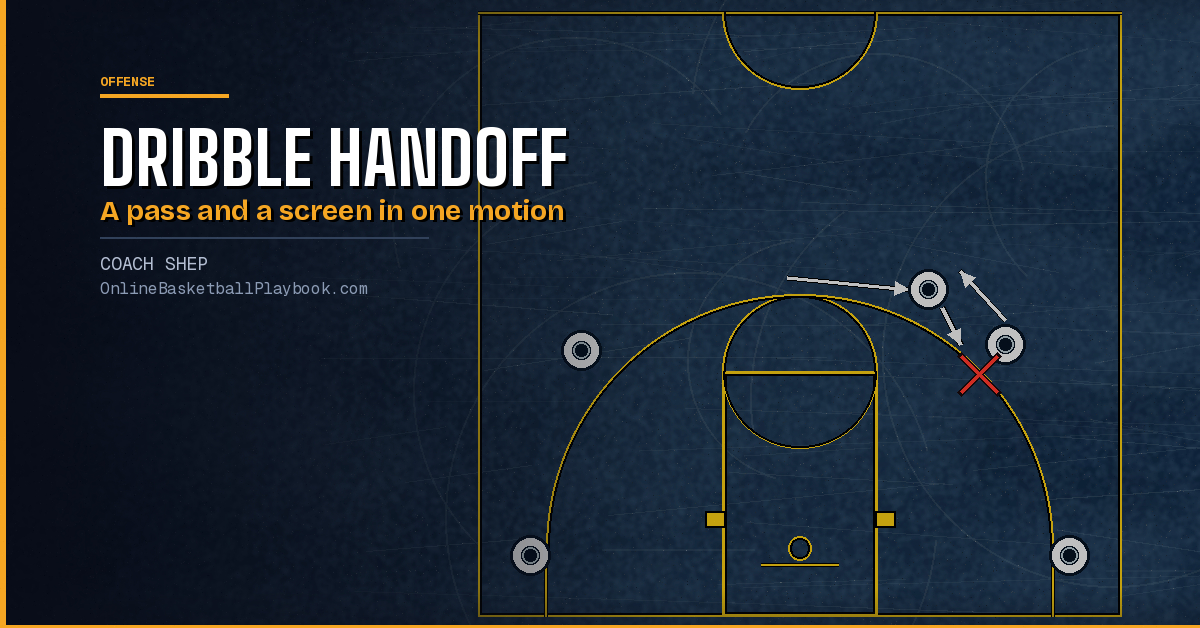
Dribble Handoff: Types, Reads, Counters and How to Defend It
The dribble handoff in basketball: the types of handoff, how the giver delivers it, the reads for both players, the counters, and how defenses guard the DHO.