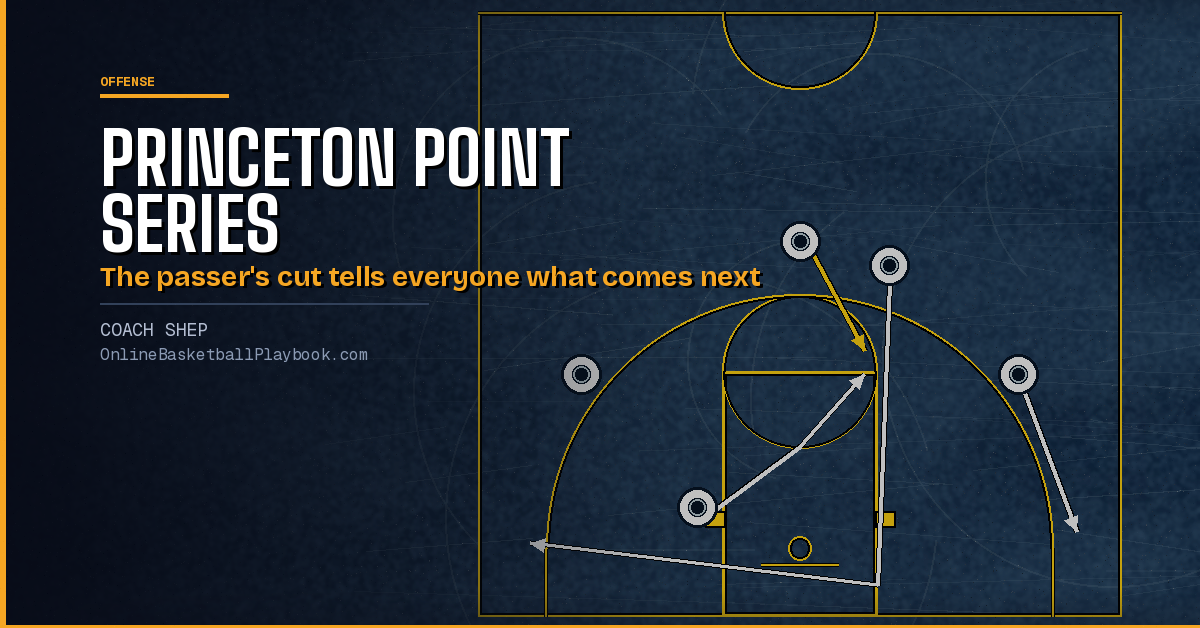
The Princeton Point series starts when the ball goes to the post at the elbow. The passer then cuts one of three ways, over the top of the ball, away from it or under it, and that cut tells the other four players what comes next. There is no call from the bench. The series is also known as OUA, for Over, Under and Away, and in some installs as Wave, because the guard waves his partner through to start it. The Princeton offense hub covers why Pete Carril played through the high post and gives the three cuts in a paragraph. This page goes through the entry and each cut in order, the options behind them, the counter when the post is denied, and a second way coaches run the series.
What the Point Series Is
It is the high-post set of the Princeton offense. The 5 catches at the elbow, and the passer's cut keys one of three actions. Over and Away each bring a backdoor and a ball screen, Under brings a screen-in and a post-up, and each has its own way back into the rest of the offense. In the six-set version of the offense the Point series sits fourth, after Chin, 5 Out and Low, and those sets feed it:
- From 5 Out. A dribble to the top keys Chin. A pass to the top keys Point.
- From the wing. A wing with the ball has three options any time: post open means Low, pass up means Point, no option means dribble up into Chin.
- From Chin. As a set call, or as a counter when the 2 is overplayed in Chin, the guard waves the 2 through and the team is in Point.
- From the post. A post who can pass dribbles up the lane line, the wing above him cuts backdoor, and if nothing opens he passes to the top and re-posts at the elbow for the return pass.
- From Circle. On the guard-to-guard pass, the 1 runs through the elbow and on to the corner, and the 5 follows right behind him into the elbow.
Getting the Ball to the Elbow

The guard waves the 2 through. The 2 runs through the elbow while the 5 crosses to the far block and comes up to that elbow, and the 2's cut works as a brush screen to get the 5 open there. As the 2 cuts through, the 4 drops to the corner to protect against a blindside steal. The ball goes to the 5 at the elbow and the read is on.
Two details set up the cuts that follow. The 1 must not be in the corner when he catches a return pass from the 5. And the forward who drops to the corner is the player the Over cut works with, while the player on the far wing is the one the Away cut works with. The post's passing job is on post play in basketball.
Over: Fake Screen, Backdoor, Side Ball Screen
Once the 5 has the ball, the 1 goes above him, toward the 4 in the corner, as if he will screen for him.

The 4 sets up the backdoor by moving toward the 1 first, then cuts behind his defender for the pass from the 5 and the layup. If it is not there, he finishes his cut to the rim. The 1 pops back out for a pass from the 5, and if he is denied he goes backdoor too. As this happens, the 3 moves above the weak-side elbow, both to screen for the 4 and to see how the defense will play the side pick and roll that comes next.

The 1 attacks off the 5's side ball screen and the 5 rolls, while the 3 down-screens for the 4 cutting to the top. The order for the 1 is a layup, then the 5 rolling, then the 4 near the top of the key. Pick and roll reads in general are on pick and roll.
| What happens | Answer |
|---|---|
| The defense traps the ball screen | The 1 strings the trap out by dribbling higher and pulling both defenders away. The 3 reads the trap and races up to the top of the key to get the ball, the 5 rolls, and the 3 passes straight to the 5 for the layup. It only works if the 3 cuts up for the ball |
| X1 plays too high, waiting for the screen | The 1 can drive the baseline for the layup. Show the baseline with a hard dribble first, then cross over into the screen. Not every time, only enough to keep X1 honest |
| Nothing open and no trap | The 1 dribbles up to the guard spot. The 4 comes off the 3's down screen for the pass, the 2 fills the wing, and the 5 has rolled to the basket |
What follows depends on the personnel version. In the Air Force version, the 3 becomes the new post for that possession only and the 5 fills the wing. The 1 reverses to the 4, the 4 passes to the 2 on the wing, and the new post sets the UCLA screen for the 4 to start Strongside. In the high school version, the post keeps his spot. With no option off the screen and no roll, the 3 comes up to the top of the key and the 1 gives him the ball. Nobody sets a down screen, and the 4 fills the open corner instead of cutting up. The 1 fills the corner, the 3 passes to the 5, and the 3 makes one of the three Point cuts himself. At that moment it is generally better to go into Away, because it gets the weak-side defense moving, and a lazy weak side gives up the back cut.
A second high school version reverses the ball with the side ball screen. The 2 fills the wing while the 3 goes backdoor, the 4 goes back to the corner after his back cut, and the 5 follows the 1 to the elbow after the screen.
Away: The Weak Side Backdoor
After the pass to the 5, the 1 cuts away from the ball toward the 3 on the far wing as if to screen for him.

The 3 cuts backdoor to the rim and the 5 looks for him. After the fake screen, the 5 passes back to the 1. From there the 1 can drive the lane line or use a ball screen from the 5, and in Away the 5 does not roll. He trails the 1 as the 1 dribbles across above the lane. The 1 shoots the elbow jumper if it is there, but most of the time he is not looking to shoot or drive off this screen. The 4 screens in for the 3, the 3 gets open on the wing, and the 1 hits him. That wing pass keys the post and flare options below.
The other Away options come off the post:
- Post entry to the 4. The 4 is usually open after screening for the 3 and pivoting hard to the ball. He looks to score first.
- The 1 finishing his cut. Open when X1 pressures or plays hard over the top of the 1.
- The 1 at the top of the key. Open when X1 drops into the lane to help against the post feed. The 5 reads it and screen down on X1 to free the shot.
- The 4 attacking the middle. He dribbles middle and finds the 2 in the corner when help comes for a three.
- Back to Chin. If the 2 in the corner has no shot, he dribbles up to the guard spot and the others relocate to run Chin. A pass to the 5 at the top of the key puts the team in 5 Out.
Under: Down the Lane and Back Out
After the pass to the 5, the 1 cuts under the ball and sprints to the rim for the pass back.

The six-set version suggests running Under first so the 1 has room to read the next time the play is run. The 4 screens in for the 1 on his turn-out to the wing, then posts up for a high-low pass from the 5 or a wing pass from the 1.
The two personnel versions split again here. In the high school version, with two spots to learn, the goal is to get the 5 back in the post. The 4 back-screens the 5 for a quick post-up, then fills the empty top-of-the-key spot, and the 1 has the wing options. In the Air Force version the post changes. The 4 stays in the post and the 5 moves to the guard spot. The 5 fakes a screen for the 3, who rim-cuts as the 2 fills the wing, and the 5 pops to the top to balance the floor. Then the 5 dribbles at the 3 for the backdoor as the 2 replaces him, and the wing should be open for the shot or a post entry to the 3. On the pass to the 2, the 5 down-screens on the weak side for the 4, who is often wide open at the top for a shot. The 4 reverses the ball to the 1, the 5 back-screens the 4 into the post for a cut like a UCLA cut, the 3 fills the corner and the 5 moves to the elbow. On the pass to the 4, the 5 ducks in for the high-low. Down screens are covered on down screen basketball.
Get the next coaching guide in your inbox
One email when a new guide or diagram set goes up. Free.
Post and Flare Options
A wing pass after the ball screen keys the post and flare option, and it comes up again and again in this offense. The ball screen turned into a flare is hard for X1 to guard.
- The flare. The 5 sets a flare screen for the 1. The 3 looks inside first, then passes to the 1, who tries to drive to the rim. The flare opens the lane on the weak side, and when X2 helps on the drive, the 2 is open for a three.
- The post. After the 1 passes to the 2 filling the wing, the 3 cuts into a post-up and the 5 flares the 1. The 2 has four choices: the post, the 1 off the flare, the 5 after his screen, or a dribble up to the top to run Chin.
- Side pick and roll, post 4. The 1 dribbles off the 5's side screen to the top of the key and the 5 pops back to the wing. After his back cut, the 4 reverse pivots, seals for post position and wants the ball from the 5.
- Side pick and roll, post 5. Same start, but after his back cut the 4 moves to the wing and back-screens for the 5 cutting into the post. The 1 can hit the 5 diving to the rim or the 4 after the screen, and a pass to the 4 is followed by a post entry into the low post options.
The flare in other offenses is on flare screen basketball.
When the Post Is Denied: the Spin Counter
The entry is the same: the 2 is waved through, the 5 cuts across and up to the elbow, the 4 drops to the corner. This time the defense denies the 5 at the high post. The denial is the cue for the 1 to spin dribble near the top of the key, and the spin calls the counter.
- The 3 cuts hard backdoor for the pass from the 1 and the layup. If the cut is not open, he reverse pivots into the post.
- The 2 fills the wing, and the 5 trails the 1 to the other side of the lane and sets up at a new high post spot.
- While the 3 works hard for post position, the 1 comes off a flare from the 5.
- The ball goes from the 1 to the 2 on the wing, and the team is in the post and flare options.
The spin, sold with a pass fake, is also a way to change sides of the floor when the post dribbles up. A spin dribble starts other backdoors too, laid out on backdoor triggers.
Princeton Point Series Versions Compared
A second Point series starts from a 2-2-1 instead: two players in the slots, two on the wings and a post on the ball-side block. A slot-to-slot pass starts it. The post steps up and back-screens the passer, who cuts to the rim for a layup and clears to the ball-side corner if he does not get it, and the post catches at the high post. The other slot player then makes the cut.
| Cut | Fake-screen version (wave-through entry) | Screen-and-hand-off version (slot-to-slot entry) |
|---|---|---|
| Over | The passer fakes a screen for the corner player, who back cuts. Then a side ball screen where the 5 rolls | The cutter goes above the post and screens the near wing. The wing back cuts and the screener takes a hand-off from the post, or the wing takes the hand-off and the screener rolls to the short corner or the arc |
| Away | The passer fakes a screen for the far wing, who back cuts. Then a ball screen where the 5 does not roll | The cutter screens for the far wing. If the wing cuts, the post feeds him or passes out to the screener for a ball screen while a down screen frees the cutter. If the wing pops, he takes a hand-off from the post and the screener stays out as the safety |
| Under | The passer sprints to the rim for the return pass and turns out off a screen in | The cutter goes below the post, uses a screen on the low block, and a curl into a hand-off with the post follows, with a down screen on the weak side |
| Hand-offs | Few. The post passes, screens and flares | Every cut ends in a hand-off option with the post |
Hand-off mechanics are on DHO basketball.
Teaching Order
The wave-through version teaches the wing's three options one read at a time, after the continuity is in: the dribble up into Chin first, then the pass-up option once the team has learned the Point set. The shooting drills built on Point, over the top and screen away, with a ball screen added in a second stage, are on drills to teach the Princeton offense. The defensive view, starting with denying the high-post entry, is on how to defend the Princeton offense.
Questions Coaches Ask About the Princeton Point Series
What is the Point series in the Princeton offense?
The high-post set. The ball goes to the 5 at the elbow, and the passer's cut over the ball, away from it or under it picks which action follows.
What does OUA stand for?
Over, Under and Away, the three cuts the passer can make after he hits the post at the elbow.
What is the Over cut in the Princeton offense?
The passer cuts over the top of the ball toward the corner as if to screen. The corner player back cuts for a pass from the post, and the series flows into a side ball screen where the post rolls.
Does the post roll on the ball screen in the Point series?
It depends on the cut. In Over the 5 rolls. In Away he does not roll and follows the ball handler across the top of the lane.
What happens when the high post is denied?
The guard spin dribbles near the top of the key. The far wing cuts backdoor, the post follows across the lane to a new high post spot and flares the guard, and the team gets into the post and flare options.
Want every diagram on the site?
OBP Pro members get the full diagram files for every offense guide on the site, ready for a practice binder or a scouting report. $9 a month. Or draw your own version free in the play drawer.
See what OBP Pro includesMore Offense System Guides
- Spread Pick and Roll Offense: Flat Screens, Reads and Counters
- Princeton Chin Series: 4 Ways Coaches Run the Chin Offense
- Princeton Low Post Series: Splits, Screens and the Laker Cut
- Backdoor Triggers and Backdoor Plays in Basketball
Back to Princeton Offense and every Offense page.
Keep Building
Related breakdowns
Princeton Offense: Cuts, Reads and Sets
How the Princeton offense works: the Chin set, backdoor cuts, the high-post reads, the players it needs, how to install it and what defenses do to stop it.
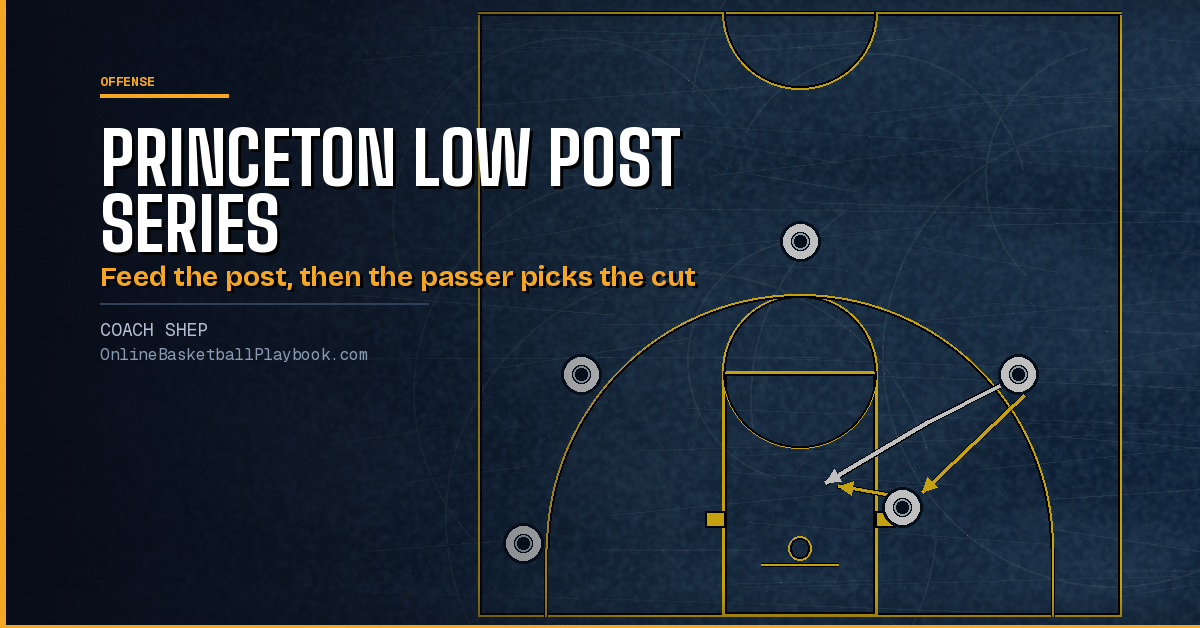
Princeton Low Post Series: Splits, Screens and the Laker Cut
The Princeton low post series: the wing entry, the passer's options after the feed, the high post split, the Laker cut and what to do when the post is denied.
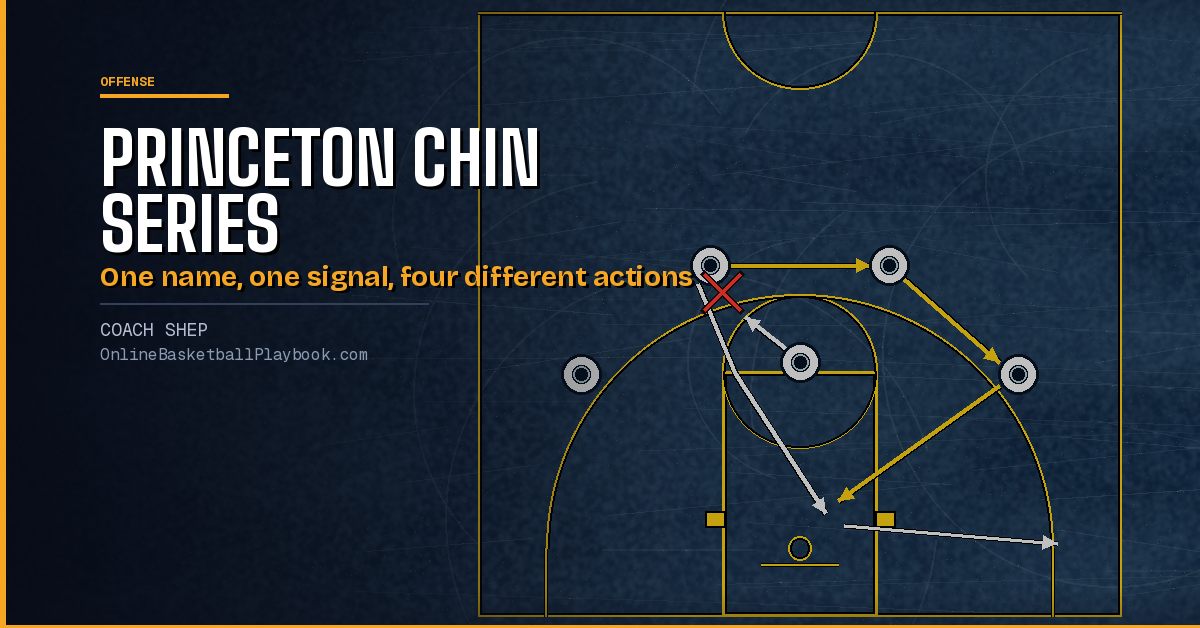
Princeton Chin Series: 4 Ways Coaches Run the Chin Offense
The Princeton Chin series compared: dribble weave and flare, shuffle cut, down screen and pop, and the two-guard read, plus branches, resets and counters.