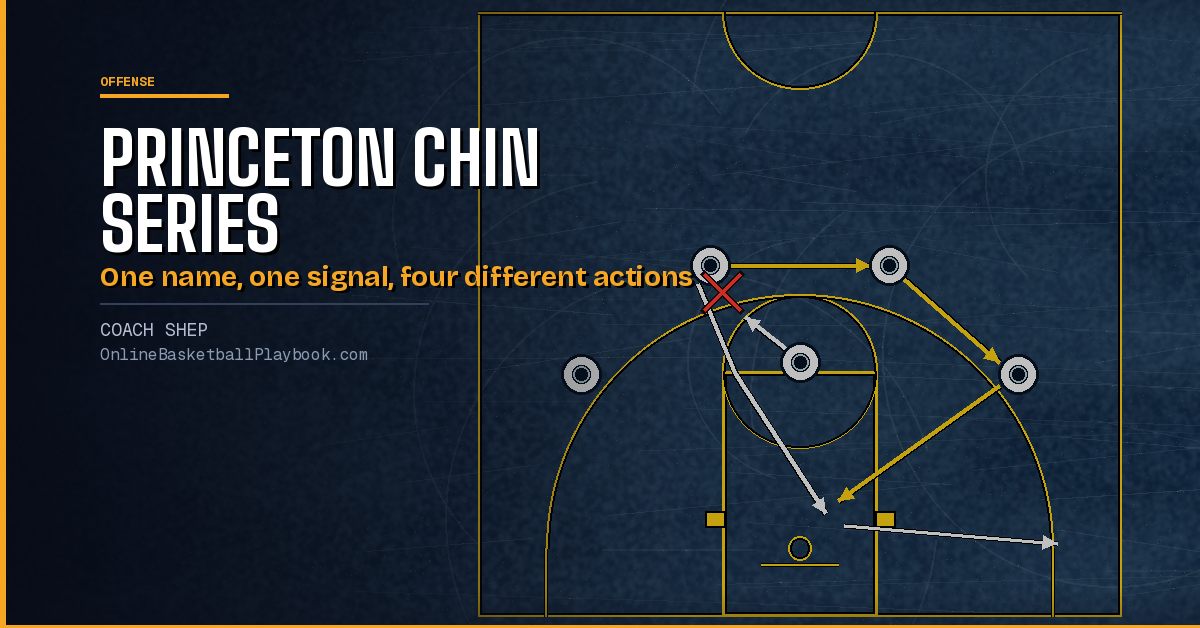
In the six-set version of the offense, the Princeton Chin series is the set taught first and the one a broken possession goes back to, but the word Chin does not mean one action. Coaches who run it share the name and the signal and little else. One version weaves the ball and sets a backscreen then a flare. Another shuffle cuts guards off a post at the high post. A third makes the post's down screen the read, and a fourth runs flare, ball screen and backdoor out of a two-guard front. The base Chin and its timing rule are on the Princeton offense hub. This page goes past it, with the four versions side by side, the branches, the resets, the counters and how coaches teach it.
What the Chin Series Is
The name is said to come from a signal: the guard bringing the ball up rubbed his off hand against his chin a few times to call it. Under that name sits a family of actions built around a post at or near the high post who screens for cutters, most often a backscreen or shuffle cut first and a flare or ball screen second. A backdoor is always live: a defender who denies gets cut behind.
In the six-set version of the offense that runs Chin, 5 Out, Low, Point, Twirl and X, Chin is the base and the reset. Its rule is that a dribble up to the guard spot after a breakdown always puts the team in Chin. That makes Chin the place a confused possession goes back to.
Chin Offense Basketball: Four Versions Side by Side
| Version | Start | First action | Second action | Main read |
|---|---|---|---|---|
| Shuffle-cut Chin | 2-3 high, the center at the high post | Ball swings guard to guard to wing, the post back-screens and the far guard shuffle cuts | The post goes with the dribble and the shuffle runs again | Shuffle cutter, then a skip if his help jumps |
| Dribble-weave Chin | Post on the ball-side block, dribble weave on the strong side, exchange on the weak side | The post fills the elbow and backscreens for a cutter to the rim | The same post flares for the next player | Layup first, the flare second |
| Down-screen Chin | Post on the ball-side block, guards high, a guard-to-wing hand-off on one side | A shuffle cut to the ball-side block | The post down-screens for a pop | The cutter's defender: heels means curl, under means pop, deny means backdoor |
| Two-guard Chin | Two guards high, the post at the nail | Four entries, one of them a post catch with both guards sprinting backdoor | Flare, high ball screen, backdoor, in that order | The guard up top reads his defender off the post |
The shuffle-cut Chin also comes in a hand-off layout: exchanges on both wings, the post sliding up to the high post, a swing around the perimeter, a back screen for a shuffle cut, and then a flare for the next player. If that player pops and is not open, the post re-screens with a ball screen. If he curls to the rim and is not open, he cuts to the weak-side corner and the post sprints over to ball-screen for the ball handler with two shooters on the weak side.
The Shuffle-Cut Chin
Pete Carril's Chin starts from the 2-3 high set: two guards, two forwards at the wings and the center high. The ball swings from one guard to the other and on to the forward on the wing. The center steps out toward the arc and back-screens for the guard who started the swing, and that guard makes the shuffle cut around him toward the ball-side corner, looking for the pass and a layup.

In another telling of Carril's Chin, the post flashes and holds the high post, and the guards cut off his outside shoulder when they can, because the shuffle cutter's defender tends to jump to the middle to help from the inside. Carril's rule for the center is that he always goes with the dribble. After the screen he cuts to the ball-side elbow. If the pass to the cutter is not there, the wing passes back to the guard, the guard dribbles across, the center follows him to the other elbow, and the same shuffle cut runs again with a new cutter.
Four options come off it:
- Skip. If the weak-side defender drops inside to help on the shuffle cutter, the wing skips to the weak side for a three.
- Center drive. The wing passes to the center as the cutter clears to the corner, and the center can turn and attack one on one with a kick-out.
- Center backdoor. If the center's defender denies him, he cuts backdoor for the pass and the layup. It works on any shuffle cut, not only the first.
- Dribble at. If the guard's pass to the wing is denied, he dribbles back toward the top, and the dribble-at sends the wing through on a back cut to the other side before the shuffle runs again.
When the ball cannot be swung and has to go to the forward on the same side, the series uses the UCLA cut. The first option is the cutter. The high post pops out after his screen, and if he is overplayed he can go backdoor for a lob. After reversing the ball, the high post can screen down and take the low post, which carries the team out of Chin and into the Princeton low post series. The shuffle cut itself is the base of a whole continuity on shuffle offense basketball.
The Dribble-Weave Chin and Its Branches
This is the Chin drawn step by step on the Princeton offense hub. Its coaching point: the 3 does not cut off the 5 until the ball leaves the 4. Two branches start from the same look.
Strongside. The 1 passes to the strong-side wing instead of across the top.

After the screen, the 5 steps out high above the elbow, behind the arc, and the 3 passes to him. Now the 5 sits in two three-man games at once. On the strong side the 3 down-screens for the 1, and on the weak side the 4 flares for the 2. That makes it six against five, because the 5 is part of both. Its key read is X2 going over the top of the flare. When that happens, the area under the rim is empty and the 2 finishes his cut to the rim for the pass and the layup. Flare reads in general are on flare screen basketball.
Strongside comes in two versions. In the Air Force version the post changes, so every player learns every spot. In the high school version the post gets back to his spot. In one, the 3 sets a back screen for the 5 after his down screen, and the 5 UCLA cuts to the rim for the pass from the 1. In the other, the ball goes to the 5 at the top of the key and the team is in 5 Out.
Chin High. The weave is the same. Then the ball reverses from the 3 to the 4 to the 2, and the 5 sets a UCLA screen for the 3, who keeps going to the opposite corner while the 5 goes to the ball-side high post.

From there the 4 cuts through the lane to the far corner, the 2 passes to him and cuts backdoor, the 3 fills the wing and the 5 dribbles to the middle. The 2 pops out to the corner, the 5 reverse pivots or dribbles left, and the 3 cuts backdoor for a layup pass from the 5. A pass fake sells the cut. If nothing comes, the 5 passes to the 2 on the wing, the 3 can enter the post, the 4 flares the 1 on the weak side as soon as the 2 makes his replace cut, and the 5 gets a back screen from the 3 to get back into the post. Chin High is a quick hit, and it can be a read by the team instead of a play call.
The Down-Screen Chin
The third version keeps the post on the ball-side block, the wings one step higher than the free-throw line extended, and the guards three to four feet off the arc. Chin starts with a dribble hand-off between the two players on one side, and as it happens the opposite guard down-screens for the far wing. The ball reverses quickly. When it does, the first cutter makes a shuffle cut to the ball-side block area, and the next player sets up his defender for a pop.

The post follows the arc to set the down screen, and the passer can hit the post slipping or the cutter on the pop. On a pop pass, the guard who started the hand-off fades to the corner. The whole version rests on one read by the cutter coming off the post's screen:
- Defender on his heels. Curl to the basket.
- Defender under the screen. Pop.
- Defender denying. Backdoor.
The post reads the cutter in turn. When the cutter pops, the post dives. When the cutter goes backdoor, the post pops. When the cutter curls, the post can pop or dive. A cutter who curls and does not get the ball keeps cutting to the basket, and the passer can throw over the top to him, hit the guard filling behind, or hit the post slipping. The post can also set an on-ball screen up top.
The same start opens three branches. On a pass to the deep corner, the passer cuts for a give-and-go and the post and the corner play two on two. On a denied pass after the hand-off, the receiver cuts backdoor and drives to the rim to score or kick, with the others filling the corner, the top and the front of the rim. If the post pops and catches, the team is in 5 Out.
The Two-Guard Chin
John Beilein's Chin lives inside his two-guard offense: two guards up top, two wings and a post at the nail who must hit a 15-foot shot. It has four entries and one read in order, flare, then high ball screen, then backdoor. The post picks the moment of his flash, and the cue is that whoever says go wins the race. Cutters go chest to chest with the post so the defender has no room to follow. The full version, drawn frame by frame, is on two guard motion offense.
Resets: How Chin Keeps Going
| Version | Reset |
|---|---|
| Dribble-weave Chin | A dribble up to the guard spot after a breakdown puts the team back in Chin. A pass up to the 5 at the top of the key keys 5 Out, the bridge to the next phase |
| Shuffle-cut Chin | The ball goes back out top and is dribbled across to reset the spacing, and the high post moves with the dribble before the next shuffle cut |
| Down-screen Chin | The guard reverses to the wing, the two complete a hand-off, the post cuts to the middle, and the far guard and wing exchange |
| Two-guard Chin | The wing dribbles up to the top, the wings fill and the post goes back to the nail |
Other sets feed Chin too. In the Point series, a wing with no option dribbles up into Chin. In Twirl, a wing with no option does the same. A set built to free the best wing shooter starts like Low, runs a dribble-at backdoor and a flare, and ends in Chin on a dribble up. The Point reads are on Princeton Point series.
Get the next coaching guide in your inbox
One email when a new guide or diagram set goes up. Free.
Chin Counters by Defense
Teams that run Chin a lot script answers for what defenses do to it. The down-screen version states the rule behind the sag counters: backdoor against pressure, screen down against a sag. Each counter below is named by what it does.
| Defense does this | Counter |
|---|---|
| Sags from the weak side to stop the backdoor | Double down. The 4 and the 5 start as usual, then both screen down on the top guard's defender for a three at the top of the key. Another version counters the same sag with a play where the top guard does not V-cut, because his defender is already off him, and the shot goes to the 3 |
| Sags, a second answer | The ball reverses to the wing, two top guards set a double down screen for the 5 for a three, and the team goes into Twirl if no shot comes |
| Jumps to stop the first shuffle cut | The play starts like Chin with a brush and a pass. The passer fakes a pass, the cutter sets up his defender, steps over the screen and cuts to the block, and the ball reverses to find him with his defender on his back |
| Switches the Chin screens | The 5 screens a little higher, holds it a moment while the 1 clears, then dives to the rim or the block for a layup or to post the 1's defender |
| Just chases the cutter off the backscreen | The cutter snaps back toward the ball in the post when the defense relaxes. It is a read, open any time in Chin |
| Gives up a matchup or a foul situation | The top guard fakes a pass to the forward, and the fake signals the 5 to come set a ball screen |
The down-screen version adds more scripted looks off the same start: a wide pin for a guard with a rip screen for the post and a post entry, a flex screen into a down screen for a three on the wing, and a stagger with the screener stopping at the block for a guard cutting hard to the corner. Another scripted look has the 5 follow the ball after the top player's flare or curl and ball-screen the wing, who attacks the middle, then finishes or kicks to a shooter. A three-point play starts from the weave too. The ball swings around, the 1 cuts over or under a double flex screen, and the 5 and the 4 stagger down screens for the 3, who comes to the top of the key for the shot, with two weak-side rebounders built in. How defenses try to take Chin away is on how to defend the Princeton offense.
Chin in Other Programs
Chin also shows up as a called series in college playbooks. Belmont's book has six Chin plays, and Butler's 2019-20 book has six, one of them marked for after a timeout. Weak-side screens of every kind are on basketball screens.
Teaching the Chin
The down-screen version's drills:
- First cutter shooting. A shuffle cut off a chair or cone, a pass from the coach for a quick finish, then a post-up, then a defender.
- Second cutter shooting. The cutter walks his defender into the post's screen and pushes off for the pop. Options: catch and shoot, shot fake and slide, a direct drive, jab and go, backdoor, or curl. Then defense, then three on three.
- The post opposite the cutter. Cutter pops, post dives. Cutter backdoors, post pops. Cutter curls, post pops or dives.
- Three on zero, second cutter. A continuous drill. The top guard always rebounds and kicks to the top, the strong-side wing rotates up after passing, and the weak-side wing stays and becomes the strong-side wing.
- Three on zero, top backdoor. The wing dribbles at the top player, who cuts backdoor for the layup, and the drill keeps running as a dribble-at backdoor chain.
The dribble-weave version has its own rule. Teach the dribble up into Chin first, and only after the team knows the Point series, add the pass-up option. More Princeton drills, including a three-on-zero Chin cutting drill, are on drills to teach the Princeton offense. The read behind every backdoor in Chin is on backdoor cut.
Questions Coaches Ask About the Princeton Chin Series
What is the Chin series, or chin action, in the Princeton offense?
A family of actions built around a post at or near the high post who screens for cutters. In the dribble-weave version the post backscreens for a cutter to the rim and then flares for the next player. In Pete Carril's version guards shuffle cut off the high post.
Why is it called Chin?
The name is said to come from a signal: the guard bringing the ball up rubbed his off hand against his chin a few times to call it.
What is the Strongside Chin?
A branch keyed by a pass to the strong-side wing. The passer UCLA cuts off the post to the rim, the post steps out, and the post ends up in a down-screen game on one side and a flare game on the other at the same time.
How do you counter a defense that sags against Chin?
Screen down instead of cutting backdoor. One counter has the 4 and the 5 double down on the top guard's defender for a three at the top of the key.
Want every diagram on the site?
OBP Pro members get the full diagram files for every offense guide on the site, ready for a practice binder or a scouting report. $9 a month. Or draw your own version free in the play drawer.
See what OBP Pro includesMore Offense System Guides
- Spread Pick and Roll Offense: Flat Screens, Reads and Counters
- Princeton Point Series: Over, Away and Under Reads
- Princeton Low Post Series: Splits, Screens and the Laker Cut
- Backdoor Triggers and Backdoor Plays in Basketball
Back to Princeton Offense and every Offense page.
Keep Building
Related breakdowns
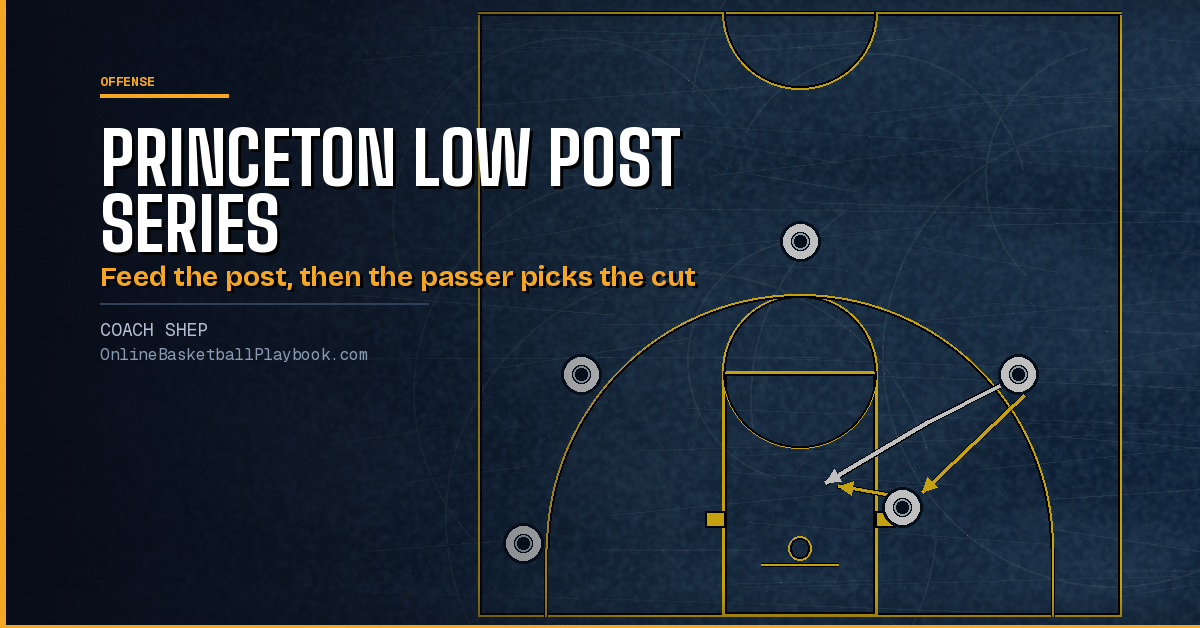
Princeton Low Post Series: Splits, Screens and the Laker Cut
The Princeton low post series: the wing entry, the passer's options after the feed, the high post split, the Laker cut and what to do when the post is denied.
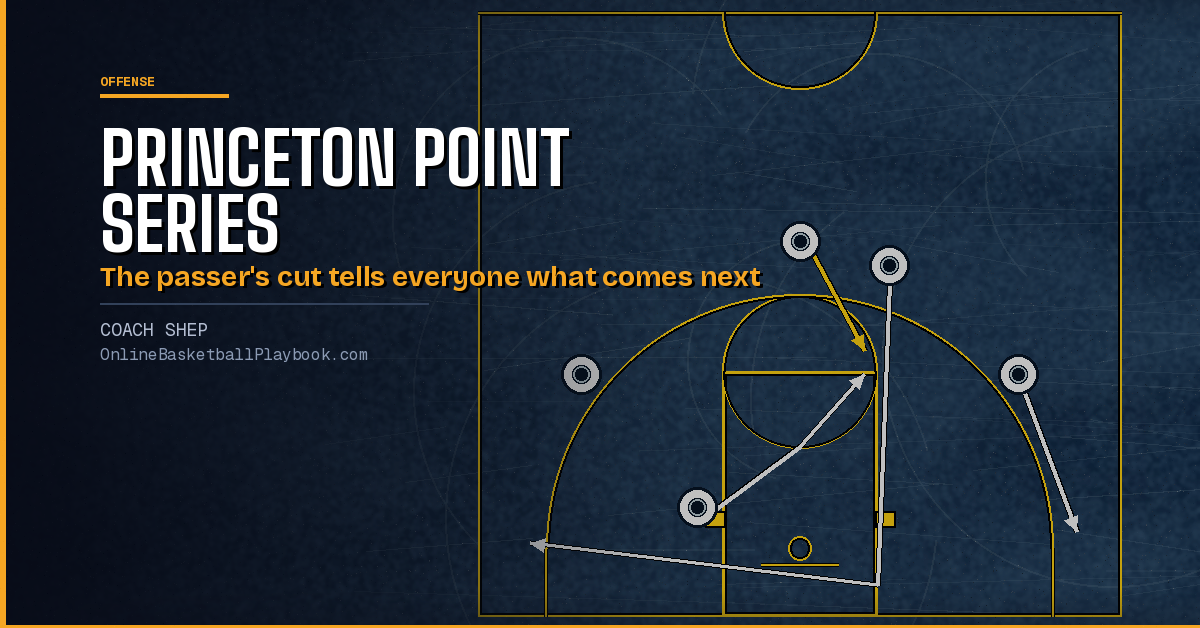
Princeton Point Series: Over, Away and Under Reads
The Princeton Point series: the wave-through entry, the Over, Away and Under cuts, the side ball screen, post and flare options and the spin counter.
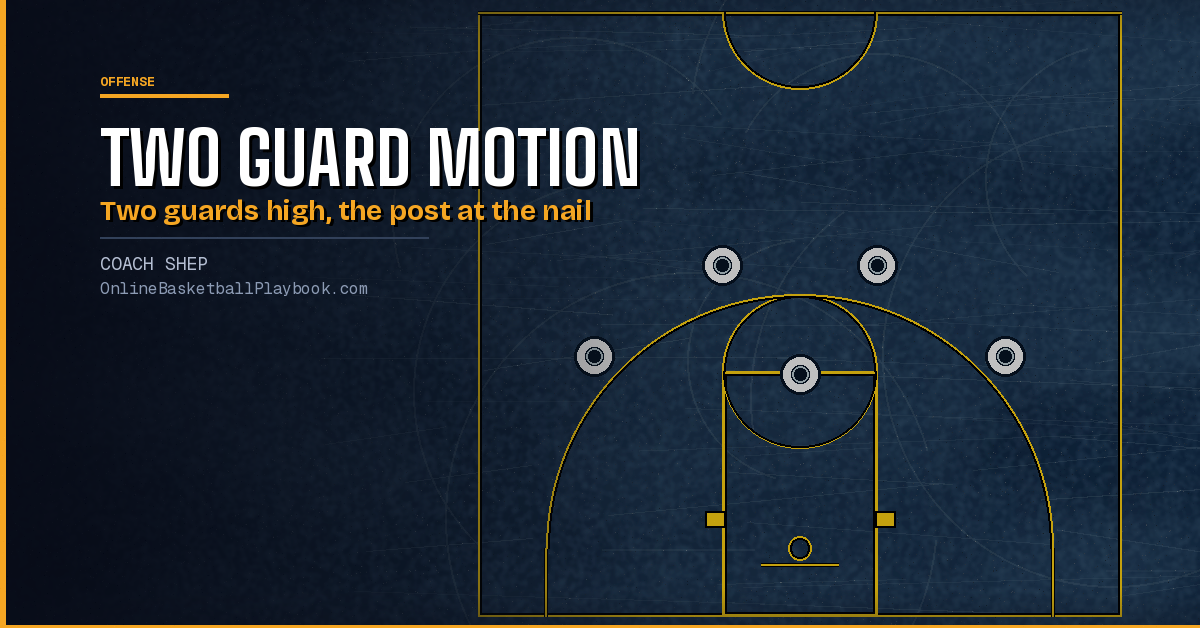
Two Guard Motion Offense: Chin, Shuffle and Motion Series
John Beilein's two guard motion offense: the high 2-3 set, the post at the nail, Chin entries, the flare, ball screen and backdoor read, and the Shuffle series.