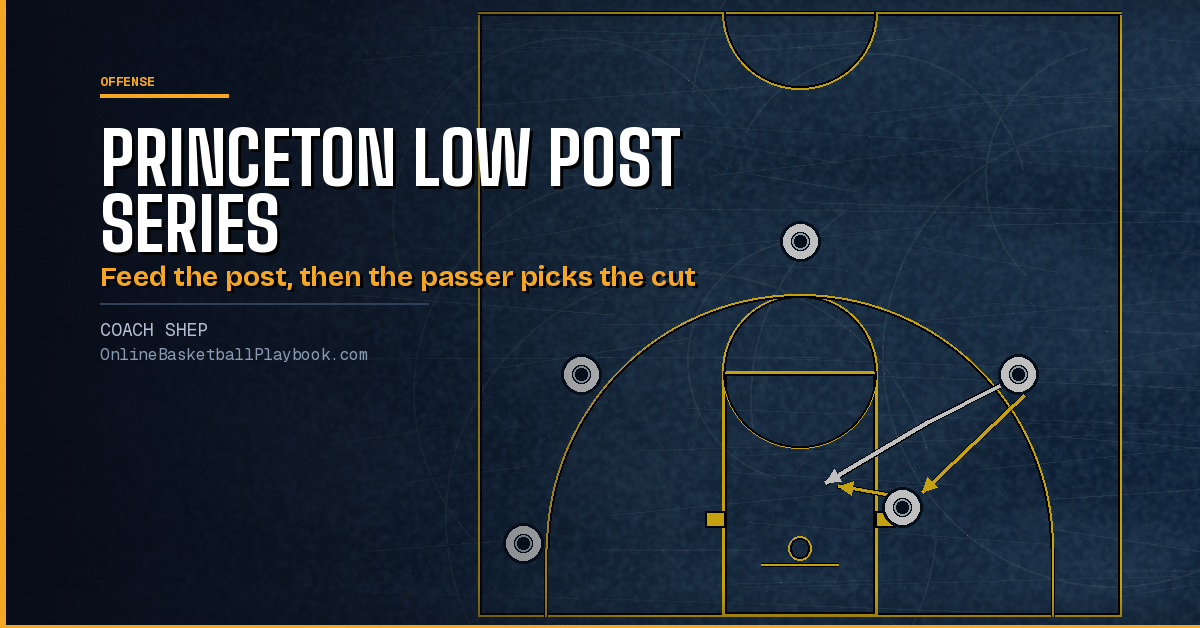
The Princeton low post series is the half of the offense played with the center on the block instead of at the high post. A guard passes to the wing and cuts through, the wing feeds the post, and the passer's next cut, the split, the screen for the guard or the Laker cut, sets up a backdoor, a shot or a pop for a three. Pete Carril taught it as one of his three sets, next to the high post offense and the Chin series. The Princeton offense hub covers the high post and Chin. This page goes through the low post series: the alignment and entry, the passer's options, the split and the Laker cut, the post dribble-up, what happens when the post is denied, and how the series hands the ball back to the rest of the offense.
What the Low Post Series Is
Carril split his offense by where the center sets up: on the low block for the low post offense, high for the high post offense and the Chin series. His advice was to scrimmage a lot in the first week, learn the personnel, and then build the offense around what that team has. Carril's advice: with a strong big man, use the low post offense, and without one, the high post offense or Chin.
Coaches disagree on where a possession starts. One version says Low usually begins each possession. An always-low-start version starts every possession from the low post. The six-set version makes Chin the base and gets into Low only when the wing passes into the post.
Alignment and the Wing Entry
Carril's basic set has two guards up top, two forwards at the wings, about free-throw line extended, and the center on the low block. Other versions set the same five spots a little differently:
- Block start. The post on the ball-side block, the forwards a step above the free-throw line extended, the guards three to four feet above the arc.
- Mid-post start. The post at the mid-post, the guard with the ball high and a step outside the lane line extended, the off guard a step behind him, and the wings at the free-throw line extended, a step in from the sideline.
- 2-2-1 start. Two players in the slots, two on the wings and the post on the ball-side block.

Carril's, the mid-post and the 2-2-1 versions enter the same way: the guard passes to the wing and cuts through, ending in the far corner. Carril's cutters always have their hands ready, looking for a return pass inside on the way through. In the mid-post version the other guard moves to the middle of the floor as the passer cuts. If the post is open, the wing feeds him and the post tries to score. Carril's cue for every player from here is to watch the man in front of you, because he will tell you where to go.
The Passer's Options After the Feed
Once the wing passes into the post, Carril gives him three choices:
- Move down to the corner.
- Laker cut inside, around the post.
- Screen for the guard.

When the wing screens for the guard, the guard sees the screen coming and reads his defender. He can come around it for a pass from the post and a jump shot. If he is not open, he passes back up top to the screener, who has popped out after screening and may have a three. The post can also pass straight to the screener for the three.

If the guard's defender gets in the way of the cut over the screen, the guard cuts backdoor to the rim for the pass from the post, and the screener pops out on top. That is Carril's second rule at work: when closely guarded, go back door. The read is laid out on backdoor cut.
The High Post Split
The six-set version calls the first option after the feed the high post split. The 3, who fed the post, sets a screen at the elbow for the player at the top, here the 1.
- Base. The 1 steps hard to the basket and finishes the cut if he is open. If not, he cuts to the wing the 3 left. After his screen, the 3 cuts to the rim looking for the dump pass from the 5. The weak-side players rotate into the top and wing spots, and the 3 fills the corner.
- Back cut. As the 1 moves to use the screen, he reads his defender and back cuts to the rim, where the 5 can drop the ball to him. The 3 fills the strong-side wing after his screen, the weak-side players fill the top and the wing, and the 1 fills the corner.
- Curl. When the defense plays the 1 tight, he curls off the 3's screen to the rim and looks for the dump pass. The fills are the same.
The 2-2-1 version reads the same screen by tight and loose. After the feed, the feeder screens for the player at the ball-side elbow area. Neither player rushes it, and both slow down and read the defenders first. A tight defender who fights over the screen gets a backdoor cut for a quick pass from the post. A loose defender caught on the screen lets the cutter use it and cut out to the wing for a midrange or three-point shot. Whichever way the cutter goes, the screener goes the other way.
The split version warns against teaching all three reads at once. Choose one option for the personnel and the goals, get the players to run it, and only then give them a choice. Screen reads in general are on basketball screens.
The Laker Cut
The Laker cut is the other answer after the feed. The six-set version credits it to Tex Winter's triangle offense, where it was made famous.

After his entry pass, the 3 cuts hard behind his defender, and the 5 looks to drop the ball off to him. If he is not open, he keeps going and fills the corner, and the others rotate to fill the wing and the top. Carril's version of the same cut goes inside, around the post. The triangle's own post-entry cuts are on triangle offense basketball.
Get the next coaching guide in your inbox
One email when a new guide or diagram set goes up. Free.
When the Post Cannot Be Fed
Each version has a plan for a wing who cannot get the ball inside.
| Version | What the wing does |
|---|---|
| Two-dribble hand-off | The wing takes two dribbles along the arc toward the elbow player. A tight defender trying to cut off the hand-off gets a back cut to the rim and a one-hand bounce pass. A loose defender lets the cutter take the hand-off while the post sprints to the top of the key to screen for him. If neither is open, the wing swings the ball to the far side and the post back-screens for the passer's shuffle cut toward the open lane. The shuffle cut runs a whole offense on shuffle offense basketball |
| Carril's denied passes | When the pass to the 2 is denied, the wing reads in order after the catch: the cutting center first, then the corner if he is open, then his own shot, and last a pass back to the man who threw it to him. When the pass to the post is denied, the ball swings back up top, then the guard drives and pitches |
| Forward dribble | Keyed when the forward can neither feed the post nor pass to the guard at the top. He dribbles toward the elbow, and as soon as the ball is on the floor the guard cuts hard backdoor. The post steps out to the short corner, and the forward jump-stops and passes to the cutter |
The post can start the backdoor himself. Carril's post takes a couple of dribbles up the lane line and passes to a guard back-cutting through. The six-set version uses the same dribble-up when the post is a passer.

On the dribble, the wing above him cuts backdoor for the drop pass and a teammate fills the corner. If the defense turns its head at any point, a pass goes for the layup or a three. If nothing is open, players fill the top, the wing and the corner, and the 5 passes to the top of the key and posts up again at the elbow for the return pass, which puts the team in the Point series. The rule behind every one of these is the dribble-at: whenever a teammate dribbles straight at a player, that player back cuts.
Going Cross Court and Screening for the Post
Carril's low post offense moves the ball side to side two ways. In the first, the post has the ball and the guard back-cuts off the wing's screen. That cut often pulls the two weak-side defenders into the paint to help, and the post skips the ball to either of them for a three. In the second, the guard swings the ball to the other guard up top, who can shoot the three or drive for a layup, a pull-up or a kick-out. If that guard-to-guard pass is denied, the receiver cuts backdoor.
A third action screens for the center. The guard passes to the wing and down-screens for the 5, who comes up to the arc for a reverse pass from the wing. The 5 power-dribbles toward the forward on the other side, who comes around for a hand-off and a screen and may have an open shot.
- Jump switch. If the defense jump-switches the hand-off, the 5 slips the screen inside, the guard pops out, and the guard can look to feed the 5 in the low post.
- Denied forward. After dribbling around the hand-off, the forward can hit the other forward on a backdoor cut if his defender is denying him.
- The next pass. Even when the backdoor is not open, the wing's defender usually drops inside to help on it for a moment, so the wing is open for the next pass and can shoot or feed the post while the forward down-screens for the 5.
The point of that last action is that each small action done right matters, because the back cut that gets no pass creates the open pass for the next man. Hand-off mechanics are on DHO basketball.
The Post's Job
The forward-dribble version spells out the post's work after the feed:
- Getting open. The post stays in line with the ball, seals his defender with one arm and holds up the other as the target. The forward faces the basket, reads how the post is guarded and picks the passing angle away from the defense: bounce, chest or step-around.
- Scoring first. The post's moves are a baseline drop step, a middle drop step and shot, a middle drop step with a shot fake and an up-and-under, or a middle drive and a jump hook.
- Passing out of it. On the elbow screen, the post hits the shooter coming off it, the screener popping out, or dives middle and kicks to the opposite side.
A block-phase version adds the double team: the perimeter players read it and look for the shooters, with a give-and-go, a wing hand-off and a back screen for the post all live. It throws every low-post entry as a bounce pass, passed to the outside of the receiver's body away from the pressure. Post skills in general are on post play in basketball.
Princeton Low Post Series Versions Compared
| Version | Post spot | After the feed | No feed |
|---|---|---|---|
| Carril's low post offense | Low block | Passer drops to the corner, Laker cuts or screens for the guard. Guard curls, backdoors, or the screener pops for three | Dribble-at back cuts, guard-to-guard swing, down screen for the post into a hand-off |
| Split version | Ball-side block | High post split with base, back cut and curl reads, or the Laker cut. Pick one | Wing options: Low, Point or Chin. Post dribble-up |
| Two-dribble hand-off version | Ball-side block, 2-2-1 start | Post one on one while the feeder screens the elbow player. Tight means backdoor, loose means cut to the wing, screener goes opposite | Two dribbles into a hand-off read, then a swing and a shuffle cut |
| Mid-post version | Mid-post | Passer screens at the elbow, goes to the ball-side corner or cuts to the basket | Dribble-at back cut and fill, or a flare if the defender sags |
| Forward-dribble version | Low post | Post scores first, then the elbow screen | Forward dribble with a guard backdoor, then a drift screen when the guard at the top is open |
Two cutting rules from the forward-dribble version keep the floor clean: a cutter from the top exits to the strong-side corner, and a cutter from the wing who gets no ball exits on the same side.
How Low Flows Into the Other Sets
The series is built to hand off to the rest of the offense. Once the ball is in the post and no cut or screen gives a shot, the 5 passes back out to the players filling the wing and the top, and he fills the strong-side elbow. A pass to the top of the key puts the team in the Princeton Point series. A dribble up to the guard spot puts it in Chin. The way in works the other way too. In the shuffle-cut Chin, the high post can screen down after reversing the ball and take the low post, which carries the team into the low post series, and in Twirl the 5 sprints to the block on the side the ball is passed and a pass to the wing keys Low. The Chin side of that handoff is on Princeton Chin series, the defense's side of the post feed is on how to defend the Princeton offense, and breakdown drills for every Princeton set are on drills to teach the Princeton offense.
Questions Coaches Ask About the Princeton Low Post Series
What is the low post series in the Princeton offense?
The half of the offense run with the center on the block. A guard passes to the wing and cuts through, the wing feeds the post, and the passer's next cut, a split, a screen for the guard or a Laker cut, sets up the backdoor, the shot or the three.
What is a Laker cut?
After passing into the post, the wing cuts hard to the rim behind his defender for a dump pass from the post, and fills the corner if he is not open. It is credited to Tex Winter's triangle offense.
What is the high post split in the Princeton offense?
After the post feed, the wing screens at the elbow for the player at the top. The cutter goes to the rim, back cuts or curls depending on his defender, and the screener cuts to the rim for a dump pass from the post.
What does the post do if he cannot score?
He passes back out to the wing or the top and fills the strong-side elbow. A pass to the top puts the team in the Point series. A post who can pass may also dribble up the lane line and hit a wing cutting backdoor.
Does the Princeton offense start in the low post or the high post?
Coaches differ. One version usually starts in Low, an always-low-start version starts every possession from the low post, and the six-set version makes Chin the base and enters Low on a pass into the post.
Want every diagram on the site?
OBP Pro members get the full diagram files for every offense guide on the site, ready for a practice binder or a scouting report. $9 a month. Or draw your own version free in the play drawer.
See what OBP Pro includesMore Offense System Guides
- Spread Pick and Roll Offense: Flat Screens, Reads and Counters
- Princeton Chin Series: 4 Ways Coaches Run the Chin Offense
- Princeton Point Series: Over, Away and Under Reads
- Backdoor Triggers and Backdoor Plays in Basketball
Back to Princeton Offense and every Offense page.
Keep Building
Related breakdowns
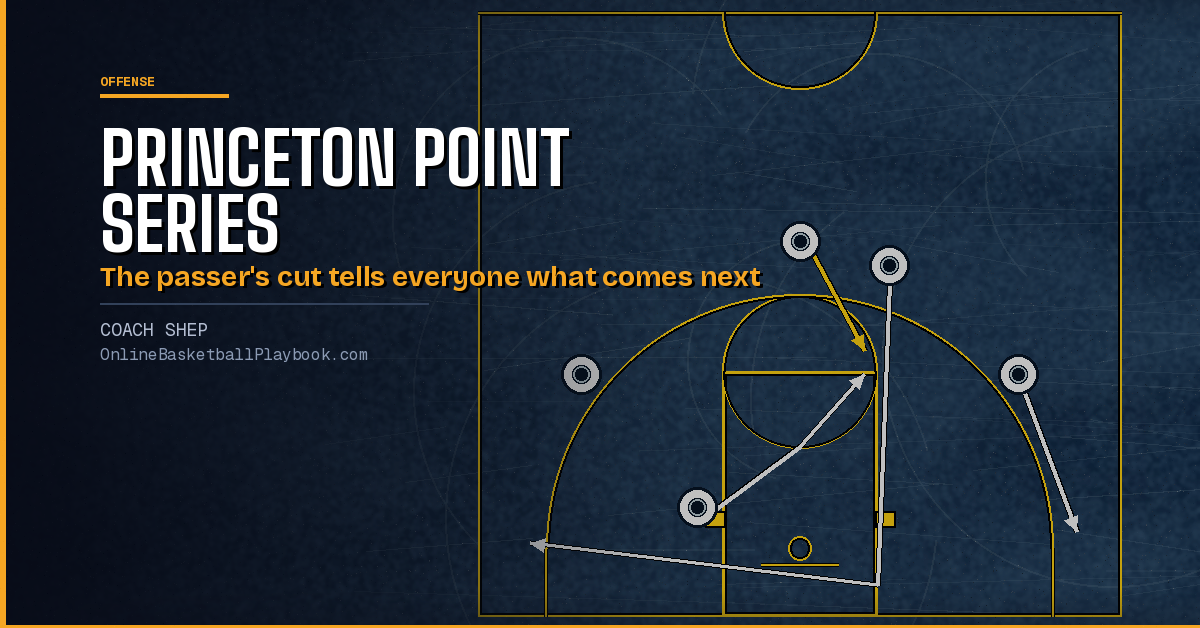
Princeton Point Series: Over, Away and Under Reads
The Princeton Point series: the wave-through entry, the Over, Away and Under cuts, the side ball screen, post and flare options and the spin counter.
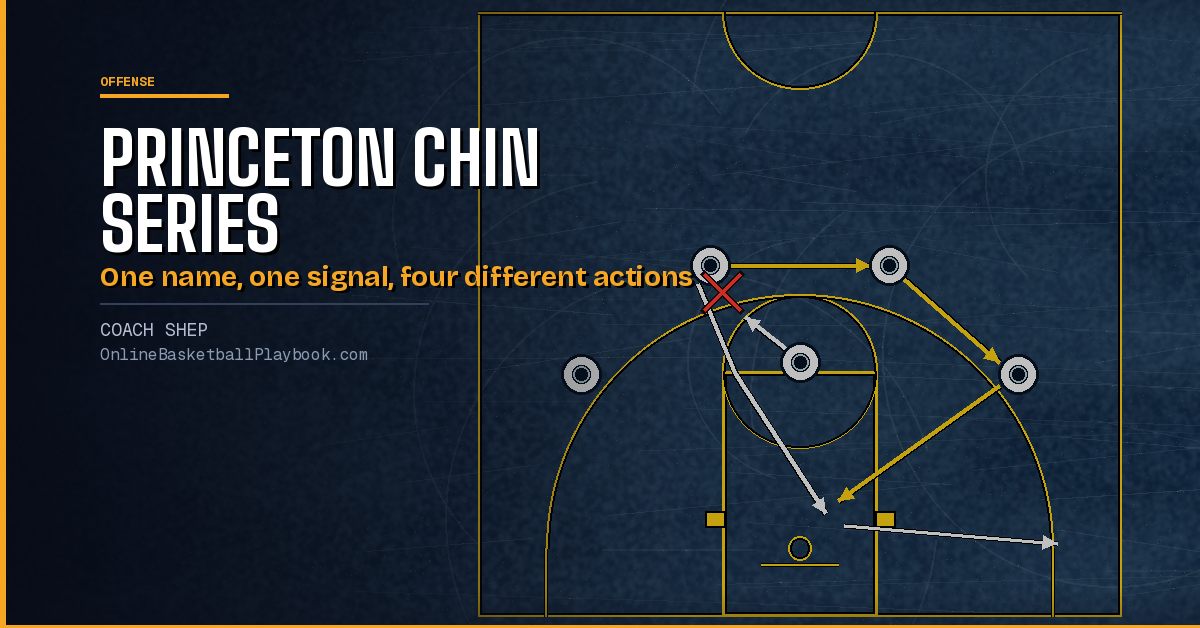
Princeton Chin Series: 4 Ways Coaches Run the Chin Offense
The Princeton Chin series compared: dribble weave and flare, shuffle cut, down screen and pop, and the two-guard read, plus branches, resets and counters.
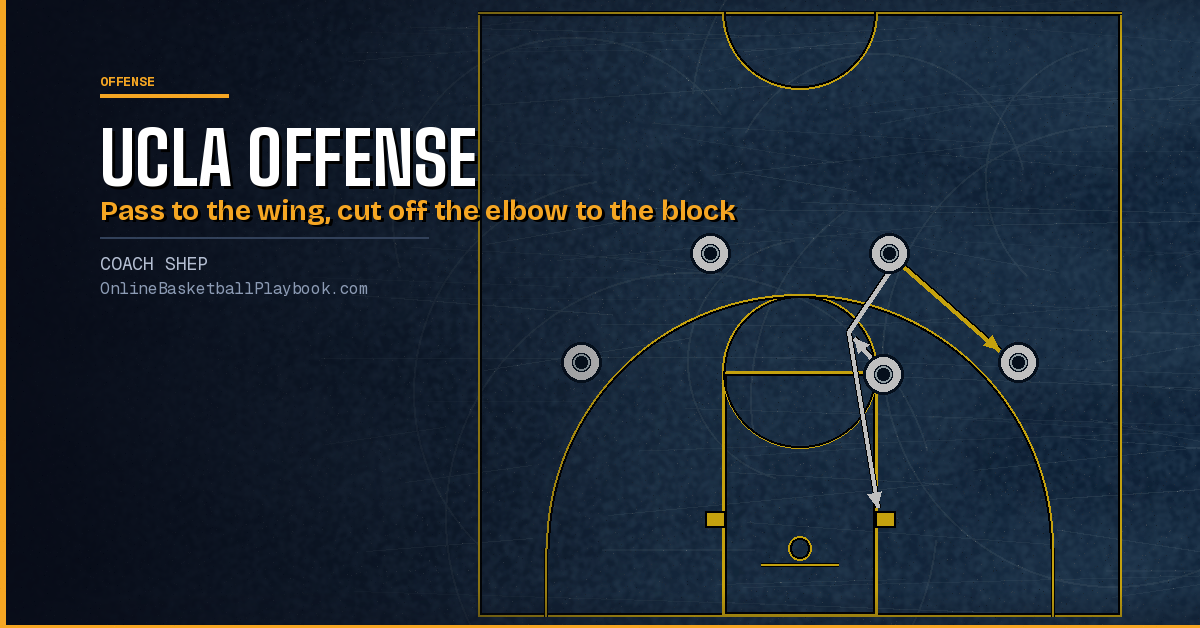
UCLA Offense Basketball: UCLA Cut, High Post Series and Counters
UCLA offense basketball in full: what a UCLA cut is, the 2-3 high and 1-4 high starts, reads off the cut, denial counters and the high-low version.