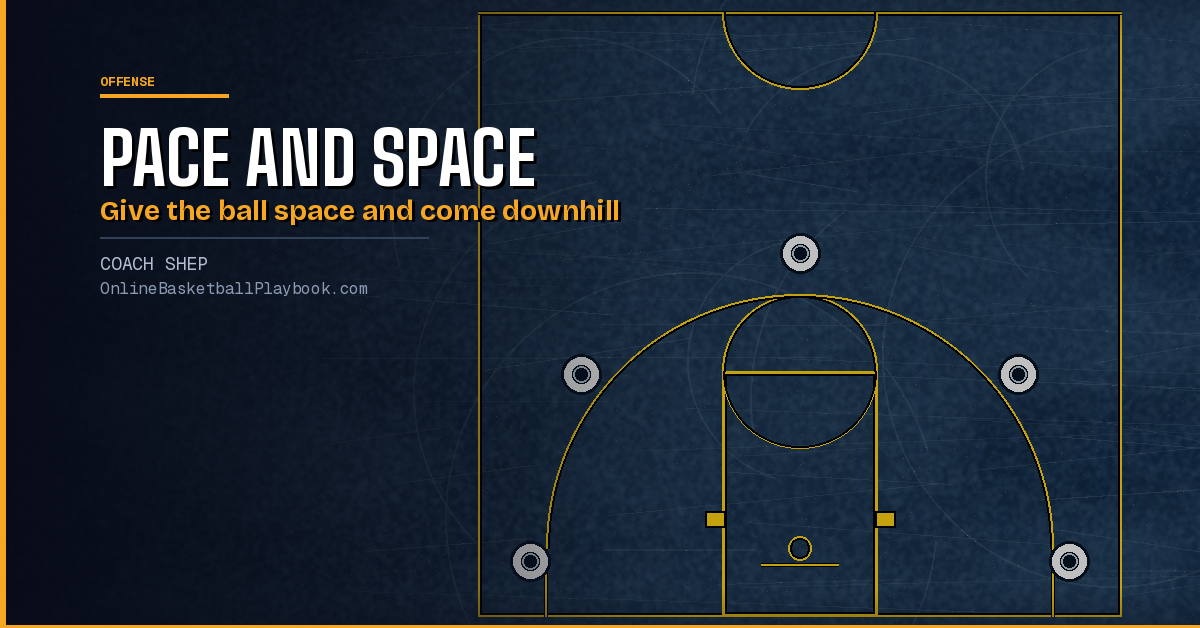
A pace and space offense pushes the ball before the defense is set, spreads all five players toward the three-point line and looks for threes and layups. The long two is the shot it tries to avoid. This guide's main college example is Nate Oats's Alabama offense, and the same idea runs through the NBA's five-out offenses, Vance Walberg's dribble drive and several clinic voices on tempo. This guide covers what the pace and space offense is, how the floor is spaced, the habits Oats teaches, the half-court entries out of a stopped break, the big's step-up and drag reads, the shot diets different coaches set, how teams score practice, who crashes the glass, and what the style costs.
What Is a Pace and Space Offense?
The name has two halves. Pace means pushing the ball right away off a rebound or a turnover, with a quick outlet and either a speed dribble or a pass ahead, aiming for a shot in the first 6 to 10 seconds of the shot clock. Space means pulling the post players out to the perimeter in a 5-out, a high horns look or a 4-out 1-in, so the paint stays open for drives. The bigs work mostly as ball screeners and rollers instead of back-to-basket scorers.
It is a system in the sense the basketball offense guide uses the word: a whole way of playing with a view on spacing and the post, built from shared actions such as the pick and roll, the drag screen and the drive and kick. It is close kin to two other systems. Dribble drive motion shares the empty paint and the threes-or-layups rule, and the five-out delay front that NBA teams now share uses the same spacing with a center at the top of the key.
Oats's own practice talk does not use the phrase "pace and space," and none of three Alabama practice recordings has him state a threes-and-layups rule in so many words. What he does say, repeatedly, is that the team plays with space, attacks downhill, shoots when open and protects the ball. The shot-diet language on this page comes from the other coaches named in each row.
Space: Five Out and an Open Paint

Two coaches who play fast put spacing first. Fred Hoiberg calls it the single most important thing, and George Karl would rather play spacing and attack the paint than run plays. The reason for moving the posts out is that the paint stays open for drives. Distances and gap sizes are covered on what is spacing in basketball.
Oats gives a concrete picture of space. His example is a left-handed driver who should get the ball going left with room in front of him. Holding the ball where he caught it leaves about 10 feet to the next defender. Dribbling over first leaves about 40. More room means a bigger runway for the downhill drive.
Five-out is not the only shape on record. The build-in-steps five-out version wants shooters at all five spots and at least two players who can create off the dribble, and builds toward five-out in steps: 3-out 2-in first, then 4-out 1-in, then 5-out as the skills grow. Pace and space also allows a high horns shell.
The Habits Behind the Offense
Oats's three Alabama practices show the habits in his own words. They are habits, not plays, and he repeats them all practice long.
| Habit | What Oats says |
|---|---|
| The 0.5 | Catch and go. A player only stands still if he is shooting. The driver rips the ball through to the drive side on the catch and is told to see the next drive while the ball is still on its way. Oats uses 0.5 as shorthand and never pins it to an exact half second. |
| Pass quality | Poor pass quality kills the 0.5, so the pass goes on the money. He ties 33 turnovers to passes that did not go where they needed to, and blames fumbled tosses and handoffs on players not catching clean. |
| Drive to score | When a player drives to pass, the defense plays the passing lane and it turns into a turnover. Any time he sees space between himself and the rim, the play is off and he goes to make the play. Off a handoff he comes off to score and turns the corner. |
| Shoot when open | Every time a player is aggressive, he keeps shooting until the defense takes the shot away. In the shooting work he wants players behind the ball and ready to shoot before the pass arrives, standing behind the college line. |
| Slide dribble | Only when the defender is flying past. He calls it another way to get a three instead of a long two. |
| Screen early | The ball screen or flare comes right after the denial or the pass: "you got to be like a second earlier." Bigs come to a stop on every screen. |
Oats ties the drive-to-score rule straight to turnovers: the drive meant to pass is the one the defense reads. How to read the help a real drive draws is broken down on teaching dribble penetration reads.
Other coaches teach the same decision speed under different names. In the concept-based read-rule version the player knows whether he will shoot, pass or drive before the ball reaches him, and if the decision is not obvious, the passer gets out to space at once. Karl's version is to "go-catch" instead of "catch-go," and his notes add that a corner catch is a shot or an attack. Both line up with the 0.5.
Oats's first practice recording opens with ball handling, a cross and then a wrap behind the back, right hand and then left, with the stronger handlers pulling the weaker ones through extra work.
Entries When the Break Is Stopped
When the first push does not produce a shot, the offense flows into a short menu of actions instead of setting up a play. The pace and space menu has six: a high pick and roll, a dribble drive, a drag screen, a horns action, pistols and zoom. The first four are drawn below.

High pick and roll. The 5 ball-screens for the guard up top, the guard attacks and the 5 rolls, with a kick-out to the shooter in the corner when his defender helps. The coverages a guard sees and his answers are on how to attack every ball screen coverage.
Dribble drive. After a made free throw or an inbound, both posts are already spaced out, so a wide driving gap exists before anyone screens. The guard simply attacks it.

Drag screen. The trailing rebounder sets a screen for the ball handler in early offense, and they play a pick and roll or a pick and pop. Alvin Gentry's Pelicans notes say drag screens in transition were 60 percent of Golden State's offense the year before, and they set the drag at an angle that lets the handler come downhill and forces his defender to chase over the top.

Horns. Both bigs start high and set a double staggered screen for the handler. The first screener slips for an inside catch and the second pops to the arc, so the handler can drive, hit the slipping big, kick to a corner or throw back to the popper.
Oats teaches his half-court offense as named families instead: Point/Swing, Away/Winner and Strong/Weak/Delay. Point/Swing has six listed variations, and after those he tells players to "just play the game out of point or swing." Away/Winner runs either a stagger or a single away screen, the group's choice. He calls which family a team plays on a rep. When the defense messes up the action, for example with a deny, players reject it, push it back and go get the ball, which can turn point into swing. The recordings give the names but not the floor spots, so they are not drawn here.
Step-Up, Drag and Ghost: The Big's Read
In Oats's first practice recording, the choice of ball screen belongs to the big. It is a read based on his own timing, addressed to bigs and guards, not a call from the point guard.
| Read | When | What the big does |
|---|---|---|
| Step-up | The big is in front of the ball | Gets to the free-throw line and comes back up for the step-up screen |
| Drag | The big is even with or behind the ball | Angles the drag for a side pick and roll at the right depth |
| Ghost | The lineup is small | Same reads, but he ghosts the screen. In front, he steps up and ghosts. Behind, he drags to a ghost and pops to shoot. |
| After the screen | Any of the three | The ball goes to the big on the roll or to the guard on the ghost. The guard reloads, and after the pass he sprints out on a reshape for a three. |

The same three words mean different things to other coaches. Gentry's notes use the step-up as the answer to an iced drag: flip the screen into a step-up and snake the dribble back to the middle, which Golden State calls "Ginobili." To the concept-based read-rule version a ghost is not a screen at all but a cut by an off-ball player whose defender has lost sight of him. A team that borrows the vocabulary should write down which meaning it uses.
Against a Blitz
Oats's second practice opens ball-screen work against a blitz from a step-up screen, with the screener free to roll or pop. The rule is to get the ball out of the two defenders as fast as possible and play 4-on-3. Two quick passes beat the long closeout. If the first passer holds the ball, the defense recovers and it is 5-on-5 again. His spur action gets the ball out of the screen "bang, bang" or throws ahead to the player sprinting to the rim. When the screener's defender tries to blow up the screen and the screener gets physical, the action becomes what Oats calls a Nash. The third practice adds a drag against a blitz and work against a hard show.
Pace: How Fast, and Who Decides

Gentry's notes give the clearest set of floor spots for the pace half. The first three steps of the break decide the quality of the shot. The point guard must pick a side and cannot stay in the middle. The wings run deep to the corners, because stopping at the wing blocks the point guard's drive. The first big sets the drag and the trailing big spreads to the opposite slot. His team pushed on a five-second count instead of eight, had no designated inbounder, and treated the 2 and 3, and the 4 and 5, as interchangeable. The full break is on fast break and transition offense and the half-court landing spot on early offense basketball.
How soon to shoot differs by coach. Oats praised one open shot because it came in the first seven seconds and was open, calling it "worth six." Karl holds that the first attack breaks the defense down and the score usually comes on the second. The four-crash press-and-threes version wants 60 percent of its threes inside 7 to 10 seconds, and the pace half of pace and space aims at 6 to 10 seconds. Karl's way to teach it is a practice clock cut from 24 to 16 and then 13 seconds.
Who owns the pace is a real disagreement.
- The players need freedom. Gentry's notes: to play this way, the coach has to give up some control.
- Let the flow run. A coach who wants players in the flow cannot keep interrupting it. This view treats basketball as a game of time, not territory.
- The coach calls the family, players read inside it. Oats's Alabama practices.
Practice tempo is a separate question. Geno Auriemma runs every drill at the coach's pace, not the players' comfort speed.
Tempo as a whole strategy, including when to slow down, is on basketball pace and tempo strategy. The best-known NBA case of playing fast with spread shooters is Mike D'Antoni's Seven Seconds or Less Suns.
The Shot Diet, Version by Version
Every version below avoids the long two. They differ in what else they allow and how strictly they enforce it.
| Version | Rule |
|---|---|
| Walberg's dribble drive (drop zone rule) | Every shot is a three or a layup. A guard who has not cleared his man's shoulders by the drop zone picks up the dribble, pivots and kicks. |
| Walberg's dribble drive (practice rule) | Mid-range shots counted as turnovers in practice. |
| George Karl | Layups, open threes and free throws. No tough twos. |
| NBA five-out (Rick Carlisle's staff) | The post-up is among the worst shots in the league and the mid-range is a poor one. Rim finishes, free throws and rhythm threes are the targets. |
| Concept-based want and avoid scale | Want rim finishes and in-rhythm threes, corner threes especially. Avoid mid-range shots, fades, like-for-like post-ups and pull-ups unless 10 seconds or fewer remain on the shot clock. |
| Four-crash press-and-threes version | The break attacks with threes or layups inside seven to ten seconds. |
| Nate Oats | No diet stated. The slide dribble is a way to a three instead of a long two, and the turnover-free possessions he points to produced wide-open threes and shots at the rim. |
Karl adds a paint-touch target. In his 2014 notes, 60 to 70 percent of possessions should end in a paint touch, players attack double gaps, and spacing begins on the defensive rebound with the big running rim to rim. How to teach players to pick shots is on basketball shot selection.
Measuring Shot Quality
Two simple measures show up beside pace and space.
A 4-3-2-1 scale. This scale rates every shot. A 4 is a layup, a power shot or a free throw. A 3 is a wide-open shot by a shooter. A 2 is a two-point jumper with a hand in the face. A 1 is a contested pull-up two or arc shot.
Effective field goal percentage. A made three counts as 1.5 and a made two as 1, divided by attempts, so a player who makes 5 of 10 with 3 threes has 6.5 points of credit on 10 shots, a 65 percent eFG. Two players who shoot 45.3 and 50.4 percent from the field can land at 52.6 and 52.1 percent eFG, because the lower shooter takes more threes. NBA evaluators are reported to call 51 percent or better decent and under 50 percent subpar. The stat ignores how hard the shot was and who created it. A basketball shot chart shows where the shots come from.
How Teams Score Practice
The programs in this guide put a number on live reps.
| Version | How it scores |
|---|---|
| Oats, practice 2 | Plus 3 for a made three, plus 2 for a two, plus 1 for a putback and minus 2 for a turnover, charted, with the losing team running. Defense is scored too ("three stops wins"). |
| Oats, practice 1 | 15-second shot-clock scrimmages, with calls of three on a turnover and one on a foul. |
| Oats, practice 3 | Nothing full court until the last 12 minutes, then continuous games to eight, with runs for turnovers afterward. |
| Rick Pitino's plus and minus chart | A plus for gaining a possession and a minus for losing one, with a manager recording each player's daily total. |
Oats ties turnovers straight to results. He tells his team that 20 or more turnovers lose the game. After a stretch of 5 possessions for 3 points, he points out that on possessions without a turnover the team is scoring 3.0 points a possession, and later says every turnover-free possession produced a great shot. Pitino cites Louisville at 9 or fewer turnovers in 90 percent of games. More scored games are on competitive basketball drills, and what counts as a turnover is on what is a turnover in basketball.
Get the next coaching guide in your inbox
One email when a new guide or diagram set goes up. Free.
Who Crashes the Glass
With nobody in the paint, the defense collects misses easily. Programs answer that cost differently.
- Four crash. The press-and-threes version sends four to the boards on every shot and looks to kick offensive rebounds out for threes.
- No more than three. Hubie Brown's checklist caps the offensive glass at three.
- One named crasher. The one-crasher five-out version names one crash player on each shot to make up for the empty paint.
- Everyone crashes. A small-ball version rebounds by committee on every possession.
Rebounding technique is on basketball rebounding fundamentals.
Who It Fits and What It Costs
The fit argument for pace and space runs by level. The offense suits pro and college rosters full of skilled players who can play several positions. Youth teams cannot yet shoot the three or play fast under control, though they can start learning the habits, and high school teams need a deep bench of shooters because three-point percentage tends to fall in the second half as legs tire. Walberg built his drive offense because he had fast guards and no reliable post. D'Antoni's run-and-gun is used as the case for matching the system to the players: it fit in Phoenix and struggled with the Knicks and Lakers.
The costs on record:
- Turnovers. Oats's 20-turnover line and his 33 turnovers tied to poor passing.
- The glass. With nobody in the paint, the defense collects misses easily, and one non-shooter lets defenders sag and take the driving lanes away.
- Drive habits. Dribble drive's weak spots are over-dribbling instead of relocating, more turnovers on kick-outs, settling for a quick three when the attack could continue, and young players drifting into the driver's lane.
Hubie Brown's offensive checklist is a useful test for any version. It asks whether the floor is spaced, whether the ball can be reversed, whether the two best players get good shots in the last six minutes, and whether the team can score against man and zone. Defenses that face these teams are covered on how to defend spacing offenses.
Questions Coaches Ask About the Pace and Space Offense
What is a pace and space offense in basketball?
An offense that pushes the ball before the defense sets, pulls the post players out to the perimeter so the paint is open, and hunts threes and layups instead of long twos.
Who runs the pace and space offense?
Nate Oats's Alabama teams are a well-documented college example, and the NBA's five-out offenses use the same spacing. Vance Walberg's dribble drive shares its threes-or-layups rule.
What is the 0.5 rule in basketball?
Oats's shorthand for catch and go: on the catch a player shoots, drives or passes at once, and only stands still if he is shooting. He does not define it as an exact half second.
Is pace and space good for high school basketball?
It depends on the roster. The warning for high school is that a team needs a deep bench of shooters because three-point percentage tends to fall late in games, and that youth teams are not ready to shoot threes or play fast under control.
What is the difference between pace and space and dribble drive?
Dribble drive is a specific system with set spots and drive rules. Pace and space is a broader idea of playing fast with five spread players, and it can enter half-court actions such as the drag screen, the high pick and roll or horns.
How many players crash the offensive glass in pace and space?
Programs differ: four on every shot, no more than three, one named crasher, or everyone in a small-ball lineup.
Want every diagram on the site?
OBP Pro members get the full diagram files for every offense guide on the site, ready for a practice binder or a scouting report. $9 a month. Or draw your own version free in the play drawer.
See what OBP Pro includesMore Offense System Guides
- Drive and Space Offense: Gaps, Pitches and the Rim Runner
- Concept Based Offense: Principles Instead of Plays
- Why Every NBA Team Runs the Same Offense: Five Out Delay
- Two Guard Motion Offense: Chin, Shuffle and Motion Series
Back to Basketball Offense and every Offense page.
Keep Building
Related breakdowns
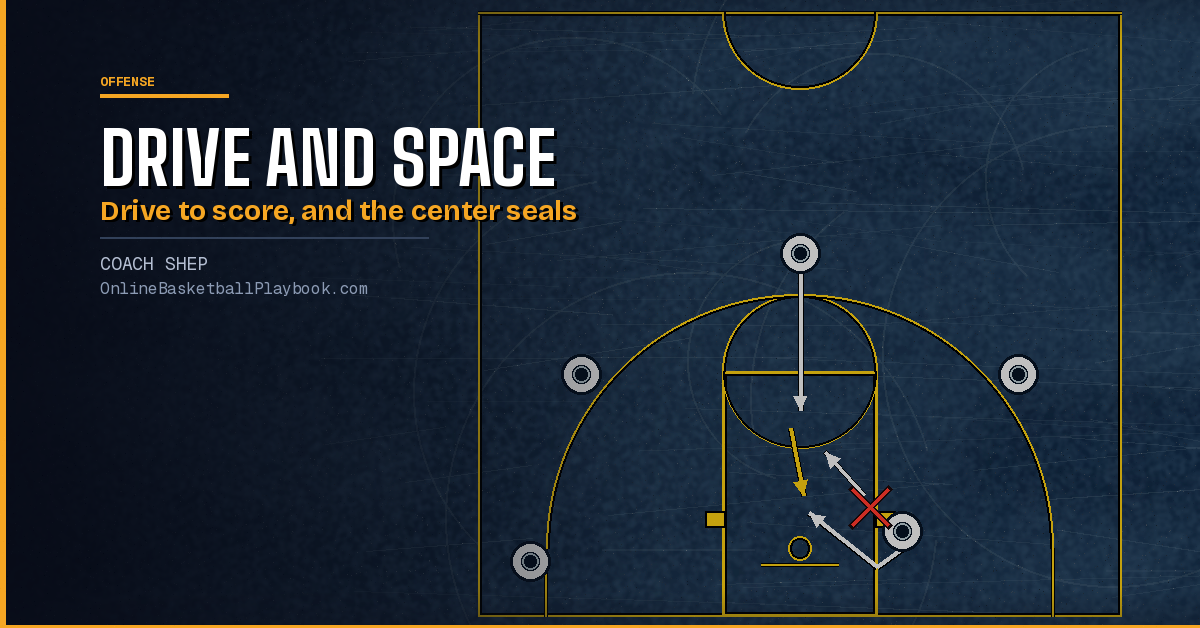
Drive and Space Offense: Gaps, Pitches and the Rim Runner
Drive and space offense explained: the three cues, penetrate pitch post, the advantage chain, the sealing center, protection plans, trail spots and how it morphs.
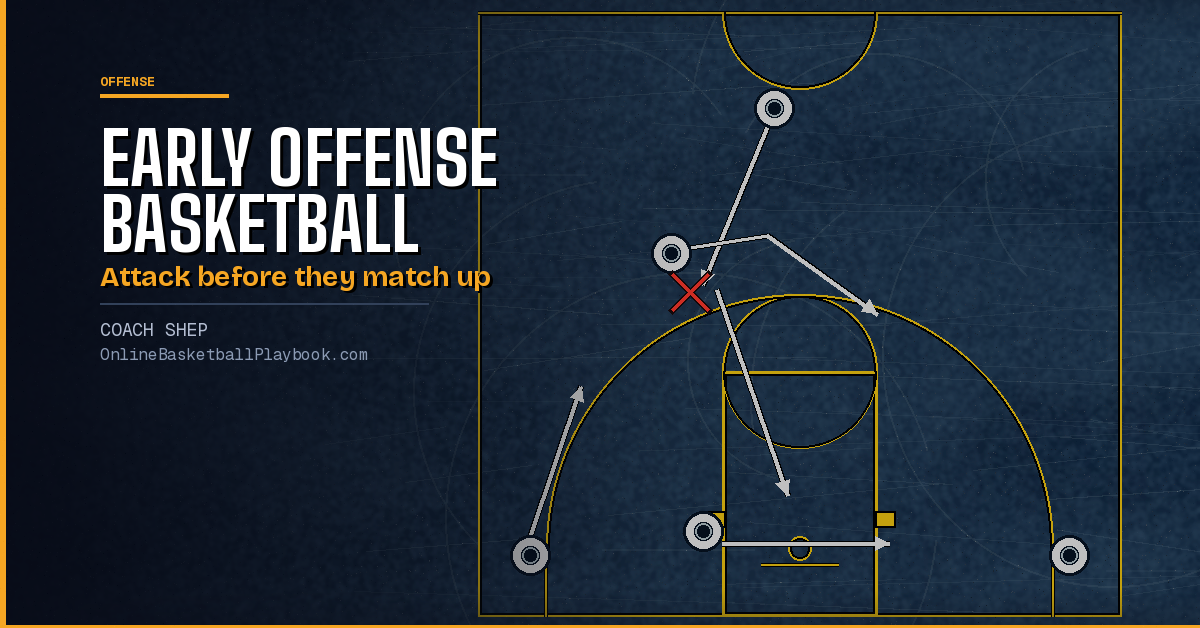
Early Offense Basketball: Pace, First Actions and Drills
Early offense basketball from the outlet to the first action: the push clock, the outlet, drag screens, pistol, flowing into your offense, shot rules and the drills.
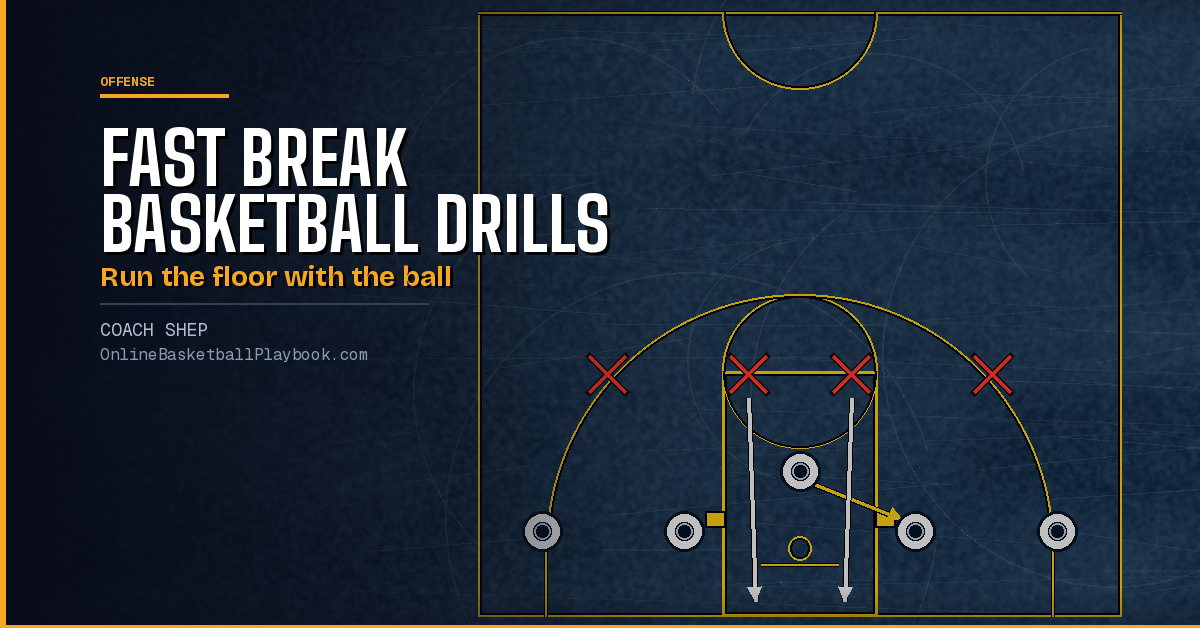
Fast Break Basketball Drills for Youth and Varsity Teams
Fast break basketball drills that run the floor with the ball: weaves, partner and no-dribble drills, catch-up drills, a finishing series and youth versions.