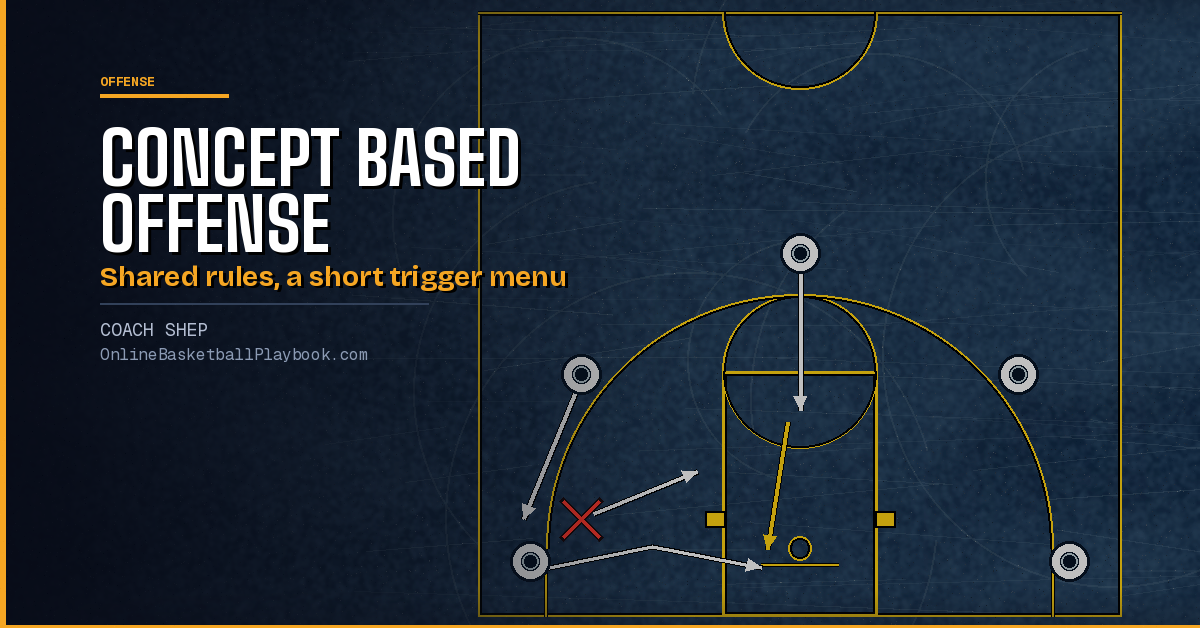
A concept based offense is built on a few shared rules instead of a library of set plays or the fixed pass-and-cut routes of a motion pattern. Every player learns the same shot values, the same reaction to a drive or a kick-out, and a short menu of named actions to flow into when nothing else is open. It is usually taught through small-sided games with constraints instead of walking through spots. This guide covers what a concept based offense is, where it sits beside motion and sets, the arrival spacing, the shot value scale, the chain of read-rules, the answers when one defender guards two, protection plans, transition, the trigger menu, how teams install it, and the questions coaches still argue about.
What Is a Concept Based Offense?
In a concept based offense, the coach teaches rules for situations instead of plays for possessions. The fullest version on record, called the read-rule version here, sets out four parts: how the team arrives in the half court, a single shot value scale, a numbered chain of read-rules for playing off an advantage, and a menu of named trigger actions grouped by how many players they use. When a defense gives an advantage, the read-rules take over. When it does not, the team flows into a trigger without stopping.
Related systems use the same idea in other forms. One layered reaction system gives the ball handler freedom to shoot, drive or pass and cut, and gives each of the four other players one correct reaction to what he does. The advantage-state version of drive and space runs on an advantage-or-no-advantage rule. Each is listed below where its version differs. Where concept-based play fits among offensive systems is on the basketball offense guide.
Concepts, Motion and Sets
Sources draw the line between concepts, motion offense and set plays in different places.
| Version | Where rules-based offense sits |
|---|---|
| Read-rule version | A third option that rejects both traditional motion and scripted sets |
| Advantage-state version | Not Princeton (false movement, limited player types), not motion (designated screeners, congested lanes), not pro ball screen (two players only), not sets (the coach dictates touches) |
| Layered reaction system | "Not an offense, it is offense": one system for man and zone from youth teams up |
| Sets first, rules as the fallback | Call a set, then fall back to the reaction rules when it breaks |
| Rules filed under motion | Reaction systems and blocker-mover grouped as kinds of motion, hard to scout because the defense never knows what is coming |
| Concepts as the backup | The six-pairs fallback version keeps a concept offense of six two-man actions with the big, plus hand-signal ball screens, for when its called plays are not available |
A related family, blocker-mover, also runs on rules, with screeners and movers in assigned areas.
Arrival Spacing and Floor Names
The read-rule version says the team arrives in one of four spacings, decided by who is ahead of the ball in transition.
| Arrival | How it forms |
|---|---|
| 5-out loaded corner | The most common arrival. A teammate is in the corner on the ball side. |
| 4-out loaded corner | A player clears ahead of the ball to the weak-side dunker spot, or a post fills the strong-side post spot. |
| 5-out empty corner | The handler catches on the far side of the floor with no teammate between him and the nearest sideline. |
| 4-out empty corner | The same far-side catch with a post filling in. |

The team sits in 5-out for only "a second or two" before a trigger fires. The same version also gives every spot a name, left and right: corner, dunker, mid-post, block, elbow, nail, 45, slot and top. Shared names let the rules be taught in one language. Spacing distances are on what is spacing in basketball and the five-out shape on 5 out offense.
One Shot Value Scale
Instead of a shot rule for each play, the read-rule version uses one scale for the whole team, which it calls the Shot Spectrum.
- Want. Rim finishes, unless heavily contested, and in-rhythm threes, especially from the corner.
- Avoid unless the clock is late. Mid-range shots and fade-aways, like-for-like post-ups, and pull-ups, which are allowed with 10 seconds or fewer on the shot clock.
Other versions order the diet differently.
| Version | Order or rule |
|---|---|
| Want and avoid scale | Rim finishes and in-rhythm threes, avoid mid-range, fades, like-for-like post-ups and early pull-ups |
| Free-throw-first order | Free throw, then layup, then three, with a target of 1.08 points per possession |
| Layups-then-threes order | Think layups and threes, in that order, with most editions adding attack the rim and get to the free-throw line |
| Shot quality game | Scores each possession on shot quality, so a good miss beats a bad make |
The scored game in the last row grades each possession 0 to 5 for shot quality and then adds the points scored. A 5 is an uncontested layup or three. A 4 is a minimally contested three, a contested layup or a shooting foul. A 3 is an uncontested mid-range shot or a heavily contested three. A 2 is a contested mid-range shot, a 1 a dead-ball turnover and a 0 a live-ball turnover. A wide-open missed three banks 5, a made contested mid-range shot banks 4, and an offensive rebound is "found money," worth points only. Each team plays 10 possessions, 5 on offense and 5 on defense. Shot selection in general is on basketball shot selection.
The Read-Rule Chain
The read-rule version chains its rules together. The moment an advantage is triggered, the team drives and kicks, or passes, to get a great shot. The rules are numbered one to three.
- Decide before the catch. Know shoot, pass or dribble before the ball arrives. On a kick-out, the four players off the ball anticipate the shot and tag up on the high side for transition defense. If the shot is not obvious, the passer gets out to space at once.
- One defender can't guard two. When one help defender can cover both the ball and an off-ball player, the off-ball player punishes it right away. The answers are in the next section.
- Kick and sprint to space. The moment a player kicks the ball, he sprints to space, the nearest corner or his original spot. Kicked before the ball gets into the paint, a back-pedal to his spot is usually enough.

Two more rules sit beside the chain. Push and pull covers every drive: a player one gap from the ball is pushed if the drive comes at him and pulled if it goes away from him, with the cue "circle the three-point line and then step into range." Hold the corner is the one place a player does not sprint out: on a drive toward the strong-side corner, the corner player holds, because the corner three is the best shot on the scale if his defender helps.

A single-side baseline lift breaks up three in a row, ball, player and defender, into two in a row. On a three-side, the player on the 45 looks for a cut from the middle of that side, and if push or pull leaves the defender attached, the player cuts again. A shorter statement of the same vocabulary pairs the chain with "ball don't stop": if the ball stops, a trigger action restarts it. Reads off a drive in general are on teaching dribble penetration reads.
When One Defender Guards Two
Three versions of the answers are on record.
The full menu
- Wing ghost cut. When the help defender loses sight of the wing, or a non-shooter is on that side.
- Corner ghost cut. On a middle drive, the corner player cuts, and the 45 player drifts to the corner he left. There is no wing ghost cut on a middle drive, because there is no space for it.
- Hammer. A flare screen with a baseline drive. Best with a great shooter on the 45, a non-shooter in the corner, or a defender deep in the paint.
- Pin in. The 45 player pins the help defender so the corner player can lift for the kick-out.
- Push and pull. The rule above.
- Wheel up. On a baseline drive, the weak-side post circles up to find a passing window.
- Wheel under. On a middle drive, the post wheels under the basket, which opens a window on the other side of the rim and room for the driver.


The two-answer version
The small-sided-game install of the read-rule version teaches two main answers. Separate: the weak-side player lifts to the slot to stretch the help. Ghost cut: the corner or slot player cuts behind the low defender's head and comes out under the basket. Its off-ball players also find windows instead of spots. If help comes early on their side, they catch early on that side of the rim. If help comes late, they come out late on the other side. When a help defender sits right under the rim, the off-ball player clears the lane so the driver has a straight path.
The one-line version
The shortest version states it as never let one guard two: react at once with a cut, a perimeter slide, a pin away or a flare. More on reading help defenders is on advantage basketball: reading the help.
Protection Plans for a Dead Drive
A driver with no finish and no pass protects the ball with a named move instead of standing still. The menus differ.
| Version | Protection plans |
|---|---|
| Read-rule version | Nash dribble under the basket, bounce-out, back pivot or Barkley |
| Advantage-state version, built-in plans | Barkley and Nash, listed as built into the offense |
| Advantage-state version, footwork plans | Stride stops, pivots, lifting and bounce-outs |
| Advantage-state version, bounce or lift | A driver at the top of the key bounces out, and a driver from the wing lifts |
Transition Without Lanes
The read-rule version replaces lane assignments with one rule for everyone. The trailer is whoever is closest to his own basket. Everyone reacts without lag, wins the first three steps and sprints. The ball goes to whichever two-side is ready first, and if both look equal, the handler dribbles to the lower side. On a skip to the far side, the trailer changes course to fill the new weak-side dunker spot. Off an opponent's free throw, the team forms its two-side away from the rebound side. "Lag-free" also has a second meaning: moving from one action to the next with pace. The rest of the break is on early offense basketball.
Triggers: The Short Action Menu
With no transition advantage, the team flows into a trigger at once, in live-ball play only. The read-rule version groups them three ways.
| Group | Triggers |
|---|---|
| By number of players | Solo (a 1-on-1 mismatch), Duet (pick and roll), Trio (pistol), Quartet (stagger) |
| Fast ball, advancing at speed | Pick and roll, get, screen away, flare screen, zoom, pistol |
| Slow ball | Scrape, double, stagger, mash |
| Dead ball | Half-court sets Flash and Side, and two sideline inbounds sets |
Another version does the same job with call words that name actions instead of plays: chest, low, wave and twirl against man, and gaps, fist down, double and loop against zones. Several of the trigger names, zoom, pistol and horns among them, also show up in the NBA's five-out offenses. Two of them, the pick and roll and the flare screen, have their own guides.
Get the next coaching guide in your inbox
One email when a new guide or diagram set goes up. Free.
How Teams Install It
Two install methods are on record, and they differ a lot.
Engineered small-sided games
Every game starts from an advantage the coach builds. He sets its size by where he places the ball, the outside hip for a baseline drive or the inside hip for a middle drive, and by how close the defender starts, then releases play with a hi-five. A guided defender plays lettered coverages, trail, cut-off or neutral, so the offense sees a different read on each rep, with at least three reps. That install says static dribbling has very little learning benefit. Its blind cut game fixes a youth habit it names directly: cutting "around the branches," a wide route that gives the defender time to recover, instead of "through the branches." Why small-sided games work is argued on reasons to use small-sided games, and decision training in general on how to teach basketball decision-making.
Layers, one at a time
The layered reaction system is taught one layer at a time. Sources count its layers differently, 20 in some and 17 in an older count. The year-by-year install starts a youth team on layers 1 and 2 in fifth grade and adds one a year, with varsity moving faster. The six-layer install teaches the first six layers as the base and runs five steps: three-player reaction drills of about 90 seconds, 5-on-0, 15 to 20 minutes of 5-on-5 against dummy defenders, a deflection game, then live play, stepping back if players freeze. That install holds that 5 or 10 minutes a day is not enough. Breakdown drills for this kind of offense are collected on drills to teach concept-based basketball.
Against Zones
Whether one rules offense handles zones is disputed. Teachers of the layered reaction system say the same rules work against man and zone. The zone-motion version runs separate concept continuities instead. From any 4-out look, every perimeter player passes, cuts straight into the middle of the zone, takes two steps back toward the ball and exits to either side. A second continuity, from a 2-1-2, is its answer to extended half-court zone traps, with no set plays against traps. Zone offense is covered on drills to teach zone offense.
Base or Backup, and Who It Fits
Programs use concepts as the whole half-court offense or as what they fall back on.
- The whole offense. A no-called-plays version runs the half court from a 2-3 high set with no primary point guard and attacks any half-court trap without changing alignment.
- Sets first. Call a set, then play the rules when it breaks.
- The backup. The six-pairs fallback version above uses its concept offense only when plays are not available.
Whether set plays can sit on top is itself disputed: the full-commitment view holds that a reaction system does not mix with fifteen set plays. Four factors come up for choosing among offense families: age and practice time, the coach's philosophy, the personnel, and the fit with the team's defense. A personnel-first view says to choose by personnel, teach one main offense first and then add plays. The costs named for a reaction system are patience, full commitment and clear roles.
Common mistakes on record:
- Hesitating after the catch. It stops the chain.
- Watching the drive. The kick-and-sprint rule is built to fix it.
- Cutting around the branches. The wide route gives the defender time to recover.
- Static dribbling drills. Replaced by games that force reading while handling.
- Short cuts and late passes. Both hurt spacing.
Questions Coaches Ask About Concept Based Offense
What is a concept based offense in basketball?
An offense built on shared rules instead of set plays: one shot value scale, a chain of reactions to drives and kick-outs, and a short menu of trigger actions, usually taught through small-sided games.
What is the difference between concept based offense and motion offense?
Motion uses pass-and-cut and screening rules. A concept based offense replaces those with read-rules that fire off an advantage and named trigger actions, though sources draw the line in different places.
What does "one defender can't guard two" mean?
When one help defender can cover both the ball and an off-ball player, the off-ball player punishes it at once with a ghost cut, a lift, a pin, a flare or a wheel.
What should a player do after kicking the ball out?
In the read-rule version he sprints to space the moment he kicks it, to the nearest corner or his original spot, instead of standing where he passed.
Can youth teams run a concept based offense?
Its teachers install it with small-sided games where the coach sets the size of the advantage, bigger for younger players. One layered system starts youth teams on two layers and adds one a year.
Want every diagram on the site?
OBP Pro members get the full diagram files for every offense guide on the site, ready for a practice binder or a scouting report. $9 a month. Or draw your own version free in the play drawer.
See what OBP Pro includesMore Offense System Guides
- Pace and Space Offense: Threes, Layups and Playing Fast
- Drive and Space Offense: Gaps, Pitches and the Rim Runner
- Why Every NBA Team Runs the Same Offense: Five Out Delay
- Two Guard Motion Offense: Chin, Shuffle and Motion Series
Back to Basketball Offense and every Offense page.
Keep Building
Related breakdowns
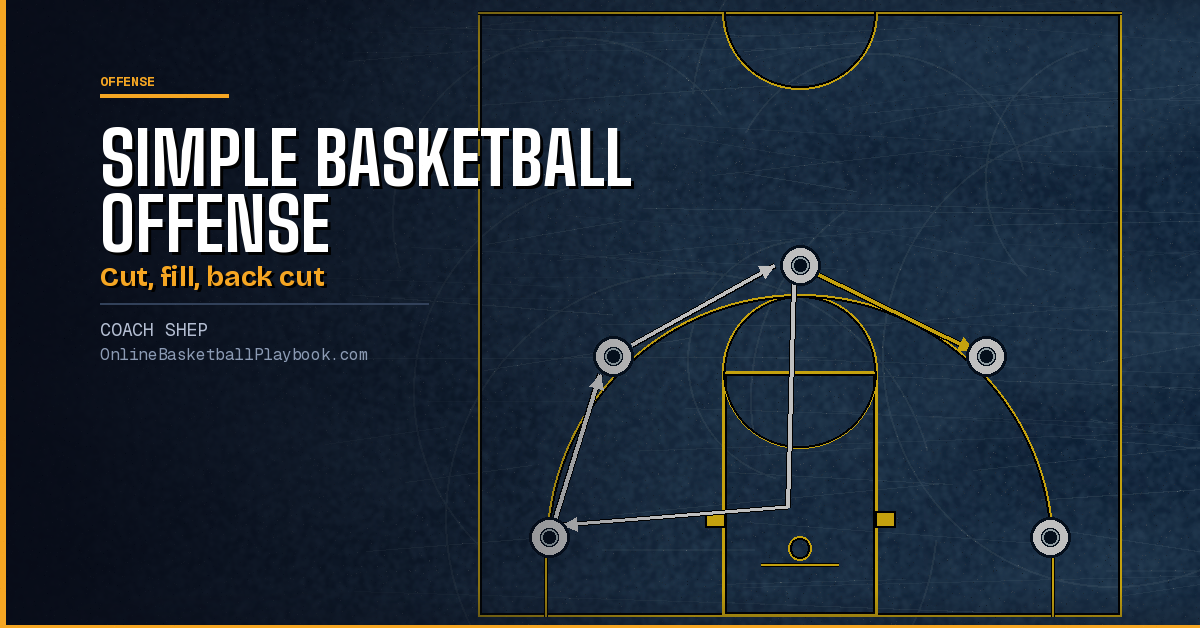
Simple Basketball Offense for Youth and Beginner Teams
A simple basketball offense for youth, middle school and beginner teams: a spacing set, the three-rule 5-out, 4-out options, a zone answer and a press break.
Basketball Offense: Systems, Actions and Sets Explained
Basketball offense explained as three layers, systems, actions and sets, with the formations, spacing numbers and a map of the major offenses and their pages.