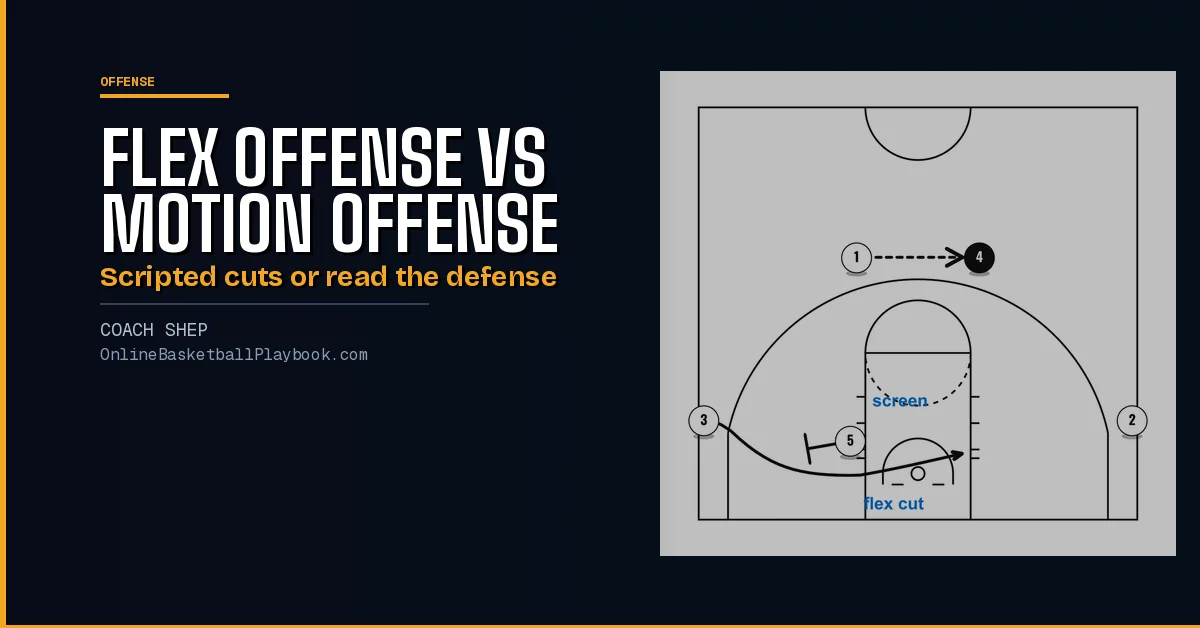
Flex offense vs motion offense is a choice between a pattern and a set of rules. The flex is a continuity. A guard-to-guard pass sends a baseline player off a teammate's baseline screen, the passer then screens down for that screener, and the same two actions repeat from side to side until a shot comes. Motion has no fixed sequence. Each player watches his own defender and the ball, then picks a pass, a cut, a screen or a screen to use. Both keep everyone moving and both ask every player to fill every spot. They differ in who decides the next action, the pattern or the player. Below, the two are drawn side by side at the same moments of a possession.
Flex Offense vs Motion Offense at a Glance
| Flex offense | Motion offense | |
|---|---|---|
| What runs it | A pattern: flex cut, then down screen, repeated side to side | Rules: read the defender, then pass, cut, screen or use a screen |
| Who decides the next move | The pass that triggers the pattern | The player, off what his defender does |
| Signature action | Screen the screener | Never pass and stand |
| Starting shapes | 1-4 low, 4-out 1-in, 2-3, 5-out, a raised high flex | 5-out, 4-out 1-in, 3-out 2-in, blocker-mover |
| Positions | Every player passes through every spot | Positionless, unless the coach adds roles |
| Best against | Man-to-man | Any defense, with the rules carried over to zones |
| Known costs | Predictable once scouted, trouble with switching | Players can drift to their strengths, unclear shots without roles |
| Install | Two pass rules, then read counters | Layers: rules, drills or alignments in order |
The Starting Shape


The flex starts from many shapes, but each one ends in the same picture once it runs: two players up top, a flex cutter on the baseline and a screener near the block. Coaches enter it from a 1-4 low look, a 4-out 1-in, a 2-3, a box, a double stack or a 1-3-1, and some disguise the entry so the defense cannot tell it is coming. Motion is a family of alignments run on one set of rules. The same rules work from five-out, four-out one-in, three-out two-in and blocker-mover, so a coach teaches them once and any alignment uses them. Full guides: How to Coach the Flex Offense and Motion Offense Basketball.
The First Action


In the flex the guard-to-guard pass is the trigger. The weak-side corner player runs off the post's baseline screen looking for a layup, going over or under the screen depending on his defender. On a pass from a guard to a wing, the passer goes and screens away from the ball. Those two pass rules are the whole base.
In motion the passer must do something after the pass, and the menu depends on the coach. Some give three choices (basket cut, set a screen, receive a screen). Others give four, five or six, adding the back cut, replacing yourself, a V-cut out, a ball screen or a shallow baseline cut. Bob Knight's version is shorter: every movement is a cut, a screen or using a screen. Reads behind the cut are on Pass-and-Cut Motion Offense.
Screens


Screen the screener is what makes the flex the flex. The man who just set the baseline screen is screened for next, which puts two screens in a row on the defense. To stop the cutter, his defender needs the screener's man to help, and that man is being screened right then. The offense puts the defense in that spot again and again each trip. One flex design counts two shots per side: the flex cut looks for a layup or a post-up, and the down screen looks for a catch-and-shoot jumper.
Motion leaves the screen to the rules, and coaches assign them differently. In one version the inside man is the screener except on flares. In another only guards screen for guards. In Dick Bennett's Blocker-Mover Offense, blockers screen for movers. Most versions agree the screener is the second cutter and must be ready to catch. Screen types are on Basketball Screens.
Get the next coaching guide in your inbox
One email when a new guide or diagram set goes up. Free.
When the Pass Is Denied


The flex needs the guard-to-guard pass, so defenses deny it. Flex coaches carry answers ready. The backdoor is the first release, and in one version the corner player comes up high to the elbow, which opens room for the denied guard to cut behind his man. Another uses a dribble exchange, with the denied player cutting underneath. After that come a set of corner options (a give and go, a UCLA cut off the post, a dribble entry, a single screen, a staggered screen, cross screens), each with a code word. Most say pick two or three. Against switching they add the duck-in, where the screener seals and steps into the lane right after screening.
Motion makes denial a trigger instead of a stop, but the trigger differs by coach. Some back cut at once when denied one pass away. Some back cut only when the defender has a foot above the arc or is making contact. Others V-cut, or screen down. The read itself is on Cut or Backdoor: Reading the Denial.
Strong and Thin Spots
Flex
Strong: it never ends, so there is no moment when the play is over and players drift into one on one. Everyone touches the ball, the dribble count stays low and the coach controls the tempo. It suits teams of average ability and teams without height.
Thin: it is predictable once scouted, and switching derails it. Opponents zone it, and the pattern develops slowly enough for a disciplined zone to rotate. When the player coming off the down screen is no shooter, his defender sags into the lane and the cut has nowhere to go. Players can also go through the motions and forget to score.
Motion
Strong: it adapts to whoever is on the floor, so one substitute does not break it. It is hard to scout, works against any defense and teaches players how to play rather than a play.
Thin: players given only the instruction to play motion lean on what they already do well. The shooter keeps shooting and the right-hander keeps driving right. Without roles it may not get the best players the most shots. Cuts made too early close the passing lane, and shooters catching on the move away from the rim cost offensive rebounds.
Personnel
Flex: every player plays every spot, so posts learn to face up and guards learn post angles. Everyone has to be able to shoot, because the down-screen pop is half the offense. Coaches split on who posts: some make all five post with a move and a counter, some keep a weak guard off the block with a push call, and one version sends a big who does not play away from the basket to the corner and frees him with the flex screen.
Motion: it is built to be positionless, but coaches add structure in steps. Some run free rules only. Some name recurring actions. Some add roles, which steer shots to the best players. Others put short set plays on top. The post follows the same rules as everyone else, and versions range from holding the post to screening and clearing out.
Where Coaches Split
1. Is a pattern good for young players?
- Any-age version: the flex fits any team from about age 11, and is at its best for short teams, shooting teams and smart teams.
- Second-offense version: run it as a structured second man-to-man offense, and as a teaching offense for young players.
- Reading version: a pattern can keep young players from ever learning to read the defense, and it eats practice time.
2. What follows the flex cut.
- Down screen to the elbow for a jumper.
- Down screen that pops the screener to the top for the shot or the reversal.
- The passer fades to the corner instead of screening, for spacing.
- Skip the down screen entirely, since it makes the flex a jump-shooting offense.
3. How much structure motion should carry.
- Free rules: no predetermined movement and nothing on paper.
- Pattern with a bail-out: a pattern plus a call that breaks into motion.
- Motion plus sets: short sets added, with options at points in the shot clock.
4. Whole offense or fallback.
- Flex as the whole base offense, run every trip.
- Flex as the place a set or the break ends, a brief continuity that holds the team together when the first action breaks down.
Both offenses sit in the larger family on Continuity Offense Basketball, and named flex specials are on Flex Basketball Plays.
Pick It When
- You need an offense in by the first game: the flex, since the base is two pass rules.
- Your opponents mostly play man-to-man: the flex is built for it.
- Your league switches every screen: motion, with screeners who separate hard opposite the cutter, or a flex with its switching counters ready (duck-in, slip, post up the small defender).
- Your opponents zone you: motion, whose rules carry over to zones.
- You have no post but five shooters: either one. The 5-out flex and 5-Out Motion Offense both start with nobody inside.
- You have one good big: 4-Out 1-In Offense motion, or a flex with a post-up call for him.
- Your players read the defense well: motion gives them room to use it.
- You want a delay or a fallback when a set dies: the flex.
From the defense side: How to Defend 5-Out Motion. Two other read offenses are compared on Triangle Offense vs Princeton Offense and Princeton Offense vs Motion Offense, and the guard spots that run them on Point Guard vs Shooting Guard.
Questions Coaches Ask
Is the flex offense a motion offense?
No. It keeps motion's pass-and-move habits but scripts the cuts, which makes it a patterned continuity. Some coaches run it as a fallback inside a motion system.
Does the flex work against a zone?
It is most effective against man-to-man. Opponents often zone it, and a disciplined zone has time to rotate as the pattern develops.
Which is easier to teach?
The flex base is two pass rules, so it goes in fast. Motion is taught in layers, with each rule owned before the next one goes in.
Can you run both?
Yes. Some programs carry the flex as a second man-to-man offense, a delay or the place a set ends, and one set uses flex, triangle and motion as its fallbacks.
Want the printable playbook packs?
Playbook packs: zone attack, press break, press defense, out of bounds, quick hitters, practice plans and the youth turnover cure, each a printable PDF. Or draw your own version free in PlayDraw.
See the playbook packsRelated Guides
- Point Guard vs Shooting Guard: Roles, Skills and Reads
- Triangle Offense vs Princeton Offense: Side by Side
Back to Basketball Offense and every Offense page.
Keep Building
Related breakdowns
Motion Offense: Spacing, Rules, Actions and How to Install It
Motion offense runs on rules, not called plays. See the spacing, four core actions, 5-out versus 4-out 1-in, the install order, drills and where it struggles.
4 Out 1 In Motion Offense: Rules, Spacing and Sets
4 out 1 in motion offense: spacing, the six rules, what the post does, pass-cut-fill, screens, quick hitters, zone adjustments and how to install it.
Davidson Basketball Plays: Motion Offense Rules and Actions
Davidson basketball plays from its motion offense: the early offense, the Strong series, the three rules and the reversal actions, drawn frame by frame.