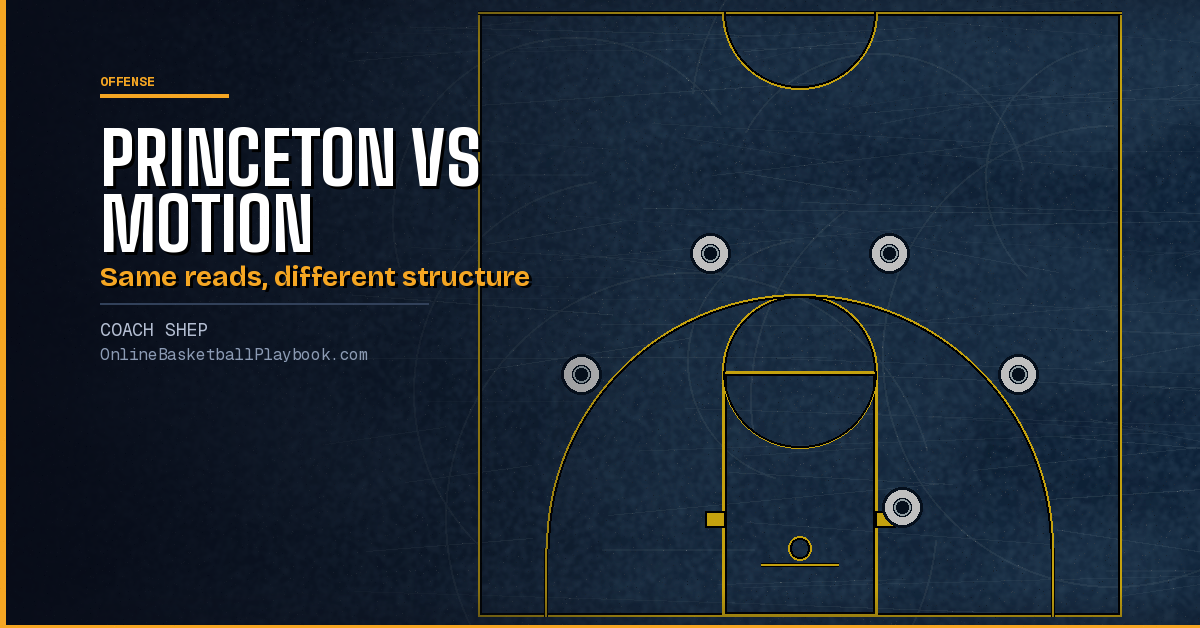
Princeton offense vs motion offense is a comparison of two read offenses that grew from the same idea. Both run on reads of the defender instead of a called sequence, both punish an overplay with a cut, and both ask every player to pass, cut and screen. They differ in how much shape they put around those reads: where the post stands, whether cutting or screening comes first, whether actions have names, and what the dribble is for. This guide puts the Princeton offense and motion offense side by side, one principle at a time, and leaves the choice to the coach and the roster.
Princeton Offense vs Motion Offense at a Glance
| Principle | Princeton offense | Motion offense |
|---|---|---|
| What runs it | Reads inside named sets (Chin, Point, Low), each keyed by a pass or a dribble | Rules taught once and used from any alignment, with no called sequence |
| Spacing | High and wide: two guards above the arc, forwards on the wings, 15 to 18 feet apart | Five-out, four-out or three-out, with spacing figures that range from 12 to 18 feet by source |
| The post | A passing hub, often at the high post | Follows the same rules as everyone else, with versions from hold your post to screen and clear |
| Cut or screen first | Cutting over screening in the six-set version | Varies: screen away on every pass, cut first, or screen-heavy |
| Overplay | Backdoor, every time, in every set | A denial rule the coach picks: back cut, V-cut, down screen or several answers |
| Dribble | A signal to a teammate, and a dribble-up resets the offense | Used only with a reason, from a short list the coach picks |
| Shots | Layups and threes, in that order | Defined player by player or by a shot scale |
| Install | One option first, sets added in order, years to master in one estimate | A ladder: alignments, drills or rules in layers |
Spacing and the Starting Picture
Princeton. The Princeton player rules say there are no typical 1 to 5 positions. Two guards start a little above the hash marks, about 15 feet apart, two forwards stand outside the arc on the wings, and the center starts on the low block opposite the ball or at the high post. The rules keep players 15 to 18 feet apart, has the ball skipped to the weak side when the help sits there, and tells everyone but the post never to stand still for more than a second. Carril's own line on it was that good spacing creates scoring opportunities.

Motion. Motion is a family of alignments run on the same rules: five-out, four-out one-in, three-out two-in and blocker-mover. The distance between players changes by source. Several rule cards use 12 to 15 feet and others use 15 to 18. The rules that protect the spacing are short: never cut into an occupied spot, no two cuts in the same direction, and in Dick Bennett's blocker-mover, movers never start on the same side. Bob Knight's high offense kept four players at the foul line or above. The alignments themselves are compared on 5-out motion offense, 4-out 1-in offense and 3-out 2-in motion offense.
The Post's Job
Princeton. The post is the hub. Carril played through the high post because it spreads the defense, centers are less comfortable guarding up top, and the ball reverses more easily from there. The hub-first view calls a post with passing, court sense and range non-negotiable and tells a coach without one to pick another offense. The low-post version of the offense starts from a post feed instead, covered on Princeton low post series.

Motion. The post follows motion rules. The versions differ on how much he touches the ball:
- Screen and clear. Inside players do not demand the ball unless their defender has helped and there is a clear path to the rim. Their job is to screen, clear out and go after rebounds.
- Hold the post. Knight's posts held their posts.
- Look inside on a count. One version looks for the post or the paint every third pass and re-feeds or reverses when the ball comes out.
- Fill the high post when it is open, in one version.
Post skills for both are on post play in basketball.
Cuts, Screens and Movement Rules
Princeton. The offense names its pieces. The Princeton player rules name eight cuts (dive, strongside, weakside, shuffle, UCLA, backdoor, duck-in and rub) and seven screens (down, back, rub, flare or fade, screen toward, screen away and double). Cutters usually go opposite of where they came from, and a cutter who goes through without the ball gets back to the perimeter fast. Carril wrote one rule in capitals: whenever you cut, look for the ball. The six-set version calls the offense more about cutting than screening.
Motion. Knight's rule is that every movement is one of three things: screening, coming off a screen, or cutting. Mike Krzyzewski's version is that the toughest man to guard is one who is moving. After a pass, every version says do something, and the menus differ by count:
| Version | After you pass |
|---|---|
| Three choices | Basket cut, set a screen, or receive a screen |
| Four choices | Back cut, screen away, set up and receive a screen, or replace yourself |
| Five choices | Basket cut, V-cut out, screen for the ball, screen away, or use a screen |
| Six choices | Screen away, go behind the ball, basket cut, replace yourself, ball screen, or a shallow baseline cut |
The first action differs too. One five-out version screens away on every pass. Others teach pass and basket cut before any screen. Knight's motion is screen-heavy. Krzyzewski's screeners must be ready to catch, because they are the second option every time.


Screen types and their reads are on basketball screens and down screen basketball.
Get the next coaching guide in your inbox
One email when a new guide or diagram set goes up. Free.
Reads: Denial and the Dribble-At
Princeton. The overplay answer never changes. The Princeton player rules say go backdoor at once if overplayed, go backdoor instead of to the ball when closely guarded, and go backdoor when a teammate dribbles at you and you are played tight. Carril put it in six words: when closely guarded, go back door. The backdoor is live in every set.
Motion. The denial rule is the coach's choice, and the versions differ:
- Back cut at once when denied one pass away and the passer looks at you.
- Back cut on a defined trigger, such as the defender with a foot above the arc or making contact.
- Back cut or down screen only, with no V-cuts and no juking.
- V-cut against denial when the defender sits in the passing lane.
- Three answers, in the Davidson rules: cut backdoor, screen down, or back screen after cutting through.
On a dribble-at, both mostly agree: a back cut when the receiver is played tight, with some motion versions making it a hand-off when the receiver is open. The read behind every backdoor is on backdoor cut basketball, and the rule both offenses share is laid out on the read principle.
Named Sets or Rules
Princeton. A pass or a dribble names the next set, so there is still no call from the bench. In the six-set version, a wing with the ball has three options any time: post open means Low, a pass up means Point, and no option means dribble up into Chin. A breakdown always ends the same way, with the ball handler dribbling up to the guard spot to start Chin. The sets are on Princeton Chin series and Princeton Point series. Before any set, the Princeton rules run 10 to 12 seconds of movement to make the defense guard something, unless the team is behind late and needs a quick score.
Motion. Motion runs on rules, with no predetermined movement. Coaches still sit at different points between free and structured:
| Version | What sits on top of the rules |
|---|---|
| Rules only | Nothing. Read the defense, with no set pattern |
| Rules plus named actions | Recurring actions get names so they can be called |
| Rules plus roles | Blockers and movers, with roles that steer the shots to the best players |
| Pattern with a bail-out | A pattern with a call that breaks into motion |
| Motion plus sets | Short set plays added to the motion, with options at set points in the shot clock |
Personnel and Shots
Princeton. Carril's line was that everybody with the ball is a point guard. A later Princeton staff said the program had no 1s, 2s or 4s and taught guards to post and bigs to dribble. Other versions keep one post and two roles. The offense needs the hub described above, and its shot rule is short: layups and threes, in that order, and it does not matter who scores. The dribble drive chases the same two shots by driving, compared on dribble drive vs Princeton.
Motion. The case made for motion over set plays is that a set play can break down when one substitute comes in, while motion adapts to whoever is on the floor. Motion gets players open, and the coach still decides who shoots. Krzyzewski's rules include getting the primary scorer where he scores, and a review of his motion tape says it is not an equal-shot offense. Shot diets vary by coach:
- A scrimmage scale that grades shots 4 in the paint, 3 wide open, 2 okay and 0 bad.
- A 1 to 4 rating where only 3s and 4s get taken.
- Layups and threes, the same diet as Princeton.
Patience floors differ too, from two passes before a shot to four passes before a 15-footer. Shot rules in general are on basketball shot selection.
How Each Is Installed
Princeton. Choose one option and get it executed before giving players a choice. Sets go in one at a time, and the ten-practice install adds no new set until players can say what defensive move triggers the read they already have. One estimate puts the full offense at two to three years before it is a consistent weapon. Princeton drills are on drills to teach the Princeton offense.
Motion. Every source teaches it in layers, with different ladders:
- Alignment ladder. 3-out 2-in first, then 4-out 1-in, then 5-out.
- Drill ladder. 4 on 0 with no post, then 4 on 4 with no dribble, then 5 on 0 with the post screening.
- Rules in order. Spread the floor first and add screens only after the cutting rhythm is owned.
- Constraint games. No-dribble 5 on 5 or 4 on 4 forces movement without the ball.
Motion drills are on drills to teach motion offense. The defender's view of Princeton is on how to defend the Princeton offense.
Questions Coaches Ask About Princeton Offense vs Motion Offense
Is the Princeton offense a motion offense?
It is a read offense like motion, and it shares motion's rules on cutting, spacing and reading the defender. It adds named sets keyed by a pass or a dribble, a passing hub at the post, and an automatic backdoor on every overplay.
What is the main difference between Princeton and motion offense?
Structure. Motion runs on rules from any alignment. Princeton gives the reads named shapes (Chin, Point, Low) and lets the pass or the dribble pick the next one.
Does the Princeton offense need a center who can pass?
Most versions run through a post who can catch at the elbow, pass to cutters and shoot. The hub-first view tells a coach without that player to pick another offense.
Does motion offense use screens or cuts?
Both, and the balance is the coach's call. Some versions screen away on every pass, some teach pass and cut before any screen, and Knight's motion was built on screens.
Which takes longer to install?
One estimate gives the full Princeton offense two to three years. Motion is installed in layers, and how long it takes depends on the ladder and how many rules a coach adds.
Want every diagram on the site?
OBP Pro members get the full diagram files for every offense guide on the site, ready for a practice binder or a scouting report. $9 a month. Or draw your own version free in the play drawer.
See what OBP Pro includesMore Offense System Guides
- The Read Principle in Basketball: Do the Opposite of the Defense
- Dribble Drive Zones: Rack, Drag, Drop and Breakdown Explained
- Dribble Drive Reads: Kick Up, Kick Back, Loop and Dump
- Dribble Drive Named Plays: Drop, Quick, Pop and Corner Sets
Back to Princeton Offense and every Offense page.
Keep Building
Related breakdowns
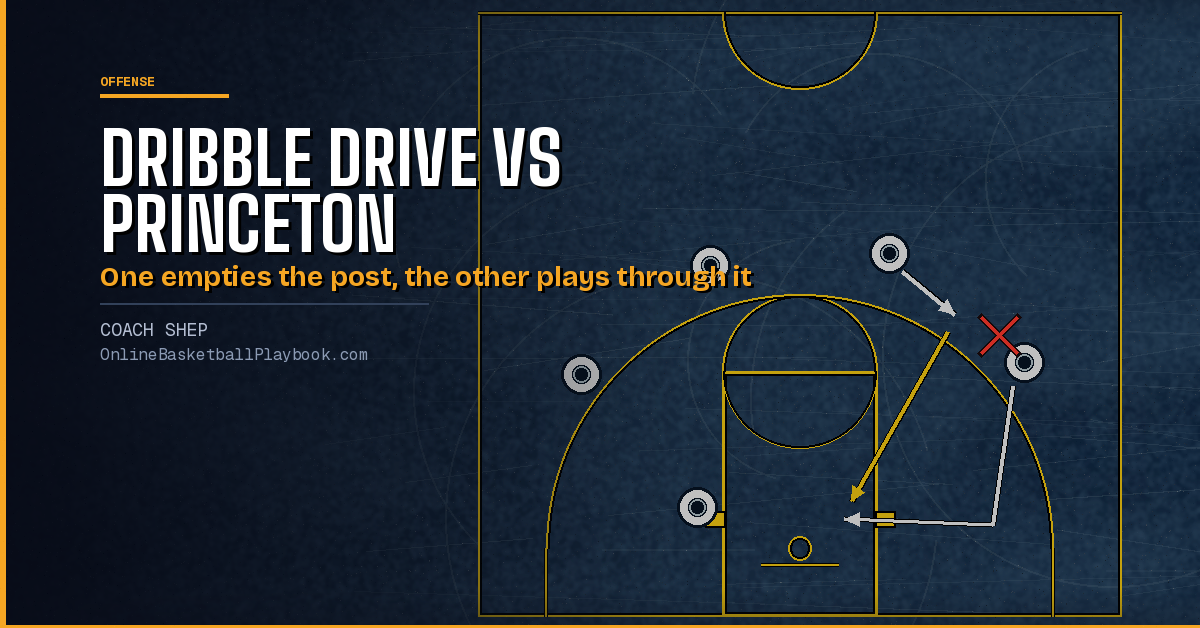
Dribble Drive vs Princeton Offense: Compared by Principle
Dribble drive vs Princeton offense, side by side: the post, spacing, dribble or cut, the backdoor read they share, screens, shots, tempo, personnel and borrowing.
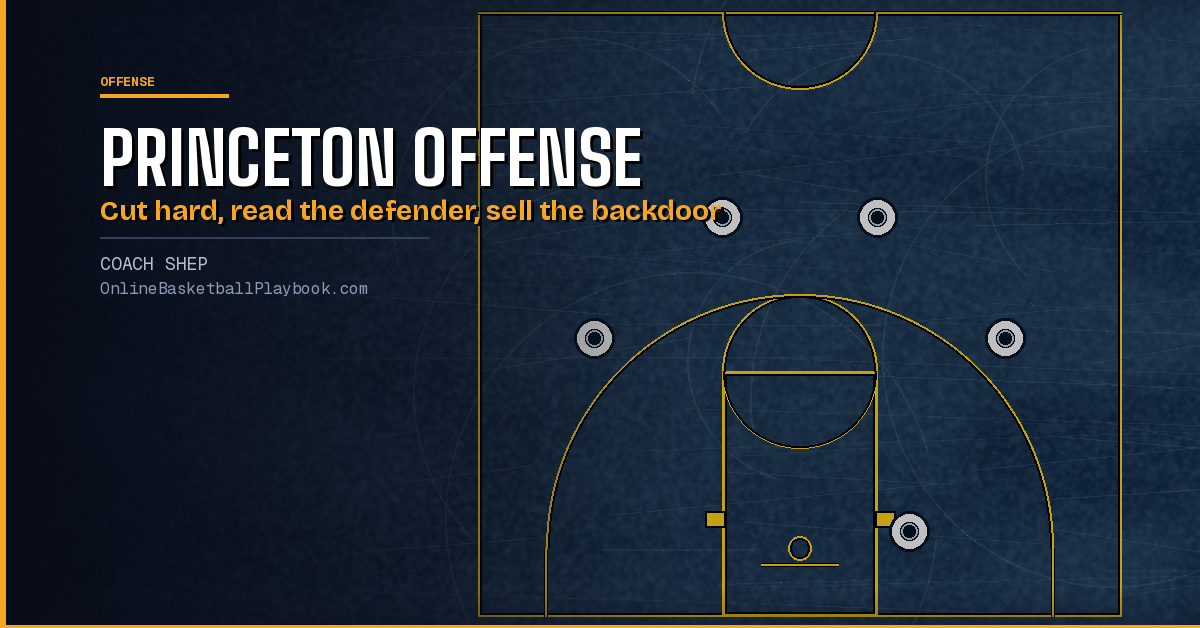
Princeton Offense: Cuts, Reads and Sets
How the Princeton offense works: the Chin set, backdoor cuts, the high-post reads, the players it needs, how to install it and what defenses do to stop it.
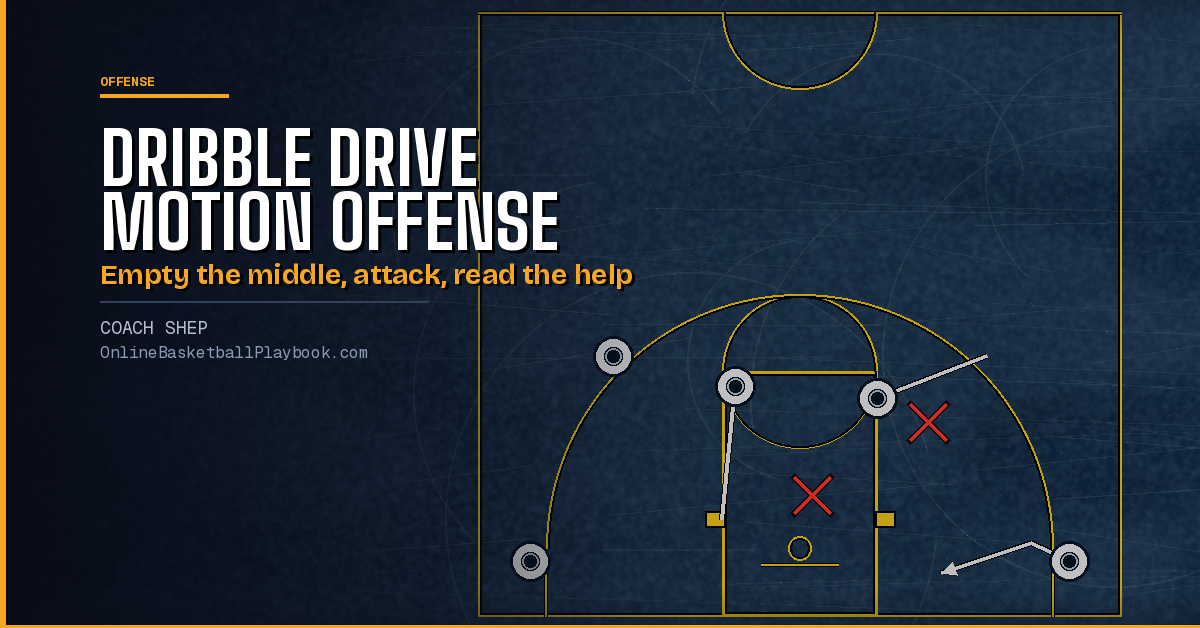
Dribble Drive Motion Offense: Spacing, Reads and Install
The dribble drive motion offense explained: 4-out 1-in spacing, the Drop, Drag and Rack zones, the read off a drive, shot diet, weak spots and the install.