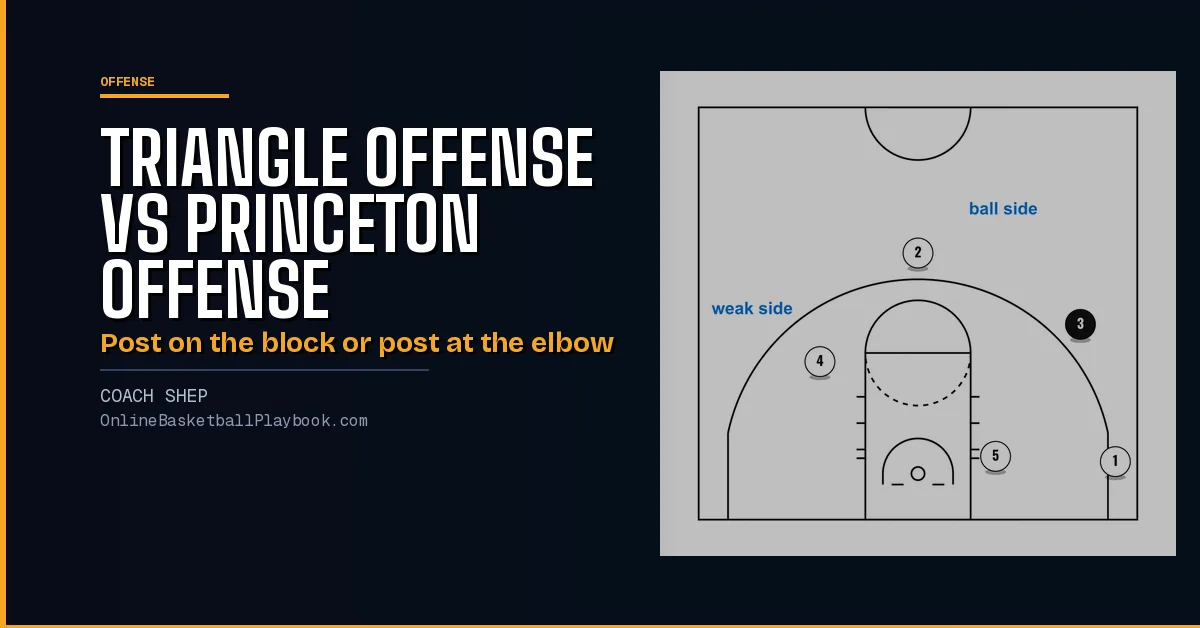
Triangle offense vs Princeton offense compares two read offenses that run without play calls. The triangle belongs to Tex Winter, and Phil Jackson's Bulls and Lakers made it famous. On the ball side, the post on the block, the wing and the corner player make a triangle along the sideline. Away from the ball, the remaining two work a two-man game. The Princeton offense is Pete Carril's patient system. It keeps all five players high on the floor around a post who passes, and it wants every one of them able to pass, dribble, shoot and cut. It scores with backdoor cuts against denial and threes against sag. Both read the defender. They differ in where the post plays, how the floor is shaped and what a pass or a dribble means. Below, the two are drawn side by side at the same moments.
Triangle Offense vs Princeton Offense at a Glance
| Triangle offense | Princeton offense | |
|---|---|---|
| Known for | Tex Winter, Phil Jackson's Bulls and Lakers | Pete Carril's Princeton teams |
| Shape | Triangle by the ball-side sideline, two-man game away from the ball | High and wide, with the area below the free-throw line kept open except for the post |
| The post | On the block, fed along the line of deployment | A passing hub, often at the high post or an elbow |
| What starts the action | The wing's read, in a fixed order | A pass or a dribble that names the next set |
| After a post feed | The passer cuts first, then a post split | Cuts and backdoors off the post, often with a backscreen or a flare |
| Against denial | Named pressure releases, such as the blind pig | Backdoor, every time, in every set |
| Shots | High percentage shots off penetration and the post | Layups and threes, in that order |
| Install load | Heavy, often recommended from high school up | Heavy, one estimate puts the full offense at two to three years |
The Starting Picture


The triangle fills five specific spots instead of moving freely, but nobody runs a called set. Once the ball reaches the wing, the corner, the wing and the post make the triangle, and a guard at the top of the key and a player off the far elbow keep the floor balanced. Spacing is the foundation, and the distances come in versions:
- Scaled by level, from Winter's notes: roughly 12 to 15 feet for high school, 15 to 20 for the NBA, and 15 to 18 for college.
- 15 to 18 feet at every level.
- 15 to 20 feet.
Princeton starts higher. Chin starts with the two guards in the slots, the forwards on the wings and the post at the elbow, and the guard with the ball weaves with the forward on his side. A dribble up to the guard spot after a breakdown always puts the team back in Chin. Full guides: Triangle Offense, Princeton Offense and Princeton Chin Series.
Where the Post Catches


The triangle's first read off the wing is the post. Ball, post, post defender and basket form the line of deployment. If the post keeps himself on that line, his defender is stuck behind him and the entry pass is simple. When the defender overplays the high side or the baseline, the passer throws to the open side. Against a half front from the high side, the ball goes to the corner and the corner player makes the feed. Against a half front from below, the guard at the top of the key makes it. A full front means seal and lob.
Carril ran his offense through the high post for three reasons he gave: the defense has to spread out, a center is less at ease guarding away from the basket, and the ball swings to the other side more easily from there. In the Point series the ball goes to the post at the elbow and the passer's cut, over, away or under, tells everyone what comes next. The offense still has a low-post side: the Low set starts with a post feed, and one of its options is the Laker cut, which Princeton books credit to Winter's triangle. Details: Princeton Point Series and Princeton Low Post Series.
Get the next coaching guide in your inbox
One email when a new guide or diagram set goes up. Free.
Cutting Off the Post


In the triangle, whoever feeds the post cuts first, so a two-man game appears without a call. The corner player cuts right behind him on the post split. If the ball side is shut off, the ball goes back to the top of the key and the guard works with a pinch post at the weak-side elbow: hand-offs, cuts off his shoulder, and a ball screen if the elbow pass is denied. The pinch post needs the best reader, not the biggest player.
In Princeton, cutting comes before screening, and every cutter looks for the ball. In the Chin version, after the swing the post backscreens for the guard, who cuts to the rim, and then the post flares for the next player. The timing comes in two versions. In the swing version the cutter holds until the second guard has passed to the wing. In the slot-pass version the post backscreens on the first slot-to-slot pass and the flare waits for the next pass. If the layup is not there he clears to the far corner, and the floor is set for the flare.
Answers to Denial

Both offenses answer denial the same way at heart: a flash to the high post and a cut behind the defender. The triangle names its pressure releases. In the blind pig the forward on the far side flashes up to the high post for the catch while the denied guard cuts behind his man. Other releases time the wing's pop to the guard's dribble or send the wing backdoor off a pass to the elbow.
Princeton writes it as a rule instead of a play: when closely guarded, go backdoor. The rules go further. Played to the inside, go outside. Played to the outside, go inside. Do the opposite of what the defense does. And when a teammate dribbles at you and your man is tight, cut backdoor. A dribble at a teammate is a signal, not a solo move. More on the read: Backdoor Triggers.
Personnel
Triangle
Without a post who can both score and pass, it is a struggle to run. Players need strong passing, footwork and ball handling, and Winter warned that very skilled players often abandon the offense. His passing rules carry it: pass to the open side, see the receiver's defender, and decide in about three seconds.
Princeton
Everybody with the ball is a point guard, in Carril's words. One Princeton staff taught guards to post and bigs to dribble. The non-negotiable piece is a hub at the post who can pass and shoot, and without one, the offense collapses. Players have to cut with their eyes on the ball and never hold it.
Where Coaches Split
1. Who plays the post.
- Positionless: anyone fills any spot, Winter's sixth principle, and any player can take the low post for a mismatch.
- Two posts and three perimeter players, with interchange allowed.
- Princeton, interchangeable four: the four perimeter players swap, the 5 does not.
- Princeton, two versions in one book: a fixed-post high school version and a version where post roles change during the possession.
2. Whole offense or borrowed parts.
- The triangle as the whole offense, or only when a low post is on the floor, or beside a structured motion.
- Youth teams borrowing triangle parts to learn to read defenders, rather than installing all of it.
- Princeton actions inside other systems, such as the Chin from a two-guard front.
3. How to install.
- Triangle: taught first as a sequence of options, with constant passing and footwork drills. A reduced high school version uses three entries.
- Princeton: teach one option until the team runs it well before offering any choice, and hold back each new set until players can say which defensive move triggers the read they already have.
Drills are on Drills to Teach the Princeton Offense.
Pick It When
- You have a post who scores and passes on the block: the triangle.
- You have a post who passes and shoots from the elbow: Princeton.
- Opponents deny every pass: either one. Both are built on the backdoor.
- Your team is young: borrow parts of either, such as post feeding or the backdoor rule, before installing the whole system.
- You want four interchangeable perimeter players: Princeton.
- You want a weak-side two-man game as a second scoring side: the triangle.
- You want every possession aimed at layups and threes: Princeton.
From the defense side: How to Stop the Princeton Offense. Princeton is also compared on Princeton Offense vs Motion Offense and Dribble Drive vs Princeton. Two more offenses are compared on Flex Offense vs Motion Offense, and the guards who run them on Point Guard vs Shooting Guard.
Questions Coaches Ask
Is the Princeton offense the same as the triangle?
No. Both are read offenses with no play calls, but the triangle builds a sideline triangle around a post on the block and Princeton plays high around a passing post. They share the backdoor, and Princeton books borrow the Laker cut from the triangle.
Who created the triangle offense?
Accounts differ. One version traces it to Sam Barry at USC, under whom Winter played, with Winter developing it at Kansas State and bringing it to Phil Jackson's Bulls before consulting for the Lakers. Another simply calls Winter its creator.
Can high school teams run them?
Yes, usually in reduced form. Reduced triangle versions use a few entries, and Princeton has a fixed-post high school version.
Which one is harder to learn?
Both take time. The triangle carries a heavy memorization load, and one estimate puts the full Princeton offense at two to three years before it is a consistent weapon.
Want the printable playbook packs?
Playbook packs: zone attack, press break, press defense, out of bounds, quick hitters, practice plans and the youth turnover cure, each a printable PDF. Or draw your own version free in PlayDraw.
See the playbook packsRelated Guides
- Point Guard vs Shooting Guard: Roles, Skills and Reads
- Flex Offense vs Motion Offense: Pattern or Rules
Back to Basketball Offense and every Offense page.
Keep Building
Related breakdowns
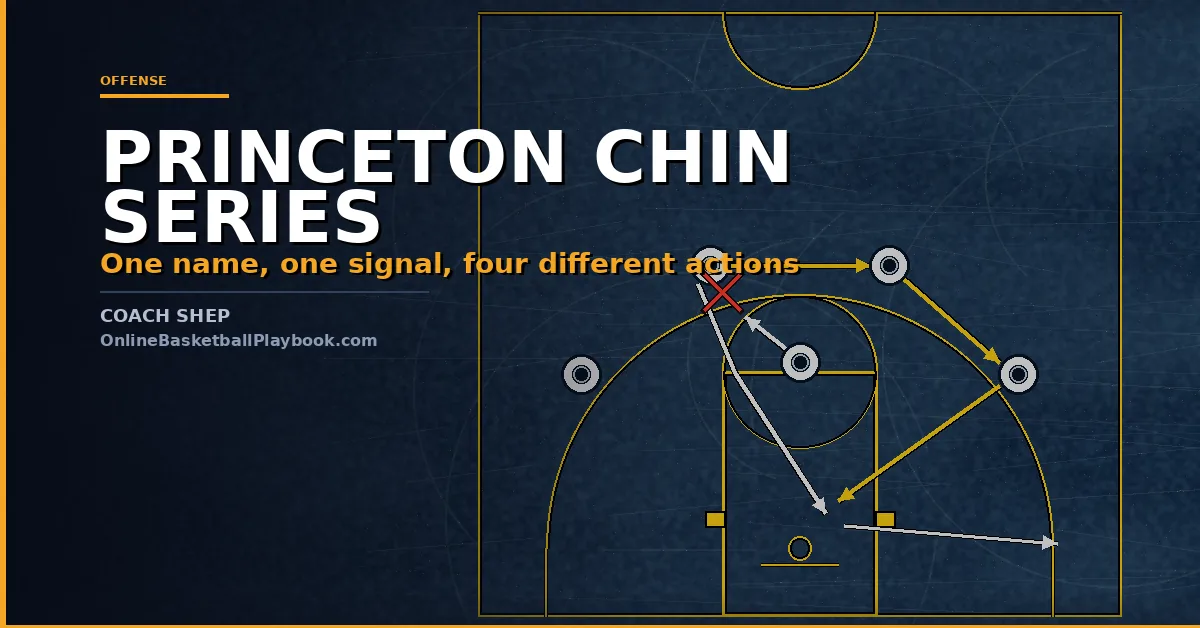
Princeton Chin Series: 4 Ways Coaches Run the Chin Offense
The Princeton Chin series compared: dribble weave and flare, shuffle cut, down screen and pop, and the two-guard read, plus branches, resets and counters.
Princeton Offense: Cuts, Reads and Sets
How the Princeton offense works: the Chin set, backdoor cuts, the high-post reads, the players it needs, how to install it and what defenses do to stop it.
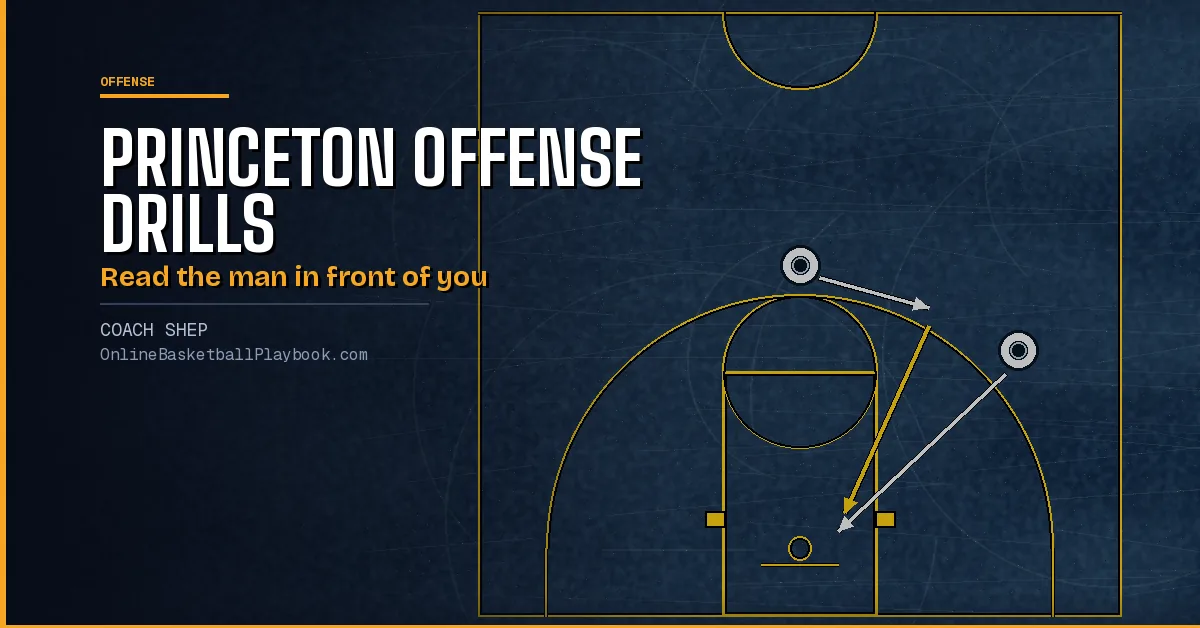
Princeton Offense Drills: Breakdowns, Shooting and Live Reps
Princeton offense drills that teach the reads: spacing, backdoor and hand-off breakdowns, 3-0 Chin and wave drills, Point shooting, a drive drill and an install.