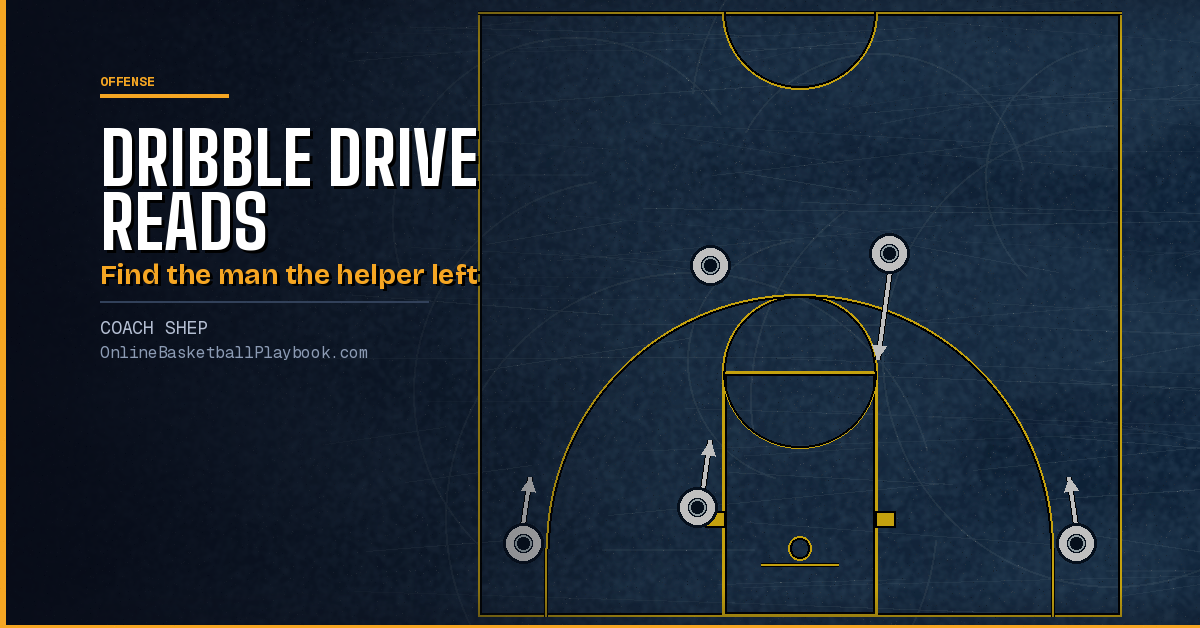
Dribble drive reads are the decisions the driver and the four players around him make once the ball attacks a gap in the spacing. The driver reads his own man before he goes, then reads who helps and where his drive stopped. The other four read the same thing from the other side: if my man helps, I move to where the pass can find me. This page goes through the reads of the dribble drive motion offense in the order they happen, with each pass and cut drawn. The guard's own skill side, the moves and finishes, is on teaching dribble penetration reads, and the general help read every offense shares is on advantage basketball: reading the help.
Dribble Drive Reads off the Help
The read on the catch and the help tree, defender by defender, are on reading the help. In short, the driver passes to the man whose defender helped, and a sag at the top sends the ball back to the guard trailing the drive.
Walberg's own drive cue in his 2007 version was to clip the hip, take a bump and take another. If the driver's shoulders are not past his man's shoulders by the time he reaches the Drop zone, he picks up the dribble, which is covered on the hub page and on dribble drive zones.

The versions order the looks differently, and the first look is where they split:
| Version | Order of looks |
|---|---|
| Helper first | Rim, then the corner if its defender helps, the post if his defender stops the drive, the weak side if the post's help is covered, the trailing guard if the top defender sags |
| Rim first | Finish at the rim, dump to the post, kick to the corner, pitch to the trailer, skip to the weak side |
| Drop-zone drill order | The corner defender first, then the post's defender, then the rim |
The drop-zone drill order comes from a live read drill. If the corner defender sits off his man, the corner shooter steps up a step and looks to shoot. If the corner defender denies, the guard keeps his dribble and goes to the basket. Then he reads the post's defender: if he does not step up, the guard shoots, and if he steps up, the guard dishes to the post.
Where the Drive Stops Picks the Read
Walberg tied the read to the zone where the drive ends. In Walberg's 2007 version in 2007:
- Rack zone. Shoot, or throw it off the backboard to the big. No wrap-around passes.
- Drag zone. A stop there means a skip, the call Drag 3.
- Drop zone. A backdoor for the ball-side wing, or a two-man game such as the pick and roll.
In Walberg's 2007 version he added two rules that take the decision away. Any pass fake or dribble at a wing is an automatic backdoor. A player who spins in the lane must shoot. The zone edges and the stops are on dribble drive zones.
Drop Zone Reads: Kick Up, Back Cut, Loop
The Drop zone stop gets the most reads, because the driver has stopped and the ball has to go somewhere. The elbow-stop version, from Walberg and John Calipari, gives each player one step and one read when the 1 drives into the Drop zone:
- The 2, ball side. One step up out of the corner, then read his man. Denied means back cut. A sinking defender means a kick up.
- The post. One step up the lane line, then clear out or duck in.
- The 3, weak side. One step up.
- The second guard. Holds his spot.


On the kick up the 2 has six options in the same version: shoot the three, put it on the floor to the rim or to the opposite Drop zone, throw it back to the 1 for a three, enter it to the post, skip to the 3, or hit the guard dragging behind. In Walberg's 2007 version he had the receiver curve off the line to set his feet before the catch. The back-cut half of the same read is drawn on dribble drive zones.
The loop cut. When the driver stops in the Drop zone, the corner player can come straight out of the corner instead of backdooring. The driver passes to him, then loops behind him and replaces him in the corner.

As the corner player comes out, the post lifts to the elbow and the far corner player up to the wing. The new ball handler attacks the middle while the post cuts to the rim and the second guard slides across up top. Other versions use "loop" for other actions, listed on dribble drive named plays.
Pitch back and gap cut. A stopped driver can pitch the ball back to the cutter behind him. A gap cut is the post flashing into the lane, timed to give the stopped driver a clean passing lane. On the elbow-box map, the three Drop zone looks are listed in order: backdoor, pitch back, flash from the post.
Get the next coaching guide in your inbox
One email when a new guide or diagram set goes up. Free.
The Guard Behind the Drive
Every version keeps someone behind the drive. In the helper-first version, when one point guard drives, the other drags in behind to fill the spot he left and spots up for the kick back. In Walberg's 2007 version, lane penetration means both corners filled, the big opposite in clean-up position and a guard dragging behind. Walberg defined the kick back there as a euro-loop pass from the weak-side guard spot, and it has to be a positive pass so the defense cannot switch it.

Kick back means other things in other versions: a guard-to-guard pass in another Walberg version, and the return pass to the original passer, usually followed by a cut to the T, on the elbow-box map. A team uses one meaning. The safety-behind-the-drive idea from European coaches is on the help page linked above.
Off-Ball Jobs by Drive
The four players without the ball move by rule. The rules differ by where the drive goes:
| Drive | Player | Job |
|---|---|---|
| Any drive | Post | Stays opposite the ball, does not follow it, and does not flash until the driver stops in the Drop zone |
| Any drive | Post | V-cuts up or down the lane for the dish-off, in the helper-first version |
| Drive on your side | Ball-side wing or corner | Stays in the corner and reads his man: denied, backdoor. Helped off, come up two slides for the kick. Waits until the driver has decided before moving |
| Drive on your side | Wing | Fades to the corner for the kick-out, in the helper-first version |
| Drive on the other side | Wing | Fills high on the weak side for the kick-out |
| Drive in the Drag zone | Weak-side wing | Drifts at least two steps up the arc for the skip |
| Baseline drive | Post | Moves to the middle of the key |
| Any pass to a wing | Passer | Cuts away to give the ball space |
The baseline drive is the exception to the post's rule. The post leaves the far block for the middle of the key, and the driver looks to the opposite corner, the post, or the player diagonal to him for a spot-up three.

Walberg's outside-Drag version names three drive types, lane, middle and baseline, each with its own set of teammate moves: the big cleans up or relocates to the opposite block, and one wing stays in the corner while the other drags.
Passing Rules That Protect the Reads
The positive pass, the passer's cut and the rest of the base passing rules are on the dribble drive motion offense hub. The elbow-stop version adds three of its own:
- Pass angles. It draws three angles, positive, even and negative. A negative pass goes to a perimeter player inside the arc who is moving back out to it. Do not pass to the 2 until he is even with or above the 1.
- No one-handed passes out of the Drop zone.
- High passes at the rim. No wrap-around or bounce passes in the Rack zone. Against post help, throw it high. The same rule bans a straight-line pass across the lane.
In another Walberg version Walberg added that the higher a kick-out is caught, the better it works. A close cousin of these reads, built around a rim-running center, is on drive and space offense.
Drilling the Reads
The read order is drilled from a 2-on-0 shell up to 5 on 0, then live in a 3-on-3 drop-zone read drill where the guard reads the corner defender first and the post's defender second. Both drills are drawn on dribble drive drills, and the defense's plan against these reads is on how to defend the dribble drive motion offense.
Questions Coaches Ask About Dribble Drive Reads
What are the reads in the dribble drive offense?
On the drive, pass to the man whose defender helped: the corner, the post, the weak side, or the guard trailing behind.
What is a kick up in dribble drive?
A pass from a driver stopped in the Drop zone to the corner player, who has stepped up and found his defender sinking. He curves up off the line to set his feet for the catch.
What is a loop cut in dribble drive?
The driver stops in the Drop zone, the corner player comes straight out of the corner, and the driver passes to him and loops behind him to replace him in the corner.
What is a kick back pass?
It depends on the version. It can be a pass back to the guard trailing the drive, a guard-to-guard pass, or the return pass to the player who passed to you, usually followed by a cut to the T.
Where does the post go on a dribble drive?
He stays on the block opposite the ball and does not follow it. He flashes to the opposite elbow on a Drop zone stop, and on a baseline drive he moves to the middle of the key.
Want every diagram on the site?
OBP Pro members get the full diagram files for every offense guide on the site, ready for a practice binder or a scouting report. $9 a month. Or draw your own version free in the play drawer.
See what OBP Pro includesMore Offense System Guides
- The Read Principle in Basketball: Do the Opposite of the Defense
- Princeton Offense vs Motion Offense: Compared by Principle
- Dribble Drive Zones: Rack, Drag, Drop and Breakdown Explained
- Dribble Drive Named Plays: Drop, Quick, Pop and Corner Sets
Back to Dribble Drive Motion Offense and every Offense page.
Keep Building
Related breakdowns
Dribble Drive Motion Offense: Spacing, Reads and Install
The dribble drive motion offense explained: 4-out 1-in spacing, the Drop, Drag and Rack zones, the read off a drive, shot diet, weak spots and the install.
Dribble Drive Named Plays: Drop, Quick, Pop and Corner Sets
Dribble drive named plays, each drawn: Drop, Drag, Quick and Pop calls, a corner ball screen set, one entry with four finishes, the numbering and when to call one.
Dribble Drive vs Princeton Offense: Compared by Principle
Dribble drive vs Princeton offense, side by side: the post, spacing, dribble or cut, the backdoor read they share, screens, shots, tempo, personnel and borrowing.