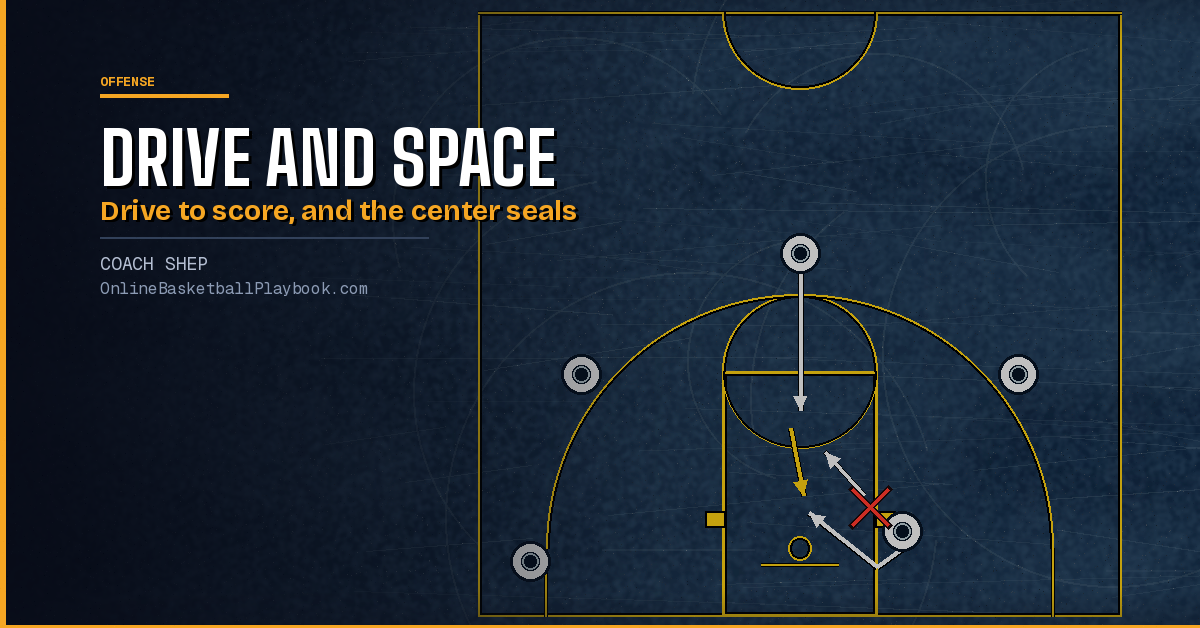
The drive and space offense is a read-based way of playing built on dribble penetration. Players drive the gaps, pitch the ball when help comes, and the passer posts on every pass. A rim-running center seals the shot blocker instead of clearing out of the way, and a catch either attacks or keeps the ball moving, with no resets. The coach who built it calls it a way of playing rather than a system, and teaches it skills first, with nothing on paper. This guide covers what the drive and space offense is, the three cues that come before any action, how space is created, the penetrate-pitch-post read, the advantage chain, the center's seal, protection plans for a dead drive, the transition pieces, how it changes shape for different rosters, and how it compares with other offenses.
What Is the Drive and Space Offense?
The drive and space offense grew out of motion. Its builder started as a motion coach following Bob Knight and Dick Bennett, turned that motion into an all-flare-screen offense to teach it more clearly, and then noticed players catching off the flares with an advantage and driving into more screens. His conclusion: once there is an advantage, the team does not need more screens, it needs space. He slipped screens to open the floor and ended up setting only a few, mostly to break up the defense's communication.
He says it is not a system, just a way of playing. Players learn individual skills first, then a second player is added, then a third, and the offense is meant to appear instead of being installed. On the first day players play 1-on-1, 3-on-3 and 4-on-4, and they get nothing on paper. His test for any offense is a napkin: if a coach cannot fit his offense on a napkin or a note card, he probably does not understand it very well. The written advantage-state version of the offense adds that the next action starts as the current one is finishing, all five players are involved, everyone gets a chance to touch the ball, the offense runs full court, and nothing can stop the ball from moving.
The phrase "drive and space" also has a narrower meaning. Jay Wright's Villanova teams use it for a single drive-and-fill action. His 3-on-0 version fills the opposite baseline on a baseline drive, with short passes for the offense and long runs for the defense. This page covers the whole way of playing. Where it sits among the other systems is on the basketball offense guide.
Three Cues Before Any Action
The builder says what a coach corrects first is probably what he cares about most, and he puts three cues ahead of every action in the offense.
| Cue | What it means |
|---|---|
| Eyes on the rim | Sounds easy, he says, but takes four years, because pressure pulls a player's eyes down to the floor. |
| Work your feet | Clean starts and stops, no false steps or rocking back, and a stride stop at speed so the player can pivot away from the defense. |
| Throw strikes | Passes the catcher does not have to reach or move for, which gives a less skilled player more time to decide. |
The advantage-state version's order of mastery follows the same line. Players cannot run the offense until they have mastered footwork, passing and catching, and cannot use their skills until they know how to space the floor. Its vision rule is short: good vision leads to good decisions and poor vision to poor ones. Its vision keys include finding the rim on every catch, playing in a stance with a strong base, keeping the eyes up through contact, watching the man above you when off the ball, and talking your action. A player without the ball asks one question: does my teammate need help, or space?
The builder calls his skill base "me first to make others better." He wants players selfish about building skills, not selfish as a trait, and says the better a player gets, the more he has to share. His four pillars are that me-first skill base, creating and using space, a flexible style that grows with the player, and attacking together.
Three Ways to Create Space
Space is the product of the offense and the drive is how it gets used. He names three ways to make it.
- Off the bounce. The drive makes its own space.
- With a cut. The fingers cut, the fan and the flash, below.
- By knowing how to use it. Reading the defense's shape: defenders on the arc, defenders arriving on the catch, a defense packing the elbow, stacked on the weak side, or fanning to the baseline.

The fingers cut comes after a guard-to-guard pass. The passer throws a hand up as if it were a give-and-go, but the cut is only there to clear space for the other guard to drive. In the fan, a player runs at a wing to push him toward the baseline as a runner, which opens a driving gap above. The flash is a player cutting into the nail or the middle, often paired with a fan. Gaps and spacing in general are on what is spacing in basketball.
Penetrate, Pitch, Post
The core action on every wing catch is three words: drive, pitch, and the passer posts. The builder encourages driving from both sides of the wing, because the post escapes and replaces a baseline driver and the floor stays balanced.
The driver's first look is his own layup. The builder is direct about it: the driver is not driving to pass, he is trying to go get a bucket. Vision shifts only when the center's defender steps up. Then the driver has two passes.

- The drop pass. A dump-off to the rim-running center when his defender steps up to the driver.
- The skip to the corner. If a defender cracks down inside the center, the builder throws a skip to the corner without looking, because the corner will be open.

The full set of reads off a drive, kick, drop and skip, is on teaching dribble penetration reads. Drills for drive-and-kick reads in general are on drills to teach the dribble drive motion.
The Catch: Advantage or No Advantage
Every perimeter catch sorts into one of two states, and the advantage-state version gives a rule for each.
Catch with an advantage
An advantage is a tough or long closeout, a catch right after an attack, a catch off a screen, or a defender in poor position. The player catches looking to shoot and attacks the closeout with a circle right or a slice left. The options come in order:
- Shot
- Layup
- Pitch, if the ball-side wing's defender helps
- Shot pass, if the center's defender helps
- Jump skip, if the center's defender helps and the weak-side wing's defender squeezes in
- Kickback
- Skipback
The list names the helper for each pass. The same advantage idea, and how to keep one alive, is on advantage basketball: reading the help.
Catch without an advantage
Work the feet and swing the ball. If it cannot be swung, dribble at the next teammate for a backdoor or a throw behind, or snap back to where the dribble started. The rule underneath all of it: nothing stops the ball from moving. The same version puts the two states plainly. With an advantage, from a dribble, a screen or a post feed, the team plays its drive and space game. Without one, it goes back to its screening game.
The Center Seals
The old rule for a post on a drive, the builder says, was always to relocate. In his offense, with the ball in the middle, the center runs as fast as he can below the net and seals his defender from behind. If the defender gets through, the center can dissolve to the weak side. The guards "ride the wave": they can arrive in the middle late, pick an elbow and attack the other side, which he says takes the shot blocker out of the play. It becomes a two-on-two game in the middle of the floor.
This is the clearest line between drive and space and dribble drive motion, which parks its post on the weak side. The builder does not name Vance Walberg's offense, but he does say that against dribble drive a defender can sit in the short corner and erase shots. Other coaches give the big a different first job.
| Version | What the big does on a drive |
|---|---|
| Seal version (drive and space) | Runs below the rim and seals from behind, and dissolves to the weak side only if his defender gets through |
| Clean-out version | A rim runner who cleans out to the weak-side short corner as soon as he touches the rim |
| Opposite-block version (Villanova) | Vacates and fills the opposite block on a middle drive |
| Short-corner version (dribble drive) | Waits in the short corner away from the drive |
Protection Plans When the Drive Dies
A driver who loses his advantage needs a plan instead of a dead dribble. The advantage-state version lists protection plans as part of the offense.
- Bounce out or lift. A driver from the top of the key bounces back out, and one from a wing lifts. That version also lists stride stops and pivots.
- The Barkley. Keep the dribble alive and turn it into the driver's own post-up.
- The Nash. Keep the dribble and go under the net, looking for a drift, a slot pass or a yo-yo game.
- The slide. When the driver cannot beat his man around the elbow, he and the corner player slide at the same time: an abbreviated stride stop with the shooting foot back and two or three slides, so the catch is stationary.
The builder says the slide replaced a get-open game for the corner player, a backdoor or a sprint up the sideline, because defenses changed and his team was not getting enough wing catches. Other programs carry their own protection menus, and Nate Oats's Alabama practices use the word Nash for something else, a ball-screen reaction.
Trail Spots and Down, Up, Over

The offense runs full court. The builder names three trail spots and tells players not to fight over who trails.
- Brush. Directly behind the ball, running to the three-point line.
- Nail, or button-hook. Run to the nail and face out.
- Wide. Stay wide and play a two-sided break.

Down, up, over is what he calls the accordion. Drive the ball down to the baseline, bring it back up, then reverse it over before the defense resets, so defenders are pulled low and the attack comes up and across. On any throwback the offense changes direction and stops cutting, which opens the driver in the slot. He uses it in transition and in the half court. The rest of the break is on fast break and transition offense.
Get the next coaching guide in your inbox
One email when a new guide or diagram set goes up. Free.
How It Changes Shape
The builder says a coach does not have to be married to dribble drive, Princeton or any one system, and he shows the same way of playing taking on other looks for different rosters and scouting reports.
| Look | How it runs | Who it suits |
|---|---|---|
| Princeton phase | The center comes up to the high post, the same fingers-type cut goes off him, with top or bottom flares and dribble-at hand cuts or back cuts | Teams that are natural motion teams |
| Five-out | If the flare does not get the catch, curl it and step the center out, then dribble-at with hand cuts or back cuts | A team with a shooting big |
| Chin | Run off bounce-outs. If the ball is reversed the team is into it, and if not, the middle ball screen is built in | Not stated |
| Ball screen | A built-in middle ball screen, or throw it and chase it | Used more against a team that defends ball screens poorly, less against one that defends them well |
He can play four or five guards, and he can feed a big who has little skill directly, mentioning a football player. He is also a critic of the Princeton offense in one way: he says it hides a power forward instead of developing him, even though he uses a Princeton phase. The advantage-state version agrees with the morphing: the system flexes to the players and the philosophy stays the same. It also asks the offense to leave rebounding position and defensive balance after the shot.
How It Compares With Other Offenses
The advantage-state version defines itself against four others. These are its own views of those styles, not settled facts about them.
| Style | Its complaint |
|---|---|
| Princeton | False movement, and only certain player types fit |
| Motion | Congested driving lanes and designated screeners |
| Pro ball screen | Only two players are involved |
| Set plays | The coach decides who touches the ball |
Its answer is all five players involved, a continuous attack with no resets, and a chance for everyone to touch the ball. For the other side of each argument, see motion offense, the Princeton page above and pick and roll.
Common Mistakes
- Driving to pass. It gives away the first look, the driver's own layup.
- A center who only relocates. He leaves the rim protector in the play.
- A corner player stuck in a get-open game. The slide replaced it.
- Unfinished cuts and late passes. The advantage-state version names cuts that stop short of the charge circle and the spot outside, and passes that are off target or late, as the two things that hurt spacing.
- A drive with no plan. Bounce out, lift, Barkley or Nash, never a dead dribble.
- Eyes on the floor. The first cue, and the one the builder says takes four years.
Questions Coaches Ask About the Drive and Space Offense
What is the drive and space offense in basketball?
A skills-first, read-based way of playing in which players drive gaps, pitch when help comes, post on every pass and keep the ball moving, while a rim-running center seals the shot blocker.
What is penetrate, pitch, post?
The core action on every wing catch: drive, pitch the ball when a defender helps, and the passer posts. Driving from both sides is encouraged because the post replaces a baseline driver.
What is the difference between drive and space and dribble drive motion?
Both empty the driving lane. Drive and space sends its center below the rim to seal his defender, while dribble drive keeps its post on the weak side away from the drive.
What is a Barkley and a Nash in basketball?
Two protection plans for a driver who loses his advantage. In the Barkley he keeps his dribble and turns it into his own post-up. In the Nash he keeps his dribble and goes under the net looking for a drift, a slot pass or a yo-yo game.
Does drive and space use screens?
A few. Its builder keeps some screens mainly to disrupt the defense's communication, and the advantage-state version calls the screening game the state the offense returns to when it has no advantage.
Want every diagram on the site?
OBP Pro members get the full diagram files for every offense guide on the site, ready for a practice binder or a scouting report. $9 a month. Or draw your own version free in the play drawer.
See what OBP Pro includesMore Offense System Guides
- Pace and Space Offense: Threes, Layups and Playing Fast
- Concept Based Offense: Principles Instead of Plays
- Why Every NBA Team Runs the Same Offense: Five Out Delay
- Two Guard Motion Offense: Chin, Shuffle and Motion Series
Back to Basketball Offense and every Offense page.
Keep Building
Related breakdowns
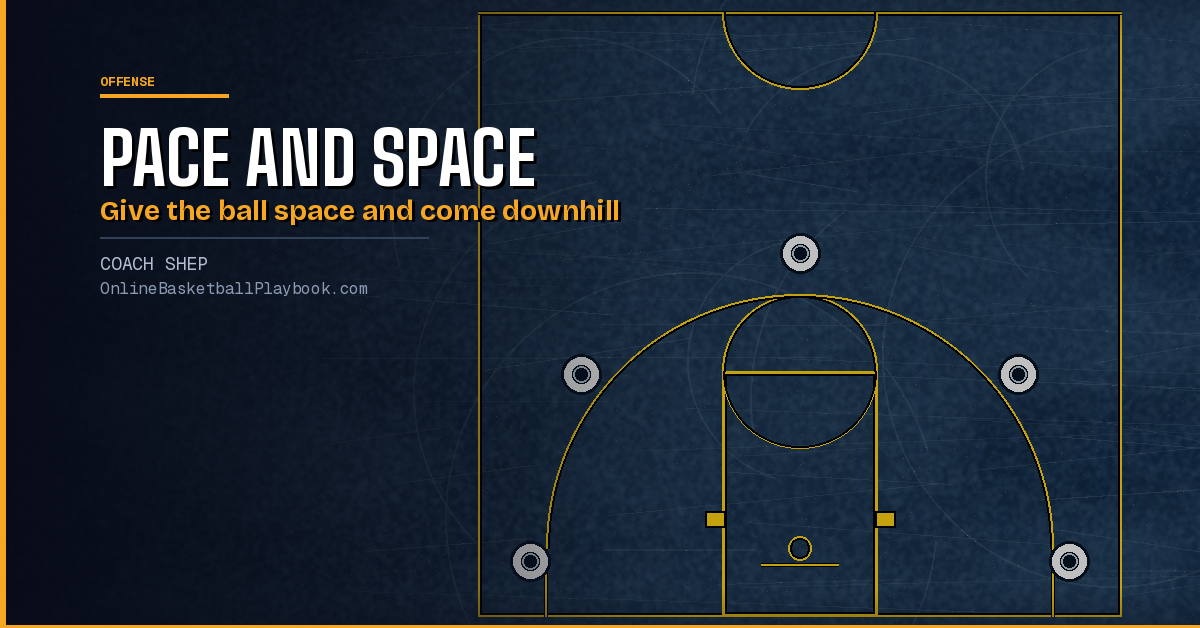
Pace and Space Offense: Threes, Layups and Playing Fast
Pace and space offense explained: five-out spacing, the 0.5 catch-and-go habit, drive-to-score rules, step-up and drag reads, shot diets and scored practice.
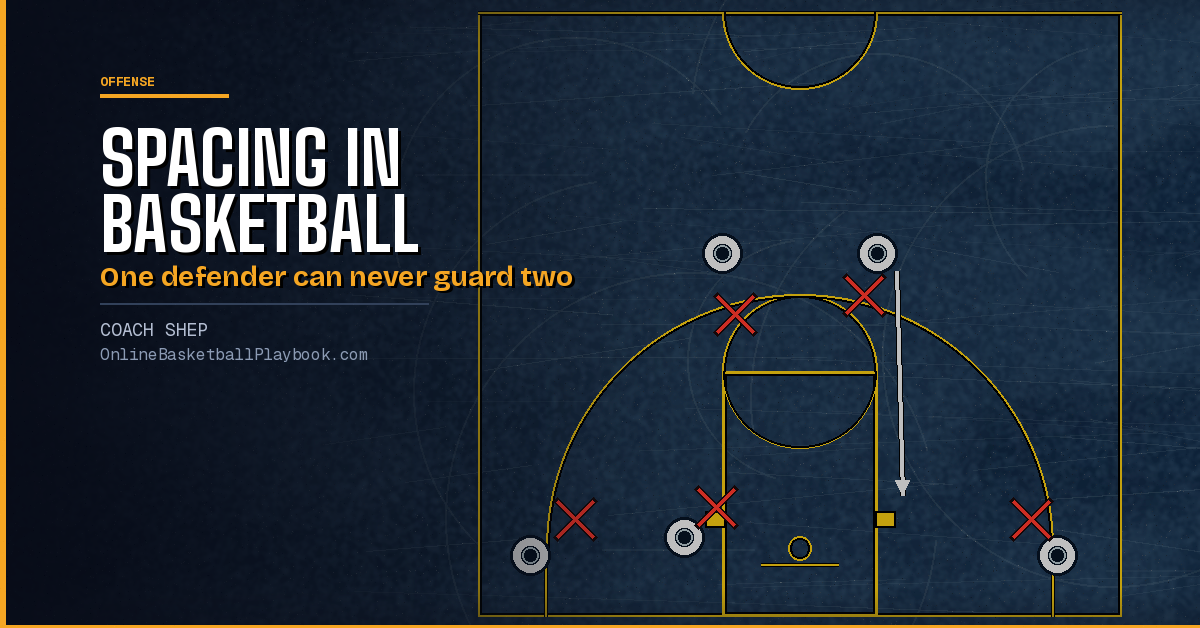
What Is Spacing in Basketball? Distances, Gaps and Alignments
Spacing in basketball explained: the distances coaches teach, single, double and triple gaps, spacing in 5 out, 4 out 1 in and 3 out 2 in, and the common errors.
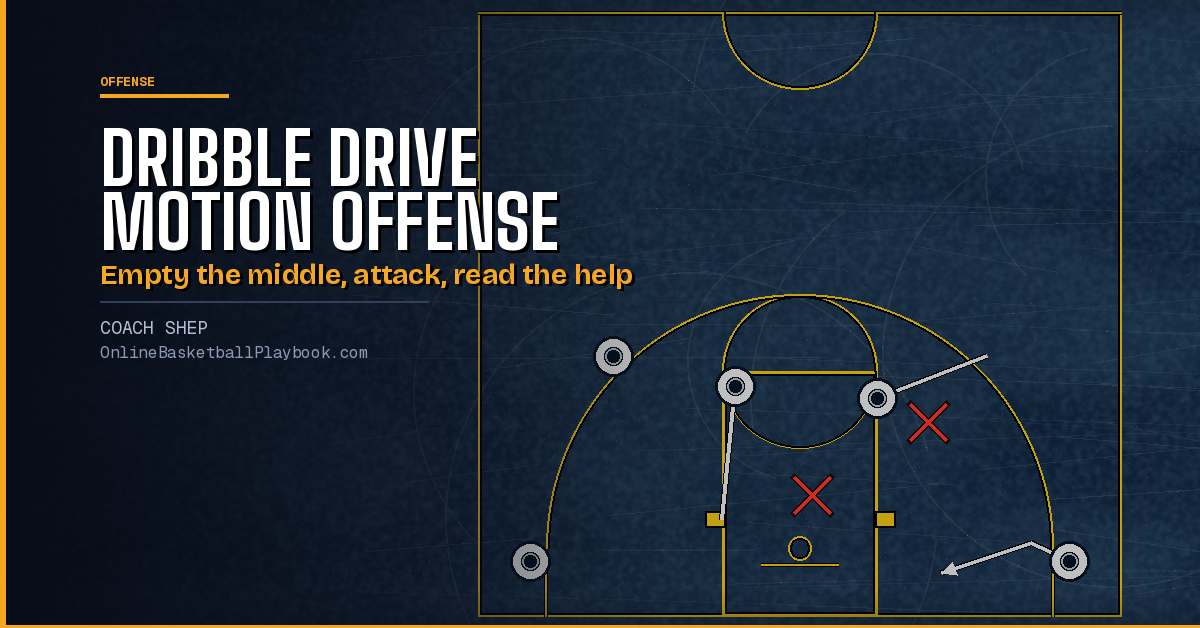
Dribble Drive Motion Offense: Spacing, Reads and Install
The dribble drive motion offense explained: 4-out 1-in spacing, the Drop, Drag and Rack zones, the read off a drive, shot diet, weak spots and the install.