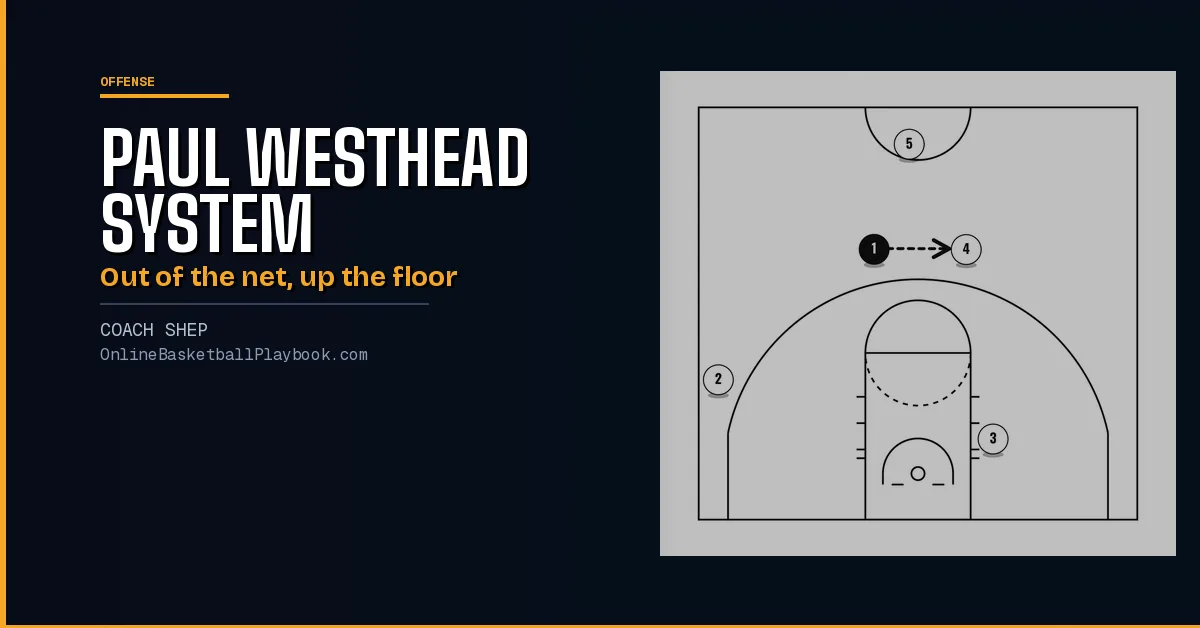
The Paul Westhead system is the numbered fast break his Loyola Marymount teams ran every time down the floor. Each player has a number, and each number has the same job every time down the floor. The point guard pushes the ball as fast as he can, and a player who catches his pass is expected to look for the shot.
This guide covers the philosophy, the lanes by number, the outlet after a made basket, the first three looks, the later options for the bigs, the rebounding rule and the drills. The general case for running is on fast break and transition offense.
Paul Westhead System: Run Every Time
Westhead's break is pure and simple. His players run every time down, whether the other team scored or his team got the defensive rebound. The idea is that over a whole game the running wears down an opponent that is not as well conditioned. The break is built to produce shots, and a player who catches the advance pass knows he is expected to shoot it.
Three more parts complete the system:
- Offensive rebounding. Second and third shots are part of the plan, not an accident.
- Man or zone. The break can be run against either defense.
- Conditioning. The court work is hard on the offensive players, and the system is sold as a help to a team's fitness.
The tempo side of the choice is on basketball pace and tempo strategy. Decide that you will run every time before you teach a single lane.
The Lanes by Number
After a made basket each number has one job:
| Number | Start | Job |
|---|---|---|
| 5 | Under the basket that was just scored on | Takes the ball out of the net, steps out of bounds on the right side, inbounds to 1, then trails |
| 1 | Right side, level with the foul line extended or a little higher | Takes the inbound and pushes it at top speed, passing for a score |
| 2 | Near the left elbow | Runs on a diagonal across to the right side, then races up it to a three-point spot, usually lower than the foul line extended and at times as deep as the corner |
| 3 | Left side | Races up the left side, staying wide until the foul line extended, then cuts in to the left block |
| 4 | Left elbow in the backcourt | Stays level with 1 and slightly behind him as the ball comes up, and helps inbound if needed |

The 2 and 3 start their sprints as the inbound pass is being thrown, not after 1 catches it. Give each player his number and keep it the same every possession.
Out of the Net: The Outlet
On a make, 5 grabs the ball as it comes through the net, before it can bounce, and steps out of bounds on a diagonal toward the right side. 1 has already moved to his outlet spot on the right side, and 5 inbounds to him quickly.
To slow the break, defenses often crowd the outlet man with one or two players. LMU's answer is the 5-4-1 pass.

5 throws it to 4, and 1 breaks to the middle to get it back from 4. Then 1 dribbles it up and reads the same looks as always. More ways to beat pressure on the inbound are on press break basketball. Rep the outlet until the ball is in 1's hands before the defense turns around.
The First Three Looks
One rule governs 1's passes. He passes to 2 or 3 only if he judges that the receiver is in position to score. Anyone who catches a pass from 1 looks for his own shot first.

First look, 1 to 3. The long diagonal pass to 3, who has run the left side and cut to the block. 3 takes the jumper or puts it on the floor.

Second look, 1 to 2. The pass to 2 on the right side, who looks for the three.

Third look, 1 drives. 1 takes it to the right elbow and shoots, or goes all the way to the rim.
The reads for a numbers advantage at the end of the floor are on how to run the fast break. Look for 3 first, 2 second and the drive third, in that order every time.
Later Options for 4 and 5
If 3 and 2 are both covered, the bigs come into it.

The 1-4 pass. 1 swings it across to 4 up top.

Ball to 2. Any time 2 catches, 4 goes on a diagonal to the right block and 5 slides into the spot behind him. 4's defender keys the next pass. If he plays behind 4, 2 passes inside to 4.

4 is fronted. If the defender fronts 4, 2 passes to 5. 4 seals his man and asks for it inside, and 3 pops out from the block to a shooting spot. 5 has three choices:
- shoot
- pass to 4 inside
- pass to 3
For the second wave, LMU game film shows what the team did when the first break gave no shot. Other ways to organize it are on secondary break basketball and early offense basketball.
Pace and Rebounding
Speed shows up in every rule:
- The ball comes out of the net before it can bounce.
- 2 and 3 sprint as the inbound pass is thrown.
- 1 pushes the ball as fast as he can.
- Whoever catches a pass from 1 looks for his shot first.
The break counts on getting a second and a third shot. Every player goes to the offensive glass, and because the break moves so fast, the defense has a hard time boxing out. Rebounding technique is on basketball rebounding fundamentals, and the fitness side is on basketball conditioning drills. Crash all five, every shot, and get back to running.
LMU Break Drills
Two drills run the whole break:
- 2 1/2 Cycle Drill. No defense. The team runs through each of the basic options.
- 5x4, two cycles. It simulates a zone defense and is used for the late options that get 4 and 5 their shots.
The other drills are named for the pass, cut or situation they rep: 5x2 and 5x3, 5-4-1 vs Pressure, 1-5 Outlet, #2 Man Shooting, 1-3 Pass, 1-4/5 Pass and 1-2-4 Cut.
Other full-court drills are on fast break basketball drills and drills to teach transition offense.
How Other Breaks Differ
Westhead's break sits in a line of numbered breaks. The numbered break grew out of Cam Henderson's break at Marshall in the late 1940s, ran through Sonny Allen's teams at Old Dominion and SMU, and reached Westhead at Loyola Marymount. Breaks in that family still differ, and coaches disagree about numbering at all.
| Version | Who inbounds | Who goes to the rim | Lanes |
|---|---|---|---|
| LMU numbered break | 5, every made basket | 3 cuts to the left block after running the left side | 2 right, 3 left, 4 level with 1, 5 trails |
| Post-runner numbered break | The same post every time after a score | The other post runs to the lane | 2 always right, 3 always left. After a rebound by 5, 4 runs to the middle of the free-throw lane while 5 trails |
| Free-flow break | Anyone | Whoever is ahead | No assigned lanes. Players ahead of the ball go wide and players behind it take the middle |
Both numbered breaks have a big take the ball out after a make. The reason given is that the post is usually near the basket for the rebound, so he can pull a made basket from the net and inbound it fast.
The case against numbering is aimed at youth and high school teams. Dean Smith's Carolina break and Westhead's Loyola Marymount system are its famous numbered examples, and the objections are three:
- A player who just contested a shot on one side may have to run across the floor to reach his assigned lane.
- Substitutions mix up the roles, and two players end up on the same wing.
- Fixed lanes take away the reading of the floor.
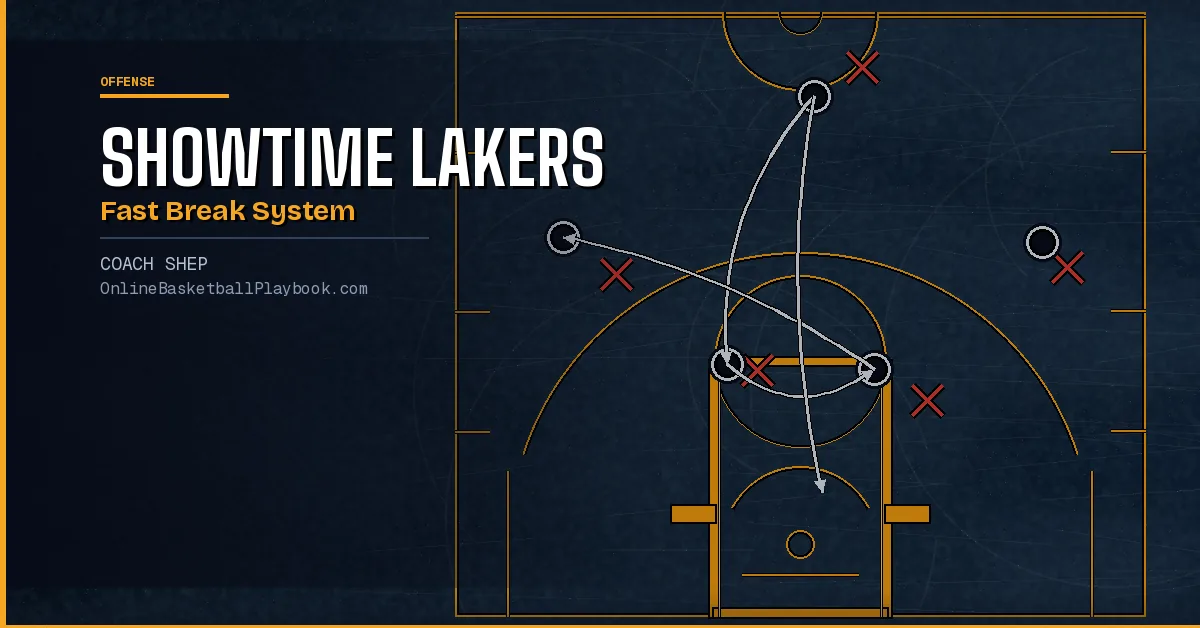
The Showtime break is on Showtime Lakers fast break system, and how to slow a running team is on strategies for coaching against high tempo teams. Choose numbered or free-flow on purpose, then teach it the same way all season.
Questions Coaches Ask
What is the Paul Westhead system?
A numbered fast break run every time down, after makes and after defensive rebounds. Each number runs the same lane every time, 1 pushes as fast as he can, a player who catches from 1 is expected to shoot, and all five crash the boards.
How did the Loyola Marymount fast break work?
5 pulls the ball from the net and throws it in to 1 on the right side. 2 races to a three-point spot on the right, 3 races up the left and cuts to the block, 4 stays level with 1 and 5 trails. The first look is 1 to 3, the second 1 to 2, the third a drive by 1.
What is the Paul Westhead offense against pressure on the inbound?
The 5-4-1 pass. When the outlet is jammed, 5 inbounds to 4 and 1 breaks to the middle to take 4's pass.
Does the Westhead system work against a zone?
The break is described as usable against man-to-man or zone, and its 5x4 drill simulates a zone to rep the late options for 4 and 5.
Is a numbered fast break good for high school?
Coaches split. Numbered breaks give every player one job and a fixed inbound. The case against it: youth and high school teams lose players across the floor, mix up roles on substitutions and stop reading the defense.
Every diagram on this page uses the symbols on how to read a basketball play diagram. The defensive side of running is on transition defense basketball.
Get the next coaching guide in your inbox
One email when a new guide or diagram set goes up. Free.
Want the printable playbook packs?
Playbook packs: zone attack, press break, press defense, out of bounds, quick hitters, practice plans and the youth turnover cure, each a printable PDF. Or draw your own version free in PlayDraw.
See the playbook packsRelated Guides
Back to Fast Break and Transition Offense and every Offense page.
Keep Building
Related breakdowns
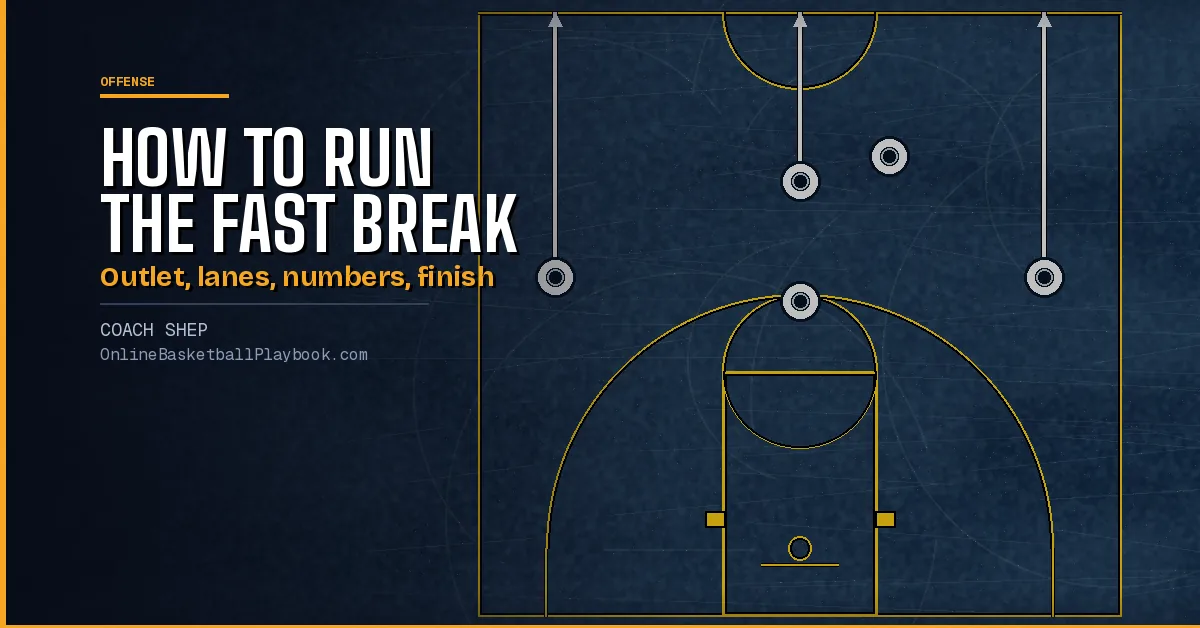
How to Run the Fast Break: Lanes, Reads and Drills
How to run a fast break: start it off a stop, fill three lanes, read each numbers situation, flow into a secondary break and build the habits with a drill ladder.
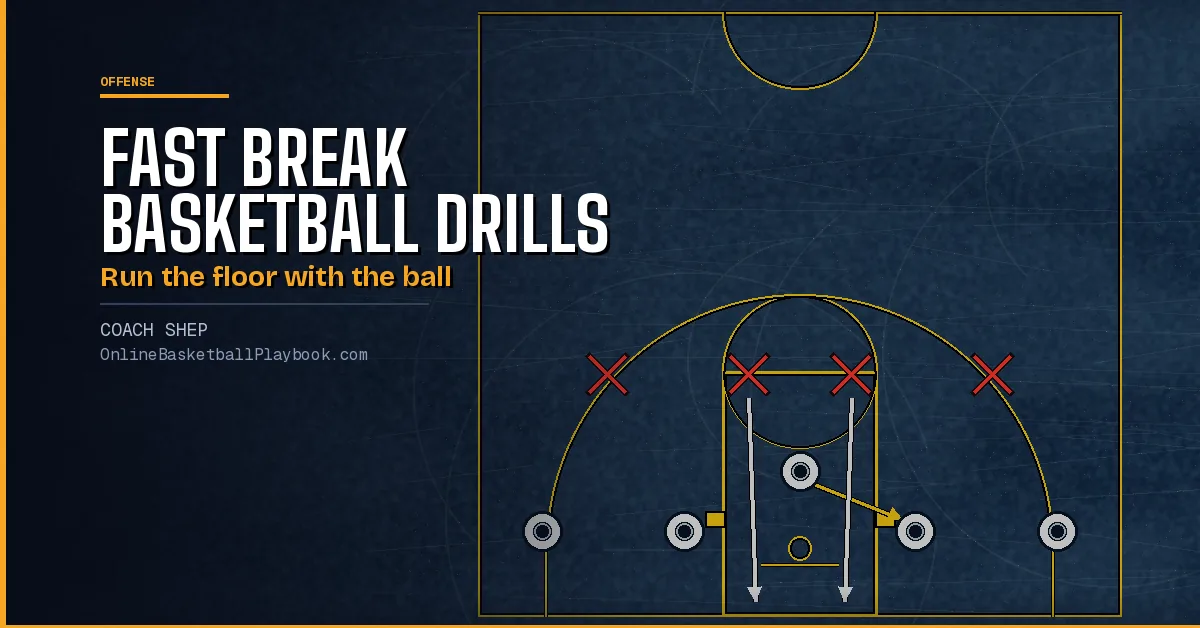
Fast Break Basketball Drills for Youth and Varsity Teams
Fast break basketball drills that run the floor with the ball: weaves, partner and no-dribble drills, catch-up drills, a finishing series and youth versions.