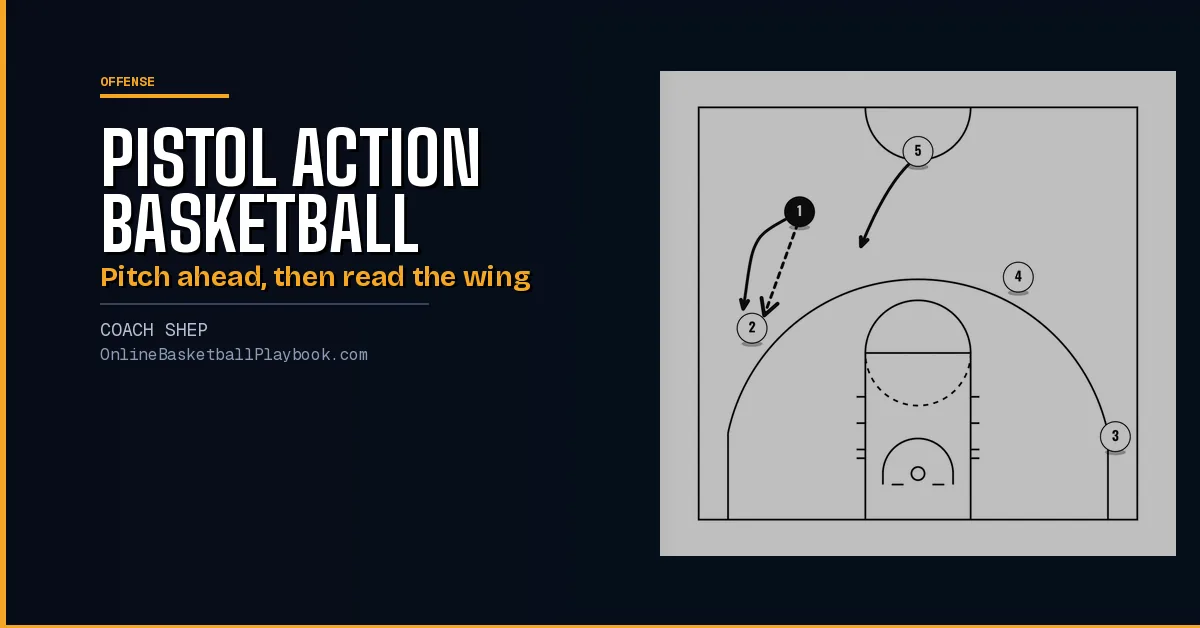
Pistol action basketball is early offense run by three players on the same side: the point guard, the wing on the side he brings the ball to, and a big man trailing the play. It is also called 21, for the 2 and the 1 who start it. In the 21 series the point guard usually pitches the ball ahead to the wing. Five options follow, and three of them start with that pitch. One answers a denied pitch with a dribble at the wing, and one swings the ball back through the trailing big.
This guide covers the floor spots, the pitch ahead, each option, the side ball screen the series aims for, the breakdown drills and the other versions of pistol that coaches run. The wider view of the opening seconds of a possession is on early offense basketball.
What Pistol Action Is
Pistol is early action for the point guard and one wing, with a big man up top as the screener. It starts from a sideline entry, not from the middle of the floor, and it is run from the NBA down to high school. Two entries are common. The point guard dribbles at the wing, or he passes to the wing and follows his pass. From either one the big sets a flare screen or a ball screen, and a hand-off can join in.
The 21 series is one NBA hurry-up offense built on pistol. Its purpose is quick, good shots early in the clock, threes included, when a team needs to get back into a game. The staff that ran it went to 21 for stretches of five or six minutes at any point in a game, not only late. Hurry-up did not mean wild. It meant good pace and good flow, with the point guard getting the ball to the operating area inside four seconds.
The pistol pieces are covered one at a time on the dribble hand-off, flare screen basketball and pick and roll. Learn each piece, then put them together on one side.
Floor Spots and the Arrival

Whichever side the point guard takes the ball to becomes the ball side. The spots in the 21 series:
- The wings. Both run wide. As they cross half court they look back over the inside shoulder to find the ball.
- The ball-side wing. He runs past the arc, then buttonhooks back up to catch with his feet straddling the three-point line.
- The point guard. He stops on the volleyball line, midway from the lane line to the sideline.
- The first big. He trails the ball and comes to the lane line extended on the ball side.
- The second big. He sits in the seam on the weak side, with the other wing in the weak-side corner.
The staff moved players to spots that suited them. A point guard who was strong going to his right hand was put on the left wing, another guard brought the ball up the left side, and the point guard buttonhooked for the catch and ran Keep so he came off the ball screen going right. Learn the spots first, then put each player where his strength sits.
Chase: The Pitch Ahead and the Hand-Off

Chase is option one. The point guard pitches ahead to the wing on his buttonhook catch and runs after it to get it back on a hand-off. The wing flips the ball back, and the trailing big goes to work.

As the ball comes back to the point guard, the big flares the wing up top. Then he follows with a deep ball screen for the point guard, who comes off it downhill.

Off that ball screen the point guard reads four things:
- the layup
- the jump shot
- the big rolling to the rim
- a drive and kick
If he passes to the wing at the top instead, the weak side comes alive.

The weak-side big does not leave for his pin down until the wing catches at the top. If the corner man is not open off the pin down, he curls and empties to the other side, and the big flashes to the pinch post for a two-man game with the wing. The pin down itself is on down screen basketball. Rep Chase until the hand-off, the flare and the ball screen run together without a pause.
Keep, Dribble, Down and At
Keep and At start with the same pitch ahead as Chase. Dribble starts when the pitch is denied, and Down starts with a pass back to the trailing big. Only At needs a call. Chase, Keep, Dribble and Down can be played as reads.
Keep

As the point guard runs past, the wing shows the hand-off and holds on to it. The trailing big must already be on top of him, so the ball screen comes the moment the fake ends. As the wing comes off the screen, the weak-side big pins down for the corner man. The big rolls and the point guard lifts out of the corner. The wing reads the layup, the jump shot, the roll man, the lift behind him and the weak-side pin down.
Dribble

When the defense takes away the pitch ahead, the point guard dribbles at the wing. The wing sets a ball screen for him and the point guard looks to attack. The big flares the wing to the top, then screens for the point guard himself, and the point guard looks to score while the big rolls. A pass to the top brings the same weak-side pin down and elbow flash as Chase.
Down

In Down the ball goes back through the trailing big, and the wing back-screens so the point guard can cut to the rim. Then the big and the wing run a dribble hand-off, the weak side sets a pin down as the wing comes off it, and the point guard empties to the ball-side corner and lifts. The big rolls. The back screen is on back screen basketball.
At

At looks like Keep at the start. The point guard follows his pass over the top of the wing and the wing fakes the hand-off. Then the wing dribbles at the big for a hand-off, and the big takes it downhill and attacks the rim. It has to be called, and the staff ran it for one particular big man.
Teach Chase first, then add the option that answers what the defense takes away.
Rules That Make the Series Work
- Two dribbles off every ball screen. One dribble and a pick-up leaves the screener's defender sure of what is coming. Two dribbles put doubt in his head.
- The flare ends at the top of the key, no farther. The wing coming off the flare cannot drift past it, or there is no room for the weak-side pin down.
- The weak-side big waits. His pin down starts on the catch at the top, not before.
- A sagging defender is a gift. If the defense sits in the paint off a big on the weak side, nothing stops him from setting a hard pin down on the corner man's defender. If he gets a piece of him, the corner man is open.
- When in doubt, spread out. Spread the floor and either drive and kick or have someone come set a ball screen.
- Screen the big into the ball screen. A team that lives on the pick and roll should add more little-for-big screens, which knock the big's defender off his body before the ball screen.
Reading the screen as the ball handler is on reading ball screens. Hold the spacing rules and the options stay open.
The Single-Side Ball Screen
Coaches who teach the 21 series put NBA teams at 80 to 90 pick and rolls a game.
Keep and Down both end in single-side bump action. The big rolls and the point guard lifts, which leaves a side ball screen with two offensive players spaced on the weak side. That setup was called the hardest pick and roll action to guard. Teams use all kinds of false motion and misdirection only to end up there.
In the single-side bump, one defender on the ball side has to bump the roll man. Defenses try to ice that side ball screen, steering the ball handler at the lone defender, and when the big rolls the two weak-side defenders help on him. Ice is on ice coverage.
Other sets are built to reach the same picture: a guard hand-off into a wide pin down and side ball screen, a wing catch tight to the elbow with a shooting power forward spaced behind, and a horns pass to the center who dribbles at a wing for a hand-off and rolls. Out of the 21 series there is also a sideline inbound. The point guard cuts open for the inbound, passes back to the inbounder and follows for a hand-off, then dribbles toward the baseline while a big sets a flare, the hammer, that sends the other wing to the weak-side corner. The center turns and screens again for the inbounder.
Build to one clean side ball screen with two shooters away from it. The defense against it is on how to defend the pick and roll.
Breakdown Drills
- Two-man Chase. The wing buttonhooks, and the point guard passes and gets the hand-off back for a layup.
- Three-man Chase. Same start, plus the big. He flares the wing, then the point guard dribbles off his ball screen. The point guard takes the jumper, drives and kicks to the wing, or hits the big rolling.
- Three-man Keep. The big runs in to screen for the wing, who has four choices: a pull-up jumper, a hook pass to the point guard filling up for a shot, a pocket pass to the big, or a hook pass to the point guard, who feeds the big posting on the block.
- Pistol shooting from transition. The wing sprints to the corner and the point guard dribbles over and hands off to him, then drifts to the corner. A big sprints up to ball-screen for the wing and rolls right away for the pass. As the big attacks the rim, the point guard drifts toward the top and the far wing passes to him for a three. The drill makes the point guard create space if the hand-off is blown up.
- Why shoot it at game speed. Pistol action is very hard to defend, and practicing threes off it at game speed, with the point guard forced to lift and create space, is how a team's three-point percentage goes up.
- Rejecting the hand-off. When the defender overplays the hand-off, the wing or the point guard signals and the wing cuts backdoor for the pass and a layup. The wing does not even need to come up for the hand-off: a jab step and the backdoor cut work right away. Use a signal the dribbler can see, such as an open hand to take the hand-off and a closed fist to reject it.
The part-to-whole method behind these is on offensive breakdown drills, and more transition work is on drills to teach transition offense. Drill two players, then three, then run 21 five on five.
Other Versions of Pistol
The name stays the same while the start changes. These versions differ from the 21 series in where the wing catches, who screens first and what happens after the hand-off.
| Version | Wing's catch | First screen | What follows |
|---|---|---|---|
| 21 series (pitch ahead) | Buttonhook on the arc | Hand-off, then the big's flare for the wing | Big's ball screen for the point guard, five options |
| Corner to the elbow | Comes out of the corner as close to the elbow as he can | Hand-off brings a flare from the trailing big | If the wing keeps it, the trailing big sets a drag screen |
| Wing screens and clears | No catch, the wing comes up to screen | Wing screens for the point guard's dribble | Wing clears to the far wing, the big screens again and rolls. If nothing is open, the point guard swings it to the other big for a reversal into a hand-off |
| Dribble entry or pass entry | Wing waits at the wing | Wing's ball screen on the dribble, or a pass and follow | Big flares or ball-screens for the guard or the wing |
| Flash | Flashes up to the free-throw line extended, catches midway from the lane line to the sideline | Read off the screen | Step-up screens and a side pick and roll |
| After a made free throw | 1 takes the outlet and passes to the wing who ran wide | Point guard cuts behind for a fake hand-off | Big ball-screens the wing toward the free-throw line. The wing pulls up, hits the roller or hits the far wing coming off a pin down |
A second made-free-throw start. After the make, the post sprints to the left block and both wings run wide. The point guard dribbles up the left sideline and keeps going past the wing on that side, which pulls the wing's defender out. The big then sets a flare screen for that wing, and the point guard throws him the ball for a three. If the flare is covered, the big turns and sets a ball screen for the point guard.
Billy Donovan's early offense with the Oklahoma City Thunder used the corner-to-elbow version. Brad Stevens's Boston Celtics playbook files the wing-screens-and-clears version under early offense.
Dribble entry and pass entry. On the dribble, the wing screens for the point guard and then flares off the big. If the wing's defender jumps out to stop the drive, the point guard skips it to the wing for a three, and if the point guard's defender goes under the wing's screen, he steps back for a three. On the pass, the point guard follows around the wing to clear to the corner, take a return hand-off or screen for him. Some coaches use the 4 or the 3 as the top screener to create a mismatch, and any screener can slip to the rim.
Flash. This version runs from five out with interchangeable spots, and every screener is a receiver first. After the pass ahead the wing reads his defender off the screen:
- Defender goes over the top: go to the rim.
- Defender goes under: race him to the rim.
- Defender goes under and the wing gets stuck: hit the flare. The screener comes off the flare to the top of the key, catches, rips and drives.
- Step-up against a switching defense: as the screener comes up to set it, he slips out, slowing down without stopping, and the ball attacks the gap.
- Step-up against the switch itself: the screener screens low, keeps the defender on his back and takes a pocket pass to finish.
Pick one version and drill its reads.
Other Meanings of Pistol
- A hand-off continuity. BYU's Pistol is a dribble hand-off continuity: four perimeter players keep handing off while the big comes out to ball-screen. It is drawn frame by frame on BYU basketball plays.
- A defensive stance. On defense, pistols means a help-side player with one hand pointed at the ball and the other at his man. See ball-you-man defense.
- Pistol and zoom. In zoom the first pass goes up top and the screen and hand-off happen away from the ball. Pistol works on the ball side. See zoom action.
Check the diagram before you borrow a pistol call from another playbook.
Questions Coaches Ask
What is pistol action in basketball?
Early offense for the point guard and the ball-side wing, with a big man up top who sets a flare screen or a ball screen. It starts from a sideline entry with a pass ahead, a dribble at the wing or a hand-off.
Why is pistol called 21?
The action starts between the 2, the wing, and the 1, the point guard.
What is the pistol offense in basketball?
A series built on pistol action. The 21 series has five options: Chase, Keep and At start with a pitch ahead to the wing, Dribble starts when that pitch is denied, and Down starts with a pass back to the trailing big.
What is the difference between pistol and a drag screen?
A drag screen is a trailing big's ball screen for the point guard in transition. Pistol first involves the wing, through a pass ahead, a hand-off or the wing's own screen, and the big's screens come after. In the corner-to-elbow version, a wing who keeps the ball gets a drag from the trailing big.
How do you defend pistol action?
Defenses ice that side ball screen, steering the ball handler at the lone ball-side defender, and help on the roll from the weak side. The offense answers with the option that fits, such as Dribble when the pitch ahead is denied or a backdoor cut when the hand-off is overplayed.
Every diagram on this page uses the symbols on how to read a basketball play diagram. Pistol is one of the actions on basketball offense and on fast break and transition offense.
Get the next coaching guide in your inbox
One email when a new guide or diagram set goes up. Free.
Want the printable playbook packs?
Playbook packs: zone attack, press break, press defense, out of bounds, quick hitters, practice plans and the youth turnover cure, each a printable PDF. Or draw your own version free in PlayDraw.
See the playbook packsRelated Guides
Back to Early Offense in Basketball and every Offense page.
Keep Building
Related breakdowns
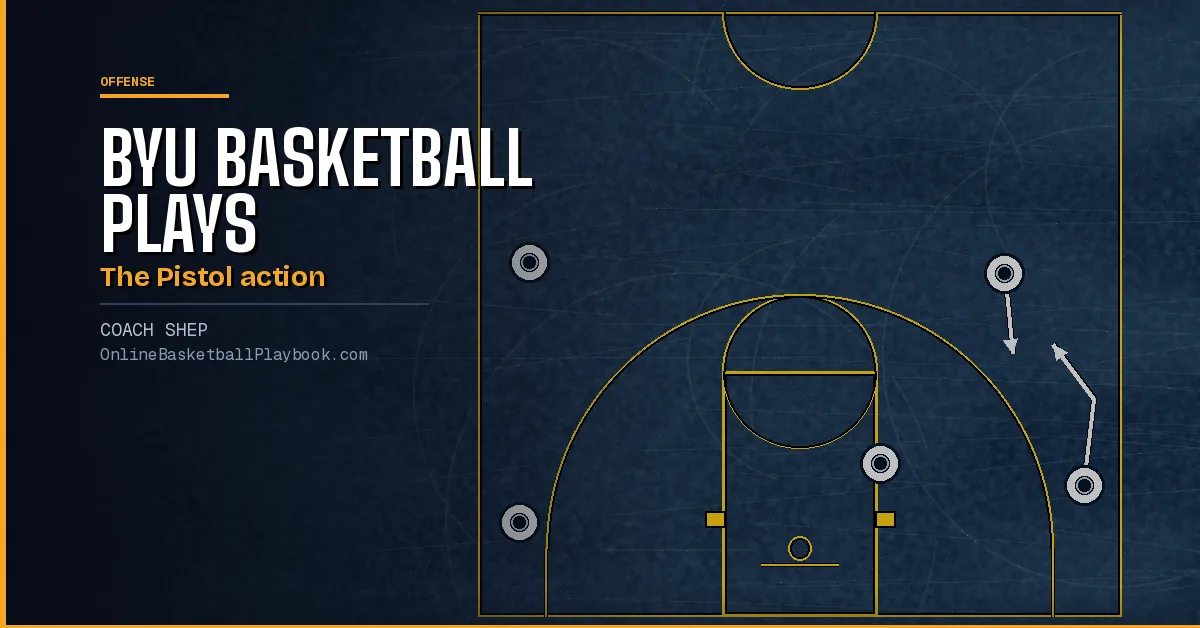
BYU Basketball Plays: Mark Pope Pistol, Ricky and STS Sets
BYU basketball plays: Mark Pope's Pistol, Ricky and screen the screener actions, plus three older BYU sets, drawn frame by frame.
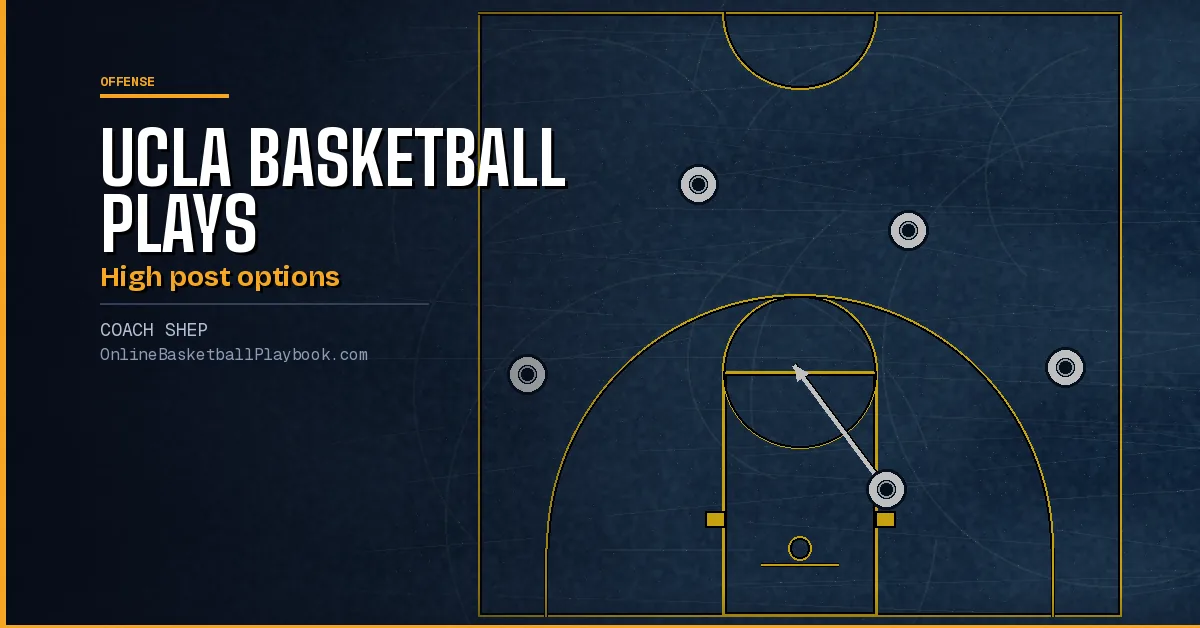
UCLA Basketball Plays: John Wooden High Post Options
UCLA basketball plays from John Wooden's high post offense: nine options drawn frame by frame with where every player goes.
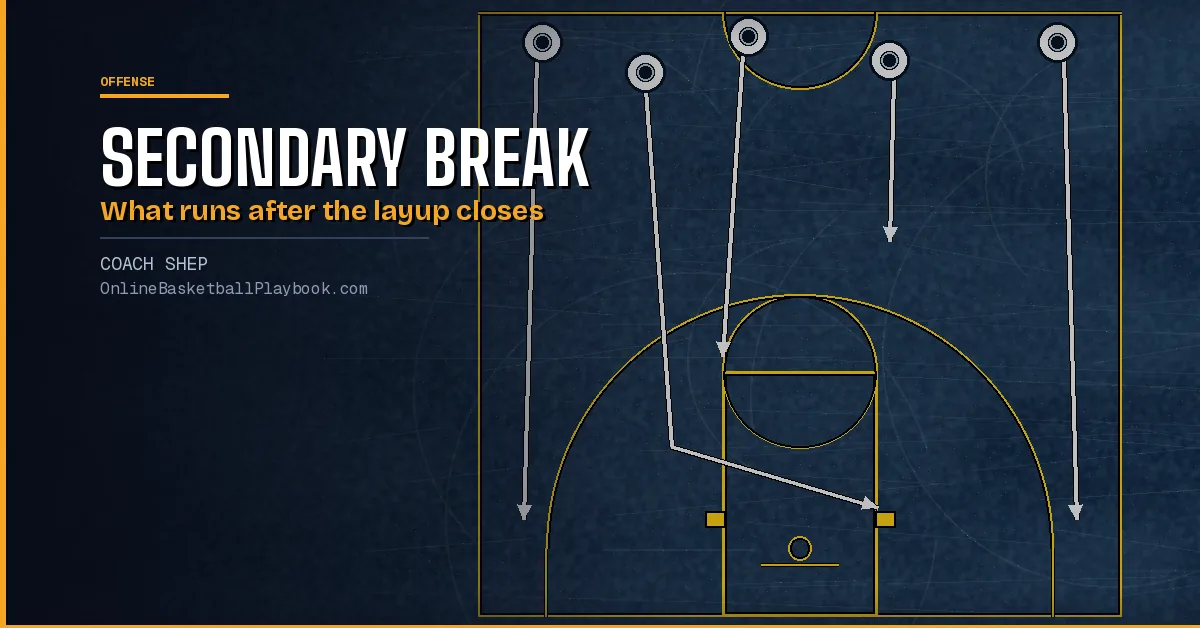
Secondary Break Basketball: Lanes, Options and Trailers
Secondary break basketball explained: where the primary break ends, the lanes, the numbered options, the trailer, after-make looks and where it flows next.