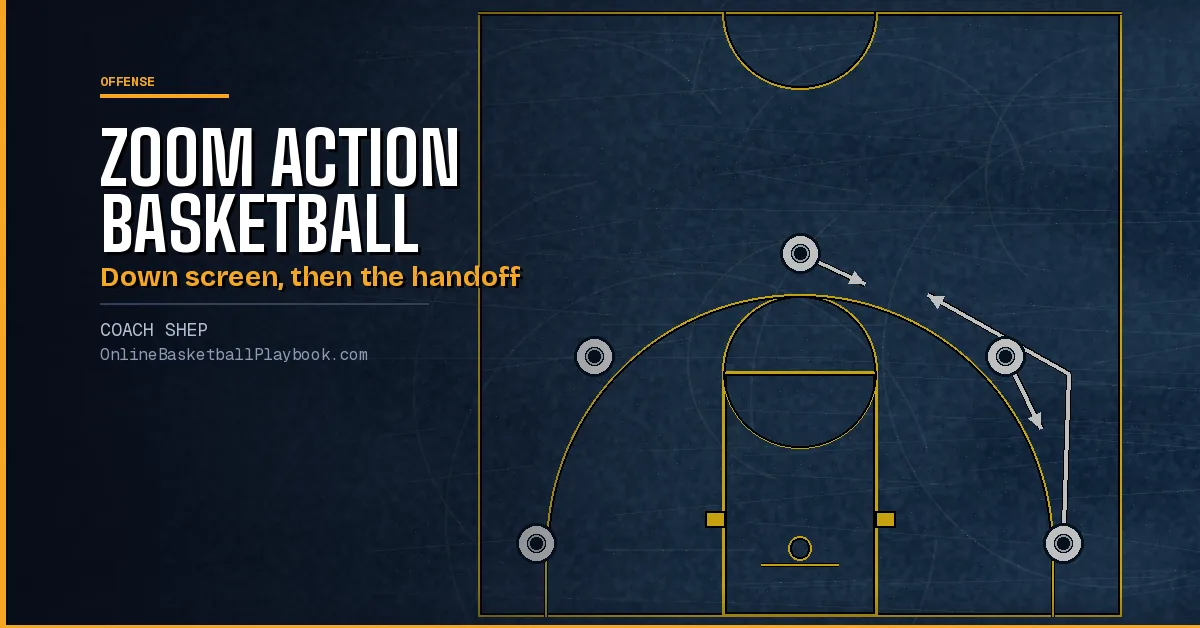
Zoom action basketball is a three-player action. A down screen is followed at once by a dribble handoff. A big, usually, brings the ball from the top of the key by dribbling at a guard who is running up off the screen. He hands him the ball and rolls to the rim. The guard has the ball going downhill with the defense turned around, the big is a threat at the rim, and the other two players space the floor for a kick-out.
FIBA defines zoom action the same way, a pin-down screen followed by a dribble handoff. This guide covers the base action, the reads for the cutter and the screener, the counters, every version, and the order to teach it in. The screen is covered on down screen basketball and the handoff on dribble handoff basketball.
The Base Zoom Action
The big has the ball at the top of the key. A second big or forward on the left wing is the screener. The guard who will use the screen starts deep in the left corner, and the other two players space the opposite side.

The order is simple.
- The screen. The wing player screens down toward the corner.
- The cut. The guard runs up off the screen toward the top.
- The dribble at. The big dribbles straight at him and makes the handoff on the move.
- The roll. The big hands off and rolls to the rim, and the screener refills the wing.

Three threats fire at once. The guard attacks off the catch, the big rolls, and the players on the far side are ready for a kick-out. The corner start matters. Receivers who creep up toward the wing take away their own room, which is the common spacing mistake. Start deep, and let the screen bring the guard up.
The big has to deliver the ball on the move, so he has to handle it. Every set in the zoom playbooks has the 5 delivering the handoff. Know which of your bigs can do that before you install it.
Pick the spacing, start the guard deep, and rep the handoff from both sides until it is automatic.
Five Finishes for the Guard
The guard who takes the handoff has five ways to finish. He picks one by reading his defender and the help.
- Drive and finish. The default when he catches going downhill.
- Pull-up or floater. When the defense drops off the drive.
- Pass or lob to the roller. The big is rolling as the guard turns the corner.
- Step-back three. The answer when his defender goes under the screen.
- Kick-out. To the opposite wing, or back to the screener who has refilled the wing.
After a drive and a kick, zoom can run again on the new side as the big sprints back to the top. The other option is a two-man pick and roll on the side the ball moved to. Give the guard the list, and let the defense choose.
The Reads
The corner player makes the first read, and the screener reads the corner player. Both reads are about what the defender does at the handoff.
- Take the handoff and attack. The first option. The guard gets downhill into the paint at once.
- Back cut. If his defender denies the handoff, the guard cuts to the rim.
- Reject the screen. The guard fakes the handoff and does not take it. A curl by the cutter is also listed as an option.
The screener does not read the defense. He reads the guard.
- The guard takes the handoff. The screener pops or rolls.
- The guard back cuts. The screener comes off for his own handoff.
- The guard fakes. The screener comes off for his own handoff.
A bad read made fast beats a good read made late, so train the players to commit.
Back Cut, Own Handoff and Slip
Teams try to stop zoom by denying the handoff or by switching it. The action has an answer built in for each.

Back cut. The overplayed guard goes to the rim and the big passes straight to him. If the pass is not there, the screener has another option.

The screener takes the handoff. When the corner player is denied and keeps running through, the screener turns and takes the handoff himself.

The screener slip. The screener fakes the screen and cuts to the rim for a direct pass. If the slip is denied, the ball can reset on the same side to the opposite wing.
Two answers exist when the guard's defender goes under the screen. Shoot the step-back three, or have the giver re-screen. Write the answer on the call sheet.
Decide the counter before the game, and rep each one against a live defender who has been told what to do.
Versions of Zoom
The screen and the handoff stay the same. What changes is where the action starts and how many screeners the guard runs past.
- Out of transition. The point guard passes ahead to the trailing big at the top. A wing screens down for the corner player, and the same handoff and roll run straight out of the fast break.
- From horns. The ball enters to a big at one elbow. The other big turns and screens down for a guard in the corner, the guard cuts toward the top, and the first big dribbles at the screen and hands off. He rim-runs and the other guard spaces the corner for a catch-and-shoot.
- With a stagger. Two players screen in sequence for the corner guard. The big waits until the guard has cleared both screens, then dribbles at him.
- In the middle. The screen is set at lane line extended, not in the corner, and the big takes one or two dribbles before the handoff. The guard attacks the middle.
- Between two wings. The same screen and handoff run between two wing players instead of a wing and a corner player.
- After a rejected away screen. A defense that takes away an away screen sees the guard turn it down and cut into the paint. The ball goes to the big, and the team runs zoom in the middle of the floor.
- With a zero cut. Skip the away screen. The big gets the ball and a teammate cuts across the top of him into the action. A defender who chases over the top gives up a cut straight to the rim.

The same handoff action also appears in baseline and sideline out-of-bounds plays, so the reps carry over to special situations. The screens are covered on down screen basketball and the horns picture on horns basketball play.
Pick the versions your bigs and guards can read, and add one at a time.
One Word, Two Meanings
On this page zoom means a down screen into a dribble handoff. It is the FIBA definition. Zoom starts with a pass to the top and the action happens away from the ball. That is the difference from pistol, which starts with the ball already on the wing.
Other books use the word for a pin-down into a step-up ball screen. Write the job next to the name on your call sheet. One film analyst says the action has moved off the side and into the middle third of the floor, between the lane lines extended, and happens in the first 8 to 10 seconds with the ball never sticking. The wider picture is on modern NBA offense.
How to Teach Zoom
Build the reads in layers, one role at a time. A chair works as the screener in the first drills.
- 1v1 handoff reads. A guard against a defender, with a chair as the screener and a coach feeding the handoff. The guard attacks the handoff and reads under, over and denial. Allow back cuts once the reads are solid.
- 1v1 screener reads. A screener against a defender, with a coach playing the guard. The screener learns the timing of his turn and reads his defender.
- 2v2 timing. A guard and a screener against two defenders, live after the handoff. They learn the windows for a kick-back or a dump to the roller.
- 2v2 live zoom. A coach at the top dribbles at the screener. The screener reads the guard and pops, or comes off for the handoff if the guard rejects or back cuts.
- 3v3 zoom. The full action live, with all the reads together. Explain each read by pointing at the defensive error that created it.
- 3v3 with a spot-up help defender. A chair is the screener and a defender stands in the opposite corner. The ball handler reads the help defender and attacks the closeout. Go to 4v4 with spot-up spacers to finish.
Do not skip a layer. Each one isolates a read, so the live game only adds speed.
Questions Coaches Ask
What is zoom action in basketball?
A down screen followed by a dribble handoff. A big dribbles at a guard coming off the screen, hands him the ball and rolls to the rim.
What is the difference between zoom and pistol?
In pistol the ball is already on the wing. In zoom the ball first goes to the top, and the screen and cut happen away from it.
Who should set the screen and give the handoff?
The giver is usually the big, who must handle the ball and deliver it on the move. The screener is a wing player, often another big.
What does the screener do after the handoff?
He reads the guard. If the guard takes the handoff, the screener pops or rolls. If the guard back cuts or fakes, he comes off for his own handoff.
How do you beat a team that switches or denies the handoff?
The back cut, the screener's own handoff and the screener slip answer a denied handoff. Rolling or posting the mismatch is the general handoff answer to a switch.
Every diagram on this page uses the symbols on how to read a basketball play diagram. The quick-call versions are on quick hitters, and the ball-screen reads that follow a handoff are on pick and roll.
Get the next coaching guide in your inbox
One email when a new guide or diagram set goes up. Free.
Want the printable playbook packs?
OBP Pro members get the premium playbook packs: the zone attack, out of bounds and practice plan PDFs, plus each new pack as it is finished. The membership page lists what is in each one. Or draw your own version free in PlayDraw.
See what OBP Pro includesRelated Guides
- Split Action Basketball: Post Splits, Cuts and Reads
- Double Drag Screen Basketball: Roll, Pop and Slip
- Chicago Action Basketball: Pin Down Into a Handoff
- Spain Pick and Roll Basketball: Screen the Screener
- Corner Stagger Action Basketball: Screens for a Shooter
Back to Basketball Plays and every Offense page.
Keep Building
Related breakdowns
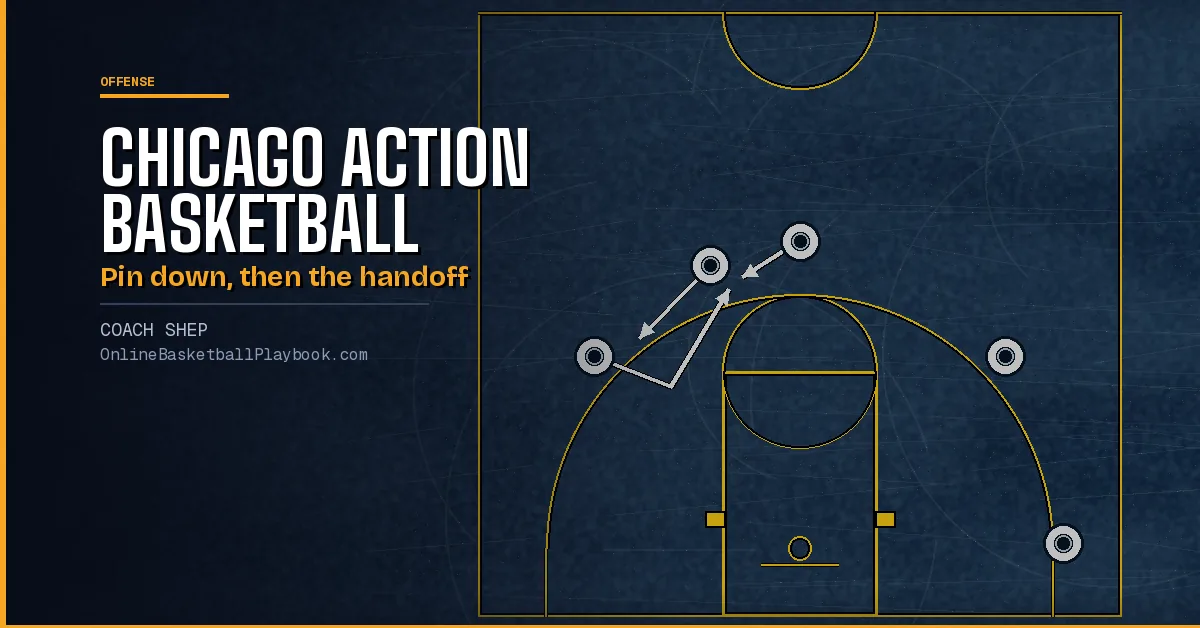
Chicago Action Basketball: Pin Down Into a Handoff
Chicago action basketball explained: a pin-down into a dribble handoff, the delay and elbow versions, what the screener does after, the reads and other meanings.
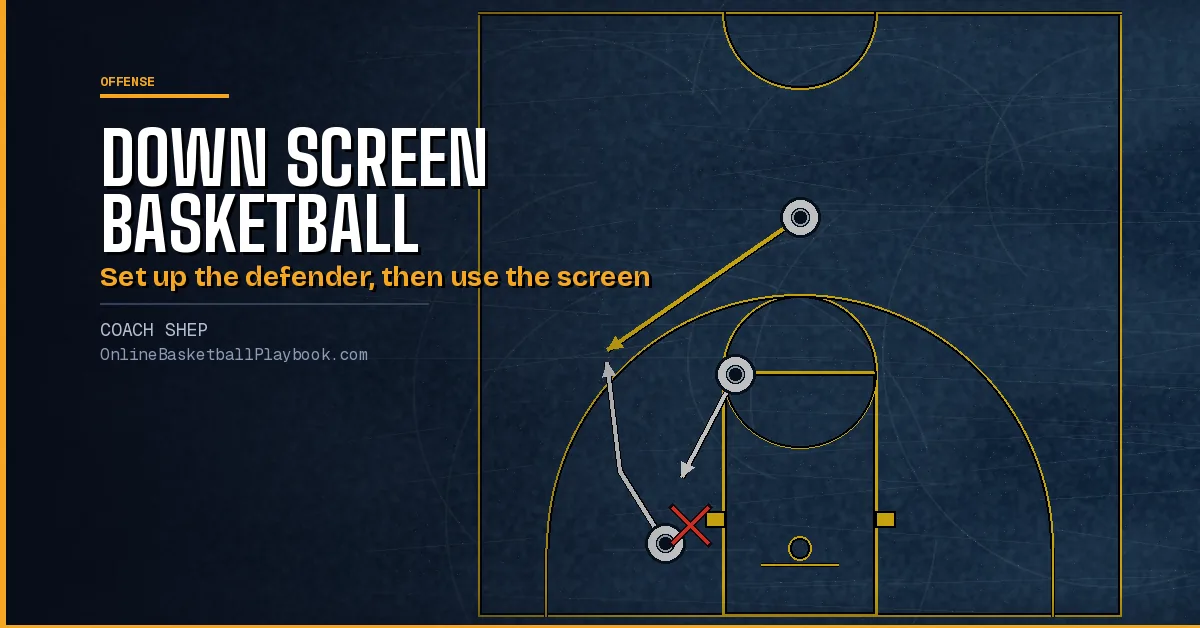
Down Screen Basketball: How to Set It, Use It and Read It
Down screen basketball for both players: how to set it, how the cutter uses it, the curl, pop, back cut and slip reads, and where coaches disagree.
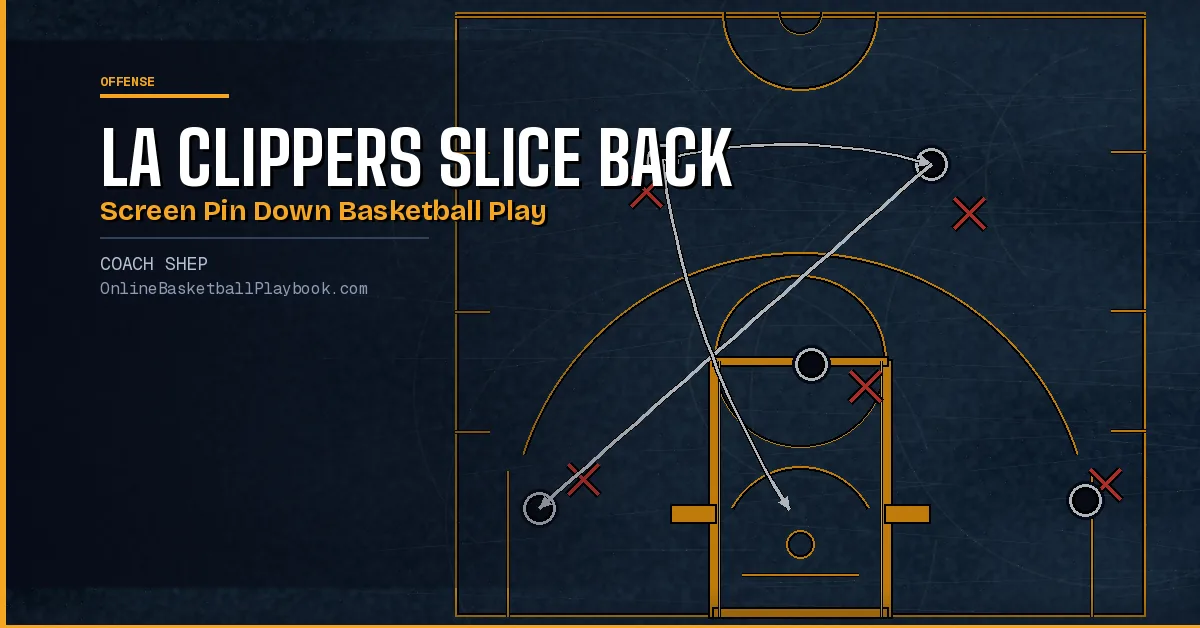
LA Clippers: Slice Back Screen Pin Down Basketball Play
LA Clippers: Slice Back Screen Pin Down Basketball Play