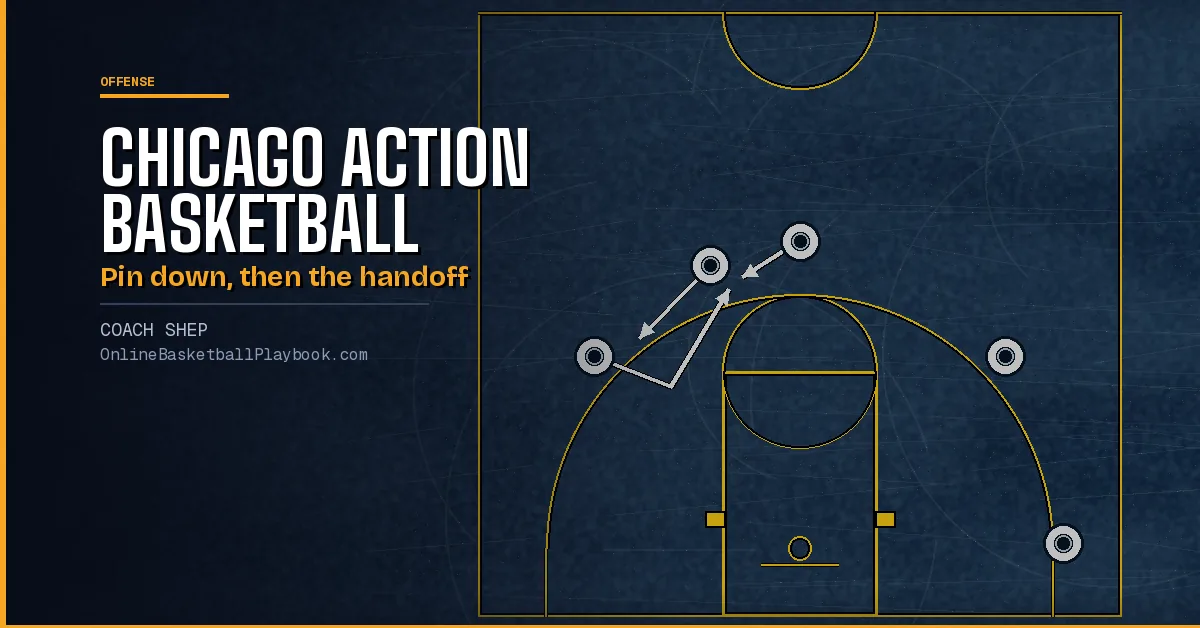
Chicago action basketball is a pin-down that runs straight into a dribble handoff for the same player. One player screens, the shooter runs up off the screen, and the ball changes hands as he arrives. In some versions a ball screen follows for the same player.
Chicago is one of the main finishes in college five-out libraries. One catalogue of 86 delay sets from 29 programs has 11 Chicago entries, and its main finishes are Get with 15, Chicago with 11, Pin with about 10 and backdoor with 8. This guide uses one meaning of the word, shows the versions by what the screener does next, and lists the reads. The screen is on down screen basketball and the handoff on dribble handoff basketball.
The Delay Version
The delay front spreads five players along the arc with the big out high. He receives the ball, and the guards read their outlets. Chicago starts with that pass.

The passer screens for a wing. The shooter runs up off the screen, and the big dribbles at him.

The handoff follows at once. The giver stays under control, dribbles straight at the defender he is screening and makes a short, clean handoff.

The screener cuts to the rim while the handoff is made, and the shooter has the ball.
Whatever else you add, rep the handoff exchange until it is automatic.
What the Screener Does After
The first screener has a job once the screen is done. Teams pick one.
- Cut to the rim. The screener goes to the basket while the big hands off. This is the delay version above.
- Clear the side. In an elbow version the screener runs to the corner and a second teammate dives to the block, so the side is cleared for the ball screen that follows.
- Swap with a teammate. In a finish after another action, one player cuts to the rim while the two players on the far side swap spots, one to the corner and one down.
- Take the pop. In a ball-screen finish, the player who screens the ball pops off it.
Pick the job, name it on the call sheet and make sure nobody else cuts to the same spot.
The Elbow Version
The handoff does not have to come from the top. A big at the elbow can give it.

One pro set builds on this. The big catches at the elbow, a wing screens down for the player in the corner, and the corner player takes the handoff. A big then sets a ball screen for him. Another pro set starts with an elbow cross screen to get the entry pass, then has one player down-screen for another, who runs off the 5's handoff to attack. For the ball-screen reads that follow, see pick and roll.
Use the elbow version when your best handoff giver is a big who is already there.
The Handoff Itself
A handoff is a short action with a few ways to go wrong. The sources agree on the shared rule and differ on the details.
- The giver dribbles at the screened defender. He stays under control and makes the handoff short and clean.
- The dribble count differs. Coaches teach two hard dribbles and a jump stop, one dribble, two dribbles at the cutter and then a screen, or no count at all with the giver delivering on the move.
- The receiver comes hard. He sets his man up, closes the gap and arrives at speed.
- The giver can screen after the give. He screens with the turn and then rolls, pops or spaces.
Two mistakes show up again and again. Too much space between the giver and the receiver lets a defender jump the lane, and a rushed handoff is a turnover. A giver who keeps moving into the defender after the give is setting a moving screen. Pick the count, put it on the call sheet and rep it as a two-person drill.
The Reads
The shooter makes two reads, one at the screen and one at the handoff.
At the screen. He reads the screener's defender and his own.
- The defense switches. Screen and roll.
- The screener's defender shows and recovers. Slip the screen.
- The defender chases and trails. Curl.
- The defender chases late. Curl all the way to the basket.
- The defender cheats over. Fade to the baseline.
- The defender cheats over early. Back cut.
At the handoff. Handoffs resolve into the same reads as a ball screen.
- The defender chases over. Turn the corner and drive.
- The defender goes under. Shoot it, or have a big re-screen. Two answers exist, so pick one.
- The defense switches. Slip, roll, post the mismatch or attack the switch.
- The receiver is overplayed. Back cut for a bounce pass or an automatic lob over the defender.
Learn the reads one at a time, and let the shooter commit to a read on every rep.
Tags That Attach to Chicago
Five-out libraries treat Chicago as a base that takes tags, so players never relocate and only the finish changes. The tags include a Spain back screen on the roller, a flare, a gap, a floppy and a ricky, and one library has a slip exit tagged as an after-timeout call. A library of 106 plays pairs Chicago with a backdoor answer to overplay in three ways, called keep, keep-pivot and reject. See quick hitters for the one-call versions and 5-out motion offense for the spacing.
Add one tag at a time, after the base Chicago is clean.
Other Meanings of Chicago
On this page Chicago means a pin-down into a dribble handoff. The sources do not use it one way. FIBA calls a pin-down followed by a dribble handoff zoom action, and the zoom action page covers that picture. Other books use Chicago for these:
- A stagger screen action.
- A UCLA cut that turns into a flex screen or a ball screen. See UCLA offense basketball.
- A back-screen action used against a sagging defense.
- A corner three off a baseline drive.
Write the job next to the name on the call sheet, and check the diagram before you borrow a call.
Questions Coaches Ask
What is Chicago action in basketball?
A pin-down for a shooter that runs into a dribble handoff for the same player. In some versions a ball screen follows.
Is Chicago the same as zoom?
The picture is close. FIBA names a pin-down followed by a dribble handoff zoom action, and some five-out books call the same shape Chicago.
Who gives the handoff in Chicago?
In the delay version it is the big at the top of the key. In an elbow version it is the big at the elbow.
What does the screener do after screening?
Teams choose. He can cut to the rim, clear the side, swap spots or pop off a ball screen.
What do you do if the defender jumps the screen?
Cut back to the rim. A pin-down offers a back cut when the defender cheats over early.
Every diagram on this page uses the symbols on how to read a basketball play diagram.
Get the next coaching guide in your inbox
One email when a new guide or diagram set goes up. Free.
Want the printable playbook packs?
OBP Pro members get the premium playbook packs: the zone attack, out of bounds and practice plan PDFs, plus each new pack as it is finished. The membership page lists what is in each one. Or draw your own version free in PlayDraw.
See what OBP Pro includesRelated Guides
- Zoom Action Basketball: Down Screen Into a Handoff
- Split Action Basketball: Post Splits, Cuts and Reads
- Double Drag Screen Basketball: Roll, Pop and Slip
- Spain Pick and Roll Basketball: Screen the Screener
- Corner Stagger Action Basketball: Screens for a Shooter
Back to Basketball Plays and every Offense page.
Keep Building
Related breakdowns
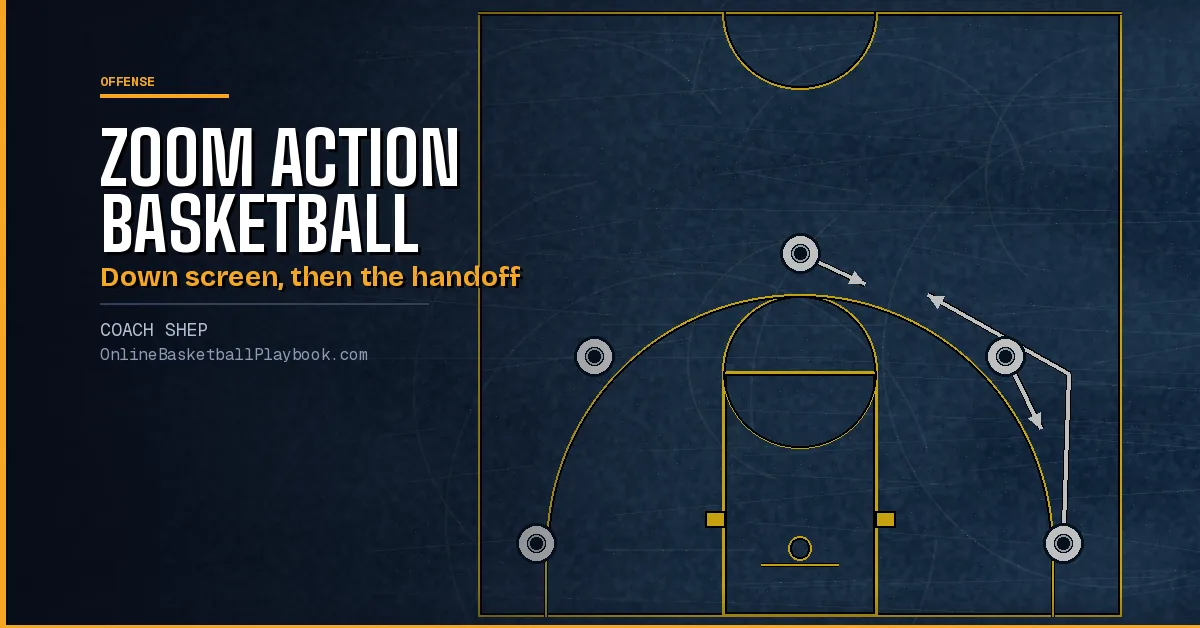
Zoom Action Basketball: Down Screen Into a Handoff
Zoom action basketball explained: the down screen into a dribble handoff, the three reads, the back cut and slip counters, every version and how to teach it.
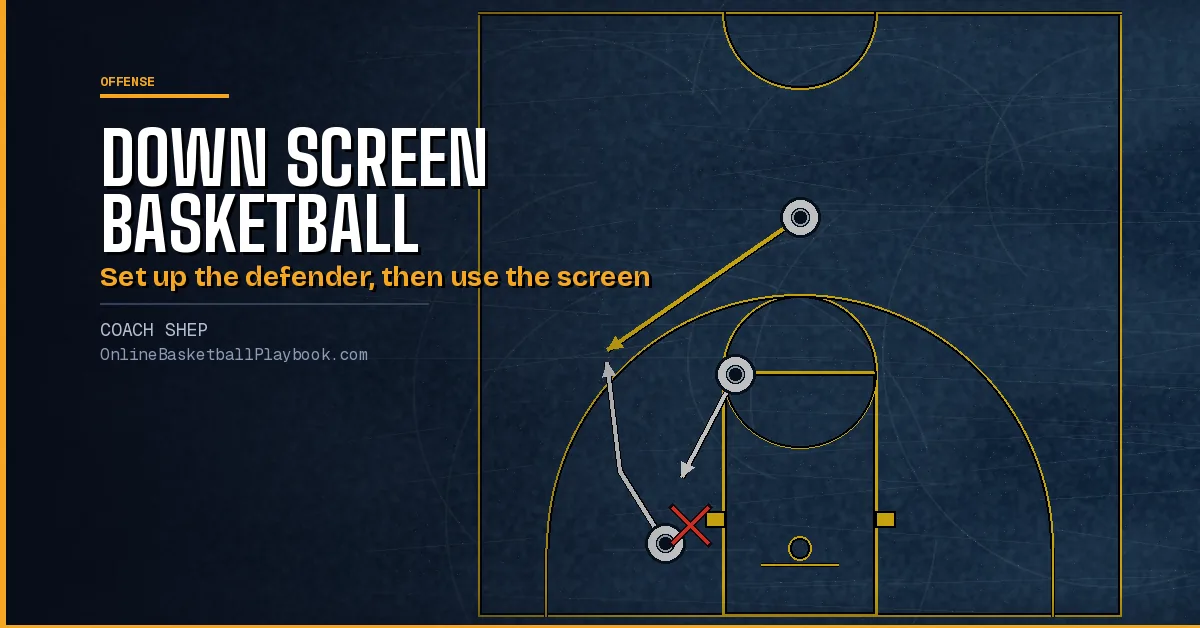
Down Screen Basketball: How to Set It, Use It and Read It
Down screen basketball for both players: how to set it, how the cutter uses it, the curl, pop, back cut and slip reads, and where coaches disagree.
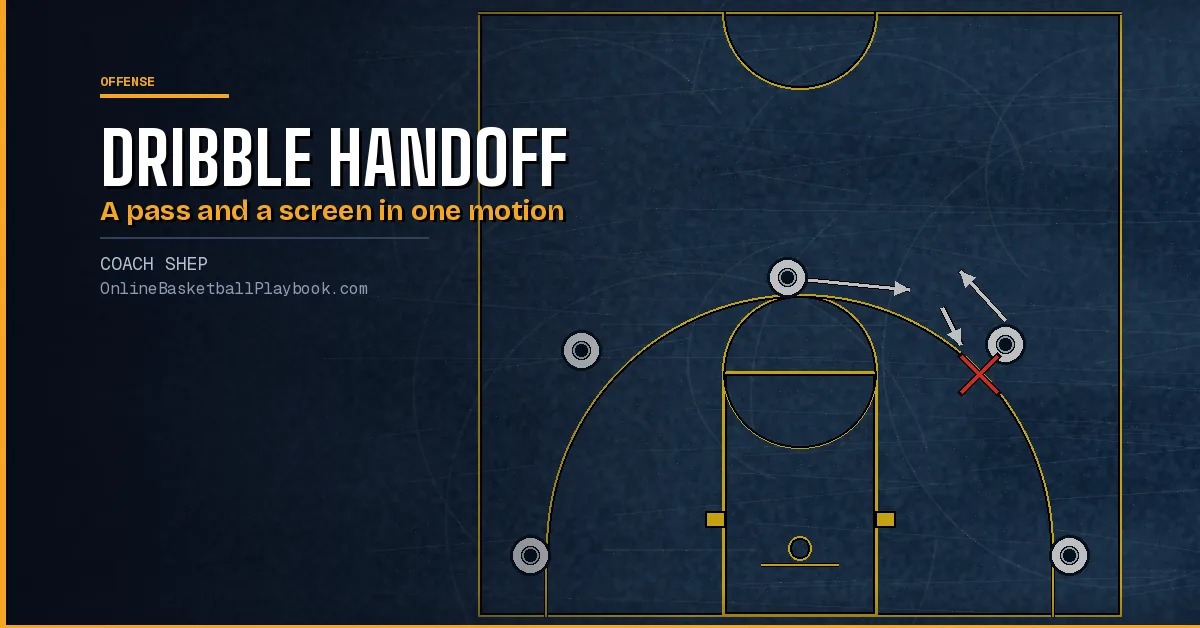
Dribble Handoff: Types, Reads, Counters and How to Defend It
The dribble handoff in basketball: the types of handoff, how the giver delivers it, the reads for both players, the counters, and how defenses guard the DHO.