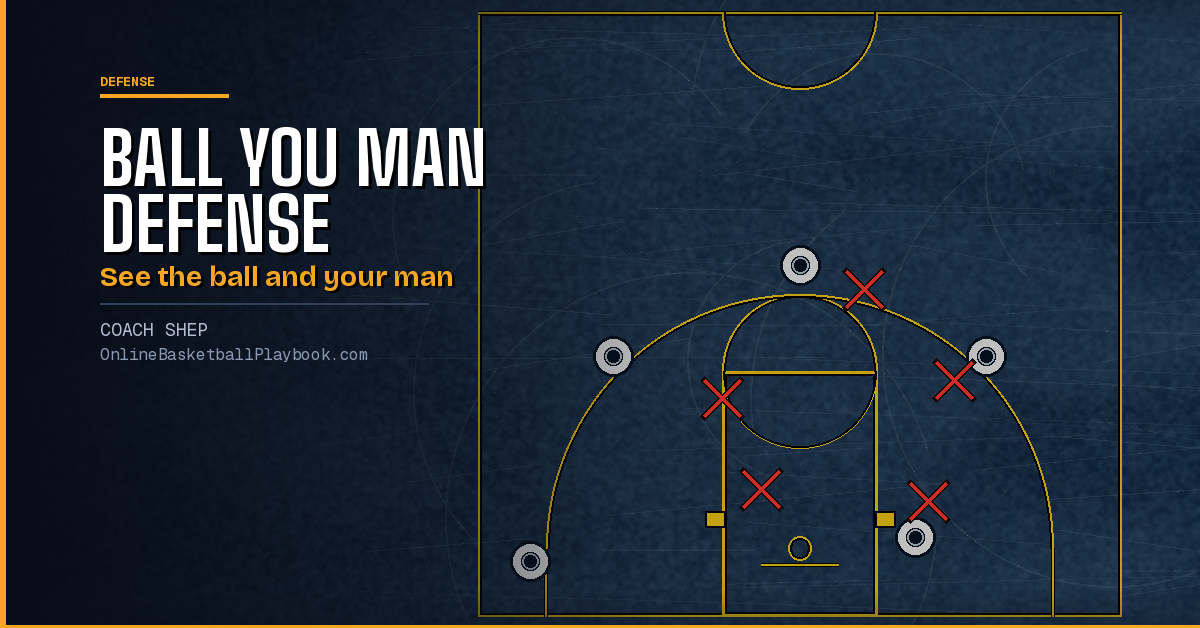
Ball you man defense is the off-ball rule under every man-to-man: each defender away from the ball stands where he can see the ball and his man at the same time, on the line between them, never between his man and the basket. Picture a triangle with the ball, the defender and his man at the corners. The farther the man is from the ball, the farther the defender sits off him and toward the help. This page covers the triangle, the positions one, two and three passes away, jumping to the ball on every pass, the one-pass-away stance argument, the ball below the free-throw line, and how the pressure and pack line versions set the same triangle differently, side by side. It sits under types of defense in basketball in the defense section.
What Ball You Man Defense Means
Ettore Messina names the most common off-ball mistake: standing between your man and the basket instead of between your man and the ball. He builds his whole defense on ball-you-man, which he calls playing "up the line," and gives four reasons for it:
- The defender sees and stops the pass and face cut.
- He sees the back screen earlier and can get ball side to recover.
- He forces the catch higher on the floor, which he calls cutting the triangle, so the post feed gets harder.
- The higher catch discourages early drives.
Other versions teach the same geometry with their own words. One skills text teaches an open "pistols" stance far from the ball and a closed denial stance near it. For 6 to 8 year olds, start with the pistol cue, one finger pointing at the ball and one at your man. The help spot one step off the line is also called "Pistol." Think of the line from ball to man as a rope.
Ball You Man Defense Positions by Passes Away
The shared rule is that distance from your man grows with the number of passes it would take to get him the ball. One pressure version gives one full set:
- One pass away. Chest to the receiver, the back foot splitting him in half, the front foot, outside arm and hand in the passing lane, seeing ball and man.
- Two passes away. One foot in the lane, able to stop ball-side penetration and the lob.
- Three passes away. Both feet in the lane, the deepest help spot for a ball-side drive.

Other versions set the spots differently:
- The ten-rule deny version denies all passes one pass away and put both feet in the lane two passes away.
- The halfway version puts the one-pass-away defender halfway between ball and man and two steps off the rope in a closed stance. Two passes away, his fingertips touch the rope at the midline. When the ball or his man moves, he reroutes to his new spot at once, which the staff calls Defensive GPS.
- The free-throw line version keys it to that line: ball above it, one foot in the lane. Ball below it, a foot on the help-side line.
- The thirds version sags one third of the way into the passing lane two passes away and halfway three passes away.
The full help-side table, coach by coach, is on help defense basketball.
The Pack Line Triangle
Dick Bennett's Pack Line keeps the triangle but changes where it sits. One defender pressures the ball and the other four stay inside an imaginary line, 16 feet from the rim in his version, in gap and help spots, never denying. Other pack programs draw the line at 17 feet or a step inside the arc. The one exception is a dead ball, when everyone jumps out to deny and hunt the steal. Off the ball, the defender plays ball-you-man in a low stance inside the line.
The pack line gives three requirements for the off-ball spot:
- About halfway between ball and man.
- Two feet inside the pack line, a step off the ball-you-man line.
- Seeing ball and man.
It names two errors. Too glued to the man opens a driving lane, and the helper has too much ground to cover. A deep triangle lets the handler drive deep, so the helper sells out and cannot recover to the kick-out. The pack line cue is to keep the triangle flat. Its stance off the ball points the top foot at the ball handler with the chest angled to see both, not square to the ball.

One pass away, the spot has two jobs. The defender must be able to stop the drive and still close out to his man on the pass. With the ball on the wing and his man at the top of the key, X1 stands near the elbow, where he can step in front of a middle drive and still get back out to 1 on the pass. Do not sag so far that you cannot recover to your man on one pass. The farther your man is from the ball, the closer you can play to the ball, because the pass to him is longer. The scouting report moves the spot too: guarding a non-shooter, you can sit closer to the ball. Guarding a good shooter, stay closer to your man.
Another version agrees on the size: big triangles invite screens and long closeouts, and it checks them with "move when your man moves." A tighter version stays never more than one step off the passing lane. The whole pack system is on pack line defense.
Pressure and Pack Side by Side
| Rule | Pressure version | Pack line version |
|---|---|---|
| One pass away | Deny: body in the lane, chest to the receiver | Gap, both feet inside the 16-foot line, no denial |
| Two and three passes away | One foot in the lane, then both feet in | Flat triangle, halfway, a step off the line |
| Where the ball goes | Outside, to the sideline and corners | Middle, into the help, never baseline |
| Dead ball | No separate rule | Everyone jumps out to deny |
| Risk the owner accepts | The backdoor and the lob | Open catches on the perimeter |
A third group decides by opponent: one version denies the wing against wing shooters and allows the catch against a penetrating point guard. Pick one pole, because mixing them without rules causes breakdowns. The full comparison is on pack line vs pressure man to man. The SOS system's snuggle denial, low with the rear foot about twelve inches behind the man, is on SOS pressure defense.
Pack Line and No-Middle Are Different Defenses
Both keep the ball out of the middle and play ball-you-man off the ball. They part ways on where the help stands and what happens on a baseline drive.
Version 1: pack line
The four defenders off the ball stay inside the pack line and nobody leaves it unless he is guarding the ball. It can look like a zone, yet every defender still has a man. Your position is your help: each defender is already in his help spot, so there is no help-and-recover step. He stops the ball, then closes out. The ball defender on the wing takes away the baseline. Some pack programs force the drive middle into the gap help at the elbows. Others deny the baseline without forcing a direction.
Version 2: no-middle
A midline down the middle of the floor splits the ball side from the help side. On the wing, the ball defender keeps his nose on the dribbler's high shoulder and steers him baseline toward the short corner. The low man on the help side, two passes away and under the rim where he sees the whole floor, decides whether to stay with his man or go stop the baseline drive.
The rotations behind each one, including what happens after the low man goes, are on help defense basketball.
Jump to the Ball on Every Pass
The triangle only holds if it moves with the ball. Messina gives a number: one or two steps toward the ball on every pass, in position before the catch. He also sets the direction. The defender drops diagonally along the passing line, never straight back, because a straight drop makes the skip-pass recovery too slow.

Jumping to the ball every time is said to remove 90 percent of the trouble with cutters. Denial defense makes it a rule for the passer's defender: jump to the ball so the cutter has to go behind you. Hubie Brown's rule is that nobody rotates until the ball is in the air. Jumping on the flight of the pass, not the arrival, counts as a toughness habit.
Up the Line or Chest to Your Man
The one real argument about ball-you-man is the stance one pass away.
Version 1: ball-you-man up the line
Messina stays between man and ball, adjusting every time the ball moves, for the four reasons above. One version plays up the passing line a step or two toward the ball, close enough to steal but able to help on a drive, and goes to full denial once the dribble is picked up.
Version 2: chest to the man
The chest-to-man denial puts the one-pass-away defender chest to his man, hand and foot in the lane, eyes over the lead shoulder. It argues against ball-you-man there, because a backdoor cut then needs a 180-degree turn. It keeps ball-you-man for two passes away.
Rick Majerus uses three stances by ball location: nose on the ball, an angled pack stance one pass away, and a close denial stance. A force-the-back-cut version plays an aggressive elbow in the passing lane on purpose, and the defender changes his eyes when the man goes behind him.
Ball Below the Free-Throw Line
When the ball goes below the free-throw line extended, the triangle sinks. Messina's second rule: drop to the ball line, a line through the ball parallel to the baseline. On a baseline drive his help-side wing climbs diagonally toward the low post rather than dropping straight down.

The split-line version stacks the two weak-side helpers on the split line once the ball drops under the foul line, the low I near the rim and the high I near the foul line. The SOS system uses the same low-I and high-I names. The straddle version straddles the lane line with one foot in the paint once the ball is at or below the line extended, to deny the flash and beat screens.
The Backdoor Is the Price
Denial gives up the space behind the defender. The pressure system above invites the backdoor on purpose, with weak-side help positioned to intercept it. Mike Krzyzewski treats the backdoor as a pressure release. The pack takes the backdoor away and is credited with killing backdoor cuts against the Princeton offense.

One version makes the back cut a team job. The denier drops shoulder to shoulder with his ear on the cutter's chest and ends in a post front with his eyes on the ball, the on-ball defender pressures the passer, and the help side intercepts, deflects or takes the charge. If the denier is beaten, he puts the opposite hand in the passing lane with a quick head snap and sprints to catch up. The offense's side of this read is on backdoor cut basketball, and cutter defense on drills to teach defending cutters.
Get the next coaching guide in your inbox
One email when a new guide or diagram set goes up. Free.
Teaching Ball You Man in the Shell
Every man system teaches these positions in a shell drill, and the versions differ in what the coach watches.
- Messina, from under the basket. He watches two things, a defender always in the paint and ball and defender arriving together, and freezes play to correct.
- A three-stage denial shell. Ball on the wing: one on the ball, one denying, two on the split line. Ball in the slot: two denying, one on the split line. Walk each position, then pass around holding the ball about three seconds, then two live rotations with players pointing and calling "ball," "deny," "help."
- A shell by stage. On-ball, deny, help side, full denial, help and recover, defending the cutter, then live versions.
- A youth shell. 4 on 4 with a jump to the ball on every pass, and a 2 on 2 help drill where a skip pass sends the helper sprinting to the rim line.
The shell itself is on shell drill basketball, and the install order for the whole man-to-man is on building up man-to-man defense. Force direction, which decides where the help comes from, is on lock left defense, and the closeout back to your man after helping is on closeout basketball.
Questions Coaches Ask
What does ball you man mean in basketball?
Each off-ball defender stands on the line between his man and the ball so he can see both, never between his man and the basket. Ball, defender and man form a triangle.
Where should a defender be two passes away?
In one pressure version, one foot in the lane. In the pack line, inside the 16-foot line, about halfway between ball and man and a step off the line between them.
Is ball-you-man the same as denial?
No. Ball-you-man is the alignment. Denial is one way to play it one pass away. Pack line teams play ball-you-man with no denial, and the chest-to-man denial uses chest to the man instead of ball-you-man one pass away.
Why jump to the ball on every pass?
The triangle changes with every pass, so the defender has to be in his new spot before the catch. One version ties it to stopping cutters, and Messina to stopping the pass and face cut.
Want every diagram, printable?
OBP Pro members get the full diagram files for every read, position and rotation on this page, ready for a practice binder or a scouting report. $9 a month. Or draw your own version free in the play drawer.
See what OBP Pro includesMore Core Coaching Guides
- Advantage Basketball: Reading the Help and Keeping It Alive
- Backdoor Cut Basketball: How to Read the Denial
- Closeout Basketball: Technique, Angles, Shooter Reads and Drills
- Help Defense Basketball: Help Side, Stunts, Rotations and 911
Back to Types of Defense and every Defense page.
Keep Building
Related breakdowns
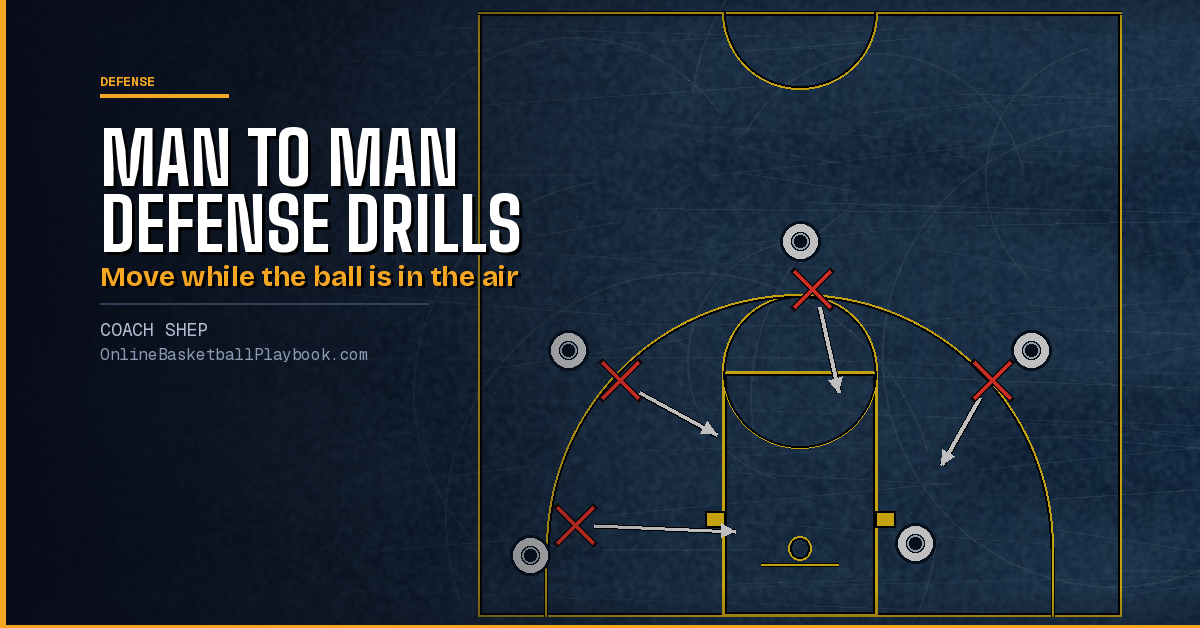
Man to Man Defense Drills: Ladders From 1 on 1 to 5 on 5
Man to man defense drills in teaching order: full ladders from 1 on 1 to 5 on 5, denial, help and recover, post and screen drills, scored games and youth versions.
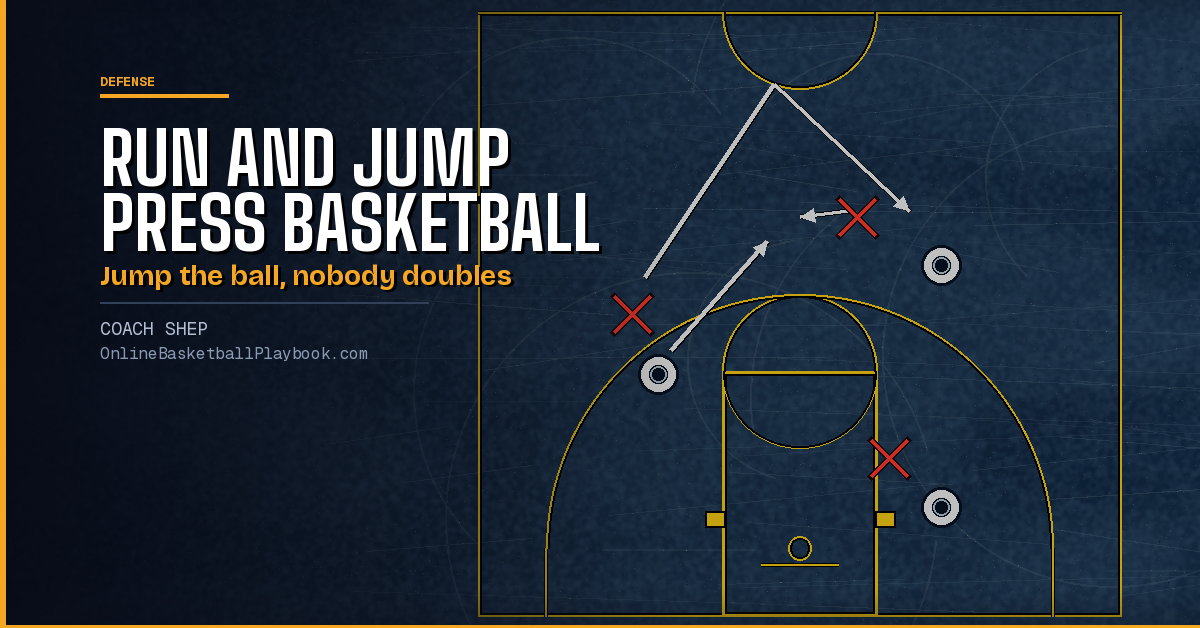
Run and Jump Press Basketball: Rules, Rotations and Drills
Run and jump press basketball explained: the jump switch, when to jump, middle or sideline, the rotation, when to call it, how offenses beat it and the drills.
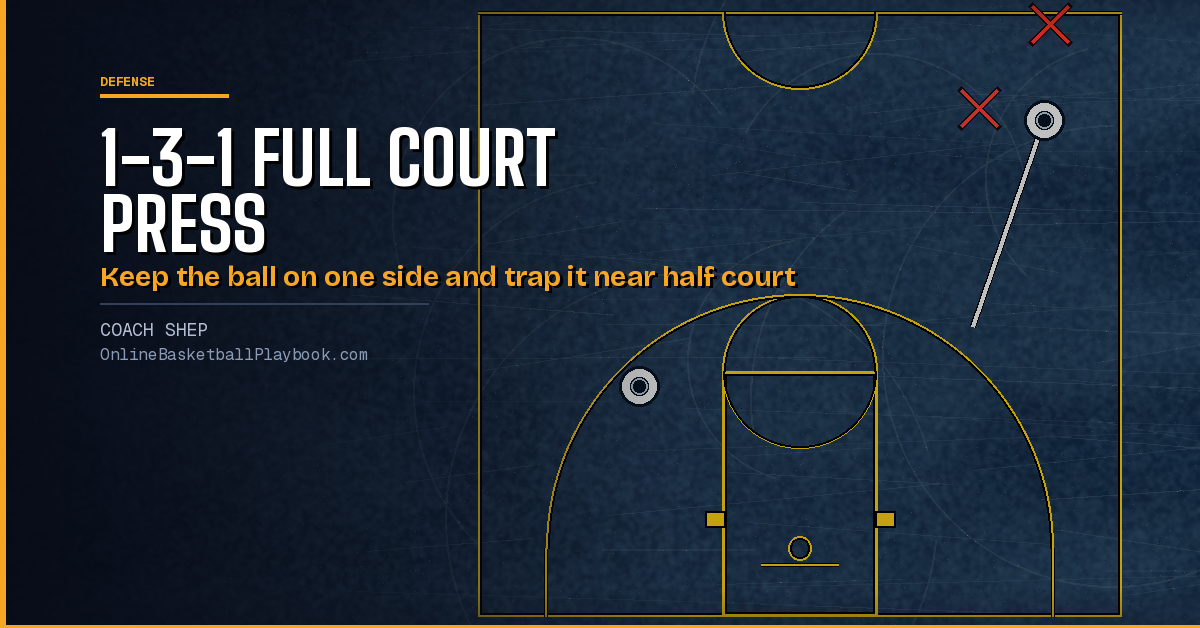
1-3-1 Full Court Press: Roles, Traps and Rotations to Install
The 1-3-1 full court press from setup to frontcourt trap: each role, the reversal rotations, an aggressive version, the costs and when coaches call it.