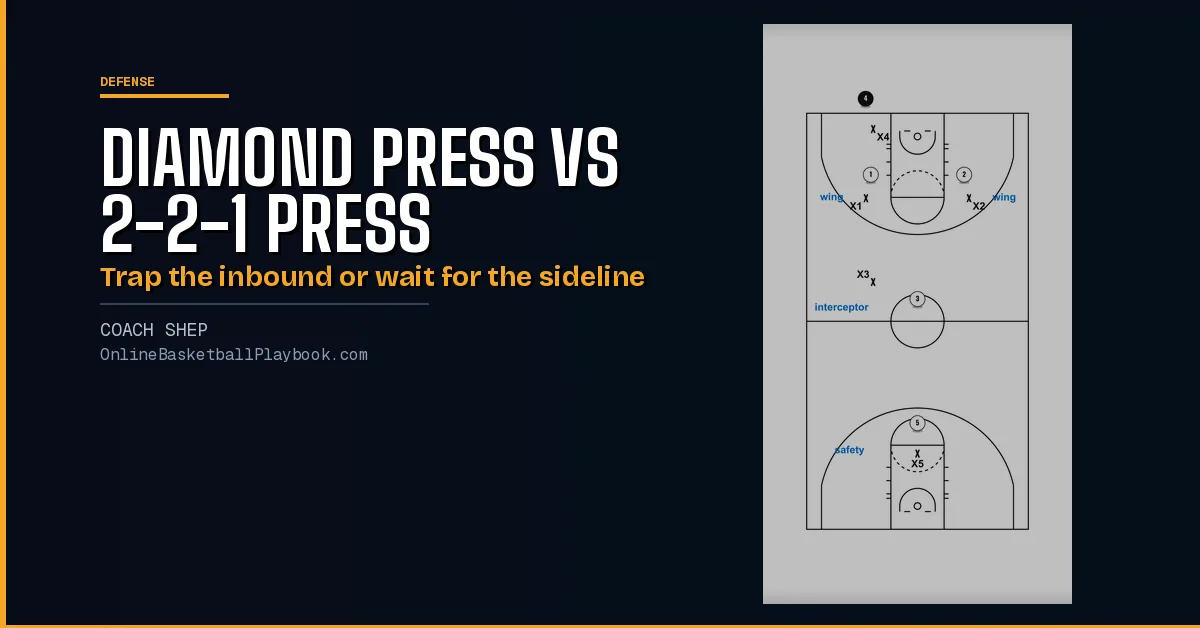
Diamond press vs 2-2-1 press comes down to where you want the trap. The diamond press, the 1-2-1-1, puts a defender on the inbounder, steers the first pass to a corner and traps it deep in the backcourt. The 2-2-1 allows the first pass, keeps the ball on the side of the floor, runs it up a sideline and traps near half court. Below, both are drawn at the same four moments: the set, the first trap, the pass back and the moment the press breaks.
Diamond Press vs 2-2-1 Press at a Glance
| Diamond press (1-2-1-1) | 2-2-1 press | |
|---|---|---|
| Picks up | Full court, on the inbounder | Three-quarter court, inbound allowed |
| Shape | Disruptor, two wings, interceptor, safety | Two front, two on a second line short of half court, one deep |
| Where it traps | The first catch in the backcourt corner | The sideline, between the free-throw line and half court |
| What it takes away | The easy inbound and the middle pass out of the trap | The middle of the floor |
| The main escape | The pass back to the inbounder | The reversal across the floor |
| Cost when beaten | A pass over the first trap gives the offense numbers | Few steals against patient teams |
| Key player, picked first | The interceptor, or the disruptor in another version | The deep player who reads the long pass |
Press vocabulary sorts them by depth. The diamond is a full-court press that guards the inbounder, often called an 80. The 2-2-1 is a three-quarter press that does not, often called a 60. The words are on the press terminology guide and every press is ranked on best full-court press.
The Set

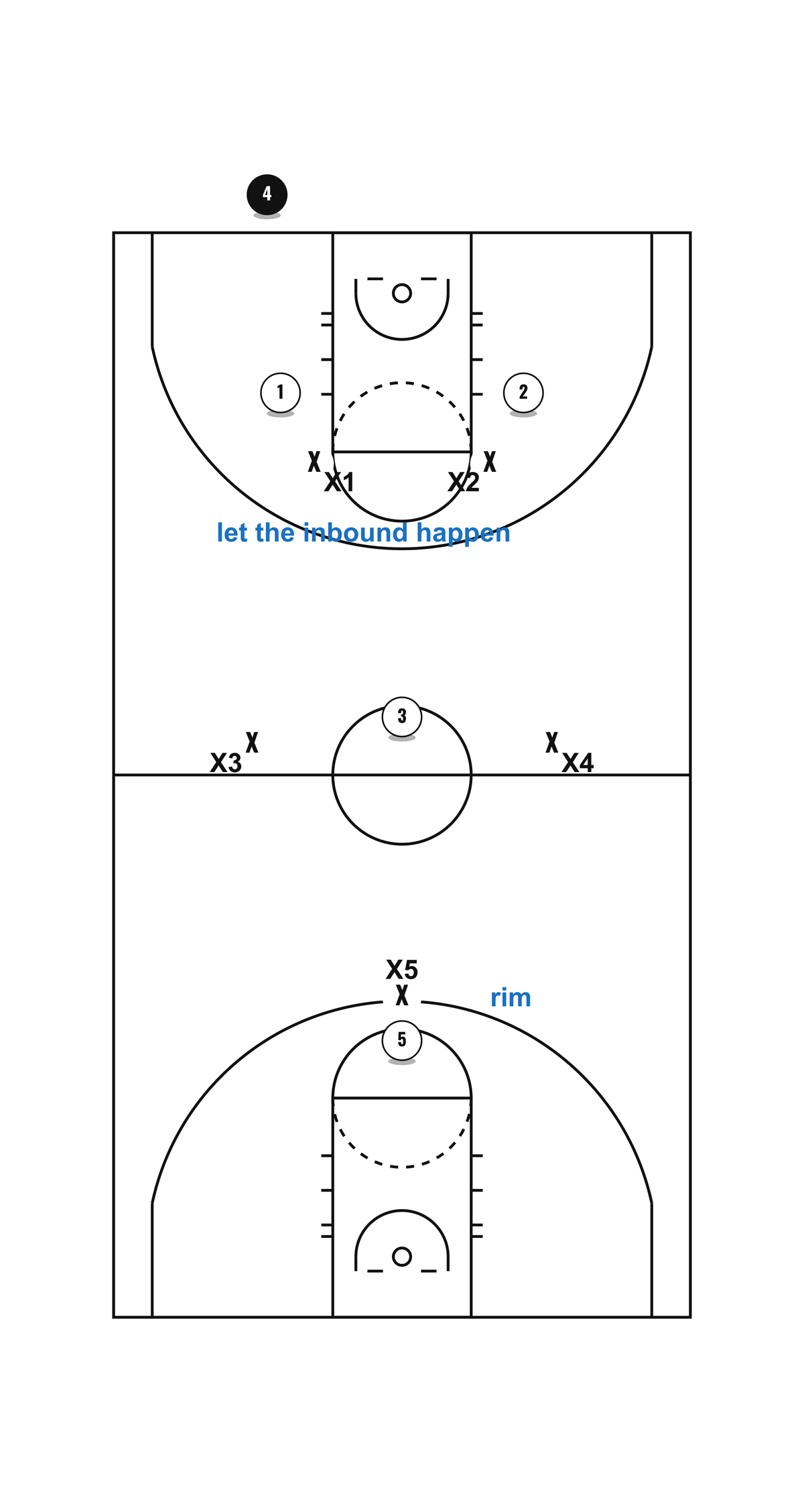
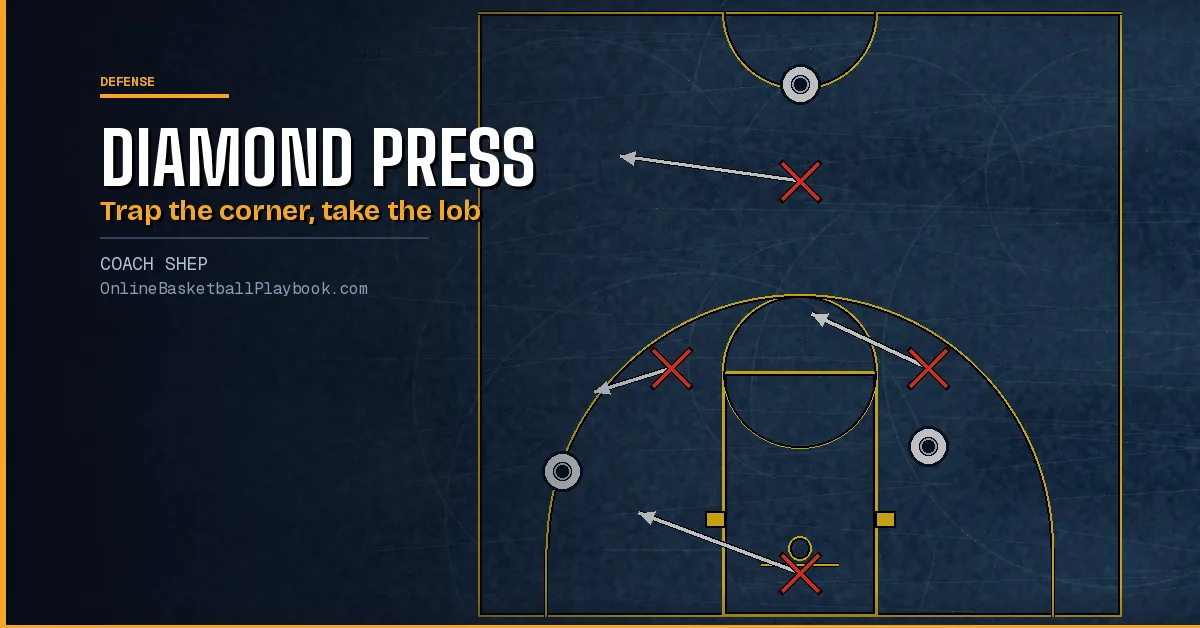
The diamond starts the fight on the end line. The disruptor stands to leave the strong-side corner as the one easy pass, and the wings start behind the nearest receivers so that corner pass looks open. The interceptor stands in line with the inbounder, roughly midway from the arc to half court. The safety plays as deep as the last offensive player.
The 2-2-1 starts with nobody on the ball. The front two sit around the elbows, the second line is a step or two inside half court and the deep player sits near the three-point line. In the base version the first pass comes in to either side. From there the front defender on the ball side pressures the catch and turns it to the sideline while his partner drops into short middle.
The First Trap


The diamond traps where the ball lands. The disruptor and the strong-side wing close on the corner catch. The wing comes under control so the receiver cannot get by him up the sideline, and the disruptor gets there with his hands high to take away the pass to the middle. The trappers take space with their legs and keep their arms high. The steal belongs to the interceptors, not the trappers.
The 2-2-1 traps where the sideline runs out. The front defender leads the dribbler up the alley and a second-line defender comes up to meet him near half court, using the sideline and the half-court line as extra defenders. Behind the trap one player holds short middle, one takes deep middle and the deep player stays home. In one diamond version the shape becomes a 2-2-1 once the first trap fires.
The Pass Back


A good diamond trap leaves one open pass: back to the inbounder, often a big who does not handle pressure well. The weak wing stunts at the ball to buy time, the disruptor guards the inbounder one on one and everyone else denies, hunting an eight or ten second count. Some versions set a second trap when the ball is reversed again, using the disruptor and the other wing.
The 2-2-1 plays the reversal with one defender on the ball and four in a box behind him. The middle guard does not leave the middle until his partner takes over, either by a call or a physical tag. Some coaches allow the reversal as bait, because every reversal costs the offense clock and resets the press. Others deny it with the weak-side guard and forward.
Get the next coaching guide in your inbox
One email when a new guide or diagram set goes up. Free.
When the Press Breaks


Both presses end when the ball reaches the middle. The diamond also ends when the ball crosses half court, and a broken diamond means playing a man down, so sprinting back is its first rule. On a lob over the first trap the interceptor steps in front of the catch to cut off the sideline while the near wing comes to trap a second time, and the far wing and the disruptor race back into the passing lanes.
The 2-2-1 is built to protect the middle, so a gut pass that gets through is the worst case. In one version two guards double the ball from behind. In the other, the closest player contains it and everyone gets back to man. Other versions sprint back into a zone. The offense side of both breaks is on press break and how to break a three-quarter press.
Personnel
Diamond: a forward goes on the inbounder in most versions, since rebounding puts him by the end line on every possession. One version picks the interceptor first, the best anticipator, usually a guard or wing, then splits the bigs with the more athletic one as disruptor and the slower one as safety, and fills the wings from the remaining guards. Another picks the disruptor first and makes the point guard the interceptor. One version also rules that the 4 and the 5 never trap together.
2-2-1: the front line gets guards. One version puts the two best on-ball defenders up front, another wants the biggest guards it has, another wants quick guards and calls the center possibly the most important piece. One version puts the two bigs on the second line and picks the deep interceptor first, because most steals come from there. Another says it needs no elite athletes, and a less athletic team can use it as its base defense.
Where Coaches Split
- When the diamond traps.
- Trap at once: trap the inbound catch immediately.
- Delay: deny the return pass until the receiver dribbles, then trap.
- Trap line: trap only below a set line unless a call says trap.
- Speed dribble: trap only the uncontrolled dribble.
- How the 2-2-1 handles the inbound.
- Let it in to either side, then force.
- Deny early, never over-deny, then release.
- Deny every receiver like man-to-man, leaving the inbounder free and the deep player back for the lob.
- One trap or more.
- One and done: trap once, then sprint back. Some diamond versions and some 2-2-1 versions both play it this way.
- Re-trap: the diamond traps a second reversal, and several 2-2-1 versions add a second trap on a lob down the sideline or after a broken first trap.
- Steals or slow passes.
- Steal version: force the lob and intercept it.
- Slow-pass version: the 2-2-1 is happy with lobs and bounce passes, which are slow and give the rotation time, and players who gamble for steals break the zone.
- Young teams.
- No trapping zone presses for youth, a man press only.
- A plain containment 2-2-1, run with youth and high school teams.
- The diamond with the immediate trap installed first, the delayed trap added later.
Whichever version you choose, drill the sprint back as hard as the trap. The youth press guide has the age questions in full.
Pick It When
- You want steals near the other team's basket and have a long, mobile forward to put on the ball: diamond.
- The other team inbounds with a big who handles pressure poorly: diamond, and play the pass back to him.
- The other team just scored a layup or an inside basket and you change presses by the shot: diamond, as in Rick Pitino's system.
- You want to control tempo without giving up layups: 2-2-1.
- The other team has no true point guard or good passers: 2-2-1.
- Your team is not built on elite athletes: 2-2-1.
- You are protecting a late lead: a retreat 2-2-1 with no traps.
- The other team is patient and handles pressure well: know the cost first. The 2-2-1 gets few steals against it, and a diamond beaten over the top gives up numbers.
Full breakdowns: 1-2-1-1 diamond press and 2-2-1 press. The family overview is on full-court press defense and the three-quarter pickup on the three-quarter court press guide. Other side-by-side guides: box and 1 vs triangle and 2 and pick and roll vs pick and pop. Every defense is mapped on types of defense in basketball.
Questions Coaches Ask
Is the diamond press the same as the 1-2-1-1?
Yes. The diamond is the 1-2-1-1, with one on the inbounder, two wings, one interceptor and one safety.
Which press is safer, the diamond or the 2-2-1?
The 2-2-1 is usually called the safe end of the press family because it does not trap early. The diamond traps the first catch, so a pass over that trap gives the offense numbers.
Can you run both from the same look?
Yes, in two versions. One menu runs three presses from one diamond look, one of them a 2-2-1, and its rotate call has the 4 bump himself back into that 2-2-1. In the other version the rotate call sends the weak wing back, which turns the press into a 2-2-1 or a 2-1-2.
Where do you trap in a 2-2-1 press?
Most versions trap on the sideline near half court. One traps between the free-throw line and half court, another in the sideline alley just past half court, and another traps any middle dribble and allows the sideline.
Want the printable playbook packs?
Playbook packs: zone attack, press break, press defense, out of bounds, quick hitters, practice plans and the youth turnover cure, each a printable PDF. Or draw your own version free in PlayDraw.
See the playbook packsRelated Guides
- Box and 1 vs Triangle and 2: Junk Defenses Side by Side
- Pick and Roll vs Pick and Pop: When the Screener Rolls or Pops
Back to Types of Defense and every Defense page.
Keep Building
Related breakdowns
Best Full-Court Press: 6 Presses Compared
The 1-2-1-1, 2-2-1, 1-2-2, 1-3-1, run and jump and full-court man, sorted by where they pick up, where they trap and how much they risk.
Full Court Press Defense: Types, Rules and How to Install It
Full court press defense pressures the ball for 94 feet. See the press families, shared rules, trap mechanics, the cost, the install order and drills.
1-2-1-1 Diamond Press Basketball: Roles, Traps and Install
How to run the diamond press in basketball: who plays each role, how to trap the corner, what to do on the reversal and the lob, and how to install it step by step.