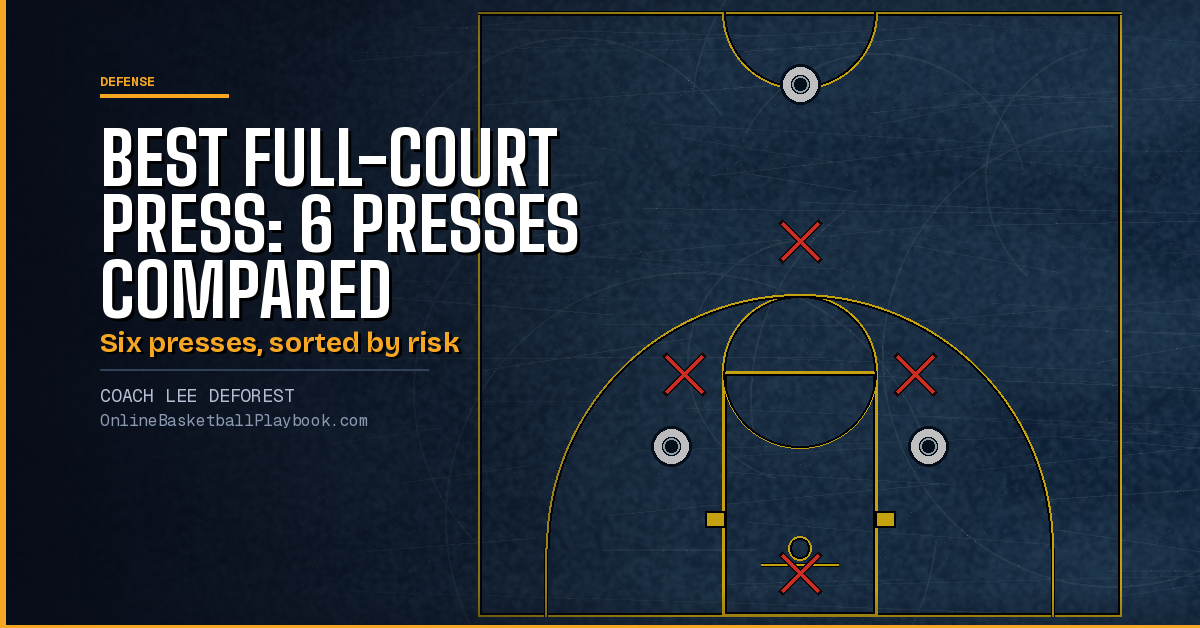
The best full-court press is the one that fits why you are pressing. Some presses exist to steal the ball. Some exist to burn shot clock and wear down a thin team. Some exist to get a slow team to play fast. Pick the reason first, then the press. Pressing without a reason gives up fouls and layups.
Presses are sorted here by how aggressive they are, from most to least, with risk rated separately. Each one lists where it picks up the ball, where it traps, what it risks and who should run it. For the half-court defenses these presses fall back into, see Types of Defense in Basketball.
1. 1-2-1-1 Diamond: Trap Early
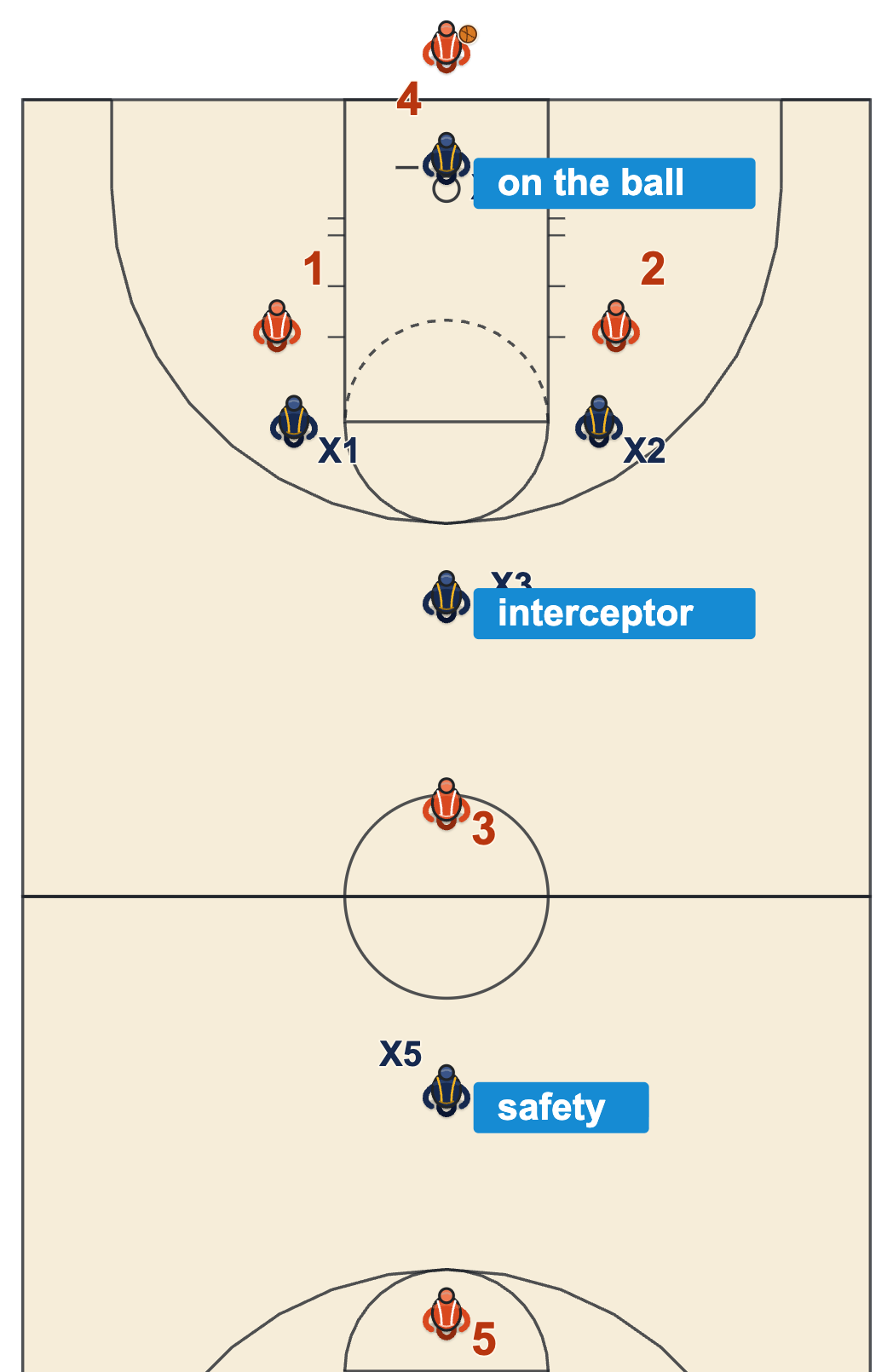
Picks up: full court, with a defender on the inbounder.
Traps: right after the inbound, usually in the corner the defense forced the pass to.
Risk: high. One safety covers the whole back half, so a broken trap can mean a layup.
Run it when: you are deep, athletic and want the ball back.
The defender on the inbounder shades so the corner is the only easy pass, counts the five seconds out loud and keeps his feet on the floor. The wings let the catch happen, then trap with him. The interceptor reads the passer's eyes for the lob out. Full breakdown: 1-2-1-1 Diamond Press.
2. 1-3-1 Full Court: Trap at the Sideline
Picks up: full court or three-quarter court.
Traps: where the sideline meets half court. The three across the middle take away the reversal pass.
Risk: high. Tall teams can throw over the middle three, and a broken trap gives up layups.
Run it when: you have long, athletic players and the opponent's first ball handlers have been escaping traps near the baseline.
Its best trick is that it looks the same as the half-court 1-3-1 zone. A team that runs both from one alignment makes the opponent prepare for two defenses. Full breakdown: 1-3-1 Full Court Press.
3. Run and Jump: Surprise Switches
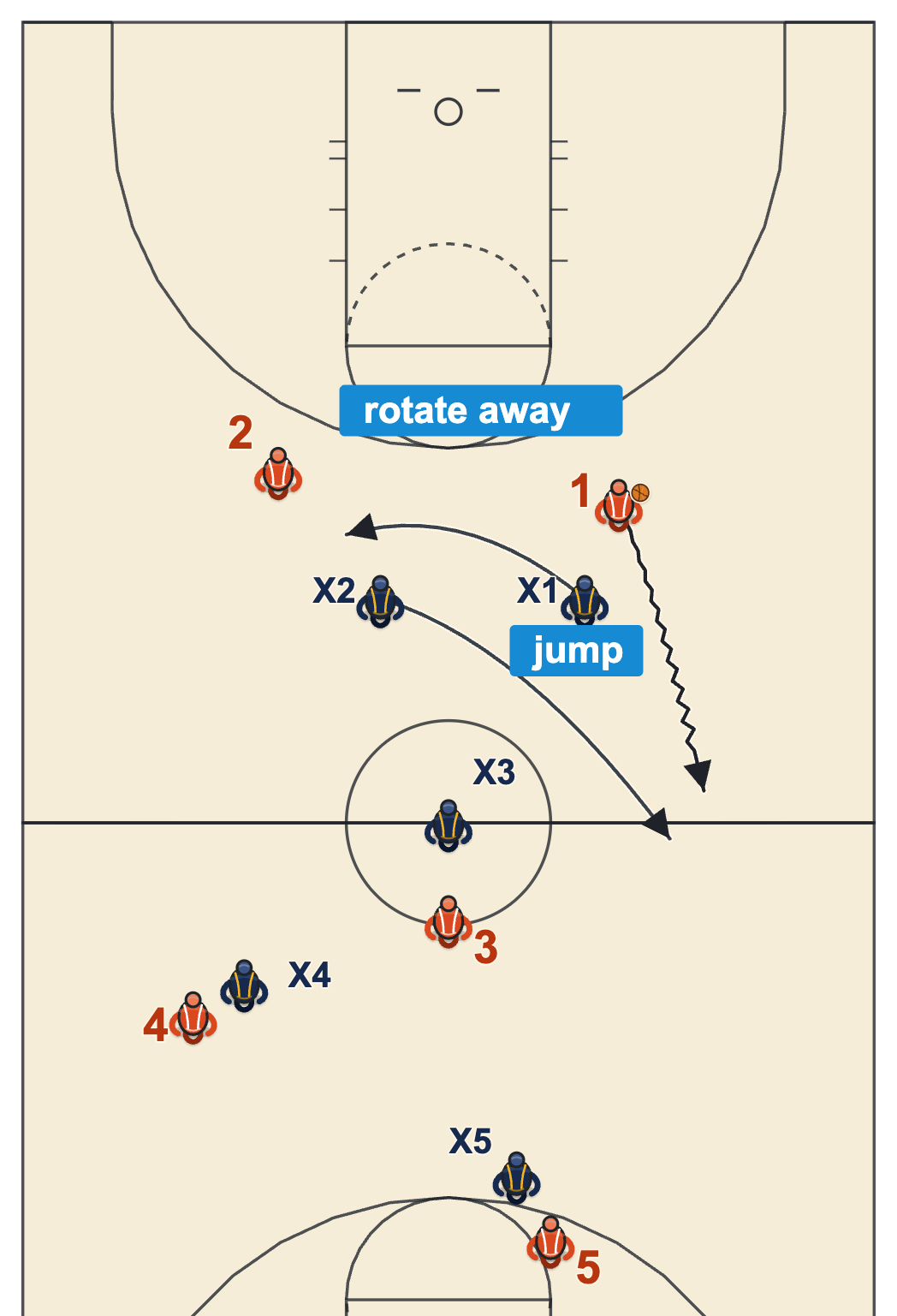
Picks up: full court, from man-to-man matchups.
Traps: nowhere fixed. A second defender jumps the dribbler and the first one rotates away. Some versions trap from the blind side on a sideline dribble.
Risk: low. No double team forms, so nobody is left open behind a trap. Every defender still has to commit fully to the rotation.
Run it when: you already play man-to-man and want pressure without learning a zone press.
Its main rule: never be behind the line of the ball. The closest defender to the rim after a score guards the inbounder. Nobody reaches on a jump. Full breakdown: How to Coach the Run-and-Jump Press.
Get the next side-by-side in your inbox
One email when a new comparison or diagram set goes up. Free.
4. 2-2-1: Contain and Turn It Sideline
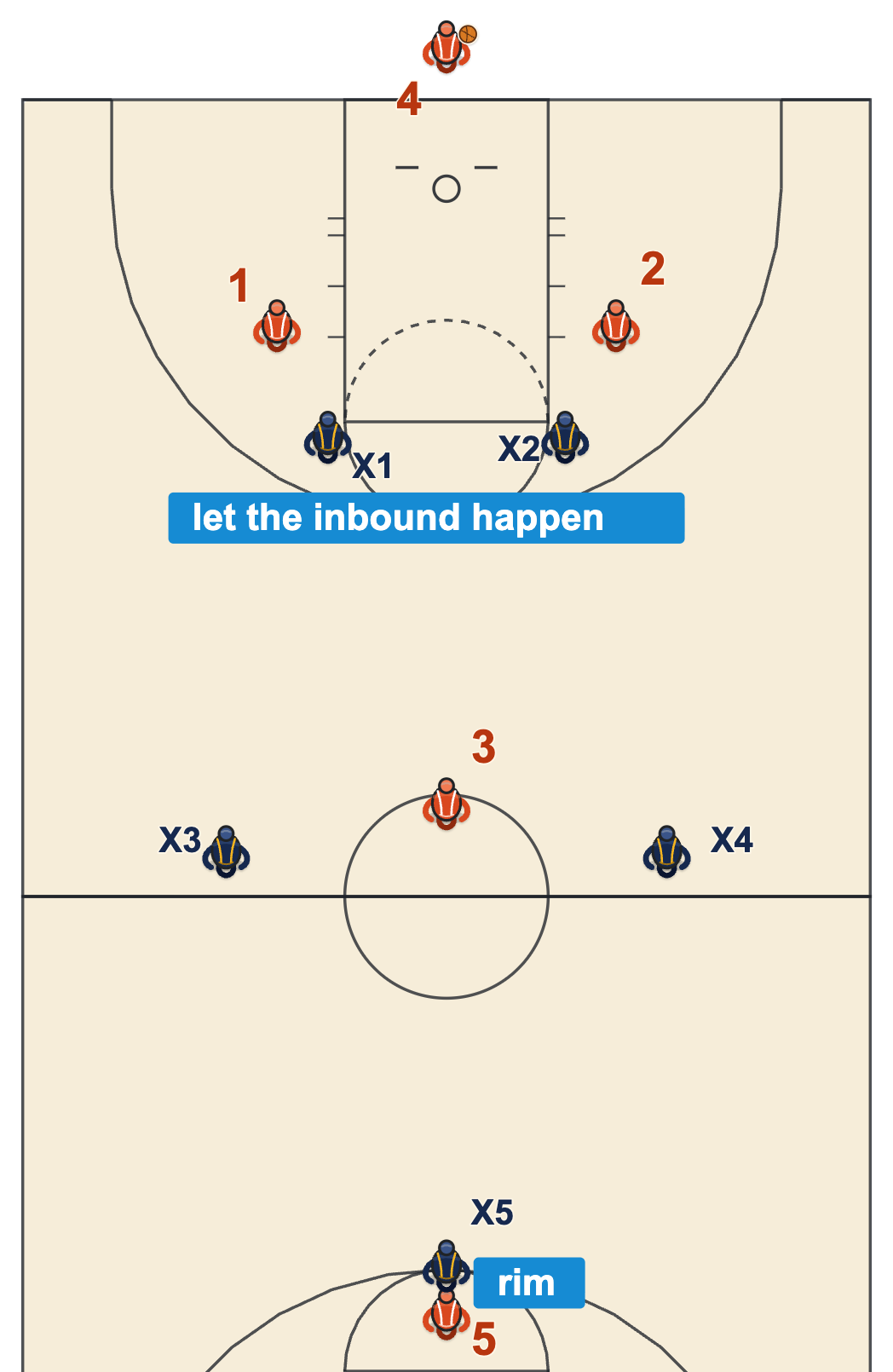
Picks up: three-quarter court. The inbound is usually allowed.
Traps: along the sideline, never in the middle.
Risk: lower. One defender always stays back on the rim.
Run it when: you want pressure that rarely gives up a layup.
Coaches split on the inbound. The traditional 2-2-1 lets it happen and turns the ball to a sideline. Other versions deny the return pass to the inbounder, which works best when the opponent's best handler inbounds and wants it right back, or deny every inbound receiver and risk a screen freeing someone. Full breakdown: 2-2-1 Press Defense and How to Coach the 2-2-1 Press.
5. 1-2-2 Three-Quarter: Burn Clock
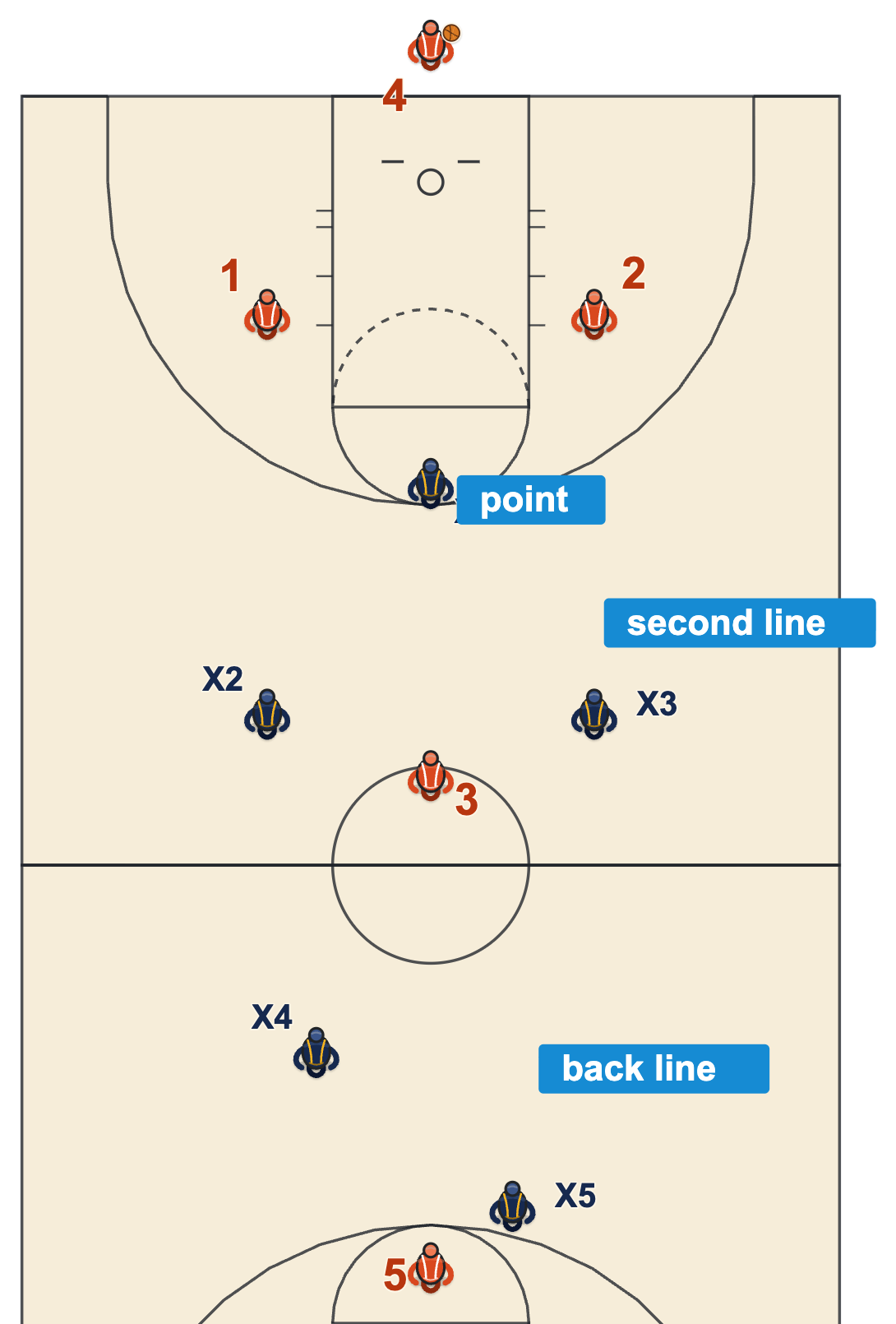
Picks up: three-quarter court.
Traps: only when the ball is dribbled up a sideline in the outer third of the floor.
Risk: lowest of the zone presses. Two defenders stay back.
Run it when: you want the offense to spend time and passes getting into its set, and you want your bench to play.
Its rules: no straight-line passes, no passes to the middle, no free dribble up the sideline, no passes behind the defense, no fouling in the trap. Some teams use it only after made baskets, drop back to their half-court defense once the shot clock has run down a set amount, and count it a success if the offense starts late. It also drops cleanly into man-to-man, a 2-3 or a 3-2. Full breakdown: 1-2-2 Press Defense.
6. Full-Court Man, No Traps
Picks up: full court.
Traps: none.
Risk: lowest. Nobody leaves his man.
Run it when: the opponent's guards are uncomfortable with the ball and you want to wear them down without gambling.
Pressure every dribble, deny the easy outlet, then everyone sprints to the paint once the ball crosses half court. It is the half-court man rules stretched over the whole floor.
All Six at a Glance
| Press | Pick-up | Traps | Risk | Main goal |
|---|---|---|---|---|
| 1-2-1-1 | Full, on the inbounder | Early, in the corner | High | Turnovers |
| 1-3-1 full | Full or 3/4 | Sideline at half court | High | Turnovers |
| Run and jump | Full, man matchups | No fixed spot | Low | Panic dribbles |
| 2-2-1 | 3/4 | Sideline | Lower | Contain, slow down |
| 1-2-2 | 3/4 | Sideline dribble only | Low | Burn clock |
| Full-court man | Full | None | Lowest | Wear down guards |
Rules Every Press Shares
- No pass to the middle of the floor. Once the ball is in the middle, the press is broken.
- No free dribble up the sideline.
- No fouling in the trap. The trap forces a lob for the interceptors to read.
- Someone always owns the rim.
- Never get split, never run at a handler nobody is pressuring, and never put three defenders on the ball.
- Have a convert rule. When the press is beaten, everyone sprints to the paint, loads to the ball, then matches up.
- Trap by player, not only by spot. Some coaches aim every trap at the best ball handler. Others trap a quick guard at once and a slower guard only after his second dribble.
When Not to Press
- Against a poised, experienced ball-handling team, unless you have a clear reason.
- When your team is not in shape or your bench is short.
- When you have no answer for the layup behind a broken trap.
The overview of every press family is on Pressing Defense Systems Explained and Full Court Press Defense. From the offense side: How to Beat a Full-Court Press.
Want every frame, printable?
OBP Pro members get the full diagram files for every defense on this page, ready for a practice binder or a scouting report. $9 a month. Or draw your own version free in the play drawer.
See what OBP Pro includesMore Side-by-Side Pages
- Types of Defense in Basketball
- Best Zone Defense for Your Team: 6 Zones Compared
- 2-3 Zone vs 3-2 Zone
- Man-to-Man vs Zone Defense
- Pack Line vs Pressure Man-to-Man
Back to Types of Defense and every Defense page.
Keep Building
Related breakdowns
Best Zone Defense for Your Team: 6 Zones Compared
The 2-3, 3-2, 1-3-1, 1-2-2, 2-1-2 and matchup zone, each matched to the roster and the opponent it beats.
Nolan Richardson 40 Minutes of Hell: Teaching the Full-Court Press
Nolan Richardson 40 Minutes of Hell: Teaching the Full-Court Press