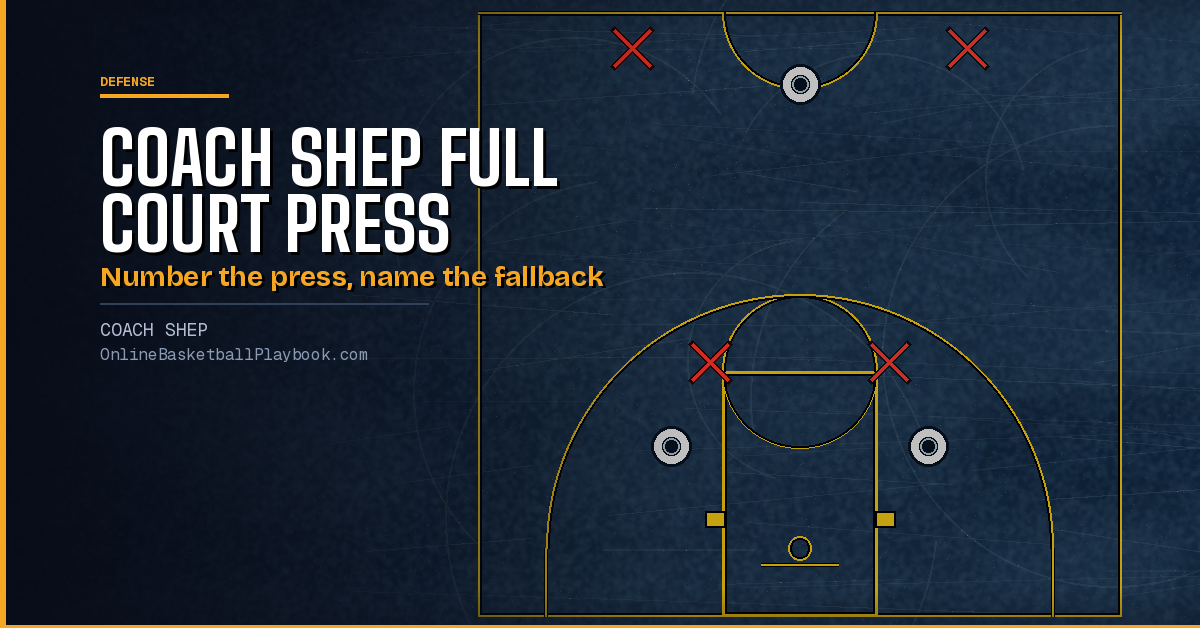
Coach Shep's full court press is a short list of numbered calls, and each numbered call carries its own fallback. 55 is full-court man with the run and jump. 22 is a 2-2-1 zone press that drops into a 2-3 zone. 25 is the same 2-2-1 that goes to man, and 12 is a 1-2-1-1 that goes to man. Black and Hold Fist add two more ways to start.
This page covers the calls, the pressure philosophy behind them, his game target of 8 to 10 points allowed a quarter, and how his teams practice and call the press. Other systems are compared on best full-court press, and the press words used here are defined on the basketball press terminology guide.
How Coach Shep Calls His Full Court Press
His defenses are called by number or by word. The full-court list on his practice plan has four numbers, and each one says where the press ends up:
- 55. Full-court man-to-man with the run and jump.
- 22. A 2-2-1 zone press into a 2-3 zone.
- 25. A 2-2-1 zone press into man-to-man.
- 12. A 1-2-1-1 zone press into man-to-man.
His player notebook adds word calls for special situations. Black is a 2-2-1 zone press that goes to man on the first reversal. Hold Fist doubles the point guard before the ball is inbounded. Fist is the run and jump in the half court, and Double Fist is the run and jump full court.
The half-court calls sit beside them: 5 is man with a pickup at half court, 2 is a 2-3 zone, 3 is a 1-3-1, 1 is a 1-2-2 matchup, and Triangle is a triangle with two man-to-man defenders, and Box is a 1-3 with one man-to-man defender. "Get the Ball" means play man tight and foul.
Some of his notebooks use 22 for a 2-1-2 full-court zone with minimum trapping instead of the 2-2-1. Whatever numbers you adopt, write the job next to each one on your sheet.
The Pressure Philosophy
He calls defense the major factor in winning and wants it to be a "WE" concept that carries over into an unselfish offense. In the full court he likes several defenses:
- Tough man with ball pressure. Heavy pressure on the ball, looking to push the handler into speed dribbles and into a run and trap.
- Zone presses. He uses three types, chosen from the 2-2-1, the 1-2-2, the 1-1-2-1 and the 1-2-1-1. Each looks for the same chances to pressure the ball and set traps.
- Pace control. The same presses can be used at times to slow the ball and control the tempo of the game.
His trapping rules come with his reasons:
- Keep the ball out of the middle. Force it to the sideline. That makes trapping easier, keeps help-side defenders ready to stop an easy basket after a breakdown, and makes a forced-wide ball harder to reverse.
- Send the wing toward the baseline. He treats the baseline as an extra defender, with help defense waiting there, and in some situations he forces the ball into baseline traps.
- Trap from the blind side. A trap works best when it comes from where the ball handler cannot see it.
- Change defenses. Switching looks during a game keeps the offense disrupted.
To reward defense he gives a T-shirt for outstanding defensive play, with "When was the last time they ran their offense?" on the back. The trap technique itself is on trapping in basketball.
Sideline, baseline, blind side. Say the words in every press drill until the players say them back.
22: The 2-2-1 That Drops to a 2-3
22 is the traditional 2-2-1 zone press. It picks up in the 2-2-1 and then drops into a 2-3 zone, so the fallback is a zone, not man.


- Review it, then scrimmage it. One of his practice plans gives 5 minutes to review the 22 press and 5 to review the 2-3 zone, then 10 minutes of scrimmage against 22, written as the 2-2-1 dropping to a 2-3.
- Switch the top two. His notebook also lists 22X, a 2-2-1 full-court press where the top two defenders switch through the middle.
The 2-2-1 press itself, with its traps and rotations, is taught on 2-2-1 press, and the zone it drops into is on 2-3 zone defense.
Press in the 2-2-1, finish in the 2-3, and rep the drop as often as the press.
25 and Black: The 2-2-1 That Goes to Man
25 starts in the same 2-2-1 as 22 and ends in man-to-man. Black adds an exact trigger. The defense stays in the zone press until the offense's first reversal, then every defender goes to man.

- 25. The 2-2-1 zone press into man. His notes give the fallback, not the moment of the change.
- Black. The 2-2-1 zone press, and man-to-man on the first reversal.
Black also names a ball-screen coverage in his drill book, where the on-ball defender turns the handler away from the screen and forces him baseline into a trap. Keep the two apart on the call sheet so nobody guesses which one the bench wants.
The reversal is the trigger. Every player should feel the ball change sides and find a man at once.
12: The 1-2-1-1 Into Man
12 is a 1-2-1-1 zone press that goes to man. It is the diamond look on his numbered list, and like 25 it falls back into man-to-man rather than a zone.

His player notebook calls a 1-2-1-1 full-court zone press White. His color system also uses White for normal containment rules, so a staff that uses both should write the job beside the word. The diamond's traps and its jobs are on 1-2-1-1 diamond press.
Know your number and know your fallback before the ball is inbounded.
55: Full-Court Man and the Run and Jump
55 is full-court man-to-man. On his practice plan it carries the run and jump, and his drill book adds the aim: deny and double the point guard and disrupt the offense's rhythm.

- 55 with the run and jump. Man pressure the length of the floor, with the run and jump as the trap.
- 55 that hunts the point guard. Deny him, double him and break the offense's rhythm.
- 55 Blue. A full-court pickup with soft pressure on the ball.
- 55 with no traps. A 5 on 5 full-court drill in his current practice plans runs 55 as a man press with no traps, while the offense works the ball into its half-court offense.
The run and jump has its own page, how to coach the run and jump press, and full-court man principles are on full-court man-to-man pressure.
Guard the ball first, and the jump has something to stand on.
Hold Fist: Double the Point Guard Before the Inbound
Hold Fist is a special situation call: double-team the point guard before the ball is inbounded. The double comes first, so the offense has to inbound to someone else.

His scouting reports aim the same idea at one player:
- One man on the driver. Against a point guard who drives to one side, one defender pressures him after every score and every made free throw, and the team denies him the ball in the half court.
- Run and jump at the inbounder. After a score, the defender on the inbounder runs and jumps to one side of him, buying time for a teammate to pick up the point guard.
Take the ball out of the best handler's hands before it is even in play.
The Target: 8 to 10 Points a Quarter
His teams have set a goal of allowing 8 to 10 points a quarter. The press is part of how they chase it, and the goal sits inside a larger defensive standard:
- One contested shot. The stated aim each trip is one contested shot, with no layups, no second shots and no rhythm shots.
- No layups. It is one of his three focus areas, with no turnovers and shot selection.
- Game goals on the wall. His posted defensive goals list 50 points a game, 39 percent shooting for the opponent, 20 opponent turnovers, personal fouls at 15 and 15 more shots a game than the opponent.
- A plan for one opponent. One of his scouting game plans set 10 to 12 points a quarter for a 40 to 50 point game.
Ways to measure a press are compared on how to build a pressing team.
Count the points every quarter. A number the players can see is a number they can defend.
How He Practices the Press
His practices are built so that the press and the pressure against it get daily work. The structure:
- Short blocks. Drills run 5 minutes at most and an offensive segment 10, and every drill has a purpose, a winner and a loser.
- Defense days. Monday is defense and rebounding, the toughest day. Wednesday is defense, and Friday is defense and rebounding again.
- Review, then scrimmage. A 22 review leads into a scrimmage against 22, as described above.
- Trapping in toughness drills. 4 on 4 ball toughness against a trap defense runs with constant trapping, high hands on the trap, a "ball" call, no dribbling and no scoring.
- Red in the full court. In 5 on 5 full-court toughness, the offense cannot dribble and the defense plays Red, pressuring the ball and fouling hands.
- Restrictions in 5 on 5. The defense changes how it guards the offense, including full-court man pressure, the run and jump, full-court zone pressure and three-quarter-court zone pressure, so the offense sees every look before a game.
- The current plans. 5 on 5 full-court 55 with no traps and 5 on 5 against a full-court diamond press both appear in his current practice plans.
More press drills are on full court press defense drills.
Five minutes, a winner and a loser, and the press gets better every day it is scored.
Calling It in a Game
The press is called from the bench by number or word, and his teams also set a pressure level by color:
- White. Normal rules and containment.
- Red. Total denial, one hand's distance from your man.
- Blue. Always a foot in the paint, a zone look.
In his current program the press is tied to the situation:
- After a made basket. A 2-2-1 zone matchup press.
- When his team shoots free throws. On a make, the diamond full-court press. On a miss, the team can set up in the 22 press.
His current call list still carries 55 and 12, with 5 for man in the half court. Breaking pressure from the other side is covered on basketball press break, and every defense page is listed under defense.
Make the call early, say it once, and let all five know the fallback before the ball is in.
Get the next coaching guide in your inbox
One email when a new guide or diagram set goes up. Free.
Questions Coaches Ask
What do the numbers in Coach Shep's press calls mean?
On his full-court list, 55 is full-court man with the run and jump, 22 is a 2-2-1 zone press into a 2-3 zone, 25 is a 2-2-1 zone press into man and 12 is a 1-2-1-1 zone press into man.
What is the Black press?
A 2-2-1 full-court zone press that turns into man-to-man on the offense's first reversal.
What is Hold Fist in basketball?
His call to double-team the point guard before the ball is inbounded.
How many points a quarter should a pressing team allow?
His teams have set 8 to 10 points allowed a quarter as the goal.
Want every diagram on the site?
OBP Pro members get the full diagram files for every guide on the site, ready for a practice binder or a scouting report. $9 a month. Or draw your own version free in the play drawer.
See what OBP Pro includesBack to Best Full-Court Press and every Defense page.
Keep Building
Related breakdowns
Best Full-Court Press: 6 Presses Compared
The 1-2-1-1, 2-2-1, 1-2-2, 1-3-1, run and jump and full-court man, sorted by where they pick up, where they trap and how much they risk.
Full Court Press Defense: Types, Rules and How to Install It
Full court press defense pressures the ball for 94 feet. See the press families, shared rules, trap mechanics, the cost, the install order and drills.
Full Court Press Defense Drills: Traps, Rotations and Live Reps
Full court press defense drills that build the press in pieces: footwork, trap drills, back-tips, sideline traps, rotation drills, live games and how to score them.