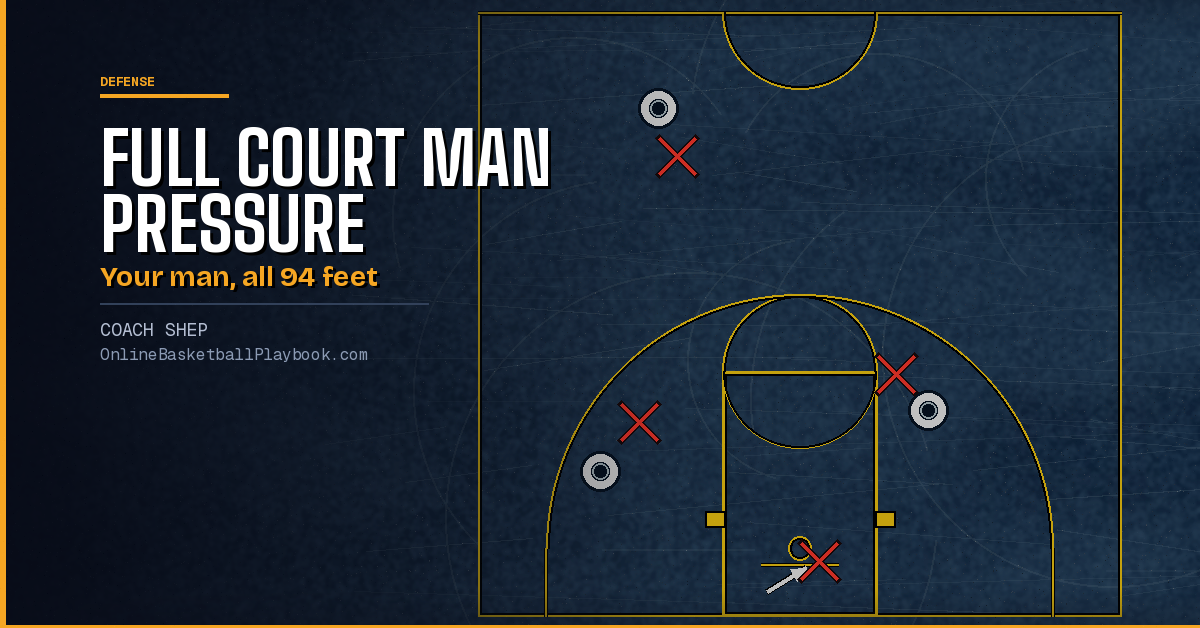
Full court man to man pressure, or the full court man to man press, has every defender guard his own man the length of the floor. It is the half-court man rules (pressure the ball, deny the passing lane near the ball, help away from it) stretched over 94 feet. Some versions never trap. Others trap only on a stated trigger, such as a dribbler who has turned his back. This page covers those versions, the pickup and the inbound, the jobs on and off the ball, what to do when the ball gets by, who it fits and the drills that teach it. The zone presses are compared on the best full-court press hub, and the man press that jumps the dribbler instead of doubling him is on the run and jump press.
Full Court Man to Man Pressure: The Versions
Several programs call full-court man "55," but the same number covers different presses. The versions side by side:
| Version | What it does | Traps |
|---|---|---|
| Low-gamble pressure | Half-court man principles over the whole floor: force the sideline, deny on the ball side, help on the far side | Not the main tool. A blind-side trap only when the handler is caught on the sideline |
| Straight man, hunt the count | Face-guard the receivers and move the inbounder's defender to center field to hunt a five-second call or an inbound steal. If the ball comes in, guard full-court man and shrink the floor | None |
| Run and trap | Pressure the ball and force it to a corner. The man on the ball does not deny the inbound | When the dribbler cannot see the trapper, across the floor, never up it |
| Half man, half zone | Man with hard denial on the ball side, zone on the weak side | Only on the sideline, never in the middle |
| Deny, then trap past half court | The inbound denier face-guards to push the ball to a sideline, and no pass goes to the middle | Once the ball crosses half court |
| Youth man trap press | Man-to-man with written trap rules | On the pass to the sideline, never in the middle third |
Tubby Smith's 55 is a run-and-trap version: he says his team does not run and jump, it runs and traps. Vivian Stringer's 55 is the half-man, half-zone version. One pressure man system with its own family of presses is on SOS pressure defense, and pressure man against the pack line is on pack line vs pressure man to man.
Pick your version, then teach its trap rule before the first game.
The Pickup and the Inbound
Who takes whom. In the low-gamble version, after a made basket or a dead ball each defender picks up his assigned man. After a live-ball turnover or a rebound, each defender takes the closest man to get pressure on at once and accepts the mismatch. Pat Summitt's rule was to start defense at 94 feet, and one press concedes no part of the floor.
Let the inbound in. The defender on the inbounder slides toward the middle with his arms out to take away the middle pass and push the inbound to the corner. The on-ball defender then forces the handler to the sideline.

Or deny it, by version. Denying the inbound leaves four defenders on four receivers, so the versions put the fifth defender in different places:
- Back man at half court. The inbounder's defender drops back to at least half court as a safety against the long pass, while the other four deny their men in the passing lanes for a five-second call or a bad pass to intercept.
- Back man at the free-throw line. One 55 offers three spots for the inbounder's defender: on the inbounder, at the free-throw line with the receivers face-guarded, or all the way back at half court as a basket protector, its most conservative choice.
- Centerfielder. In one deny system the inbounder's defender drops off to play center field and reads the inbounder's eyes, while the other four play full denial and do not worry about the lob. He slides a little toward the inbounder's side, because a lob is more likely to go to that side.
One warning comes with the full deny look: if one defender slacks off, the whole look fails. It works best set up quickly after a timeout or a dead ball.
Decide before the game whether you let the inbound in or deny it.

On the Ball: Turn the Dribbler
The on-ball defender's job is to change the handler's direction before half court and keep him on a sideline.
- Count the turns. Vance Walberg's on-ball defender has done his job with one turn before half court and a great job with two. In the effort-first version, the coach gets on the group when every handler has been turned only once.
- Make him dribble. Walberg says a straight-line pass up the floor means the on-ball pressure failed, and he calls a lob a good outcome.
- Weak hand and sideline. Another version forces the dribbler to his weaker hand and never lets anyone beat the defender to the sideline.
- Take his vision. In another version, the handler should see jerseys, not the basket.

The stance and slides behind it are on defensive footwork.
Turn him, turn him again, and keep him on the sideline.
Off the Ball: Deny, Help and Switch
Deny near, help far. In the low-gamble version, defenders on the ball side deny in the passing lanes, and defenders away from the ball play help and protect against the easy layup. It looks like man on the ball side and like a zone in the paint on the far side.
The ball line. In one 55, every defender stays up the court in support of the on-ball defender, which it calls ball-line rules.
Steal off the ball. Stringer's press steals on the flight of the pass, not in the trap, and it lets the offense give it the ball. In the effort-first version, reaching on the ball counts as a foul, so its steals come from deflections and running through the passing lane.
Screens. The low-gamble version switches every screen at once and calls it loudly, so the ball never gets a clean look. The mismatch can be fixed later in the half court, or the team can drop into a zone.
Deny near the ball, help away from it, and talk on every screen.
When a Man Press Traps
The trapping versions of full-court man do not trap a spot. They trap a moment:
- Caught on the sideline. In the low-gamble version, if the handler gets caught on the sideline or in a trapping area, a second defender can run to his blind side and trap without reaching in, while the rest get ready to intercept.
- He cannot see you. In one 55 the trap fires when the on-ball defender has turned the dribbler and he cannot see the trapper. It traps across the court, never up it.
- The sideline only. Stringer's 55 traps only on the sideline, never in the middle.
- Past half court. One full-court man press traps once the ball crosses half court.
- On the pass to the sideline. The youth man trap press traps the pass to the sideline, never in the middle third, and has the trappers go after the dribbler's back pocket. A teammate who stays home guards two men once someone leaves to trap.

The trapping rules themselves, the angles, the feet and the interceptors, are on trapping in basketball.
Trap a moment, never a spot.
Get the next coaching guide in your inbox
One email when a new guide or diagram set goes up. Free.
When the Ball Gets By
In the low-gamble version, if the ball breaks past the perimeter or gets ahead of a defender, every defender except the on-ball defender sprints back to the paint to stop the layup. The on-ball defender stays attached and keeps trying to force the sideline.

Other exits, by version:
- Back off and match. Billy Donovan stops the press when the ball crosses half court on the dribble with no defender close enough, and his team keeps backing up until each man has someone.
- A named half-court call. In the named-call version every press flows into a named half-court defense once the ball has clearly crossed half court.
- Shrink the floor. The straight-man version, if the inbound comes in, guards full-court man and shrinks the floor.
The sprint-back habits are on transition defense.
When it breaks, paint first, man second.
Who It Fits and What It Costs
Younger and less experienced teams. The low-gamble version is recommended for younger players because it works even at a light level of pressure, takes little practice time compared with a zone press, reuses the man concepts players already know and does not gamble with traps. Youth guidance points the same way: hold back trapping zone presses, and a man press is fine. Some youth leagues limit or ban pressing, so check your league's rules first. How to teach it to kids is on how to teach a press to youth teams.
Early in games. One version starts games in full-court man because many players have butterflies early and turn the ball over under early pressure.
The cost. A man press is simple, but a composed handler beats it. Stringer's notes say players can usually handle only 5 to 6 minutes of her 55 at a time, so the press needs a bench. And pressure invites fouls: one version wants no fouls at all, while another tells its trappers to foul with the legs or body, never the hands. When not to press at all is on the best full-court press hub.
Press only as long as your legs and your bench last.
Drills
- Full-court 1 on 1. The on-ball defender turns the handler in the backcourt and channels him to a sideline. Bob Knight runs a zig-zag version every day for 3 to 5 minutes.
- Inbound deny. Three receivers and an inbounder against three denying defenders, with the inbounder's defender in center field. The goal is to deny past five seconds, scored by turnovers, first to five.
- Stringer's live start. Ten players in a tight circle in the lane. The coach drops the ball and yells "Shot," and it is live 5 on 5, with talk, an arm bar on cutters and a rule for when the ball beats the press.
The full press drill library, from trap drills to scored live games, is on full court press defense drills. Half-court man pressure drills are on man to man defense drills.
Drill it full court, every day, at game speed.
Questions Coaches Ask About Full Court Man Pressure
What is a full court man to man press?
A press in which every defender guards his own man the length of the floor, pressuring the ball and denying the passes near it. Some versions never trap and some trap only on a trigger.
How do you run a full court man to man press?
Pick up after a make, force the ball to a sideline, deny on the ball side, help on the far side, switch screens, and sprint to the paint if the ball gets by.
Is full court man press good for youth basketball?
Youth guidance favors it over trapping zone presses, because it reuses man-to-man rules and does not gamble with traps. Some leagues limit pressing, so check your league first.
Should you deny the inbound pass?
Programs differ. Some let it in and pressure the catch. Others deny every receiver and drop the inbounder's defender back as a safety, aiming for a five-second call.
What is the 55 press in basketball?
A common number for full-court man pressure, but programs use it for different presses, from straight man with no traps to half man and half zone.
Want every diagram on the site?
OBP Pro members get the full diagram files for every guide on the site, ready for a practice binder or a scouting report. $9 a month. Or draw your own version free in the play drawer.
See what OBP Pro includesMore Coaching Guides From This Batch
- Full Court Press Defense Drills: Traps, Rotations and Live Reps
- Half Court Trap Defense: The 1-3-1, 2-3 and 1-2-2 Traps
- How to Teach a Press to Youth Teams: What to Teach First
Back to Best Full-Court Press and every Defense page.
Keep Building
Related breakdowns
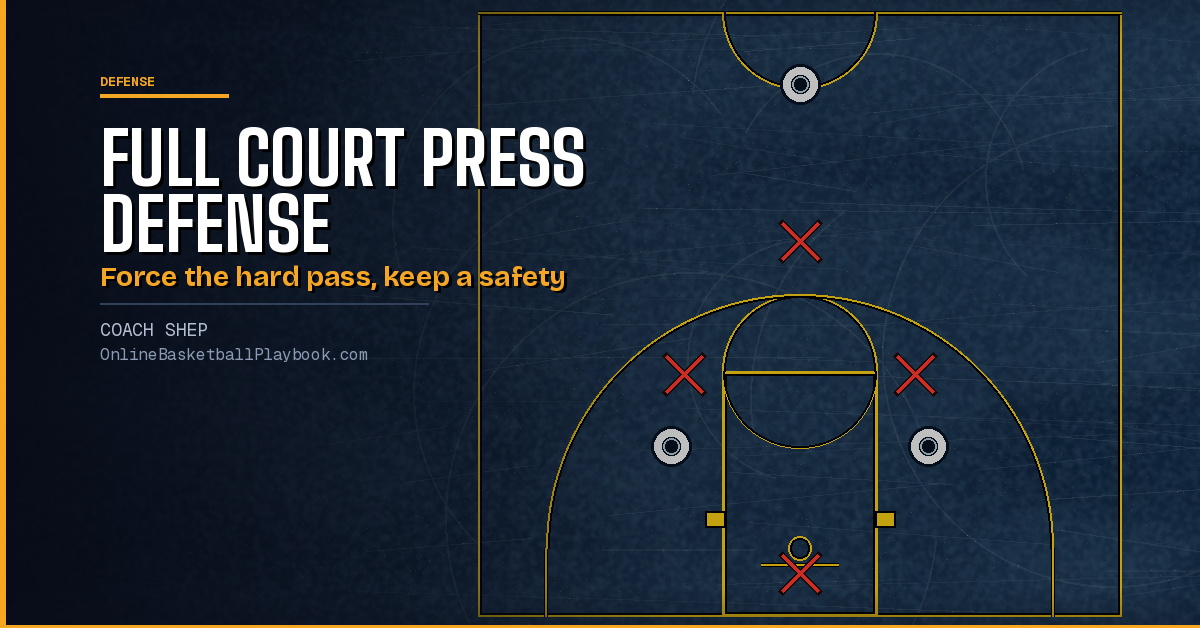
Full Court Press Defense: Types, Rules and How to Install It
Full court press defense pressures the ball for 94 feet. See the press families, shared rules, trap mechanics, the cost, the install order and drills.
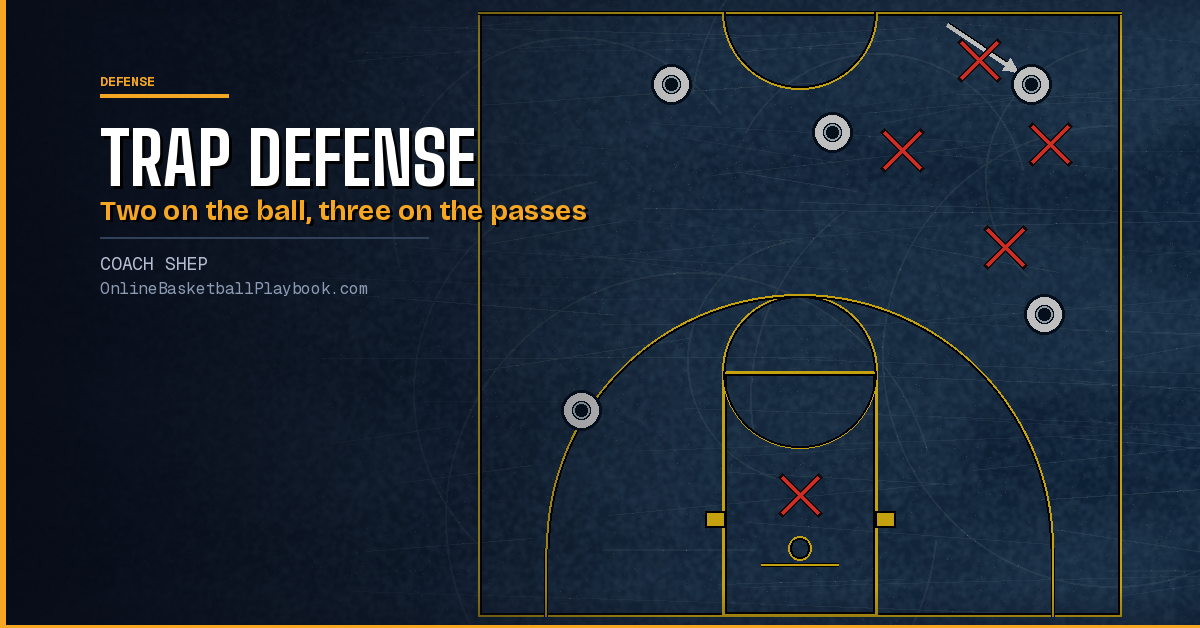
Trap Defense Basketball: When, Where and Who to Trap
Trap defense basketball explained: how two trappers close, when to spring the trap, the spots on the floor, the interceptors and goaltender, and every version.
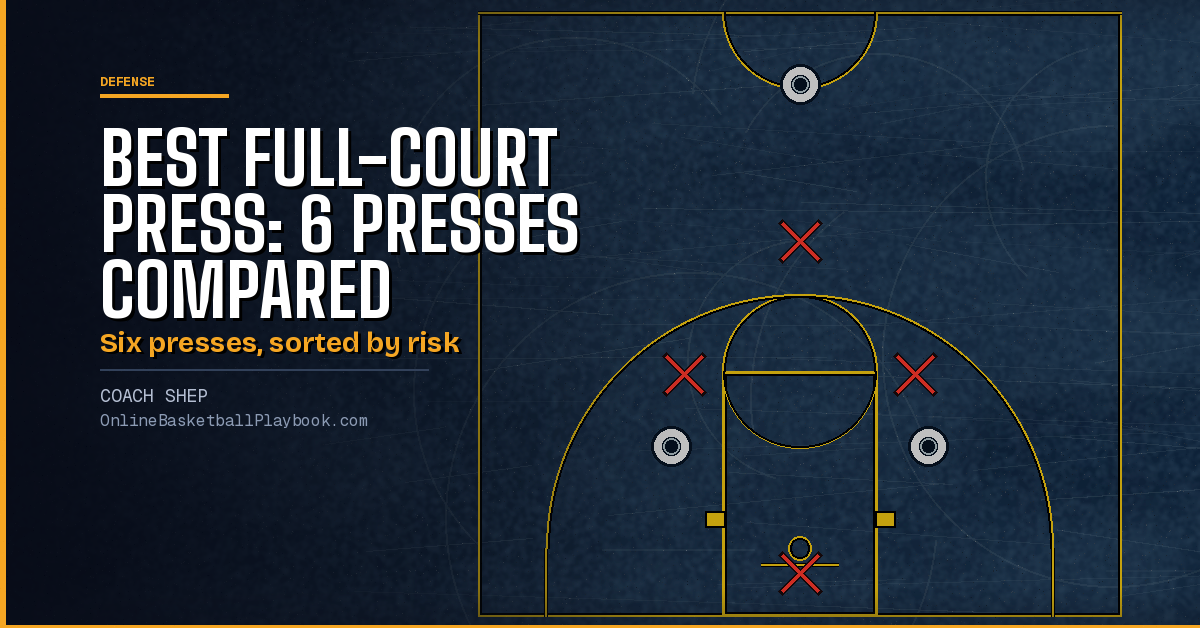
Best Full-Court Press: 6 Presses Compared
The 1-2-1-1, 2-2-1, 1-2-2, 1-3-1, run and jump and full-court man, sorted by where they pick up, where they trap and how much they risk.