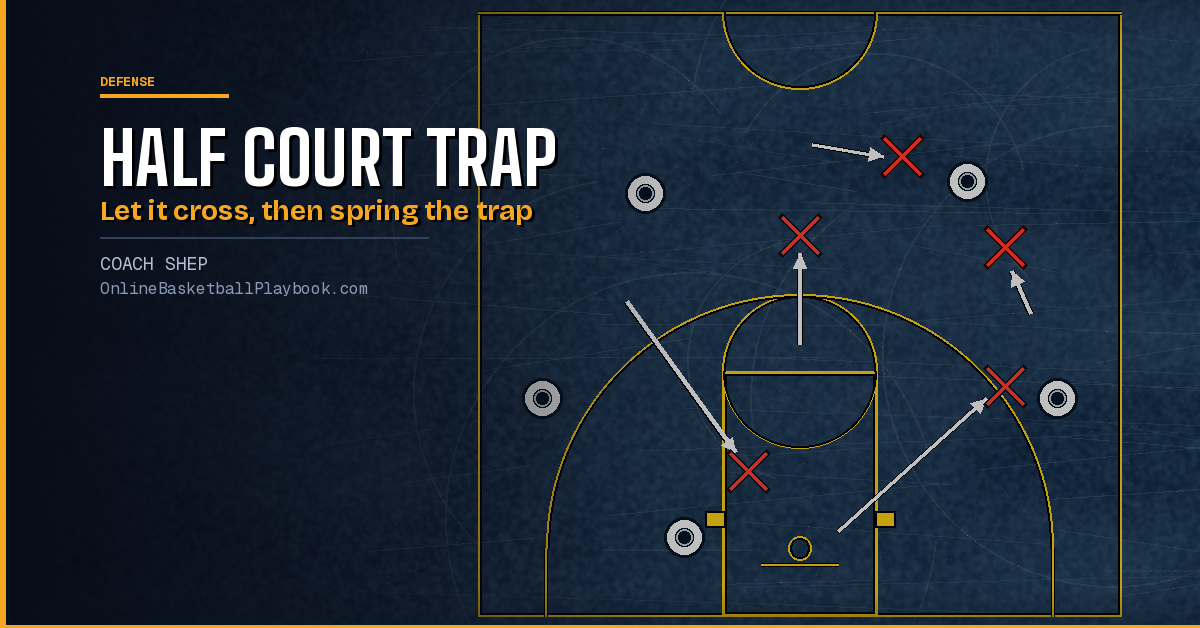
Half court trap defense lets the offense bring the ball to half court, then doubles it as it crosses the line or once it reaches a set spot, usually a wing or a corner. All five defenders start back, so a trap that breaks leaves less floor behind it than a full-court press. This page covers the 1-3-1 half court trap, the 2-3 looks (the 1-1-3 and the trapping 2-3), the 1-2-2 trap at the half-court line, when coaches call each one and how they teach it. The trap mechanics every version shares, angles, feet and hands, are on trapping in basketball, and the later pickup that traps near half court from a press is on the three quarter court press.
Half Court Trap Defense: Why and When
Presses are often numbered by pickup depth: 80 for full court, 60 for three-quarter court and 40 for half court. A half-court press is the 40. Half-court presses are called lower risk and easier to teach than full-court presses, because all five defenders start in the half court.
Coaches name different reasons and moments for it:
- To speed up a slow team. One 1-3-1 half-court trap is built to make a slow team play faster than it can, break its rhythm and create turnovers.
- Against a team holding the ball. A 1-3-1 corner trap is called when trailing late against a team that stalls, or as a surprise after the other team's timeout.
- To protect a late lead or slow a break. One half-court press is called to disrupt fast breaks, protect a late lead and take the ball out of a strong handler's hands.
- By the shot just made. Rick Pitino goes to a half-court trap after his team makes a three.
- Against weak guards. One half-court 2-2-1 is aimed at mediocre or inexperienced guards, with the warning that any trap risks an easy layup on the weak side.
Most of the moments above are change-ups, and changing defenses only works if your players stay less confused than the opponent. Whole menus of looks are on changing defenses in basketball.
Know why you are calling it before you call it.
The Versions at a Glance
| Version | Shape | When it traps | Who traps |
|---|---|---|---|
| Point-directs 1-3-1 | 1-3-1 | On the guard-to-guard pass and in the corner | The point and the ball-side wing, or the wing and the baseline man in the corner |
| Four-corner 1-3-1 | 1-3-1 | Whenever the ball enters one of four corners of the half court | Depends on the corner: the point above the free-throw line, the baseline man below it |
| Midcourt-line press | 1-2-2 or 1-3-1 | Only after the ball crosses midcourt | The point and the ball-side container |
| 1-1-3, a 2-3 look | 1-1-3 | On the wing | The guard and the long ball-side wing |
| Trapping 2-3 with a man switch | 2-3 | Every pass from the corner into the low post | The ball-side wing and the low defender |
| 1-2-2 at the line | 1-2-2 | As the dribbler crosses half court on a sideline | The two front defenders |
| Lure, then trap the corner | 1-2-2 | After a light look lets the ball cross, in the corner | The front unit |
| Middle-man 2-2-1 | 2-2-1 | On the dribble toward a sideline | A front guard and the ball-side defender at the arc |
Pick one version and teach it fully before you add a second.
The 1-3-1 Half Court Trap
The set. In the point-directs version, the point guard plays out front and decides which wing traps and which protects the basket. The two wings either trap or drop back, the 4 plays the middle of the defense, and the center plays the baseline and traps in either corner.

Guard to guard. When the ball goes from one guard to the other, the point follows the ball and traps with the ball-side wing, and the far wing rotates to protect the basket. The middle man looks to steal the pass back to the first guard, and the baseline man slides across to steal the pass from the guard to the ball-side forward.

Guard to forward. On a pass to the forward in the corner, the ball-side wing and the baseline man trap him. The point looks to steal the pass back out to the guard, then covers the pass into the low post, while the far wing protects the basket and discourages passes to the free-throw line. If the forwards exchange, the 4 and the center may swap jobs. Once any trap is made, this 1-3-1 collapses into a 2-2-1 shape.

The four-corner version. This 1-3-1 is aimed at a team that spreads the floor and holds the ball, and every decision comes from one read: which corner the ball is in. The half court is split into four corners, two above the free-throw line and two below it:
- The point traps above the free-throw line and plays interceptor below it.
- The baseline defender traps below the free-throw line and covers the ball-side corner as an interceptor above it.
- Each wing traps on his own side and reads the cross-court pass on the other.
- The post has one job, keeping the ball out of the middle. If the ball gets there, he takes a nose-on-chest stance and pushes it back toward a corner or the baseline.
Two variations come with it. A taller player can be put at the top of the key to bother guard-to-guard entry passes. And one corner can be named a home corner where the defense does not trap but plays a match-up zone, aimed at the other team's weakest handler, and changed during the game.
Other 1-3-1 versions. The wait-for-the-line 1-3-1 does not commit until the ball crosses half court, then traps in every corner. A passing-lane 1-3-1 says its corner trap usually comes off a dribble, with one defender on the pass back out and another taking the ball-side high post. The base zone, its slides and its weak spots are on 1-3-1 zone defense.
Wait for the ball, trap with two, and let the other three play the passes.
The 2-3 Looks: 1-1-3 and the Trapping 2-3
The 1-1-3. This shape plays like a 2-3 with the two guards stacked. In one version, the quickest guard is at the top of the key and makes the handler pick a side, the smartest guard is second and keeps the ball out of the lane, the two longest athletes play the wings and the biggest player protects the rim. Its wing trap:
- The second guard and the ball-side wing trap the ball aggressively.
- The top guard drops into the passing lane between the top of the key and the high post as the interceptor.
- The far wing is the safety and reads the passer's eyes.

A man-zone 1-1-3 starts as a press that pins the ball to a sideline, then uses extreme ball pressure, stunts and traps on set triggers. Its traps are soft: the defenders trap, then go back home. That version lists giving up threes, fouling and loose rebounding and transition accountability among its costs. The full 1-1-3 is on 1-1-3 zone defense.
The trapping 2-3. The corner-to-post version runs a half-court 2-3 trapping zone whose main weapon is a pass from the corner into the low post. That pass is always trapped, with no call needed: the ball-side wing defender sprints down and traps with the low defender, who has already cut off the baseline. The center stays on the corner player to stop the kick-out, one guard zones off high to cover the pass out to the wing, and the other rotates inside the weak-side player. The zone fronts every low post and moves on the flight of the pass, not before or after.
The same version hides itself with a count. The call names a pass number and a man defense, and on that numbered pass in the half court the zone becomes man-to-man, switching, not switching or trapping. Defenders call "stay" instead of "switch" so the offense does not hear the change. Zone corner traps in the plain 2-3 are on 2-3 zone defense.
Whichever version you run, everyone moves on the flight of the pass.
Get the next coaching guide in your inbox
One email when a new guide or diagram set goes up. Free.
The 1-2-2 and 2-2-1 Half Court Traps
The 1-2-2 trap at the line. This half- to three-quarter-court press uses three quick front defenders and two back. The point contains the dribbler above half court without pressing him tight, steers him to one sideline, and closes in as he nears the line. When the handler crosses half court on the dribble, the two front defenders trap him with the half-court line and the sideline as extra defenders. The third front defender slides to the middle to deny that pass, one back defender denies the sideline pass and the other reads whether anyone is deep, staying as the safety or cheating to the middle. If the guard passes across before crossing, the whole coverage flips to the other side. The defender guarding the middle pass does not leave to trap until a teammate can rotate over and take the middle away.

The midcourt-line press. Another half-court press names five jobs from a 1-2-2: the point chases the dribbler into the sideline trap, a container on each side, and two protectors who guard the basket until the ball crosses midcourt, then become interceptors. Once the handler crosses, the point and the ball-side container trap, the far container drops to the help side for the cross-court pass, and the two back defenders deny the wing and the high post. It also runs from a 1-3-1 for a lineup with one big, and in a shadow version the inbounder's defender can trap, fake the trap or jump switch. If the offense reverses the ball early, the point drops back and waits for midcourt. Its four warnings cover waiting on the ball reversal, dribble penetration and the split, the middle of the floor, and slow closeouts on the skip pass.
Lure, then trap. One 1-2-2 runs three ways from the same set. Its light version floats in front of the offense with no trap. Its lure version starts the same way to coax the ball over half court along the sideline, then traps hard in that corner while the far wing denies the reversal. The lure version was the one its users liked best, because it left less floor to cover.
The middle-man 2-2-1. In this half-court press, the two guards pick up the ball at the half-court line and turn it toward one sideline. A defender always holds the middle of the free-throw line to cut off the center pass. On a dribble to the sideline, the ball-side defender at the arc comes up to trap with the guard, the other guard drops toward the arc, the middle man slides toward the corner and the far defender at the arc shifts to the middle. On a cross-court pass every job mirrors to the other side. When the ball reaches the corner, the team drops into its regular man or zone. The full-court version of that shape is on 2-2-1 press.
Use the half-court line as your extra defender, and never leave the middle open.
Rules the Versions Share
- Two on the ball, three on the passes. One trapper stops the ball and one closes the gap, while the others become interceptors and a goaltender.
- Keep it out of the middle. Every version above protects the middle, with a post, a middle man or a defender at the free-throw line.
- Do not get split. The trappers' feet close the seam between them.
- Move on the pass. The rotations start while the ball is in the air.
- Know the exit. Some versions trap once and then fall back into the base defense, man or zone.
The help rules behind the rotation are on help defense principles.
Trap with two, guard the gap, and know the exit.
Teaching the Half Court Trap
Parts first. The four-corner 1-3-1 is taught piece by piece: trap zones, double-teaming, quick closeouts and high-post defense on their own, then 4-on-4 double-team reps, then half-court scrimmages for stops and for defense into the break. Offenses most often attack it from a 2-1-2 look, so watch for changes after timeouts and substitutions.
When to add it. One install calendar adds the half-court trap in the fifth and fourth weeks before the season, along with 2-on-2 and 3-on-3 breakdowns.
Daily reps. Jim Boeheim's 2-3 gets 3 to 4 minutes of short-corner and corner trap reps a day. More set-ups are on zone defense drills, and the man-pressure alternative to a trapping zone is on full court man to man pressure.
Teach the parts, then rep the trap every day.
Questions Coaches Ask About the Half Court Trap
What is a half court trap in basketball?
A defense that picks the ball up at half court and doubles it as it crosses the line or reaches a set spot, such as a wing or a corner, with the other three defenders playing the passes out.
How do you run a 1-3-1 half court trap?
The point and the ball-side wing trap the guard, the middle man takes the pass back, the baseline man takes the pass to the forward and the far wing protects the basket. In the corner, the ball-side wing and the baseline man trap.
Is a half court trap better than a full court press?
It is called lower risk and easier to teach, because all five defenders start back.
When should you use a half court trap?
Coaches call it as a change-up: against a team that holds the ball late, as a surprise after a timeout, against weak guards, or after a made three.
What is the difference between a 2-3 trap and a 1-1-3?
The 1-1-3 stacks the two guards, one at the top of the key and one behind him, so it traps the wing with the second guard. A trapping 2-3 keeps two guards side by side and traps the corner or the low post.
Want every diagram on the site?
OBP Pro members get the full diagram files for every guide on the site, ready for a practice binder or a scouting report. $9 a month. Or draw your own version free in the play drawer.
See what OBP Pro includesMore Coaching Guides From This Batch
- Full Court Press Defense Drills: Traps, Rotations and Live Reps
- Full Court Man to Man Pressure: Pickup, Deny and Trap Rules
- How to Teach a Press to Youth Teams: What to Teach First
Back to Best Full-Court Press and every Defense page.
Keep Building
Related breakdowns
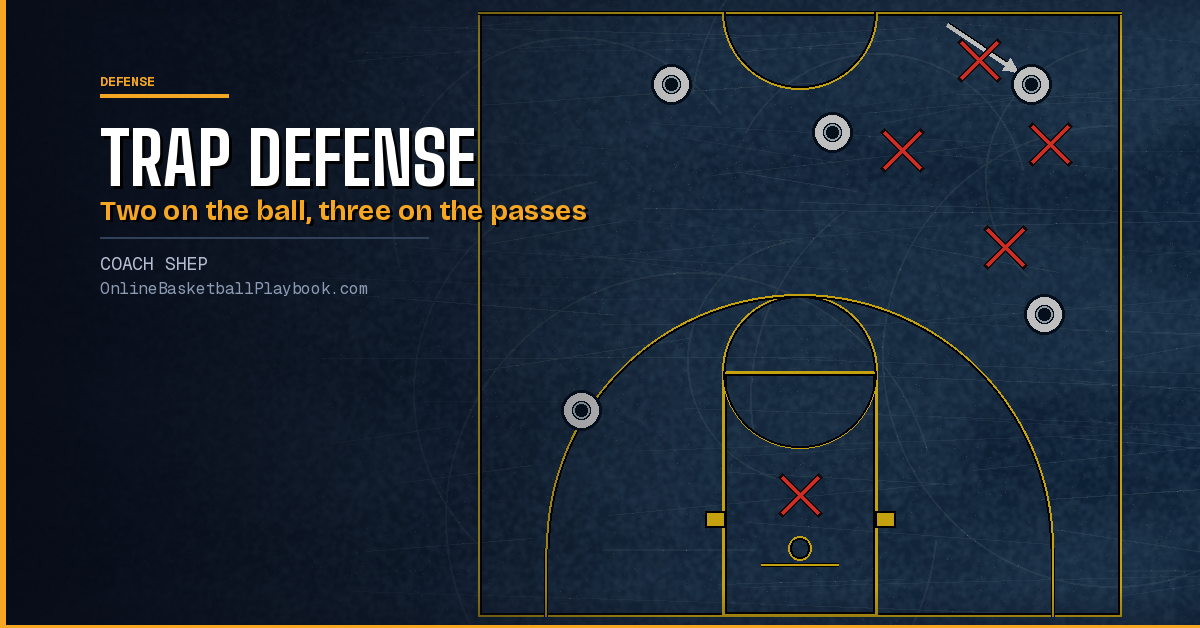
Trap Defense Basketball: When, Where and Who to Trap
Trap defense basketball explained: how two trappers close, when to spring the trap, the spots on the floor, the interceptors and goaltender, and every version.
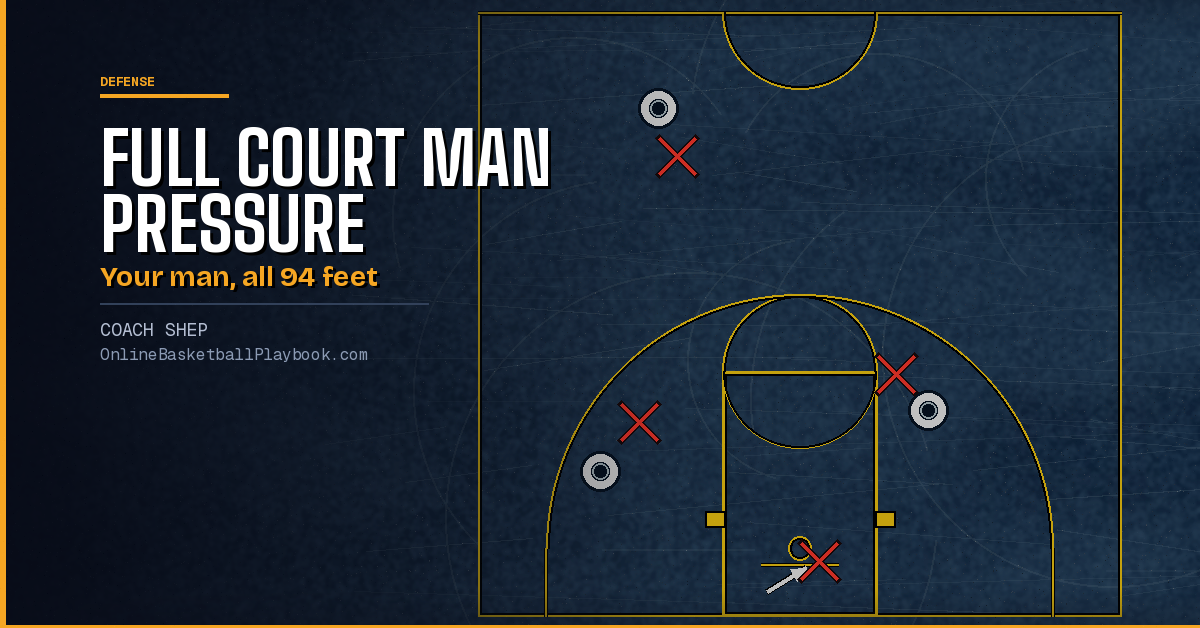
Full Court Man to Man Pressure: Pickup, Deny and Trap Rules
Full court man to man pressure by version: the no-trap press, the trap on a trigger, the half man, half zone 55, the inbound deny and the exit when it breaks.
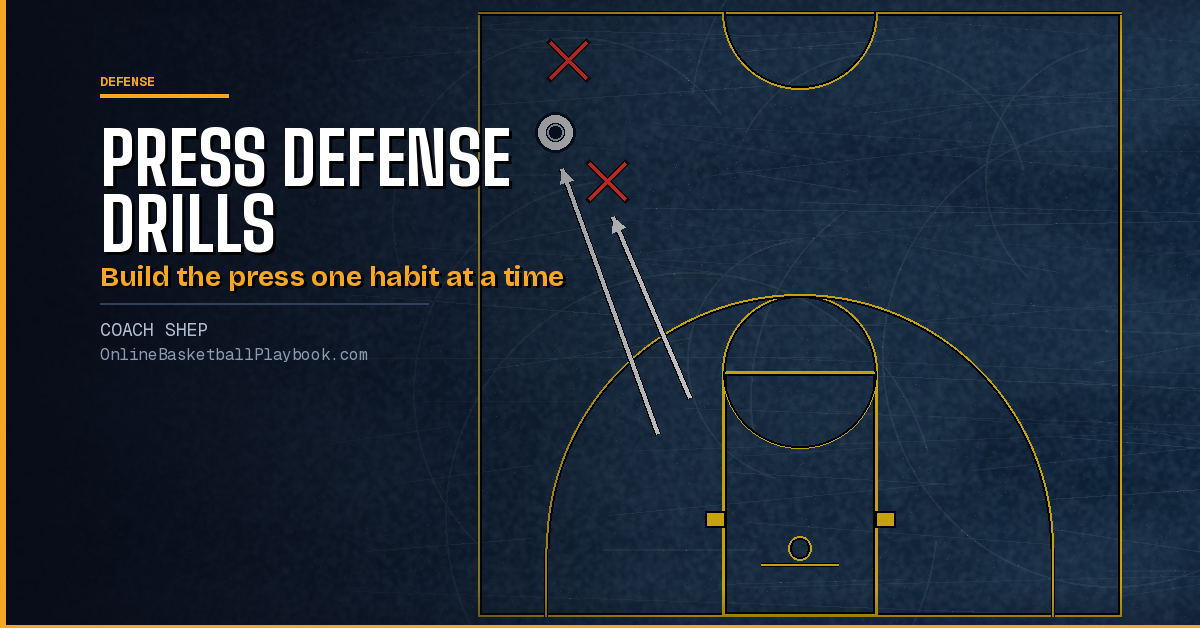
Full Court Press Defense Drills: Traps, Rotations and Live Reps
Full court press defense drills that build the press in pieces: footwork, trap drills, back-tips, sideline traps, rotation drills, live games and how to score them.