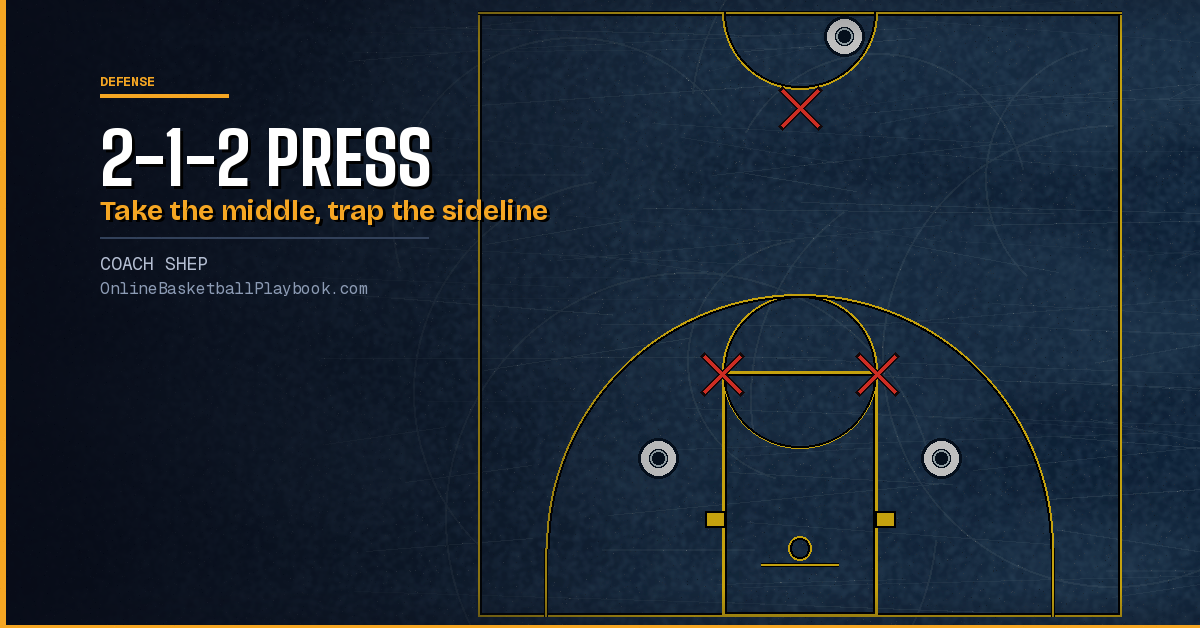
The 2-1-2 press is a full-court zone press with two defenders in front, one in the middle and two in back. It is built against the way most teams are taught to break a press. Press breakers are told to get the ball to the middle and to stay off the sideline dribble. The 2-1-2 full court press puts a defender in the middle from the first pass, so the middle is never open, and leaves the sideline dribble as the only way up the floor. Then it traps the sideline. This page covers the setup, each line's job, the inbound, both traps, the reversal and the versions coaches run. How it compares with the other presses is on best full-court press.
What the 2-1-2 Press Is
The numbers read from the inbound end of the floor. Two guards make the front line near the elbows. One agile defender makes the middle line near the backcourt center circle. The two tallest players make the back line near the three-point line in the frontcourt. The press has two goals.
- Keep the ball out of the middle. In most zone presses, a reversal or two leaves the defense late to the middle, and the offense finds a hole there. In the 2-1-2 the middle is covered from the start, so the rotations that keep it covered are short.
- Force the dribble up the sideline. With the middle pass gone, the offense has to look up the sideline, and the sideline is where the press can trap, in the backcourt or the frontcourt, with several different players.
It is an uncommon press. It looks like the 2-2-1 press and the 1-2-2 press but differs from both in where the middle defender starts. The same numbers also name a half-court zone with a defender at the high post, the 2-1-2 zone defense.
The Four Rules
- No middle passes. The middle line covers the middle from the start, so there should be no hole there to throw to.
- Do not get beaten up the sideline. The defender who rotates over to stop the ball gets his outside foot out of bounds, so the dribbler cannot get past him along the line.
- No layups. Two bigs play the back of the press, so one is always in the lane to contest a shot even when the offense dribbles through.
- No fouling. Pressing players show their hands to the officials so they do not get cheap hand-check calls in the full court. In the trap, hands stay high, with no swatting or slapping at the ball. Most steals out of a trap come from the players who are not in it, after a deflection.
2-1-2 Press Setup and Personnel

| Line | Who plays it | Where it starts | Job |
|---|---|---|---|
| Front line (X1, X2) | The two remaining guards, quick and good at guarding the ball. Strength helps | Around the elbows | Pressure the catch, steer the dribbler to a sideline, complete the trap without fouling. The guard off the ball drops toward the middle to replace X3 |
| Middle line (X3) | The most agile player, who moves well side to side and reads the next pass. Length is a bonus | Near the front of the backcourt center circle | Deny anyone near the middle, jump toward the ball on the inbound, then sprint to the sideline to start the trap |
| Back line (X4, X5) | The two tallest players, long and quick enough to get from the sideline to the lane. Shot blocking is a bonus | Around the three-point line in the frontcourt | The ball-side big takes away the sideline pass. The weak-side big protects the rim |
Choosing the middle defender may be the most important decision in the press. He has to deny the middle, leave at the right time and still get to the sideline before the dribbler, so his workload is huge. The words used for each spot are in the basketball press terminology guide.
The Inbound: Steer to the Sideline
Denying the inbound pass is optional. Steering the catch toward a sideline is not. The front guards play behind and inside the receivers, which makes it easier to push them toward the sideline for the catch.

- X1 (on the ball). Pressures the catch so the point guard cannot look over the floor, and makes the sideline dribble feel like his only choice. Letting the ball go middle makes the trap hard to set.
- X2 (off the ball). Drops a little toward the middle, between the center circle and the reversal pass. He stays close enough to the reversal to pressure it quickly and keep the offense from dribbling up the middle.
- X3 (middle). Edges away from the center toward the sideline pass. The more athletic he is, the farther he can sit, so the pass looks open before he jumps it.
- X4 (ball-side big). Moves up and out toward the sideline to take away a deep pass up the line and make the offense beat the press with the dribble.
- X5 (weak-side big). Rotates back near the lane and contests any shot at the rim. He keeps dropping as the ball comes up the floor.
The First Trap
Once X1 has the ball handler dribbling up the sideline, X3 sprints to the sideline to stop him. He takes an angle far enough ahead of the dribbler to get there and get set legally, without a foul. He must not leave the middle too early, or the offense throws into the hole he left.

- X3. Sets up perpendicular to the sideline with his outside foot on the line, so there is no room to drive past.
- X1. Stays directly on the dribbler's hip so he cannot cross over back to the middle, and guides him into X3.
- X2. Sits in the middle to take away the direct pass there and watches for a flash, which can come from in front of or behind the half-court line.
- X4. Moves up to take away the player up the floor near the sideline. The offense often does not see him coming and floats the pass, which makes this a steal chance.
- X5. Rotates to the lane. No pass should go over his head for a layup.
The trap can happen in the backcourt or the frontcourt, depending on how fast X3 gets to the line, and ideally it happens near the half-court line. Trap footwork, hands and the interceptors' reads are covered on trap defense in basketball.
Get the next coaching guide in your inbox
One email when a new guide or diagram set goes up. Free.
The Second Trap
Sometimes the offense completes the pass up the sideline before X4 gets there. The press does not have to stop. The ball is often in the hands of a player who is not comfortable with it, and the offense is not expecting a second trap.

- X4. Gets in front of the ball and cuts off the sideline, the same job X3 did in the first trap.
- X3. The pass went over him, so he follows the ball at once and completes the trap. The offense will try to attack the basket quickly off this pass.
- X5. Stays in the lane. With the ball this close to the rim, his job matters more.
- X1 and X2. Sprint to the frontcourt and take away the outlets, looking at the middle first and then working down toward the basket.
When the Ball Is Reversed
A reversal pass is not a problem for this press. The offense uses up its backcourt count without moving the ball forward (10 seconds in high school and college, 8 in the NBA and FIBA, see the 10-second rule).

On the reversal X2 takes the ball. His path matters: a slow approach lets the offense keep dribbling sideways, still toward a sideline, instead of up the middle. X3 works to stay in line with the ball so the middle stays covered. On the new side the goal is the same, the dribble up the sideline.
Other Versions of the 2-1-2 Press
Other versions use the same alignment with different rules.
| Version | What changes |
|---|---|
| Sideline trap (above) | Middle defender plugs the middle, sideline dribble trapped by the middle defender and the ball defender, second trap in the frontcourt |
| Match-up press | The front two put heavy pressure on the ball and push it into one half of the floor, then deny every pass out of that half. The back line keeps the ball out of the middle and denies diagonal and skip passes. Every trap has two trappers, two interceptors and one goaltender, and the basket protector is the last to commit |
| Middle-drop version | X2 drops to cover the middle. The press can drop back to man-to-man, and it runs at a mismatch and switches |
| Tempo version | A variation of a 2-2-1 tempo press. The second line plays deeper with a trapper in the middle at half court, so the first pass cannot go down the middle. Options: face-guard the inbounder, double a lone guard, or change to man-to-man when the ball is reversed to the inbounder |
| After a score | Some teams run it only after a made basket or a made free throw |
The match-up version comes with a call menu that changes the press without changing the alignment.
- Trap the first pass only, then trap only the ball handlers.
- Let only the front two trap, with the middle running and jumping and the sides cutting and chasing to trap.
- Rotate the press into a three-quarter-court 1-3-1.
- A back-up press that traps only the corners.
Its trapping rules are specific. Stay down with hands and arms raised, trap foot to foot with the legs locked, with the second defender using his last two steps to control his speed. Read the passer's shoulders, do not foul in the trap, and sprint out of the trap to the next job as soon as the ball leaves. It traps the players who make decisions and pressures the ones who do not, so they have to play faster. The run-and-jump that the middle uses in one call is on the run and jump press, and the three-quarter look on the 1-3-1 full court press.
Strengths and Costs
- Strong middle coverage. The ball stays out of the middle, so the offense takes longer to get across half court and the press gets more chances.
- Good trapping chances. With the middle gone, the offense attacks up a sideline, where traps leave it few passing options.
- Consistent basket coverage. One of the two bigs is always rotating to the lane, whichever side the ball is on.
- Low risk. The setup should prevent many easy looks while still forcing tempo and some turnovers.
- The cost. The whole press leans on the middle defender, who has to deny, read and sprint to the sideline on every possession.
It fits as a change-up press, paired with another press to keep the offense guessing, for a team with athletic guards who can pressure the ball and posts who cover ground. The case for pressing at all, and how to install a press, is on full court press defense, and the drills on full court press defense drills.
How Offenses Attack It
Jay Wright's press offense lists three ways to attack a 2-1-2: pass to the middle and look opposite, pass to the middle and drive, or drive the middle. All three go at the spot the press is built to protect. The full set of press breaks, with alignments and reads against each press, is on press break basketball.
Questions Coaches Ask
What is a 2-1-2 press?
A full-court zone press with two guards near the elbows, one defender in the middle near the backcourt center circle and two tall players near the frontcourt three-point line. It takes away the middle pass, forces the dribble up a sideline and traps it there.
Who plays the middle of the 2-1-2 press?
The most agile player, who moves well side to side and reads where the next pass is going. Length is a bonus. He denies the middle, then sprints to the sideline to start the trap.
Where does the 2-1-2 press trap?
On the sideline, ideally near the half-court line, with the middle defender cutting off the dribble and the ball defender on the dribbler's hip. If a pass gets up the sideline, the ball-side big and the middle defender set a second trap in the frontcourt.
What is the difference between the 2-1-2 press and the 2-2-1 press?
The 2-1-2 starts one defender in the middle to take away the middle pass from the first catch. The 2-2-1 has two defenders in its second line and one at the back. See the 2-2-1 press guide for its setup.
How do you beat a 2-1-2 press?
Go at the middle. One press offense passes to the middle and looks opposite, passes to the middle and drives, or drives the middle. Avoid dribbling up the sideline, which is what the press wants.
Want every diagram, printable?
OBP Pro members get the full diagram files for every rule, defense and press on this page, ready for a practice binder or a team meeting. $9 a month. Or draw your own version free in the play drawer.
See what OBP Pro includesMore Guides From This Batch
- Basketball Timeout Rules: Length, Number and Signals by Level
- Basketball Coach Resume: What to Put on It and What Gets Read
- Basketball Defense Positions: Where Each Defender Plays
Back to Best Full-Court Press and every Defense page.
Keep Building
Related breakdowns
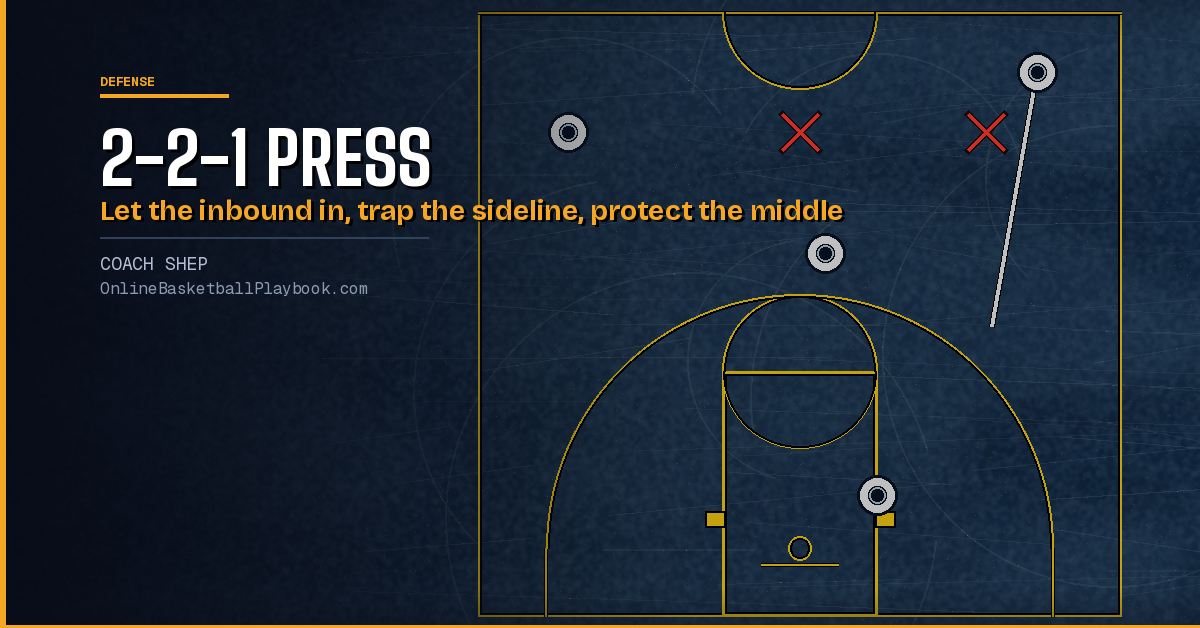
2-2-1 Press: Setup, Traps, Rotations and Drills
How to run the 2-2-1 press: who plays each spot, how coaches trap the sideline, the rotations after a reversal, how it breaks, how offenses attack it and the drills.
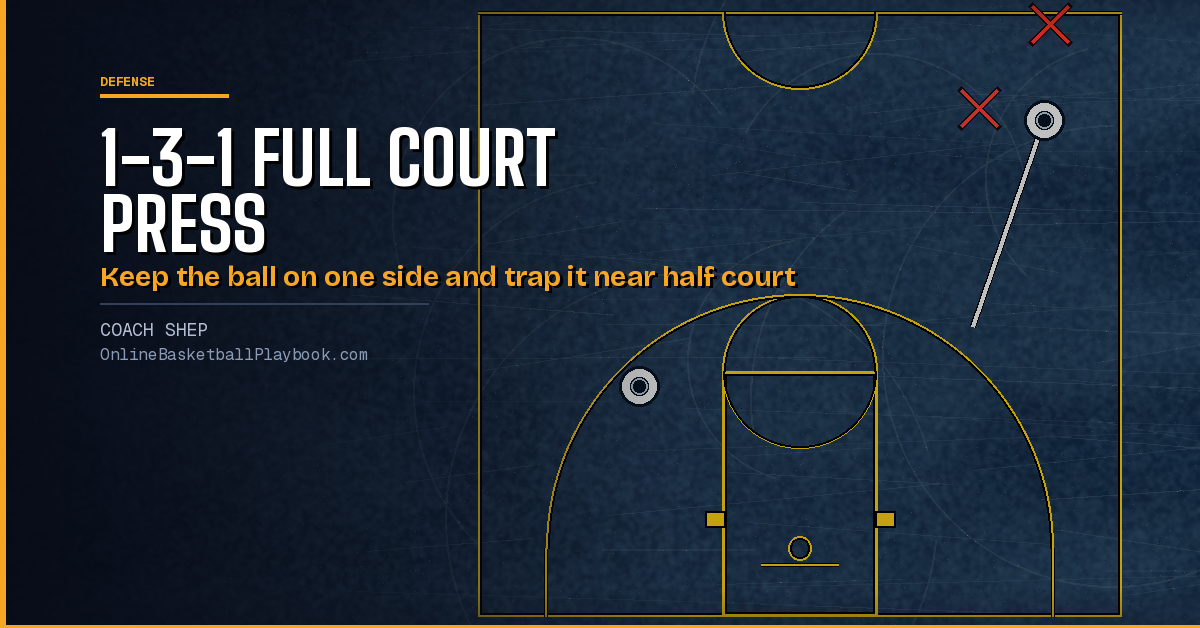
1-3-1 Full Court Press: Roles, Traps and Rotations to Install
The 1-3-1 full court press from setup to frontcourt trap: each role, the reversal rotations, an aggressive version, the costs and when coaches call it.
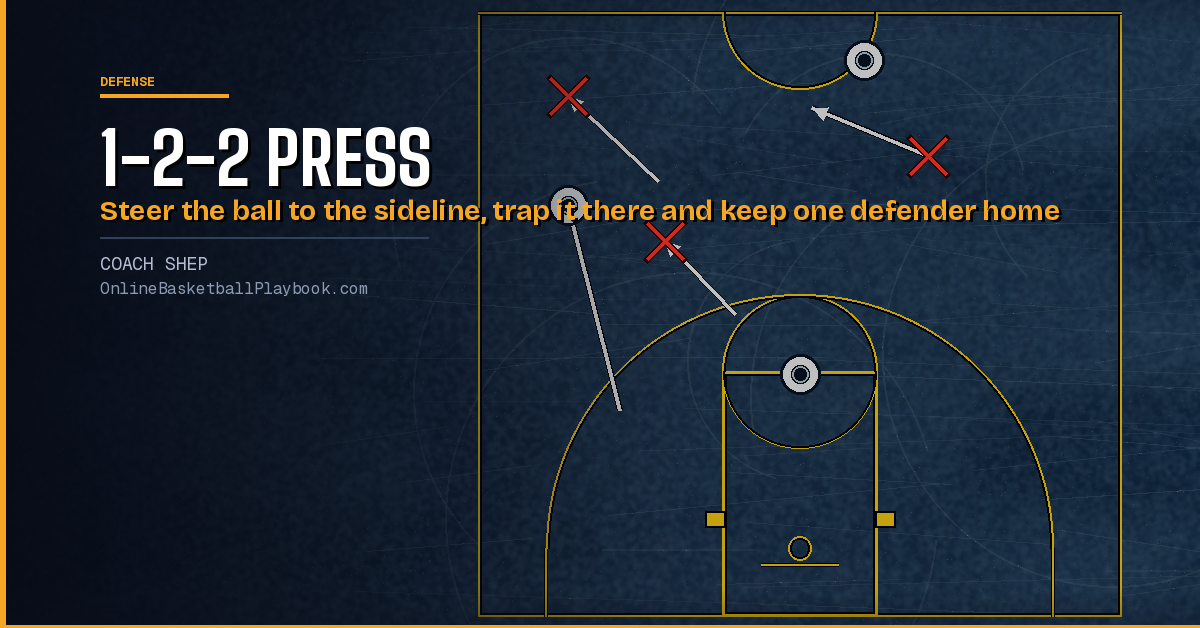
1-2-2 Press: Roles, Traps, Rotations and Breakdowns
1-2-2 press guide covering who plays the top, middle and back line, where each version traps, how it rotates on a reversal and what to do when it breaks.