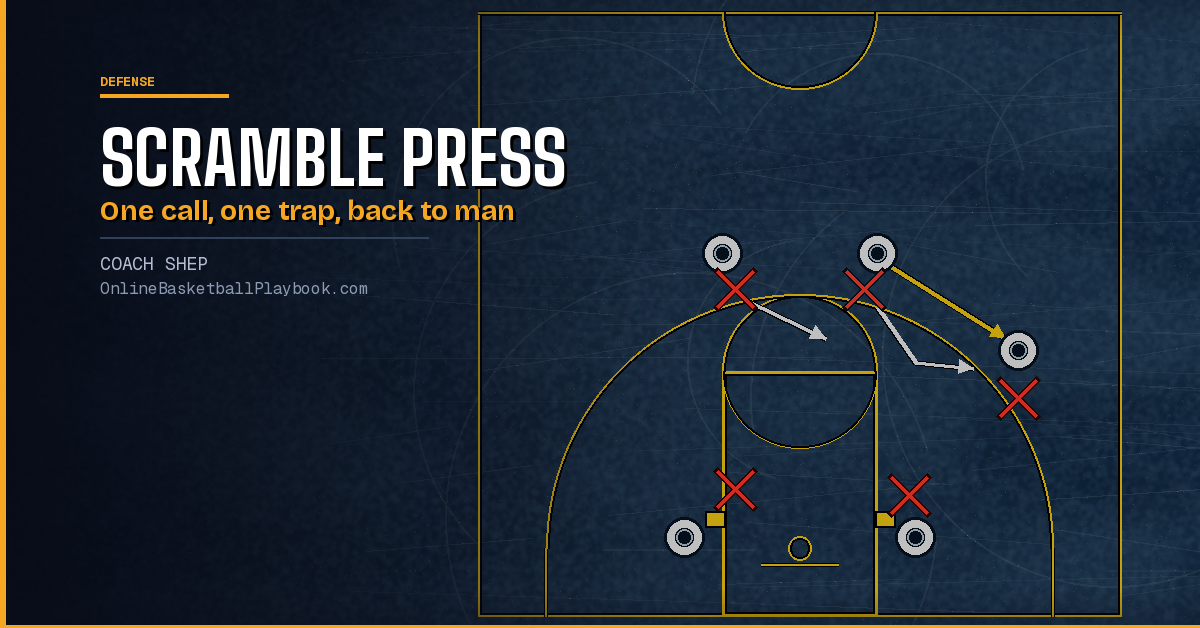
A scramble press is man-to-man pressure that springs a trap on a call, then scrambles: after the trap, every defender rotates to the open man and guards someone else's player until the defense is back in straight man. The hand-call form, built on Dean Smith's philosophy, runs only after a score and gives the point guard five hand calls.
The basics of pressing are on full court press defense. The run and jump on its own is taught on how to coach the run and jump press, other press systems are compared on best full-court press, and every defense page is listed under defense.
How a Scramble Press Starts
The hand-call scramble attaches to a man-to-man team. Man is the main defense, and the scramble goes on only when the team scores, never off a miss. Its stated purposes are to stop the opponent's sets, change the momentum and speed the game up, and use the players' intelligence.
- The point guard. Sprints to half court, then sprints back to a spot near the free-throw line to pick up at three-quarter court, and makes the call while sprinting toward the ball.
- The off guard. Sprints back to the free-throw line, then back out to half court to pick up his man.
- Wings and bigs. Sprint back to half court in the outside lanes, make contact with their men and get set to attack.
The man principles come first, and the scramble sits on top of them. Turn the ball handler two or three times in the backcourt, deny all passes, front all posts, sag farther off the farther your man is from the ball, and double every ball screen. It asks for a team in great shape that is already a great half-court defensive team. The full-court man base is on full-court man-to-man pressure, and pressure man-to-man as a full system is on SOS pressure defense.
Guard the ball straight up first, and the scramble has something to stand on.
The Five Scramble Press Hand Calls
The point guard signals the call with his arms while he runs, so every teammate knows the plan before the ball is in:
- Straight (22). Arms straight out. Straight man, no trap.
- Down (23). Arms pushed down below the waist. Double the first pass after half court.
- Fist. Arms in a circle. The run and jump, with no double team.
- Up (23). Arms straight up overhead. Double the dribbler.
- Zone (13). A 1-2-2 zone trap, which rotates into 11.
Down is the trap on the pass.
- Allow the wing catch. Leave the wing open for the catch above the free-throw line. The point guard steers the ball down to a wing and keeps it from going guard to guard.
- Chase and double. The guard whose head the pass went over runs after it and becomes the second trapper.
- Front and rotate. Front the post, and the far guard slides across to pick off the next pass.
- Read the second pass. A pass back up ends the scramble. Another pass down starts it again, with the defender the ball went over rotating to it, so a wing-to-corner pass can be trapped too.

Up is the trap on the dribble.
- Outside third first. Get the ball to an outside third of the floor.
- Double on the turn. While the point guard turns the handler, the nearest defender leaves his man and doubles right away, as the handler's back turns to the basket. The nearest wing doubles the ball as soon as it is past half court.
- Post up to the wing. The nearest post defender moves up to the wing to intercept, and if the wing catches it, he must stop the dribble drive.
- Other forward fronts. The other forward fronts the low post.
- Peel the guard down. To double a completed pass to the wing, bring the guard down to double, not the defender running up toward the ball. It is the one exception to the chaser rule.

Fist is the run and jump with no double team, built for a quick handler the closest defender cannot stay in front of. The full move is on how to coach the run and jump press.

One call, made early, and all five know where the trap is coming from.
Behind the Trap and the Way Out
The calls differ in where the trap comes from. What happens behind every trap is the same.
- It becomes a 2-2-1. Every scramble trap turns into a 2-2-1 zone the moment the double forms. The player farthest from the ball is left open on purpose. That is the risk.
- Interceptors play 50/50. Half toward the first available pass and half toward the middle. When the outlet pass is completed, the interceptor gets between the ball and the rim, 6 feet closer to the basket than the ball, and stops the drive.
- The chaser reforms the double. Whoever had the pass go over his head sprints to the ball, and the other two get into 50/50 spots.
- Do not foul in the trap. Sprint off the double team when it breaks.
Three things take the double team off and put the team back in straight man:
- A skip pass. The offense completes one.
- A gut pass. A pass into the middle of the floor heading toward the rim, such as to the post or a cutter from the weak side.
- Common sense. The offense has the advantage and the rotations are too slow.
If the first trap gets no steal and no score, the team returns to straight man. Expect mismatches and give up an easy shot now and then. Rebounding is the cost: players are guarding different men after the scramble, so everyone boxes out, and if the 1 or the 5 is caught in a mismatch, try to switch back.
Trap, rotate, and the moment the offense finds the middle, everyone finds a man.
Larranaga's Full-Court Scramble
Jim Larranaga's full-court scramble is a family of one-trap looks. Slow Trap, Twist and 55 each trap once and go back to man, and the guard-inbounder look may keep trapping on a reversal. Most name the jobs as trapper, interceptor and goaltender, defined on press terminology. The Slow Trap herds the dribbler to the middle before the trap and is taught on three-quarter court press. The other looks:
- Twist. The on-ball defender will double someone on the other team. The player guarding the inbounder helps take away the likeliest receiver, or the man you least want to catch it. If the player who was doubled before the pass gets the ball, trap him. If someone else gets it, get back into straight man. One trap and out, back to full-court man on a reversal, and sprint back on a skip.
- 55. The 4 is always on the ball, the 2 and 3 defend the guards, the 1 always intercepts and the 5 always stays back. Players match up into these jobs so the press looks like a normal conversion, then trap the first pass, make one trap and convert to half-court man.
- Guard-inbounder trap. The 4 guards the inbounder, the 2 and 3 defend the guards, and the team switches all screens. On the pass in, the 4 and the 2 or 3 trap, the opposite guard and the 1 intercept and the 5 is the goaltender. This look can keep trapping on a reversal, with whoever has the ball over his head trapping, or recover to half-court man.

Twist and 55 both start with a quick conversion from offense to defense. More presses that hide what they are doing are on disguised press defense.
One trap and out. The surprise does the work, and man defense does the rest.
The Half-Court Scramble: Thumbs Down and Thumbs Up
The half-court scramble calls itself the ultimate man-to-man trapping defense. All five have man assignments, but after the first trap everyone must be willing to rotate to the open man.
Its stated purposes: disrupt rhythm, force the opponent out of its offense, make it prepare differently, push the game to 80 to 100 possessions, and force turnovers or quick shots.
The jobs are the trapper, two interceptors and the hoop defender. One interceptor takes away the high post and the other the reverse pass, and the hoop defender guards the basket area and is willing to take a charge.
- Thumbs Down. The low-risk call. Always trap down on the first pass after the ball crosses half court, and recover to man on ball reversal. Keep trapping on a downward pass, or when the receiver is only 15 to 20 feet away.
- Thumbs Down habits. Pressure the ball, everyone moves toward the ball, beat the ball to the receiver, and seal the trap with hands high and legs crossed. When you leave a trap, run to where your help came from. Contest every shot, and trappers run to rebound. Whoever left his man to trap down is the one responsible for finding the open man.
- Thumbs Up. The aggressive call. Trap the dribbler the moment he crosses half court or dribbles to a wing. Surprise the dribbler, seal the trap, steal or deflect any pass out of it, make a pass look open and then take it away, and trap the dribbler on every ball screen. After the first tip on the dribbler, Thumbs Up becomes Thumbs Down on any entry pass.

Thumbs Up has four uses:
- Take the ball from a great handler. Get it out of an excellent point guard's hands at mid court.
- Attack a shaky point guard.
- Punish a dribble entry. Create a scramble when the offense enters with the dribble.
- Keep the first pass from a great player. Double the point guard and rotate to the wing.
Zone traps that start at half court are on half court trap defense, and a press that matches men before it traps is on match-up press.
Thumbs Down first, Thumbs Up when the team can rotate without thinking.
Don Meyer's Fist Calls
Don Meyer's selective trapping uses fists to tell the team when to trap. Every trap has two trappers, two interceptors and a goalie, and he warns that getting the trap is not enough unless the others anticipate and shoot the gap.
- One fist. Trap the first pass inbounds. Come into the trap at a right angle so it cannot be split, set it toe to toe with hands up, and take away the diagonal pass.
- Two fists. Trap the dribble, and wait until the ball is on the floor. Trap the sideline and run and jump the middle, the same rule as the Vance Walberg full court press. Jump the ball, not the man.
- Side fist. Trap the first pass or dribble after half court, outside the volleyball lines. Two side fists trap the sideline and run and jump the middle until they score or you get the ball, which he calls a good answer to delay and pattern teams.
- Cross fist. The only trap from the sideline.
Meyer's fist words mean trap timing, not the run and jump the hand-call scramble calls Fist, so write the job next to each call on your sheet. His half-court options:
- Trap every ball screen. Stay, trap and recover, or trap and switch, by opponent.
- Trap handoffs.
- Trap baseline penetration. Trap dribble penetration to the baseline outside the paint.
- Switch the weak side. Once the offense picks a side, switch everything on the weak side.
He names the costs too: you may give up layups and foul more, and you need depth and some speed. The trap technique itself is on trapping in basketball.
A fist is a promise. Everyone knows the trap is coming, so everyone moves on it.
Scramble Drills
The hand-call scramble's own drills:
- Trapping drill. The only offensive rule is to dribble: change speeds, use the retreat dribble, and attack the rim after every pass. The defense takes away the sideline or the middle, depending on the call. It can be run from a diamond at three-quarter court, or 4 on 3.
- Intercept drill. The defense takes away every gut pass.
- Transition finish. A transition drill, 3 on 3, 4 on 4 or 5 on 5, where one or more players touch the baseline.
The half-court scramble builds each call from 3 on 3 up:
- Thumbs Down ladder. 3 on 3 with a steal on the return pass, 3 on 3 with a one-man rotation, 4 on 4 with a two-man rotation, 5 on 5 with the ball-side low post fronted, then live 4 on 4 on 4 and 5 on 5 with a coach signaling man or Thumbs Down.
- Thumbs Up ladder. 3 on 3 from three-quarter court, 4 on 4 with the offense cooperating, 5 on 5 with a fronted low post, then a live 5 on 5 game.
- Defense-only game to five. Only the defense scores: half a point for a deflection, one for a steal, one for a defensive rebound and one for a basket in conversion. If the offense scores, the teams swap.
- Cut off and herd. One defender beats the dribbler to a spot to cut off the sideline while the other herds from behind, and the chase finish adds a pass out to a coach and a sprint to stop the layup, with the trap sealed by high hands and crossed legs.
- 1 on 1 ball pressure. A 1 on 1 drill that can finish with a take-the-charge rep.
Run every drill to both sides of the floor so each player knows his job from either side. Meyer starts his traps 3 on 3, trap, shoot the gap and rotate, with a corner drill where one player tosses to another and the other two trap. More are on full court press defense drills.
Score the defense in practice, and the scramble's habits win the scrimmage.
Get the next coaching guide in your inbox
One email when a new guide or diagram set goes up. Free.
Questions Coaches Ask
What is a scramble press in basketball?
Man-to-man pressure that traps on a call and then scrambles, with every defender rotating to the open man after the trap. It returns to straight man on a skip pass, a gut pass or when the rotations are beaten.
What are the hand calls in a scramble press?
In the scramble built on Dean Smith's philosophy: Straight (no trap), Down (double the first pass after half court), Fist (run and jump, no double), Up (double the dribbler) and Zone (a 1-2-2 zone trap).
What is the difference between Thumbs Up and Thumbs Down?
Thumbs Down traps the first pass after the ball crosses half court and is the low-risk call. Thumbs Up traps the dribbler as soon as he crosses half court or reaches a wing, and after the first tip on the dribbler becomes Thumbs Down on any entry pass.
Should a scramble press run after misses?
Not in its hand-call form. That scramble runs only after a score, never off a miss.
Want every diagram on the site?
OBP Pro members get the full diagram files for every guide on the site, ready for a practice binder or a scouting report. $9 a month. Or draw your own version free in the play drawer.
See what OBP Pro includesMore Press Systems
- Vance Walberg Full Court Press: Five Jobs, Quarters and Traps
- Match-Up Press: Matching Up, Who to Trap, Calls and Drills
- Disguised Press Defense: Show One Look, Play Another
Back to Best Full-Court Press and every Defense page.
Keep Building
Related breakdowns
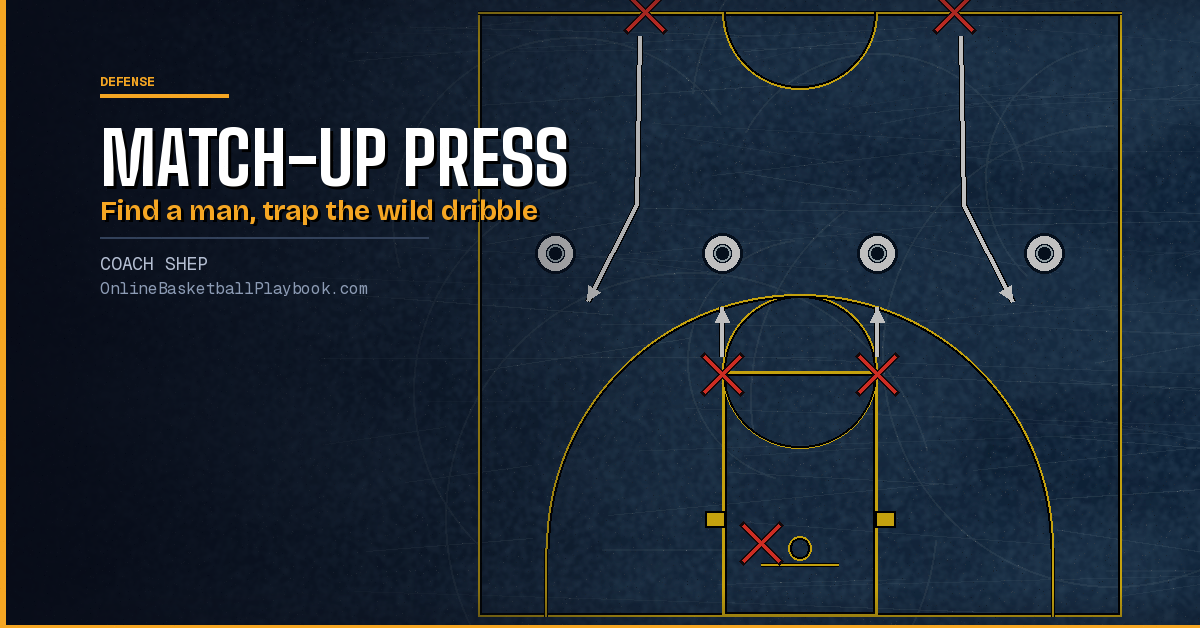
Match-Up Press: Matching Up, Who to Trap, Calls and Drills
The full-court match-up press: matching up from spots, box and diamond, trapping the uncontrolled dribble, the coffin corner, pressing by shot and call menus.

Vance Walberg Full Court Press: Five Jobs, Quarters and Traps
The Vance Walberg full court press in action: five jobs, zones and quarters, trap the sideline and jump the middle, Gold, the vertical re-trap and the umbrella.
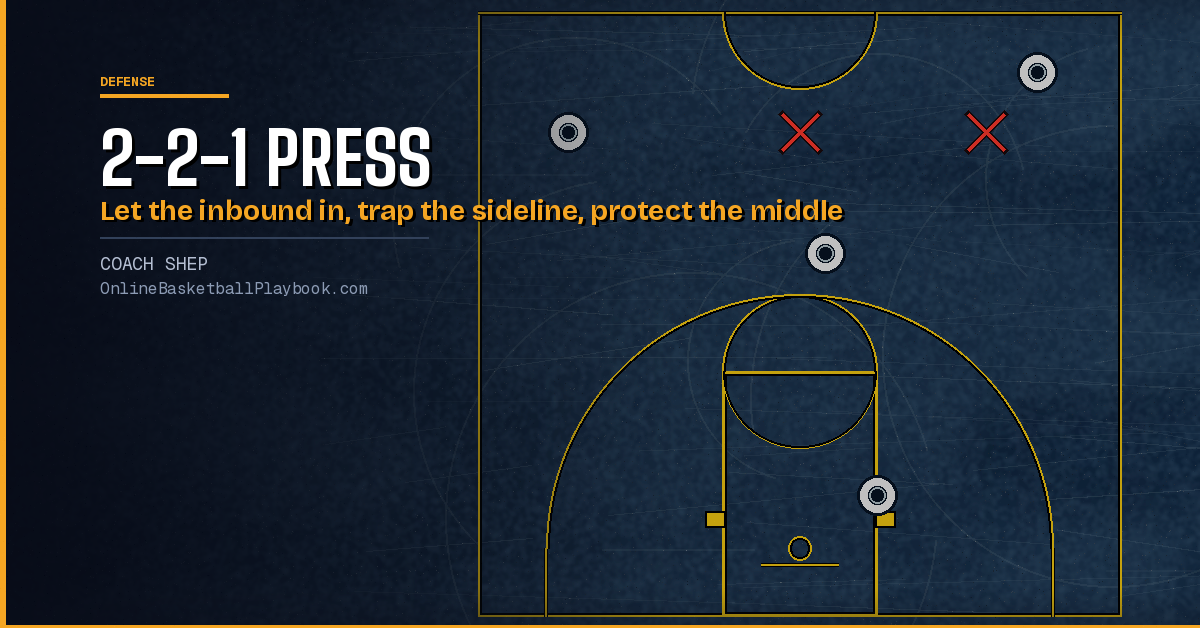
2-2-1 Press: Setup, Traps, Rotations and Drills
How to run the 2-2-1 press: who plays each spot, how coaches trap the sideline, the rotations after a reversal, how it breaks, how offenses attack it and the drills.