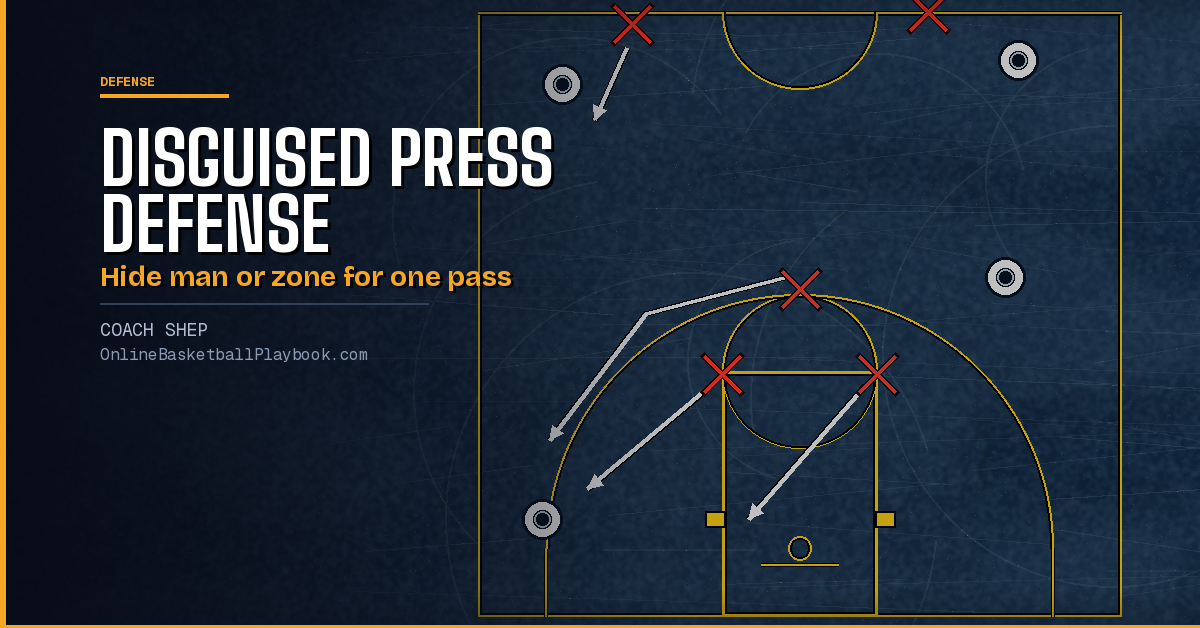
A disguised press defense shows the offense one look and plays another, for a pass or two or for a whole possession. Most teams run one offense against man and another against zone, so a defense that hides which one it is in can get the offense running the wrong one, or at least burning clock to figure it out.
This page covers four of them. The 1-1-1-2 Conceal hides man or zone for one pass. The Circle is a 2-3 trap that turns into man on a pass count. In the 21 press the same five can become a man press, a diamond or a 2-1-2. The Face call turns a zone press into a face-guarding man press. Pressing shapes without a disguise are on best full-court press, the basics of pressing are on full court press defense, and every defense page is listed under defense.
Why Run a Disguised Press Defense
The offense wants to come down the floor, see the defense at once and set up the offense that beats it. A disguise takes that away. The four here aim at different payoffs:
- Run the wrong offense. The Conceal hopes the offense runs its zone offense against man, or its man offense against zone. At worst the offense has to stop and figure it out, and it spends more time on that than the defense spent putting it in.
- Get the ball out of the point guard's hands. The Conceal pressures the point guard at half court so he has to give it up to another guard, a poorer handler and decision maker.
- Confuse the read. The Circle adjusts its 2-3 trap in small ways to confuse the offense, and can turn into man in the middle of a possession.
- Break the wrong press break. The 21 press can switch from zone to man, or from one zone to another, even after the inbound. The Face call waits until the offense has set its zone press break, then goes man, and the offense either rushes into a five-second call or calls timeout.
Decide which payoff you want before you choose the disguise.
The 1-1-1-2 Conceal
The Conceal is an initial alignment, nothing more. It hides the defense for the first pass, or the second if you trap the first, and then every player is in his normal defense with no teaching changes. The name is defined on press terminology.

- #1 at half court. The best on-ball defender. He puts extreme pressure on the ball, discourages penetration and anything to the middle, and encourages the easy pass to a wing. Once the pass is made, he takes his spot in whatever defense follows.
- #2 above the top of the key. One to three steps above it. He takes the first pass if it is caught above the free-throw line, closing out the way his normal defense closes out.
- #3 at the free-throw line. At, slightly above or slightly below it. He takes the first pass if it is caught below the free-throw line, and otherwise stays in help, keeps the ball out of the middle and bumps cutters.
- #4 and #5 at the basket. Interchangeable. They protect the basket, match up with the post on their side and may have to cover a corner.
After the first pass there are two answers, and a team can run either or both.
Match up off the first pass. Each player drops into his spot in man or a zone:
- Drop to man. #2 or #3 takes the receiver and the other matches the back-side wing.
- Drop to a 1-2-2. The drops are the same as in man, which is why the Conceal is called nearly impossible to read for a while when a team runs both.
- Drop to a 2-3. #3 drops ball side as the bottom wing, #1 drops to the back-side guard spot, #5 moves to the middle and #4 takes the back-side bottom wing.
- Drop to a 1-3-1. #4 cuts up to the elbow as the middle man and #5 is the bottom.
Trap the first pass. The same rotation wherever the ball is caught. #2 and #3 sprint on the air time of the pass and trap the receiver, #1 also moves on air time to drop into help, and the posts stay with their posts. When the ball comes out of the trap, #1 takes that pass and one trapper sprints out to the open man.

If the point guard beats #1 off the dribble, #1 pushes him to a sideline, and the same match-up or trap choice applies as on a pass to the wing.
Matching up first also does not rule out trapping later: a 1-2-2 or 1-3-1 can match up off the first pass and spring its traps when the ball goes back to the top of the key. The zones themselves are on 3-2 zone defense, 2-3 zone defense and 1-3-1 zone defense.
Practice it in minutes a day, not hours. The only new thing is where players stand before the first pass.
The Circle: A 2-3 Trap With a Pass Count
The Circle is a half-court 2-3 trapping zone built to be adjusted slightly in several ways. It can trap now and then, trap all possession, switch into man during the possession, or start as a 1-2-2.
Its base rules protect the high post:
- Hands wide. At all times.
- Guards close together. When the ball is at the top of the key, both guards start close enough to stop a pass into the high post.
- Front low posts belly to belly. The fronting defender faces the baseline, which gets him to the corner faster.
- Move on the air time of the pass.
- Common sense on skips. A high skip pass is the guard's, a low one is the forward's.
The corner-to-post pass is the Circle's automatic trap. With the ball in the corner, X5 is on the corner player and X3 fronts the low post.
When the pass into the post is completed anyway, X3 and X4 trap him, X4 coming over to cut off the baseline. X5 stays on the corner player to take away the easy pass out, X1 zones off high to cover a pass out of the trap, and X2 rotates down inside the weak-side player.

Three changes make the same look play differently:
- Free the strong-side guard. The strong-side guard may trap at the wing, trap in the corner, or lay back and run through passing lanes for steals. When the ball is reversed, the other guard gets the same freedom.
- Everyone traps but one. All five trap except the low defender on the weak side.
- Start in a 1-2-2. A 1-2-2 start for a three-guard lineup, or against a four-out zone offense, with the guards on the wings, the top of the key and the fronted low post, and the bigs on the corner and the low post.
The deepest layer is the pass count. The team pairs the Circle with three man defenses:
- 10. Switching man.
- 11. Man with no switching.
- 12. A run-and-jump trapping defense.
The call is "X to Y": "2 to 10" means that on the second pass in the half court, the Circle becomes switching man. Inbound passes and backcourt passes do not count, defenders signal each pass with their voices, and the call is made at any dead ball.
To hide the change, the defense does not deny perimeter passes, off-ball players stay loose instead of rushing out to their men, and players say "stay" instead of "switch" when they switch. The 2-3 slides themselves are on 2-3 zone defense, and a man defense that runs and jumps is on how to coach the run and jump press.
Keep the voices quiet and the stances loose, and the zone look lasts longer than the zone does.
The 21 Press
The 21 is a full-court press that is part man and part zone. It leaves the inbounder free and uses that defender as a roamer who reads the ball.
- Up men. Two defenders on the elbows. They own the inbound pass and get right up on whoever is in their area, and after a score they face their men with their backs to the inbounder and deny every catch.
- Spy. A free defender at the top of the key who watches the inbounder's eyes and jumps any lob thrown over the up men. When a guard comes open, he and the up man on that side close the space together in a quick contact trap.
- Safeties. Two defenders who sit level with the deepest attacker on their side, which usually puts them near half court. On a pass in to his side, a safety takes away the next pass up the sideline. The far safety covers the other two and is the one who gets back to protect the rim.

When the trap forms, the far up man takes away the return pass to the inbounder, and the safeties cover the other three. A late flash to the middle or up the sideline gets a three-quarter deny from a safety, however close to the ball he comes. If a guard runs deep while a big flashes, the safety and the up man talk it over and switch.
The press adjusts to two press-break starts:
- They start deep. When three or four players wait at half court before flashing, the whole zone slides up toward half court. The up men take the first two players who flash and the safeties go with the rest.
- They crowd the inbounder. If more than two crowd the ball, the safeties step up and three-quarter deny the additional receivers.
Once the first trap is broken, the 21 turns into a run-and-jump man press. Each defender takes the closest player and stays with him all over the floor, and any gap defender may leave his man to trap a handler who loses control.
The disguise is in the spy's job:
- Spy takes the inbounder. Now it is a man press.
- Safeties rotate. One rotation gives a 1-2-1-1 diamond press.
- Spy stays put. The look is a 2-1-2 zone.
Even with the ball in, the offense cannot tell whether to clear the floor for its handler, the answer to man, or to attack the middle and the sidelines.
Give one player the switch, and the other four only have to know where he went.
Face: Zone Look, Man Press
The Face call turns zone pressure into man at the worst moment for the offense.

- Show the zone. Line up in zone pressure and let the opponent set up its zone press break.
- Call Face. The front players in the zone go to man to man and face guard. The opponent rushes to switch to its man press break and either gets a five-second call or uses a timeout. Other presses use the word Face for other jobs, such as SOS pressure defense, so write the job next to the call.
- Call Base. With veteran teams, a second call returns to straight match-up zone pressure once the opponent is in its man press break. The switch comes as the official gives the inbounder the ball, so the offense has almost no time to talk.
The zone presses it can start from are on 2-2-1 press, and the man pressure it turns into is on full-court man-to-man pressure.
Wait for the offense to commit, then change the picture.
When to Use Each Disguise
The Conceal names its own moments:
- After made baskets. Unless the opponent is a great fast-breaking team.
- On throw-ins at or behind half court. If the ball is entered up a sideline from half court, match up right away off the inbound.
- At the end of a quarter or half. When the offense wants a set play for the final shot, reading the alignment eats its clock.
- Not off a miss. Unless the opponent likes to walk the ball up slowly.
- Not under their own basket. Never when the offense takes the ball out under its own basket or in its own half of the court.
The Conceal trap is preferred when the point guard drives, because it gets the ball out of his hands. The Circle's call can be made at any dead ball, on free throws, out-of-bounds plays and timeouts. Other ways to hide a trap inside a normal look are Jim Larranaga's 55 on scramble press, Vance Walberg's Gold, a fake trap, on Vance Walberg full court press, and Tubby Smith's Black and White starts and the zone-start man press on match-up press.
Pick one disguise, run it on its moment, and keep the base defense behind it simple.
Get the next coaching guide in your inbox
One email when a new guide or diagram set goes up. Free.
Questions Coaches Ask
What is a disguised press in basketball?
A press that shows one look and plays another for a pass or two, such as a 1-1-1-2 that turns into man or zone after the first pass, or a zone press that switches to face-guarding man once the offense sets its zone break.
What is the 1-1-1-2 Conceal defense?
An initial alignment with one defender pressuring the ball at half court, one above the top of the key, one at the free-throw line and two at the basket. On the first pass the team either matches up into its man or zone defense or traps the receiver.
How does the 21 press work?
Two up men deny at the elbows, a spy floats at the top of the key to read the inbounder and trap, and two safeties start near half court. After the first trap breaks it plays like a run-and-jump man press, and changing the spy's job turns it into a man press, a diamond or a 2-1-2.
How do you switch from zone to man without the offense knowing?
The Circle counts passes in the half court and switches on a number called at a dead ball. Its defenders say "stay" instead of "switch," do not deny perimeter passes and stay loose off the ball, so the man defense still looks like a zone.
Want every diagram on the site?
OBP Pro members get the full diagram files for every guide on the site, ready for a practice binder or a scouting report. $9 a month. Or draw your own version free in the play drawer.
See what OBP Pro includesMore Press Systems
- Vance Walberg Full Court Press: Five Jobs, Quarters and Traps
- Match-Up Press: Matching Up, Who to Trap, Calls and Drills
- Scramble Press: Hand Calls, One-Trap Looks and Drills
Back to Best Full-Court Press and every Defense page.
Keep Building
Related breakdowns
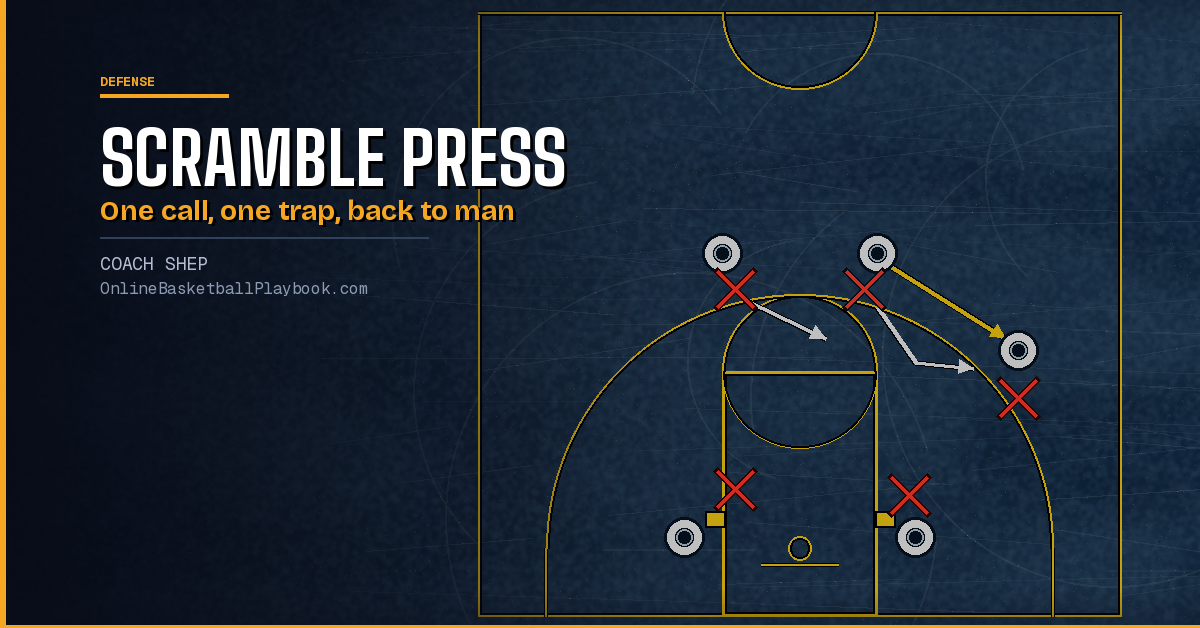
Scramble Press: Hand Calls, One-Trap Looks and Drills
The scramble press explained: five hand calls after a score, Larranaga's Twist and 55, half-court Thumbs Down and Thumbs Up, Don Meyer's fist calls and drills.
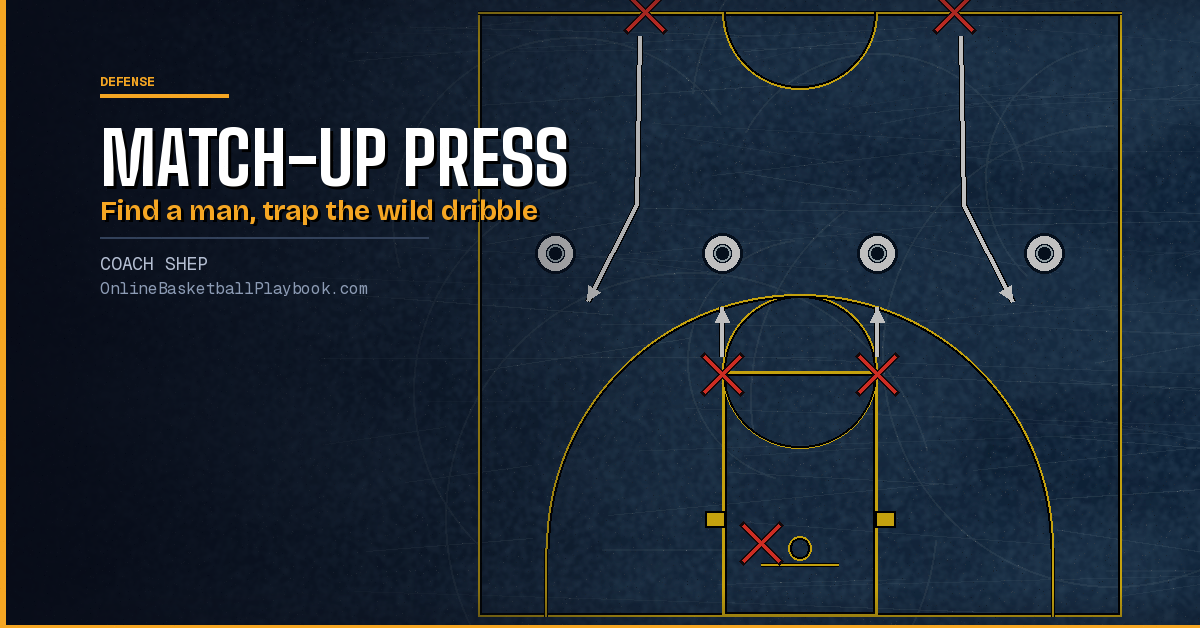
Match-Up Press: Matching Up, Who to Trap, Calls and Drills
The full-court match-up press: matching up from spots, box and diamond, trapping the uncontrolled dribble, the coffin corner, pressing by shot and call menus.

Vance Walberg Full Court Press: Five Jobs, Quarters and Traps
The Vance Walberg full court press in action: five jobs, zones and quarters, trap the sideline and jump the middle, Gold, the vertical re-trap and the umbrella.