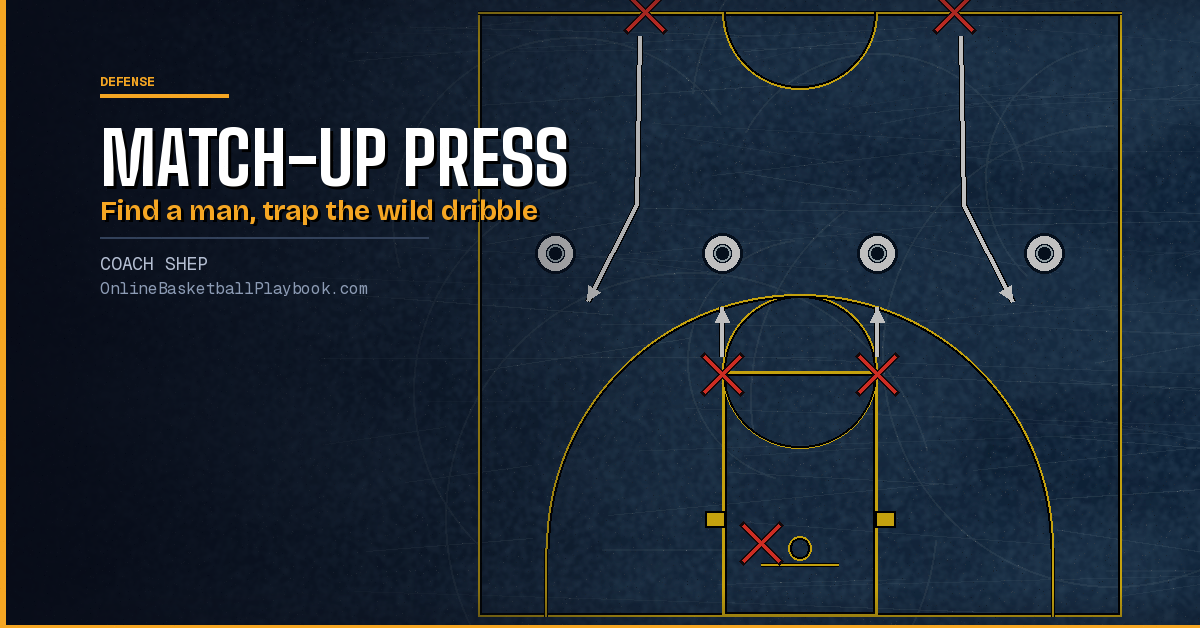
A match-up press is a full-court press where every defender matches up with a man on the inbound instead of guarding an area. Because the defense plays people, no single press break beats it the way one alignment can beat a zone press. Rick Pitino built it at Kentucky, and a numbered version later grew it into a full system for athletic high school teams. The traps come only on a trigger, usually an uncontrolled dribble.
The zone presses are compared on full court press defense and best full-court press, and every defense page is listed under defense.
What a Match-Up Press Is
The difference from a zone press shows after the catch. A zone press keeps covering areas. A match-up press has each defender pick up a player and follow him using press rules, except in a full deny look. It costs more practice time than a standard zone press, which is why the numbered version recommends teaching it at the freshman and JV levels so players know it by varsity.
- It is a ball defense. Billy Donovan says his team is not denying passes, it is playing the basketball. The ball tells every defender where to go.
- It disrupts more than it steals. Donovan's success test is an offense that cannot run its half-court sets. He says good teams will not dribble into traps, but the press still gets the ball out of the point guard's hands and makes other players handle it.
- It needs bodies. Pitino asks for outstanding quickness, great anticipation and desire, plus 10 players in top condition. Donovan's reasons include playing 9 or 10 players and making conditioning a factor late in the game.
Pitino's Louisville teams pressed about 90 percent of the time at home and about 60 percent on the road, by his own account.
Decide what a good possession looks like before you press: a turnover, or an offense that never gets into its sets.
Matching Up From Spots
These match-up presses start from spots and then find men. A press that gives each defender a job instead of a man is on Vance Walberg full court press.

- Zone start, man finish. The 4 is on the inbounder right away, the 3 and the 2 take the elbows, the 1 goes to half court on the ball side and the 5 to half court on the help side. The zone shape lasts only 1 or 2 seconds. Players sprint to their spots, find someone, and that player becomes their man, mismatches or not.
- Deny before the inbound. Before the inbound they deny fully, never face guarding but never behind the man either, and switch every screen.
- Sprint to spots, then match. A ball press built the same way puts the 4 on the ball, the 3 at the ball-side elbow, the 2 at the weak elbow and the 1 back at half court, and the 5 takes the nearest man. Swapping who is on the ball, 3 or 4, is just a different number in the call. Each defender makes the catch tough: outside shoulder, running the passing lane.
- Donovan's Circle. After a made basket the team circles up and sprints to press spots while the on-ball forward attacks the inbounder to buy time. A player who reaches his spot with no man backs up to the middle and finds one, and the point guard organizes the matchups from behind. His power forward, picked for foot quickness, usually guards the ball.
- Posts in front. The numbered version uses the two post players on the inbounder and the first receiver. They are near the basket after a score, their length can tip the inbound, and they only need to force a pass or a one-way dribble.
Against special alignments the zone-start version has answers. If four line up across and the 5 comes up to get the ball, X5 follows him and can trap with X4. If the point guard is the inbounder, X4 stays with him to stop the flash back in. If they isolate their point guard, X4 drops off the ball and face guards him, with the 3 man behind him.
Sprint to the spot, find a man, and never worry about the mismatch.
Box on the Side, Diamond in the Middle
Behind the ball, four match-up defenders keep one of two shapes. Pitino's rule: a box with the ball on the sideline, a diamond with it in the middle. On every pass someone rotates to fill the empty spot, and all four must be able to play all four spots.
Tubby Smith uses the two shapes as two starts, Black and White, chosen by the shot just made:
- Black. After a made deep perimeter shot, set in a box, lined up like a 2-2-1 press.
- White. After a close-in shot or a layup, set in a diamond.


Once the ball is inbounded the two are identical: box on the side, diamond in the middle, pressure the ball and match up with anyone in your zone. If your zone is empty, back off and find an open man. His press video adds the habit that goes with it: back up until you match someone, and make him catch in front of you.
Know your shape by where the ball is, and fill the empty spot on every pass.
Who to Trap and Where
A match-up press traps on a trigger, not at a spot on the floor. The trigger is the ball handler's control.

- Trap the uncontrolled dribble. Pitino's rule: if the dribbler is speed-dribbling, trap big. If he is under control, back up and keep pressure on the ball. Tubby Smith defines it the same way, a player who needs a second dribble to beat his defender, and never traps a handler who is looking up to pass. His rotating defenders read the trapped handler's eyes and shoulders to time the steal.
- Trap who, not where. The zone-start version picks who to trap, not where. Pick who to trap by scouting, never trap a non-ball handler, and look for surprise traps, which it calls the best ones.
- Trap the great point guard early. Pitino's notes say to trap a great point guard right away to get the ball out of his hands. When he throws it away, you have overplayed him.
- Trap the coffin corner. Donovan's one automatic trap is a ball-side inbound caught below the block. He never traps the long-side inbound, because it is too far to recover.
- Trap at the top of the key. Otherwise Donovan traps only when a second defender is on the side of the handler and the dribble crosses the top of the key extended. Before that line, cut him off.

The numbered version drills the same line: X4 and X5 double the corner inbound only if it is caught even with or below the block.
Pitino's trappers take one shoulder each and lock legs, moving with the pivot and playing for a deflection, not a steal.
Donovan's trappers keep their feet touching to take away the step-through, with short choppy steps and hands up. His phrase is trap on the ball, steal off the ball: no reaching, grabbing or slapping, and the only steal he wants on the ball is a back-tip. The full technique is on trapping in basketball.
Read the dribbler first. A wild dribble gets two defenders, a controlled one gets one.
Pressing by the Shot They Just Made
Pitino changes the press at every dead ball, by the shot the opponent just made.
- Change by shot type. Pitino after a jump shot runs the match-up press, after an inside basket or layup the 1-2-1-1 all-out steal press, and after a three a half-court trap. After any dead ball, even a ball knocked out of bounds, the press can change.
- Press all 94 feet. The zone-start version concedes no part of the floor.
The 1-2-1-1 that follows a layup is on 1-2-1-1 diamond press, and the half-court trap that follows a three is on half court trap defense.
Two other families change looks without a timeout: the hand calls on scramble press and the one-look starts on disguised press defense.
Tie every call to a shot, and nobody needs a timeout to change the press.
Match-Up Press Call Menus
Pitino's call menu:
- White. The 1-2-1-1, a dead-ball press. Its theme is trap the sideline, tip the middle.
- Red. A half-court trap.
- 3. A 2-3 zone.
- 22. A trap out of the 2-3 zone, all out, best when the point guard goes through or at the ends of quarters and games.
- 24. For the ball in the corner: deny the reversal, with the block defender looking for the steal.
- 5. A 1-3-1 trapping zone played like the White press. A lateral dribble gets a wing trap and a dribble to the basket gets a middle trap.
Pitino's sheet adds a half-court rule between the 22 and 24 entries: ball above the free-throw line, no trap, below it, trap, and try to speed up the offense. Other systems use White and Black for other jobs, so write the job next to every call.
Tubby Smith's menu adds a rule all four of his presses share: when the ball has clearly crossed half court, each press flows into a named half-court defense, called with the press, such as "to 5." A ball press built on spots adds these calls:
- Face-guard the handler. Deny the primary ball handler the inbound and the throwback, and make a non-handler bring it up.
- Straight man, no traps. Face guard, move the defender off the inbounder to center field, hunt a five-second call or an inbound steal, then guard full-court man and shrink the floor. Man pressure as a whole system is on SOS pressure defense.
The rule of thumb behind those two calls: effort matters more than trap spots or rotations. The number words for depth, 80 for full court down to 20, are on press terminology, the three-quarter pickup is on three-quarter court press, and the full-court man presses are on full-court man-to-man pressure.
Keep the menu short enough that every player can say what each call means.
When the Press Breaks
Name the outcomes you will not accept and the way back to the half court before the press starts.
- Two unforgivable outcomes. Donovan never gives up a wide-open layup or a wide-open three. A quick shot out of transition or a long two is acceptable. He concedes the lateral pass back and, five on five, the farthest pass opposite.
- Never two bodies behind the ball. If a trapper is beaten, the on-ball defender sprints behind his own teammate's back to cut the dribbler off before half court.
- Stunt, don't lunge. Out of position, fake a trap and recover. A lunge past the handler, which Donovan calls fake hustle, takes the defender out of the play.
- Get a man. If the ball crosses half court on the dribble with no trap available, sprint and get a man. The last good trap spots are a step past half court, or a pass to the corner or sideline after half court.
- Turn sideline, tip middle. Pitino's beaten defender either beats the dribbler to a spot ahead of the ball on the sideline, or catches up and tips it from behind toward a teammate.
- Level off and back-tip. Tubby Smith has an available defender level off a dribbler who beats the trap to the middle, while the players behind the ball back-tip and run through the passing lanes.
After a steal, pass it ahead at once for an open shot, not back into traffic.
Know your exit before the press starts, and sprint to it the moment the trap breaks.
Match-Up Press Drills
Pitino, Donovan and the numbered version all teach the press small to large, 1 on 1 up to 5 on 5. Donovan splits press time into an 8 to 15 minute breakdown block and an 8 to 15 minute 5 on 5 block, and Pitino's ladder is on full court press defense drills.
- 1 on 1 speed dribble. Force the handler into a speed dribble, then cut it off and contain it, on both halves of the floor at once.
- 2 on 2 corner trap. Trappers go knee to knee so the dribbler cannot split them, then sprint out the instant the ball is passed and try to back-tip it.
- 2 on 2 cut and double. X5 forces the speed dribble up the sideline and cuts it off, often past half court, and X4 sprints over to trap, usually catching a reverse pivot.
- 2 on 2 run and jump. When the ball is speed-dribbled at a defender in the middle, he sprints and contains, and the nearest teammate jumps to the receiver. The full rotation is on how to coach the run and jump press.
- 3 on 3 and 4 on 4. X4 skips the corner trap and sprints above the ball to trap a middle dribble or intercept the middle pass. The 4 on 4 adds X3 as a safety who rotates to steal the sideline pass.
- Rotating 4 on 4 on 4. Three teams of four and no fifth player, and the ball cannot be thrown past half court. One team brings it up against another's press, then the teams rotate so every group gets a press rep and a press-break rep.
- Quick pickup. Players circle up in a free-throw alignment, the coach tosses the ball up and calls a color, "black ball," and that team inbounds while white sets the press. It drills the quick pickup.
Tubby Smith practices the press every day, and his press video sets a goal of 35 deflections a game. His drills:
- 4 on 4 on 4.
- 2 on 1 trapping.
- Sprint out of traps.
- Full-court 1 on 1, 2 on 2 and 3 on 3.
The press-break side of these drills is on how to beat a full-court press.
Short and every day. The habit of finding a man is built in the drill, not in the game.
Get the next coaching guide in your inbox
One email when a new guide or diagram set goes up. Free.
Questions Coaches Ask
What is a match-up press in basketball?
A full-court press where each defender matches up with a man on the inbound instead of guarding an area, and traps only on a trigger such as an uncontrolled dribble.
What is the difference between a match-up press and a zone press?
A zone press covers areas and traps at set spots. A match-up press lines up from spots for a second or two, then each defender follows a man and the traps come where the dribbler loses control.
What is the coffin corner in a press?
Billy Donovan's name for a ball-side inbound caught below the block.
When should you trap in a match-up press?
When the dribbler is out of control. Rick Pitino traps a speed dribble and backs off a controlled handler.
Want every diagram on the site?
OBP Pro members get the full diagram files for every guide on the site, ready for a practice binder or a scouting report. $9 a month. Or draw your own version free in the play drawer.
See what OBP Pro includesMore Press Systems
- Vance Walberg Full Court Press: Five Jobs, Quarters and Traps
- Scramble Press: Hand Calls, One-Trap Looks and Drills
- Disguised Press Defense: Show One Look, Play Another
Back to Best Full-Court Press and every Defense page.
Keep Building
Related breakdowns
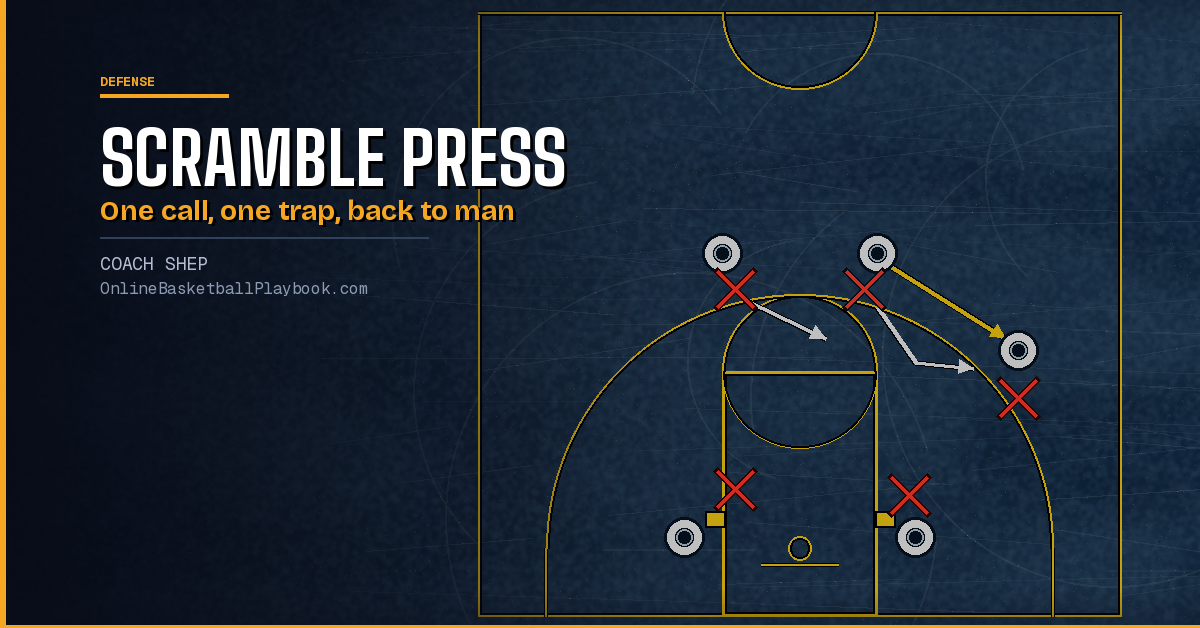
Scramble Press: Hand Calls, One-Trap Looks and Drills
The scramble press explained: five hand calls after a score, Larranaga's Twist and 55, half-court Thumbs Down and Thumbs Up, Don Meyer's fist calls and drills.

Vance Walberg Full Court Press: Five Jobs, Quarters and Traps
The Vance Walberg full court press in action: five jobs, zones and quarters, trap the sideline and jump the middle, Gold, the vertical re-trap and the umbrella.
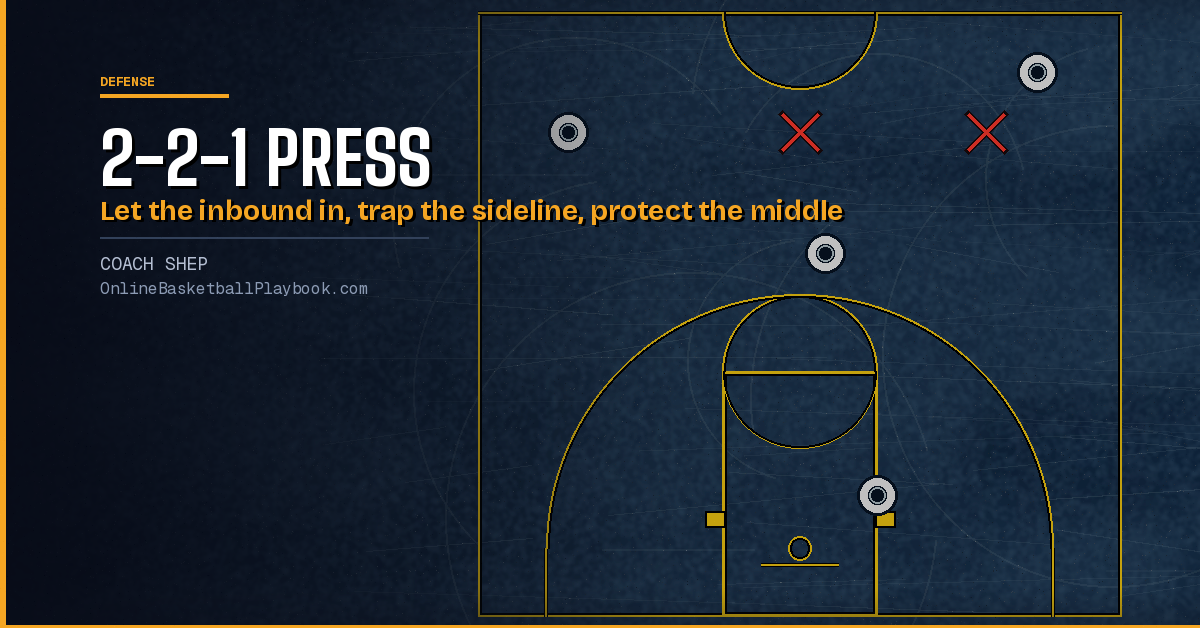
2-2-1 Press: Setup, Traps, Rotations and Drills
How to run the 2-2-1 press: who plays each spot, how coaches trap the sideline, the rotations after a reversal, how it breaks, how offenses attack it and the drills.