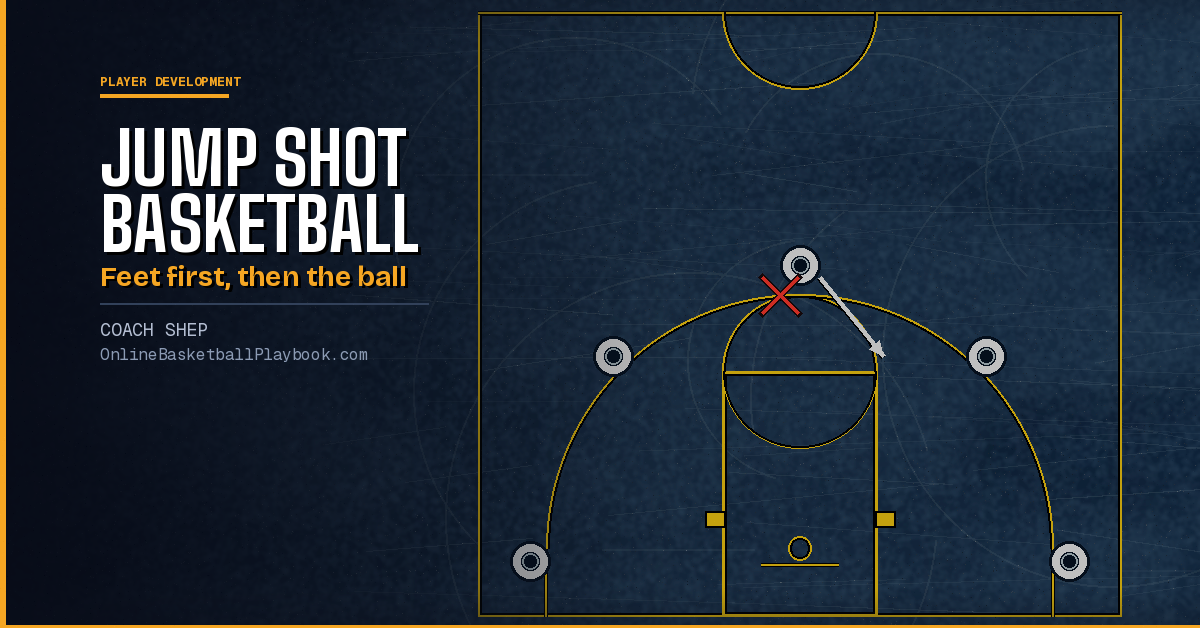
The jump shot in basketball is a shot the player releases while he is in the air, after a catch or a dribble. It starts with the feet: how the shooter lands the catch or the last dribble decides whether he goes straight up or drifts. This guide covers that footwork, the lift and the release, the difference between shooting off the catch and off the dribble, the step-back jumper and how coaches diagnose a jump shot that misses. The arm, hand and aim mechanics that every shot shares are on basketball shooting form, so this page stays on what makes the jump shot its own skill.
What a Jump Shot in Basketball Is
A set shot is taken with the feet on the floor. A jump shot is taken in the air. The shooter stops, squares up and releases the ball with one hand while he is off the floor. Kenny Sailors of Wyoming is credited with the first recognizably modern jump shot, in a 1942 game at Madison Square Garden: stop, square up, and shoot one-handed in the air.
Most of the shot is shared with the free throw and the set shot: the grip, the elbow under the ball, the aim point and the follow-through. Those are covered on basketball shooting form, in the BEEF shooting method and on which part of the rim to aim at. What changes with the jump is the footwork before the shot, the timing of the release in the air and the way a moving player turns sideways momentum into a straight jump.
The Versions at a Glance
| Version | How the shooter gets into it | When it fits |
|---|---|---|
| Jump stop catch | Jump behind the ball and land on both feet as it arrives, then go up in one motion | A quick release on the catch, and a pass that is off target |
| Inside foot first (1-2) | Plant the inside foot, then the outside foot, then lift | Catches off a V-cut or a screen |
| One-two stop when closely guarded | Land on the inside foot, pivot into the defender, jab with the ball high | A pass to the outside hand with a defender close |
| Pull-up to the strong hand | One or two dribbles, jump behind the ball, pick it up in front of the shooting-side knee | Space created with one or two dribbles |
| Pull-up to the weak hand | The same pick-up, with a crossover on the last dribble to bring the ball to the shooting knee | Going toward the weak hand |
| Step-back | Jab step, the defender retreats, step back with the jab foot and dribble away from him | A defender who retreats after a jab step |
Footwork Into the Shot
The feet are ready before the ball. The shooter faces the basket with his hands above his shoulders and his knees slightly flexed, and he jumps behind the ball instead of reaching out for it. One version sets a ready stance before the ball is thrown: hips down, back straight, both palms showing the passer a target with all ten fingers up, and the trigger foot behind so the player can create energy on the catch. Another calls it "hungry hands": show the target and be fully prepared to finish the catch, which gives a quicker release. The same version shoots off the inside pivot foot and drills "attack the catch and elevate" from every angle on the floor, rising into the shot without shooting it, until the footwork is a habit.
There are three ways to land the catch, and each has its place.
- The jump stop. The shooter lands on both feet as the ball arrives and shoots in one motion. One teaching of the quick release says this is faster than stepping into the shot, which is a two-motion catch, and easier to adjust when the pass is off. Rhythm and range come from a quick down-and-up motion of the legs, not from dropping the ball or stepping in, and keeping the ball high through the catch shortens the shot to one count.
- Inside foot first. On a V-cut or a catch off a screen, the shooter plants the inside foot first, then the outside foot, and lifts. In this version players say the sequence out loud during technique work: 1-2, lift, follow through. It is taught with the knees bent and the hands up before the ball comes.
- The one-two stop when closely guarded. When a defender is close and the pass comes to the outside hand away from him, the receiver lands on the inside foot, pivots into the defender and jab-steps with the ball held high in triple threat.


The full catch-and-shoot footwork, with the hop, the stride and the inside and outside pivot compared, is on catch and shoot basketball. Shots that come off down screens, flares and curls are on basketball shooting off screens.
The Jump Shot Action: Lift and Release
The stance, the grip, the elbow, the wrist snap and the follow-through are the same in every shot and are on basketball shooting form. What the jump adds is below.
- Jump. Spring straight up off both feet, or slightly forward on longer shots, without drifting sideways or backward. Most of the shot's power should come from the jump, not from the arm, wrist or hand.
- Arm. As the ball rises, the shooting arm makes an L, with the forearm straight up and down and the elbow aimed at the rim. The set point sits to the shooting side of the face, as high as the forehead or higher, never cocked behind the head. Younger players with less strength start lower and raise it as they get stronger.
One version opens every practice with set lifts (elbow under, lift and follow through) and a drill that holds the ball as high as possible to teach the rhythm of jumping and lifting together.
Where the Versions Split
| Question | One version | Another version |
|---|---|---|
| When the ball leaves the hand | Just before the top of the jump on outside shots, for extra power, and at the top of the jump in the paint to shoot over a defender | On the way up, taught with the ball held as high as possible |
| Where the ball sits before the shot | Between the shoulder and the hip on the shooting side, level with the chest, with the shooting elbow behind the ball | Up high through the catch, so the shot is one count |
None of these is wrong. A coach picks one set of cues, uses the same words every day, and lets a player who already shoots well keep what works. Steph Curry's set point, for example, sits about level with his right eye, and that release is broken down on Steph Curry shooting form.
Off the Catch or Off the Dribble
Off the catch, the shooter's feet are set before the ball arrives, so the work is the footwork above. Off the dribble, the player is moving sideways when he decides to shoot, and the job is to turn that motion into a straight jump.
The pull-up is easier going to the strong-hand side. One or two dribbles create space from the defender. On the final dribble the shooter hops in behind the ball, square to the rim, and gathers it at the knee on his shooting side, shooting hand above the ball and balance hand below. With the shooting hand on top, the hand faces the rim as the ball comes up. Picking the ball up at the knee is what turns sideways momentum into upward momentum, so the shooter jumps straight up instead of floating to the side.

Going to the weak-hand side is harder, because a right-handed player moving left has farther to go to get the ball to his right knee. A crossover on the last dribble brings the ball to the shooting knee. Two errors cause most pull-up misses: picking the ball up with the hands on its sides, which puts side spin on it so it circles out, and floating to the side, forward or back, which sends the ball wide, long or short.
Coaches split on how much the pull-up belongs in an offense. A dribble-drive version bans the mid-range pull-up and asks for a three or a shot at the rim. Other versions train it, with rip-through and shot-fake pull-ups from 12 to 15 feet, and one likes the pull-up off an L-cut because it keeps guards from driving too deep. The footwork for the pull-up is on shooting off the dribble, the hesitation version is on the hesitation pull-up, and the mid-range game is on mid-range shooting.
The Step Back Jumper
The step back jumper creates space by moving away from the defender instead of past him. There are two versions.
- One-dribble step-back. Start in triple threat as a real threat to shoot. Make an aggressive jab step and shot fake, then stop and read the defender. If he takes a retreat step, step back away from him with the jab-step foot and dribble back with the strong hand. Hop behind the ball and gather it at the shooting knee, shooting hand above and balance hand below.
- Step-back after several dribbles. Dribble with the outside hand with the eyes on the basket, protecting the ball with the inside hand and the body. On the last dribble, dribble back to free yourself and jump behind the ball. Going to the weak-hand side, make that last dribble a crossover. Jump straight up and land in balance.

The common miss on a step-back is leaning back. The correction is to exaggerate the follow-through of the shoulders, head and shooting hand toward the basket. The jab that sets it up is on jab step basketball, and the shot fake on basketball shot fake.
Get the next coaching guide in your inbox
One email when a new guide or diagram set goes up. Free.
How to Get a Better Jump Shot
Build the form first, close to the rim, then move out only while the motion stays the same. When the shot breaks down at a distance, go back to the close shot and rebuild the release and the backspin before moving out again.

- Start the jump shot when the player is strong enough. One view says a player who starts too young gives up technique, and that young players who are not strong enough yet often shoot two-handed. Begin with form shots one foot from the basket and extend range gradually.
- Form shooting every day. A few feet in front of the basket for five minutes a day grooves the motion before the player moves out to game spots. The same drill helps good shooters work through a slump.
- Shoot with arc. An arched shot sees a bigger opening at the rim than a flat one.
- Diagnose the miss before changing anything. Read what the ball does at the rim, find the cause and give one correction.
| Miss | Likely cause | Correction |
|---|---|---|
| Short | Too little leg drive, a follow-through cut short, or a rhythm that is slow or jerky | Drive with the legs and hold the arm up until the ball reaches the rim |
| Long | A flat release, the shoulders leaning back, or the hands set too far apart | Raise the arc, drive the shoulders forward and up, bring the hands closer |
| Off the side, off the dribble | Reaching to the side for the ball instead of jumping behind it | Pick the ball up in front of the shooting-side knee, shooting hand on top |
| Floating forward, back or sideways | The ball not picked up at the shooting knee with the knees flexed | Pick it up at the knee so sideways momentum becomes a straight jump |
| Leaning back on a step-back | Falling away from the defender | Exaggerate the follow-through of shoulders, head and hand toward the rim |
One view is that a form fix dips before it recovers, so the first week of a change can look worse. Every miss and every slump fix is on basketball shooting slump solutions, and choosing which jump shots to take is on basketball shot selection.
Jump Shot Drills
- Attack the catch and elevate. From every angle on the floor, attack the catch and rise into the shot without shooting. Repeat until the footwork is automatic.
- Toss to the elbow. The player tosses the ball off the backboard to the elbow, sprints to it, and catches and shoots in one motion. Run it from both elbows to train a quick release in a balanced jump shot.
- Toss and catch. Toss the ball out with backspin, plant a foot, get back into the stance in one motion and release a balanced shot square to the rim. The target in one version is 7 or 8 makes in a minute at game speed.
- Step drill. Fire the feet quickly into the shooting position, with a ball and without one.
- Knee and chair shots. Kneel or sit with a straight back and the eyes on the rim to train the release in one motion without the legs. Add the jump once the form is right.
- Set lifts. Elbow under the ball, lift and follow through without hitting the rim, with the follow-through exaggerated.
Scored shooting drills with make standards are on basketball shooting drills and three-point shooting drills, a full individual program is on how to build a shooter, and game-speed work is on shooting at game speed. Free throws, which have their own routine, are on free throw shooting.
Questions Coaches Ask
What is a jump shot in basketball?
A shot the player releases while he is in the air, after stopping and squaring up to the basket. A set shot, by contrast, is taken with the feet on the floor.
Who invented the jump shot?
Kenny Sailors of Wyoming is credited with the first recognizably modern jump shot, in a 1942 game at Madison Square Garden.
How do you get a better jump shot?
Build the form close to the rim, move out only while the shot stays the same, get the feet ready before the catch, and diagnose each miss by what the ball does at the rim before changing anything.
Should you jump straight up on a jump shot?
Yes, or slightly forward on longer shots. Drifting sideways or backward causes misses. Off the dribble, picking the ball up in front of the shooting-side knee turns sideways momentum into a straight jump.
When do you release a jump shot?
Versions differ. One releases just before the top of the jump on outside shots and at the top in the paint. Another teaches shooting on the way up with the ball held high.
What is a step back jumper?
A jump shot taken after the shooter steps or dribbles back away from his defender to create space. It usually follows a jab step or a drive that makes the defender retreat.
Want every diagram, printable?
OBP Pro members get the full diagram files for every shot, rule and zone attack on this page, ready for a practice binder or a team meeting. $9 a month. Or draw your own version free in the play drawer.
See what OBP Pro includesMore Guides From This Batch
- Is Zone Defense Allowed in the NBA? Rules and History
- How to Break a 1-2-2 Zone Defense in Basketball: Sets and Reads
Back to Basketball Shooting Form and every Player Development page.
Keep Building
Related breakdowns
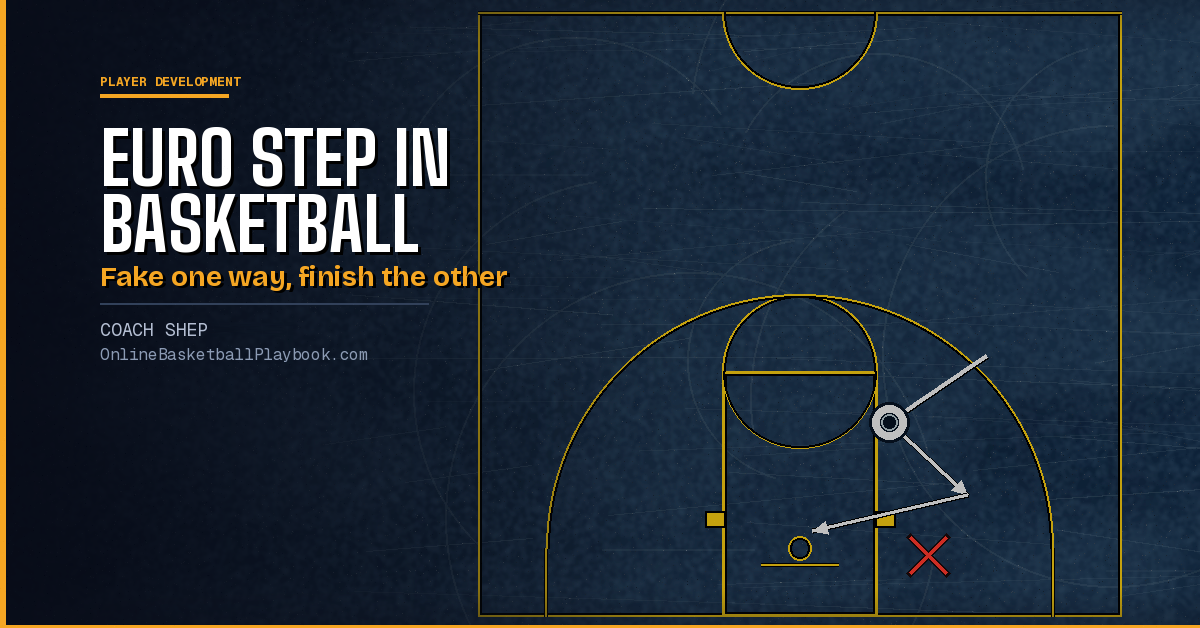
Euro Step in Basketball: Footwork, Rules and Drills
How to teach the euro step: the four-part footwork, when it beats help and shot blockers, the decelerated version for transition, the travel question and drills.
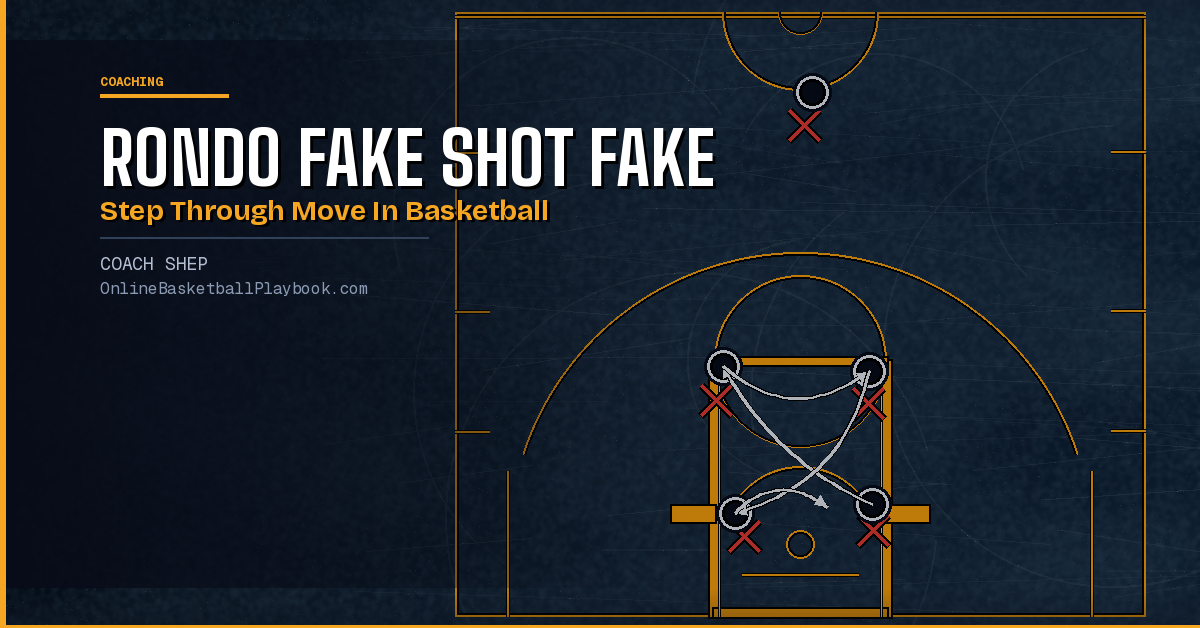
How to Do a Rondo Fake Shot Fake Step Through Move in Basketball
How to Do a Rondo Fake Shot Fake Step Through Move in Basketball
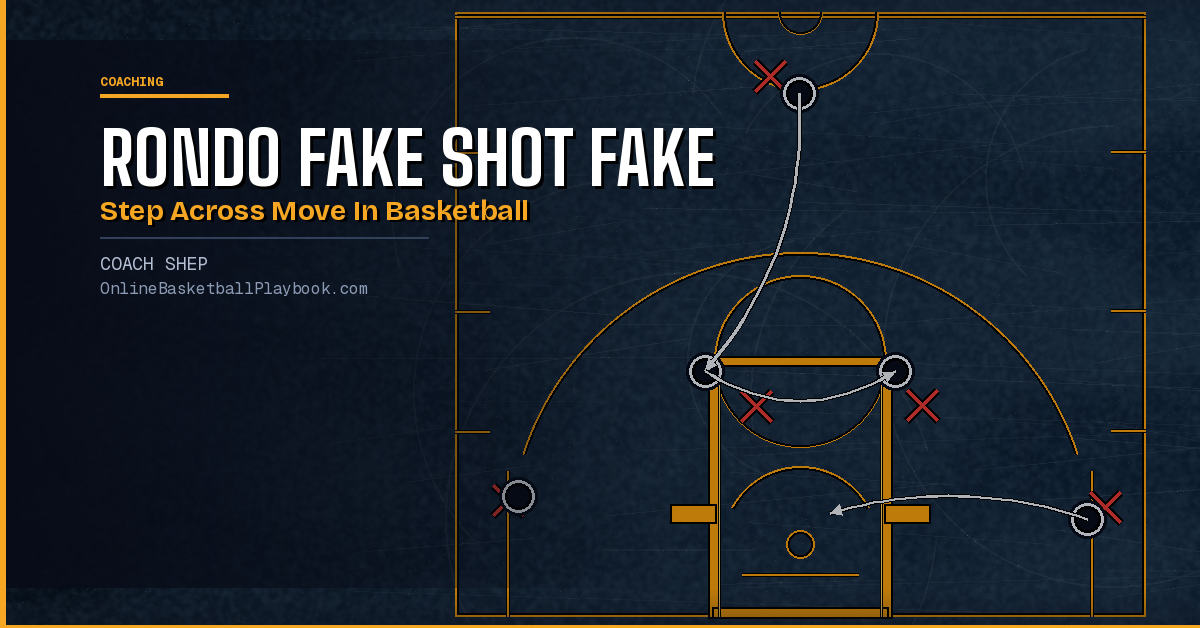
How to Do a Rondo Fake Shot Fake Step Across Move in Basketball
How to Do a Rondo Fake Shot Fake Step Across Move in Basketball