Learning how to shoot like an NBA player starts with what the best pro shooters repeat on every shot: the same hand on the ball, the same path up, power from the legs and a follow-through that holds. Around that base, NBA shooters differ in stance, in one-motion or two-motion release and in the footwork they use to get into the shot. The full build order is on shooting development, and the basketball drills library holds a drill for each part of the shot.
The Base Form NBA Shooters Share
No two NBA players shoot exactly alike, because height, wingspan and hand size change the shot. A frame-by-frame look at Stephen Curry's form still shows the parts most players can copy.
- Hand on the ball. The shooting hand sits on the side of the ball, a little above its middle, with the whole hand touching it. The fingers spread and the thumb and index finger make a loose V. The guide hand goes on the other side.
- Elbow. Curry keeps his shooting elbow close to his side when he catches. The Stephen Curry Skills Academy teaches a universal release with the elbow and the wrist behind the ball and the arm extending all the way through it.
- Set point. Curry reaches his set point before he leaves the floor, and the ball never stops on the way up. His set point covers his right eye, lower than the eyebrow height many coaches teach.
- Release. His wrist snaps at the same moment his elbow straightens. The ball rolls from the palm to the fingers. Most elite shooters finish with only the index finger pointing down. Curry is an exception, with the ball leaving his middle finger last.
- Follow-through. He holds the arm straight but relaxed with the elbow level with his forehead, which gives the ball arc even off a low set point.
- Eyes. He aims at the front of the rim, where rim and net meet, then watches the flight of the ball. Asked whether players watch the flight, NBA shooting coach Dave Hopla answered that the best ones do.
The checkpoints for teaching this base to young players are on basketball shooting form and BEEF shooting, and a longer study of Curry is on Steph Curry shooting form.
Square or Turned Feet
This is the biggest split in shooting instruction, and NBA shooters are found on both sides.
| Version | What the feet do | Who it is tied to |
|---|---|---|
| Square stance | Ten toes to the rim, feet level, "perfect feet" on every shot | Taught by Dave Hopla and Steve Alford. The Curry Skills Academy drills call for squaring up. |
| Turned stance | Feet parallel but rotated slightly, shooting-side foot a little ahead, like 11 o'clock for a right-hander | Curry, Klay Thompson and Kevin Love turn, even when they describe themselves as square |
| Open, staggered stance | Feet pointed about 35 to 45 degrees left of the target for a right-hander | Diana Taurasi, Chris Mullin and Jeff Hornacek |
The turned and open versions say a fully squared body puts tension in the shooting motion and that an open body lines the hand up with the eye and the rim more easily. The square version teaches that good feet make a good shot. Whichever stance a shooter picks, the feet go down the same way on every shot.
One-Motion and Two-Motion Shots
After the catch and the dip, an NBA shooter brings the ball up in one of two ways.
- One-motion. Catch, dip and shoot without a pause. The elbow stays behind the ball the whole time. If it drifts out past the ball, the shot turns into a two-motion shot. Curry, Damian Lillard, James Harden and Steve Kerr are listed as one-motion shooters, mostly guards who do not jump high, since a higher jump pulls a shooter toward two motions. It takes less power, so it suits girls and younger boys.
- Two-motion. The ball slows after the dip and before the release, so the shooter hangs in the air longer. Michael Jordan, Kobe Bryant, Carmelo Anthony, Ray Allen and Dirk Nowitzki are listed as two-motion shooters. It fits the mid-range shot. Three-point range takes longer to build because the shot needs more strength.
Some coaches use the same words for footwork instead. In that sense a jump stop on the catch is a one-motion shot that gets the ball out quickly, and stepping into the shot after the catch is a two-motion shot. Know which meaning a coach has in mind before changing anything.
Power and Arc From the Legs
The legs make the power and the arms guide the ball. How the legs do it is where coaches part.
- The dip. Film study of NBA, WNBA and college shooters shows them dipping the ball on passes caught between the head and the waist. Ray Allen dips almost to his knee. Curry's dip is short and fast, and off the dribble his last dribble is the dip. The other way keeps the ball up. The NBA quick release drill in the Curry Skills Academy uses the cue catch it high and keep it high while a coach swings an arm at the shot, and some quick catch-and-shoot shooters take the ball straight up to the shooting pocket with no dip.
- Knee bend. Curry waits for the ball with his legs bent and loaded, then sinks a little more as the ball dips. Another view holds that the quickest shooters flex their knees slightly instead of bending them deeply and spring off their toes, with Ray Allen, Kevin Durant and Kobe Bryant as the examples. On the catch and shoot, a quick down and up of the legs gives the shot its rhythm and its range.
- Sweep and sway. Many great shooters let the feet float forward in the air and land a little in front of where they took off, with the shoulders leaning back. It eases tension and adds arc. The deeper the shot, the bigger the sweep. A free throw needs a few inches of it and a three can take six to twelve inches. Curry does it only from well behind the line. John Wooden had his players jump about six inches forward on the shot. Kevin Love describes jumping straight up and landing on the same spot, but on film his feet still sweep forward.
A shot that keeps falling short can come from tension in the shoulders or the guide hand as well as the legs. More fixes are on how to fix common shooting errors.
Footwork: the Hop and the 1-2 Step
The 1-2 step catches the ball in a staggered stance, brings the back foot up level with the front one, then jumps. The hop jumps into the catch and lands on both feet at once. Bob Knight and Dick Bennett taught the 1-2 to their teams. Ralph Miller is credited as the first coach to talk about the hop, and Lute Olson made his Arizona players hop in practice. Pete Maravich was the first NBA star to use it.
| NBA height | Usual footwork | Players named |
|---|---|---|
| 5'10" to 6'4" | Mostly the hop, because it is faster | Stephen Curry, Damian Lillard, JJ Redick, Kemba Walker, Derrick Rose |
| 6'5" to 6'8" | Both, depending on the shot | Michael Jordan, Kobe Bryant, Carmelo Anthony |
| 6'9" and taller | Mostly the 1-2 step | Kevin Durant is the named exception and hops |
Not every breakdown files Curry with the hop shooters. Another study of his form says he rarely hops on the catch. He keeps the left foot planted and steps the right foot forward as the ball reaches the bottom of the dip.
Each footwork has its spot.
- Hop on the catch. Catching in the air and landing on two feet gets the shot off fastest, can buy space from the defender and makes a bad pass easier to handle.
- 1-2 with time. The 1-2 is slower but easier to control when the shooter is open and unhurried. Its fans also use it coming off screens.
- 1-2 when closely guarded. With the pass thrown to the outside hand, plant the inside foot, turn into the defender and play from triple threat.
Footwork drills for both are on catch and shoot basketball.
Off the Catch and Off the Dribble
On the catch, Curry waits in what he calls his catch-ready position, ball near the waist and legs loaded, and aims while the pass is still coming. Off the dribble he is already low, so the guide hand puts the ball straight into his shooting pocket. Off a hard dribble or a sprint around a screen, he squares up to stop his momentum and turns his body in the air.
On the pull-up, the 1-2 stop is the quicker footwork when the defender is running alongside. The shooter plants and rises while the defender is still moving. A hop into a two-foot stop on the pull-up is slower and can carry the shooter toward the defender. More is on shooting off the dribble.
How to Shoot Like an NBA Player in Practice
NBA shooters count makes, not attempts.
- Make goals. Curry counts makes. He sets 500 in the summer and 200 to 350 in season and does not cut the workout short of the goal he set. Workout camp notes put NBA players at 500 made shots a day.
- Game speed over volume. Kyle Korver rarely shoots more than 150 shots at a time, because nobody can shoot 500 at game speed and intensity.
- Game shots, game spots, game speed. Release within 2 seconds of the catch, shoot from the spots your offense creates, contest every practice shot and try never to miss two in a row. Ideas for each are on shooting at game speed.
- Chart every shot. Dave Hopla has long pushed shooters to log the kinds of shots taken, the attempts and the makes after every session. A charting setup is on game shooting and charting.
Drills named for NBA players give the reps a target.
- Ray Allen five-spot. Start close at one spot and take 10 shots. Make at least 6 and move back 4 feet. Work back, then go around the floor, about 250 shots in all.
- Curry challenge. At each of five spots around the arc, shoot a pickup shot, a one-dribble pull-up and a step-back three in that order. Make 5 of 7 to move on. Fall short and drop back a spot.
- Klay Thompson three-point competition. Make as many threes as you can before missing two in a row. The drill started with the Warriors.
Warm up from the rim out. Start with lay-ups, work toward half court and break a sweat before stretching. Allen called practice and shootarounds the source of his confidence in games. At the line, Steve Nash and Ray Allen both rehearsed the stroke without the ball before the referee handed it over, and NBA players as a group make the second of two free throws more often than the first. Full workouts are on how to build a shooter, the LeBron James shooting workout and basketball shooting drills, with a free throw routine on free throw shooting.
Pick a form, rep it until it never changes and count only the makes. More shooting questions are answered on Ask the Coach.
Questions Coaches Ask
Do NBA players hop or 1-2 step into their shot?
Both. Guards from 5'10" to 6'4" mostly hop because it is faster, players from 6'5" to 6'8" use both, and players 6'9" and taller mostly use the 1-2 step, with Kevin Durant a hop shooter. See catch and shoot basketball.
Is Stephen Curry a one-motion shooter?
Yes. He catches, dips and shoots without stopping the ball, with a low set point and a low jump. A higher jump would turn it into a two-motion shot.
How many shots do NBA players make a day?
Curry makes 500 a day in the summer and 200 to 350 in season. Kyle Korver keeps a session to about 150 game-speed shots.
Should a shooter square the feet to the rim?
Coaches split. Dave Hopla and Steve Alford teach ten toes to the target. Others teach a slight turn or an open stance, as Curry, Klay Thompson and Diana Taurasi use. Whichever you pick, set the feet the same way every time.
Get the next coaching guide in your inbox
One email when a new guide or diagram set goes up. Free.
Want the printable playbook packs?
Playbook packs: zone attack, press break, press defense, out of bounds, quick hitters, practice plans and the youth turnover cure, each a printable PDF. Or draw your own version free in PlayDraw.
See the playbook packsMore Answers From Ask the Coach
- How to Shoot a Basketball Left Handed: Form, Layups, Drills
- Perimeter Defense in Basketball: Ball, Closeouts and Help
- How to Start a Youth Basketball Team or League, Step by Step
- Basketball Substitution Rules: How Many Subs Are Allowed
Back to Shooting Development and every Player Development page.
Keep Building
Related breakdowns
How to Shoot a Basketball Left Handed: Form, Layups, Drills
The left-handed jump shot and layup as a mirror of the standard form: hand and foot set-up, step-in footwork, lefty mistakes and the drills that fix them.
Basketball Shooting Questions: Form, Layups and Footwork
Basketball shooting questions answered short: shooting form, hand placement, range, fixing misses, the layup, the reverse layup, steps and footwork.
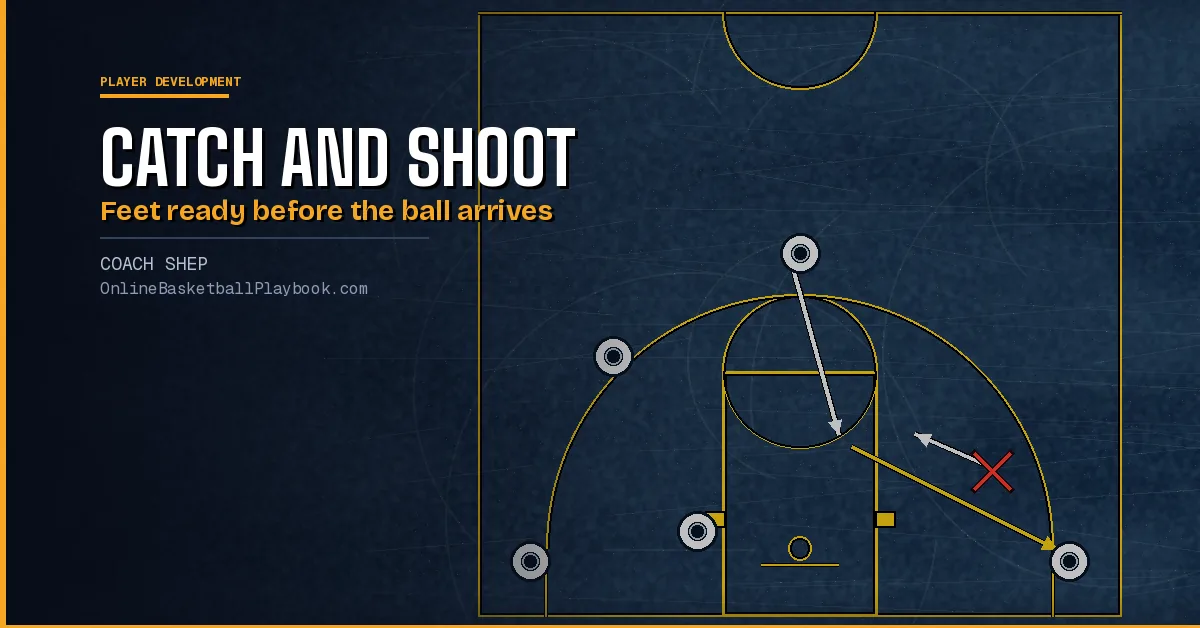
Catch and Shoot Basketball: Hop or 1-2 Footwork and Drills
Catch and shoot basketball: getting ready before the pass, hop or 1-2 footwork, the inside pivot, reading the defender early, screen reads and scored drills.