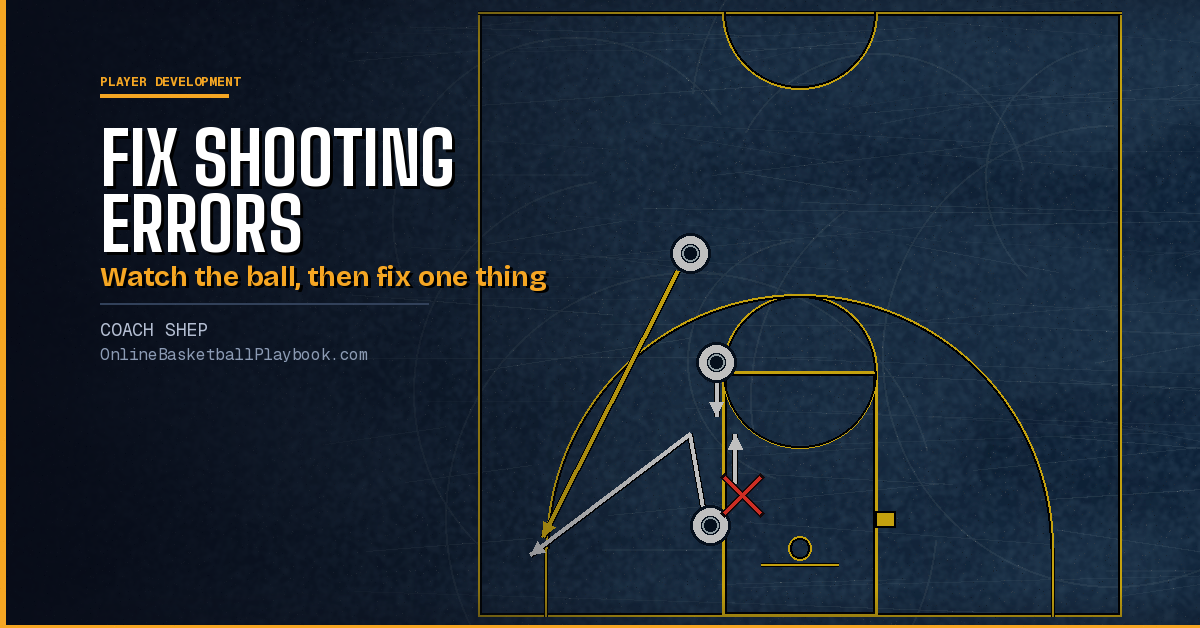
How to fix common shooting errors starts with the ball, not the player. Watch what the ball does on the rim, short, long, left, right or spinning out, then work backward to the mechanical cause and apply one correction. A generic cue such as "bend your knees" skips that step, and repeating it grooves the wrong pattern.
The full mechanics of the shot are on basketball shooting form, the jumper's lift and release on jump shot basketball, and a cold spell that is not mechanical on basketball shooting slump solutions. Every skill guide is under player development.
Diagnose Before You Change Anything
A poor percentage has two possible roots, and they need different fixes. Decide which one it is before touching the shot.
- Split the percentages. Look at field goal, three-point and free-throw percentage separately. Field goal percentage is diluted by floaters and finishes at the rim, so the three-point and free-throw numbers say more about the jump shot.
- Selection or mechanics. If the problem is shot selection, the fix is coaching and shot discipline. If it is mechanical, the shot is rebuilt through repetition, a long process that takes determination.
- Log the direction of every miss. Record shots, makes and misses for each drill, and the direction of each miss, left, right, short or long, so the shot gets fixed faster.
- Count the contested shots. Rick Pitino's notes put Louisville at 22 percent on challenged shots against 42 percent for NBA players on challenged shots, so his rule is to restart the action instead of taking one.
The miss pattern itself is a clue. Good shooters miss short and long, while poor shooters miss to the sides, most often from an arm that drifts. Charting is on game shooting and charting.
Know whether you are fixing the shot or the choice of shot before you say a word about form.
How to Fix Common Shooting Errors by the Miss
Work backward from what the ball does to the cause, then apply one named correction. The table is for a right-handed shooter.
| Miss | Likely cause | Correction |
|---|---|---|
| Short | No leg drive, a follow-through cut short, or a rhythm that is slow or uneven | Drive with the legs, hold the arm up until the ball reaches the rim, even out the rhythm |
| Long | A release angle flatter than 45 degrees, shoulders leaning back, or hands set too far apart | Raise the arc to 45 to 60 degrees, drive the shoulders forward and up, move the hands closer together |
| Short one time, long the next | Incomplete or uneven elbow extension | Fully extend the arm on every follow-through |
| Right side of the rim | Not squared to the basket, or the ball started in front of the head with the elbow out | Square up and set the ball between the ear and shoulder with the shooting hand facing the rim |
| Left side of the rim | The ball started too far toward the right hip and was shoved left to right, usually with no leg power | Square up, ball between ear and shoulder, elbow in, and let the legs supply the force |
| Every direction, no range | Lowering the ball, or bringing it behind the head and throwing it | Start the ball high, use a down-and-up leg motion and finish the follow-through |
| Hits the rim and circles out | Sidespin from a shooting hand that starts on the side of the ball and rotates behind it, a palmed ball, a release off the ring finger, or a thumb from the off hand | Set the shooting hand behind and facing the ball, and tuck the off hand's ring finger and pinky under it |
Fix the row the ball tells you to fix, and leave the rest of the shot alone.
Other Quick Reads of a Miss
Shorter checklists read the same misses. Pick one language for the gym and use it every day.
- Four-point check. Look at the shooting hand, the guide hand, the legs and the target. Short means no follow-through or no legs, long means the shooter pulled back, and a side miss means the hand did not finish in line with the middle of the rim.
- Elbow, aim, legs, wrist. Coach Shep's teams read a miss this way. Left or right is the elbow or the aim. Short is leg power or the wrist. A guide-hand thumb that adds a second motion is fixed by holding a quarter between the thumb and a finger, and a shot that breaks down at range is a small-muscle strength problem trained with chair shooting.
- The drifting arm. A side miss from a drifting arm is fixed with one-eye shooting, correct alignment and a straight index finger.
Whatever checklist you choose, all the coaches in the gym use the same words.
Errors Before the Shot: Feet and the Catch
Some misses start before the ball arrives. The feet have to be ready before the catch, and the shot has to move forward, not away from the basket.
- Drifting on the catch. Drifting back or sideways on the catch spoils open looks off cuts. Coming off a screen, let the momentum carry the shooter in toward the basket, not away from it.
- Off the heels. Mark Few's Gonzaga workouts cue heel-toe-toe and never shooting off the heels.
- The trail foot. Slow shooters often have the trail foot too far behind and straight knees.
- A foot on the line. Billy Donovan does not want shots taken with a foot on or just inside the three-point line, and has someone chart them in practice so players see their footwork.

The footwork for the catch itself, hop or 1-2, is on catch and shoot basketball, and the screen reads on basketball shooting off screens.
If the feet are wrong, fix the feet before the hands.
Errors Off the Dribble
Off the dribble, most side misses and drifting shots trace to where the ball is picked up. The fix is the same pickup point every time.
- Side misses off the dribble. The shooter reaches to the side for the ball instead of jumping behind it. Pick the ball up in front of the knee on the shooting side, shooting hand on top of the ball.
- Floating forward, back or sideways. Pick the ball up in front of the shooting knee with the knees flexed, so the sideways momentum turns into a straight-up jump.
- The weak-hand side. Shooting off a dribble to the strong-hand side is easier for most players, because going the other way the ball has farther to travel to reach the shooting knee. Cross it over to that knee. Not everyone sees it this way, and the opposite claim, that right-handers shoot better going left, is taught too.
- Leaning back on the step-back. A shooter falling away from the defender exaggerates the follow-through toward the basket with his shoulders, head and shooting hand.

The full pull-up is on shooting off the dribble.
Same pickup, same knee, every dribble jumper.
Get the next coaching guide in your inbox
One email when a new guide or diagram set goes up. Free.
The Shot Fake Error
The common fake error is rising out of the stance. The hips come up on the fake and the first step is gone.
- Ball to the chin, stay low. Billy Donovan brings the ball to the chin, not above the head, and keeps the player low.
- Load, raise, stop. Make the fake look like the shot, then attack if the defender jumps and pass if he does not.
- Only a little. The fake is the first 3 to 5 inches of what the shooter does normally.
- Test it. A fake works only as far as the shooter is a real threat, so test it by shooting right after the fake.

More fake work is on basketball shot fake.
A fake that looks like the shot keeps the shooter ready to shoot.
Correction Drills and One-Word Cues
Give each correction one word, said in the rhythm of the shot, so the player corrects himself on every rep without a coach standing over him.
- Front. For throwing the ball instead of lifting it.
- In. For an elbow out that sends the miss to the strong-hand side.
- Point. For a soft release off the index finger.
- Straight. For an arm that goes to the side.
- Down and up. For leg rhythm instead of shoving the ball.
Then use drills that give the feedback for you:
- One-hand form shots. Start close with the shooting hand only. The hand faces the front of the rim and the elbow stays in. Count a form make only when the form is correct.
- Backboard targets. Shoot at the front of the board, then the side, then the spot between them. A clean shot comes back to the shooting hand without the shooter moving, and a miss that drifts confirms the flaw.
- Chair drill. Shooting from a chair takes the legs away, so the force must come from the back, the shoulders and full extension. The cue is back, shoulder, through.
- On your back. Lie down and shoot straight up so the ball returns to the same hands, from one foot high up to rim height.
- Scored form. Coach Shep's players shoot a one-hand set, then lift, scored +1 for a swish, 0 for a rim touch and -1 for a miss, so quality counts with no coach watching.

Move out only while the motion stays the same, and step closer whenever range changes the form. The full drill sets are on basketball shooting drills.
One cue, one drill, until the miss is gone.
Coaching the Fix
How the correction is delivered decides whether it sticks. Listen first, keep it short and protect the player's confidence.
- Start with what he does well. Listen more than you talk, and remember some players assume the coach thinks they cannot shoot.
- Ask before you tell. Ask "When you are shooting well, what are you doing?" A player who answers "the ball is going in" probably does not know much about his shot.
- One or two parts at a time. Teach the parts of the shot one or two at a time, keep instruction brief, and get him shooting, since a player is not improving while the coach talks.
- Keep confidence high. Keep telling him "You're a shooter!"
Warn him about the dip. A corrected motion goes through three stages: it feels awkward and misses, then accuracy climbs back while he still has to think about it, then it feels right and runs on its own. A coach who quits the change in the first stage loses the gain.
Coaches split on when to change a shot at all:
- Change it, even in season. If a player cannot shoot, change his shot, because reps alone do not fix a technique problem. Leave proven shooters alone.
- Keep the mechanics, raise the percentage. A player can improve his percentage without rebuilding his mechanics, unless he is elite, it is mid-season, or he cannot stay accountable to a change.
Decide which shooters you will rebuild before the season starts.
Questions Coaches Ask
Why does my shot keep coming up short?
Usually there is no leg drive, the follow-through is cut short, or the rhythm is slow or uneven. Drive with the legs and hold the arm up until the ball reaches the rim.
Why does my shot miss to the left or right?
For a right-handed shooter, a miss off the right side often means he is not squared up or starts the ball in front of his head with the elbow out. A miss off the left side often means the ball starts too far toward the right hip and is shoved across. Square up and set the ball between the ear and shoulder.
What causes a shot to spin out?
Sidespin. The shooting hand starts on the side of the ball, the ball is palmed or released off the ring finger, or the off-hand thumb pushes it. Set the shooting hand behind the ball.
Should you change a player's shot during the season?
Coaches split. If a player cannot shoot, change the shot even in season and leave proven shooters alone, or raise his percentage without rebuilding his mechanics in mid-season.
Want every diagram on the site?
OBP Pro members get the full diagram files for every guide on the site, ready for a practice binder or a scouting report. $9 a month. Or draw your own version free in the play drawer.
See what OBP Pro includesMore Game Day and Shooting Guides
- Basketball Substitution Patterns: Shifts, Fouls and Closers
- Game Day Routine for Basketball Coaches: Shootaround to Tip
- Catch and Shoot Basketball: Hop or 1-2 Footwork and Drills
Back to Basketball Shooting Form and every Player Development page.
Keep Building
Related breakdowns
Basketball Shooting Form: Step-by-Step Mechanics
Basketball shooting form step by step, from the ready stance and grip to release and follow-through, with drill progressions and where coaches disagree.
Basketball Shooting Drills for Every Level
Basketball shooting drills for every level, from form work and youth games to team competitions and free throws, each with a score or a consequence.
Competitive Shooting Drills: Scored Games and Records
Competitive shooting drills with a score on every shot: streak games, timed targets, Beat the Pro, plus and minus, 2-on-1 shooting and record boards.