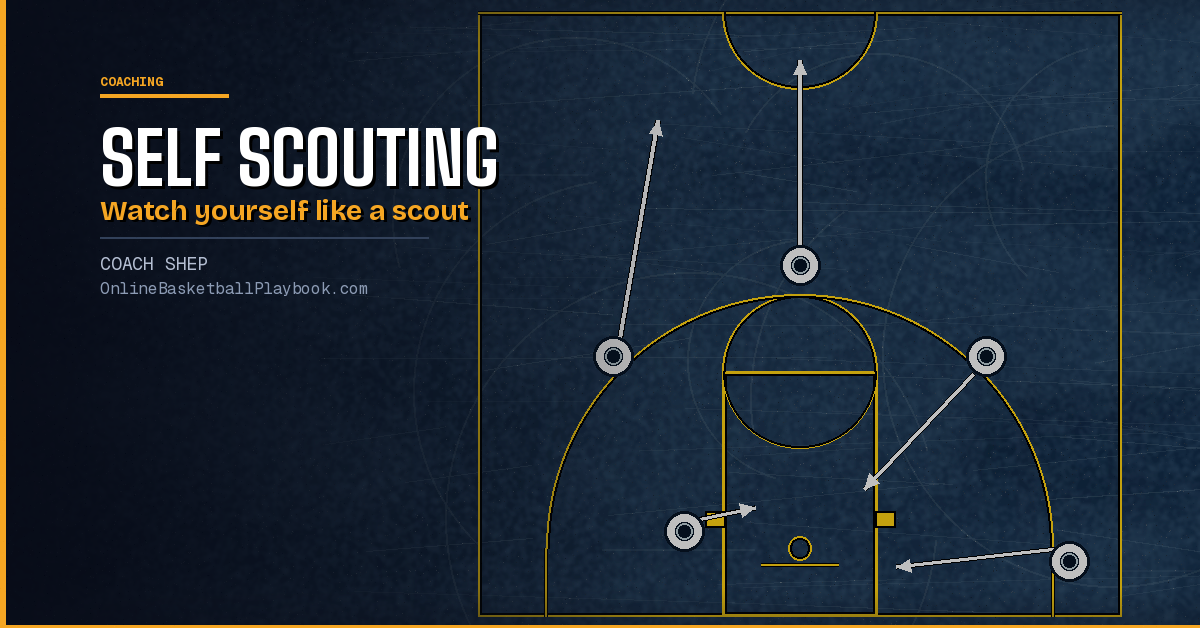
Self scouting in basketball means watching your own team's film the way the next opponent will. Erik Spoelstra's question for his staff is "what don't they want you to see?" The answer is the tendency a good scout will find and plan against, so find it first.
This page covers how much prep time goes to your own team, what to chart, the numbers worth tracking, a weekly film rhythm, and how to find what a scout would steal. Scouting the opponent is on basketball scouting, and the report itself is on basketball scouting report.
Self Scouting Basketball Starts With Your Own Film
A staff that watches only the opponent misses its own habits. Look inward:
- An outside scout. A coaching staff's tunnel vision is natural. Have your own team scouted by an outside source, especially early in the preseason.
- Outside eyes. Jay Wright says not to be afraid to have outside people evaluate your program, because they bring an unbiased view.
The defensive game plan starts the same way. Name your own strengths first, such as speed or shot blocking, and build the plan around them, for example a quick team pressing full court to force turnovers. Then scout the opponent. The plan itself is on basketball defensive game plan.
Watch your film as if you had to beat this team next week.
How Much Prep Goes to Your Own Team
A self-first staff runs pre-game scouting at roughly 80 percent self and 20 percent opponent. The split shifts:
- Mostly self. The 80 and 20 split for most weeks.
- All self. A team good enough to overpower anyone goes fully self-focused.
- All self for a system. A press or a zone that does not change by opponent needs no opponent prep.
A staff stat plan can follow the same order across a season. Evaluate individual players in preseason practices and scrimmages, then team performance and lineup combinations, then the opponent.
Spend most of the week getting your own team better.
What to Chart on Your Own Film
The box score tells the obvious story. Assist-to-turnover ratio, rebound margin, field goal percentage and turnover margin show who controlled the possessions. The charts below show what is driving your system:
- Paint touches. Touches by dribble or pass, charted against the shots they produced. An offense that gets paint touches is in control, and a defense that denies them has the edge.
- Ball reversals. Moving the ball side to side two or three times keeps the defense closing out and rotating.
- Contested and uncontested shots. Chart both. Contested shots lower your percentage and raise the risk of a live-ball turnover on the extra pass or dribble.
- Fouls drawn. A team that shoots well from the line turns drawn fouls into points.
- Deflections. A sign of press and on-ball aggression.
- The hockey assist. The pass or screen one step before the assist.
- Kills. Three straight defensive stops, with a team goal of four a half.


Grade every shot. Sort each attempt into one of four grades:
- Easy. Point blank.
- Open. No defender within six feet.
- Contested. Taken against or over a defender.
- Bad. Forced or rushed.
A good offense gets easy plus open above 50 percent. A good defense forces contested plus bad above 50 percent. A bad shot can also be defined by four checks: outside the offense, no rebound balance, late in the shot clock, or the wrong shooter. Shot charts are on basketball shot chart.
Chart what your system says it wants, then see if the film agrees.
Grade the Effort Plays
Effort shows on film better than in a box score. Grade it on film:
- Rebound balance. On every shot the 3, 4 and 5 go to the offensive glass with reckless abandon, and the 1 and 2 get back. The staff scores each shot from film.
- The breakdown chart. Chart each player's breakdowns in practice and games. A player with fewer breakdowns than minutes played has played well. The line that goes with it: the chart doesn't lie.

One habit at a time. Self-scout film flags one fixable habit, such as a player failing to rotate on defense or not sprinting back right away in transition. The first two steps often count most. Rebounds per minute played is another effort number, useful for spotting an energy player or calling out a lack of effort.

Transition habits are on transition defense basketball, and rebound jobs are on box out basketball.
Show the player the clip, name the one habit, and look for it again next game.
Get the next coaching guide in your inbox
One email when a new guide or diagram set goes up. Free.
The Numbers That Matter
Raw totals mislead. Total rebounds, bench points and raw turnovers mean little until they are divided by the possessions played. Points per possession, not points per game, is the team performance number.
Targets. Benchmarks to hold your own team to:
- Offense. Score more than 1.0 points per possession.
- Defense. Hold the opponent under 0.90 points per possession.
- Defensive rebounding. Above 67 percent.
- Offensive rebounding. Get 40 percent of your own misses. Offensive rebounding percentage is your offensive rebounds divided by your offensive rebounds plus the opponent's defensive rebounds.
- Turnovers. Under 10 percent of possessions, or 15 to 20 percent for an up-tempo team.
Second-effort points. Points scored directly off an offensive rebound are the stat coaches skip most often. Winning the offensive boards and losing the second-effort points is possible.
Two numbers for the whole team. Track an offensive and a defensive efficiency rating after every game, game by game and season by season, in a spreadsheet. The offensive rating uses field goal attempts, free-throw attempts and turnovers. When the offense rates poorly, break it down: is the problem the field goal percentage, the free-throw shooting or the turnovers?
Lineups. Rank five-player groups by point differential, rebound differential and defensive stops. The same report is a scouting tool on an opponent's most-used five. More on the numbers is on basketball statistics guide and basketball stat sheet.
Divide by possessions before you believe a number.
Stats Say What, Film Says How
Stats tell you what happened and film tells you how. A staff that uses only one misses half the story. A film study order that puts the numbers first:
- Decide what you want from the film. The goal often changes as you watch.
- Numbers first. Basic stats, then deeper stats, then shot charts by area and distance.
- Watch with no notes. 10 to 20 minutes of plain watching.
- Pen and paper. Write everything down, then replay, pause and slow it down.
- Try to prove yourself wrong. Look for the detail most viewers skip.
The order was written for studying players on film. Film sessions themselves are on how to run basketball film sessions.
Let the numbers point you to the clip, then let the clip explain the number.
A Weekly Film Rhythm
Film becomes a habit when it sits on the schedule. A film week for a Tuesday and Friday schedule:
- Three sessions a week. Monday, Wednesday and Thursday for a Tuesday and Friday game week, about 30 minutes each, in a classroom just before practice.
- A film person. Filming, editing and running sessions is too much for one coach, so a dedicated person films every away game, edits before the next viewing and is treated as a member of the team.
- Positive clips too. A charge taken or a hustle play builds confidence.
- Full focus. On defense, players watch rotations and hustle. On offense, spacing, movement and shot quality.
- Individual sessions in the off season. One-on-one film work was rarely possible in season.
After the game. Split post-game review into three parts: the stats review, film grading with shot charts valued in points per possession and rebounding graded plus or minus by role, and film cutting split among the assistants by position group.
Put film on the calendar and it gets watched.
Find What a Scout Would Steal
Assume the opponent has your film. By tournament time every opponent has your regular-season menu, so look at your own film for what is easy to read:
- The same look every time. If one alignment always means one play, run the same action from several alignments, or several finishes from one alignment.
- A call they can hear. Rename a play with a number or color code, or change the hand signal by the week.
- No read. A read has no call to steal. Motion that reacts to the defense is harder to scout than a set play.
- Nothing new for March. Install a new play or out-of-bounds alignment late in the season.
Calls and signals are on play calling and signals, and a read-based offense is on motion offense basketball.
Find your own tell before the other bench does. More coaching guides are on the coaching hub.
Questions Coaches Ask
What is self scouting in basketball?
Watching your own team's film the way an opponent would, to find the tendencies they will plan against and the habits you need to fix.
How much time should go to self scouting?
A self-first staff runs pre-game scouting at about 80 percent self and 20 percent opponent, and goes fully self-focused for a press or zone that does not change by opponent.
What stats should I track on my own team?
Points per possession on offense and defense, rebounding percentages, turnover percentage, paint touches, ball reversals, contested and uncontested shots, deflections and second-effort points.
How often should a team watch film?
Three 30-minute sessions a week, in a classroom right before practice, fit a Tuesday and Friday game schedule: Monday, Wednesday and Thursday.
Want every diagram on the site?
OBP Pro members get the full diagram files for every guide on the site, ready for a practice binder or a scouting report. $9 a month. Or draw your own version free in the play drawer.
See what OBP Pro includesMore Coaching and Program Guides
- Pat Summitt's Definite Dozen: The 12 Principles Explained
- Jay Wright's Villanova System: Habits Over Plays
- Coaching Communication: How to Explain Basketball to Players
- Basketball Parent Meeting: Agenda, Handout and the 24 Hour Rule
Back to Basketball Scouting and every Coaching page.
Keep Building
Related breakdowns
Basketball Scouting: How to Scout a Team and Build the Report
Basketball scouting for coaches: personnel first, what to chart, report formats, self-scouting, film sessions and turning the report into a game plan.
Basketball Scouting Report Template and How to Fill It Out
A printable basketball scouting report template with team, offense, defense, player and game plan sections, the questions to ask and how to brief players.