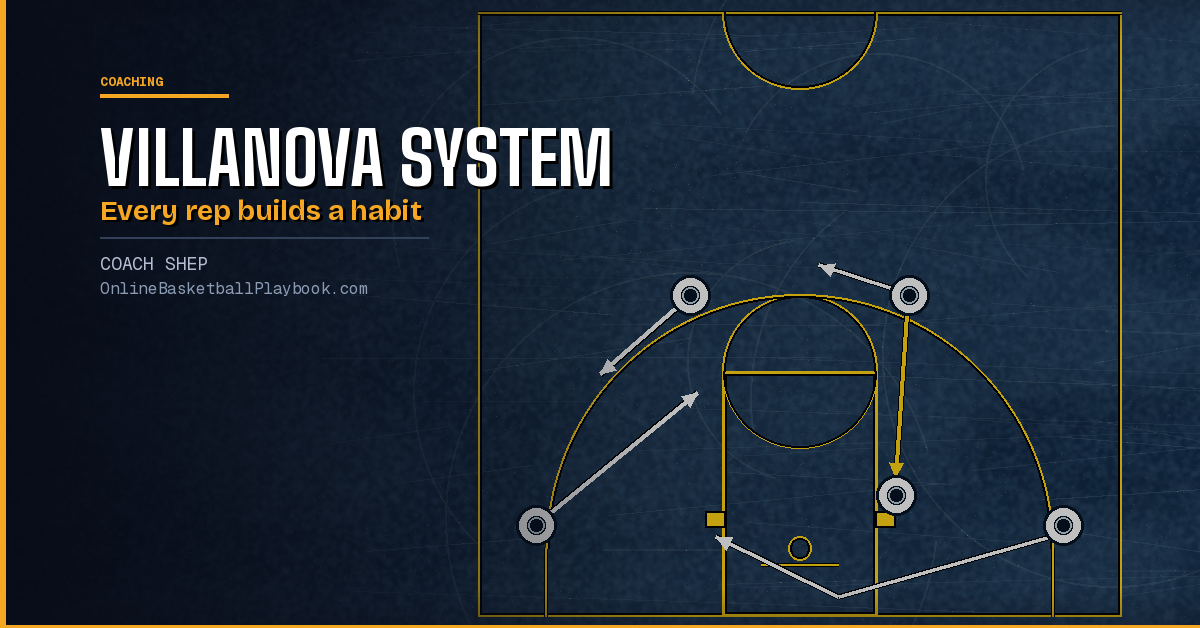
Jay Wright's Villanova system starts with habits, not plays. His drill book says that in practice you are either creating a good habit or a bad habit. In a game his players lean on those habits without thinking about them.
The offense sits in more detail on 4 out 1 in offense, and the culture ideas sit beside other programs on basketball team culture.
The Jay Wright Villanova System Starts With Habits
Every drill gets the same standard as a game. Wright's rules for practice:
- No sloppy reps. A drill run carelessly installs the wrong habit, so racing through technique work is worse than skipping it.
- Footwork before the offense. Wright ranks footwork above any offense, because whatever the offense, the player still has to make the play.
- Correct first, then fast. Form comes first, then shooting with rhythm, then game speed and scored competition. Makes and misses are charted.
- Mistakes belong in practice. His footwork notes say players are supposed to make mistakes while they learn a move.
- Run for concepts, not for losing. Wright runs players when they fail a team concept, or when one player keeps making the same mistake and his teammates do not help him fix it. Losing a drill is not on the list.
His development calendar puts individual work in five areas in the spring and summer: shooting, passing, dribbling, footwork and defense. Team work comes in the fall and winter. In the off season the staff fixes a player's weakness. In season it finds where he is comfortable and builds plays for that.
Decide what habit each drill builds before you run it.
The Daily Skill Block
Wright's season-opening notes list a fixed 30-minute skill block:
- Stretch, 7 minutes. The notes also stretch for 7 minutes before and after practice.
- Passing, 4 minutes. Passing and cutting run in one order: pass, V-cut, post moves, the jab series, then change spots or sides of the floor.
- Shooting, 9 minutes. Set the lift, form shooting first.
- Footwork, 4 minutes.
- Dribbling, 4 minutes.
Get 50. His form routine is 10 each of form shots, Mikan, reverse Mikan, Bradleys and a shot one to two steps from the three-point line. A Bradley teaches the rhythm of jumping and shooting on the way up: the ball goes as high as possible, and the closer the player is to the rim, the higher the release. Set Lifts keep the elbow under the ball, lift and follow through, and the ball should not touch the rim.
Thirty minutes a day, every day, is where the habits come from.
Footwork and Shooting Drills
The inside foot lands first. On every V-cut and every catch off a screen, the player plants the inside foot, knees bent and hands up. The sequence is a 1-2 step in, lift and follow through, and players say it out loud during technique work. More catch footwork is on basketball footwork drills.
The pivot series. Wright's perimeter footwork talk names a run of drills:
- Catch and pivot against a dummy. One foot on every rep, then the other foot.
- Elbow drill. Jump stop, pivot on the inside foot and face up.
- Jab series. Jab and go, and jab and step back for the jumper.
- Swing series. For catches with no screen.
- Rocker step and reverse pivot. The reverse pivot is for a defender who will not let the player face up.
- Two-foot bully move. The player gets to two feet so he can read the help.
Scored shooting. Every shooting drill has a clock or a count:
- Olympic Shooting. Two shooters and a passer work in 30-second windows, and groups compete for makes. The shooter follows his shot. The passer jumps to an open angle, jump stops and throws a two-handed pass. The cue is "set up quick and shoot slow."
- Twenty. Shoot until you miss, 1 point inside the arc and 2 outside, with no repeated spots.
- Slide 3's. Three players, two balls and 30 seconds, for the end-of-game three when the defense knows it is coming.
- Position groups. Guards shoot slide jumpers while forwards shoot lane jumpers at the same time, so each player reps his own game shots.
- Lefty drill. Right-handers finish and pull up off the left hand.
Two Ball Shooting. One player screens down for another. The cutter catches, passes back to the screener and pops out for a second ball and a jumper. The two passers tell each other who they are passing to. Three cuts change the drill:
- Straight cut. The cutter goes to the free-throw line area and takes the elbow jumper after the pop.
- Curl and pop. The cutter curls into the lane, passes to the screener and pops out of the key.
- Backcut and look back. The cutter catches at the rim, pump fakes and passes back to the screener, who is spotting up. Players learn to look for the screener when the layup is not there.

The screener is the second cutter. Screener and cutter read "eyeball to eyeball" and finish shoulder to shoulder. After the cutter goes by, the screener releases and thinks catch and shoot. More scored drills are on competitive shooting drills.
Count every shot.
Get the next coaching guide in your inbox
One email when a new guide or diagram set goes up. Free.
Spacing Is Offense: the 4 Out 1 In Base
Wright says spacing is offense and offense is spacing, and his clinic notes credit the line to Chuck Daly. At a 2010 clinic he added a second truth: reverse the ball and make a play. Every Villanova offense in his talks uses a 4 out 1 in alignment.
The spread spots in the article he co-wrote put two players in the slots, two in the corners level with the block, and the post on the lane line at the first marker above the block. The spots sit about 18 feet apart and are taped on the practice floor. Every perimeter catch is a shot look first, eyes on the rim, then a pass or a drive, so every player is a shooter.

The spot maps differ by talk:
- Dribble entry every time. His 2008 talk starts 1 at the top on one side with the ball, 2 in the weak-side corner, 3 in the ball-side corner, 4 on the weak side up top and 5 on the ball-side block, 15 to 18 feet apart.
- Two slots and two corners. The article's map above, with the 4 and 5 interchangeable in the post.
- Forwards high and low opposite. Two forwards stay opposite each other, one high and one low. Forwards screen only at the slot, and guards basket cut with leave a spot, fill a spot.
Personnel. Wright's 2008 rule is to play your best players regardless of position (he had started four forwards and one guard the year before), and the offense finds the player with the advantage and creates his shot.
Tape the spots and hold the spacing before you add any action.
The Actions: Post and Rip, Drive and Space, Ball Screens
At the 2010 clinic Wright listed four sets, Spread, Pin, Horn and Flash, and five actions he wanted out of them: drive and space, iso drive, sprint out ball screens, post and rip, and screener-cutter.
Post and rip. When the ball goes into the post, the perimeter players cut in order so the post has passes. Two orders:
- By number, from any spot. From the 2008 talk: the 1 goes to the weak-side wing, the 2 to the top of the key, the 3 to the weak-side elbow and then dives, and the 4 to the weak-side block, wherever the players start.
- Block first, then elbow. As the post looks to the middle, the 4 rips to the far block, then the 3 rips to the far elbow, while the 1 and 2 space out for the kick-out three.

Drive and space. A guard drives and the other three perimeter players replace and fill behind him, one to the top of the key and one finding the pass ahead. On a middle drive the post leaves his spot for the far block. On a baseline drive the weak-side wing slides to the corner for the skip pass. A full offense built on driving gaps is on drive and space offense.

Ball screens in the middle. The post sprints up to set a slot ball screen, best in the middle of the floor, with his back parallel to the sideline so both defenders have to choose. When the screener's defender plays off and gives no help, the screener rolls to the offensive rebound, the roll to rebound mindset of the 2008 talk. Two dribbles off the screen is the decision window. More on the action is on pick and roll.
Hand-offs and the lob. If a big's defender will not guard him on the perimeter, use a dribble hand-off. The dribble count changes by talk:
- One dribble. From the 2008 talk.
- Two dribbles, then screen. Two dribbles at the cutter, the cutter takes the ball, and the handler then sets a screen.
If the defense jumps or cheats the hand-off, it becomes an automatic lob over the defender's head, caught before the rim. The hand-off itself is on DHO basketball.
Reads by player. Off a screen the 3 curls a good screen, pops to the wing for a skip pass if his man cheats under, and goes backdoor if his man plays over the top. Against a team that switches, the 4 and 5 interchange so the double screen leaves the 5 on a smaller defender.
Teach each action as a read, and the offense needs very few calls.
Defense: Calculated Risk and Convert to the Paint
Villanova's base is ball-you-man, and its traps are a calculated risk with three triggers. In Wright's 2007 retreat talk, a defender blitzes or steps up when:
- The ball is dribbled at him.
- His man brings him to the ball.
- The ball goes baseline.
Trappers are deflectors who never foul or go for steals. When a two-man game starts, the other three load to it. The screener's defender calls Blitz or Switch, and blitz is the default over switching for convenience. The rules apply in the scoring area, about 3 feet beyond the arc and in. The base is on ball you man defense, and the trap itself on blitz and trap ball screens.
Multiple defenses. In a 2014 talk Wright ranked players by spot so every alignment looks the same to the offense, and he set rules that hold in any alignment:
- No middle. If the ball reaches the middle, chase from behind and convert to the paint.
- Trap on the sideline only. Never in the middle.
- Diagonal skip, convert. Any diagonal pass back to front is an automatic convert.
- Out of a trap, convert.
He calls how they convert once beaten the most important thing they do. All five sprint through the middle of the floor to the paint, call "Wolf" if behind the ball, then point and call who has whom.
Opponents saw a different defense on some nights. Dan Hurley describes a Villanova team that switched everything and fronted the post, and he attacked it with a deep post-up on the smaller matchup. His note does not date the games.
Pick your trap triggers, then drill the convert until it is automatic.
Late Game and Press Offense
Wright's 2006 talk says what matters late in a game is what the players know, not what the coach knows. Players count each dribble, pass, shot fake or shot as about one second, and Villanova lines up the same way every time.
The windows by seconds left differ by year:
- Two color series. White for 1 to 3 seconds and Blue for 4 to 7, with sets for a free throw, baseline, full court and sideline (2006).
- Three windows. 0 to 3, 4 to 7 and 8 or more, with screener-cutter options under your own basket and the drive game from the sideline (2007 and 2008).
Press offense. Teach spacing first, give players room and never look backward. The ball handler does not go below the first lane marker. Late-game sets are on last second basketball plays, and press attacks on basketball press break.
Keep the late-game menu inside what the team already runs.
Culture: Smart, Together, Hard
Wright opens with three words, smart, together and hard, and with pride: everything the program does should make players believe it is the best place to be. Larry Brown said Wright respects his players every day in a way that makes them do whatever he asks.
The Attitude Club. Effort plays earn points:
- Passing. The pass to the assist, a paint pass and a quick outlet.
- Screening. A screen assist.
- Hustle. A loose ball, a deflection and a shot contest.
- Rebounding. An offensive rebound and a tap-back on a free throw.
- Inside. A paint catch.
A good rate is 0.8 plays a minute or better. Scoring effort this way is also on basketball leadership.
Scorers stay aggressive. Wright wants a shooter aggressive no matter what his last shot did: "Shoot 'em up or sleep in the streets."
Get players, and get outside eyes. When Wright took the Hofstra job, John Calipari told him to just get players and not worry about size or position. Wright also says not to be afraid to have outside people evaluate your program.
Count the plays you want and the players will chase them. More coaching guides are on the coaching hub.
Questions Coaches Ask
What offense did Jay Wright run at Villanova?
A 4 out 1 in spread built on spacing, with post and rip, drive and space, ball screens in the middle of the floor, dribble hand-offs and screener-cutter reads.
What is the Villanova Attitude Club?
A points system for effort plays such as the pass to the assist, a screen assist, a loose ball and an offensive rebound. A good rate is 0.8 plays a minute or better.
What is Jay Wright's coaching philosophy?
Every rep builds a good habit or a bad habit, so drills are run to game standards. He opens with smart, together and hard, and he says footwork matters more than any offense.
What is Villanova's Calculated Risk defense?
A ball-you-man base where defenders blitz or step up on three triggers: the ball dribbled at them, their man bringing them to the ball, or the ball going baseline.
Want every diagram on the site?
OBP Pro members get the full diagram files for every guide on the site, ready for a practice binder or a scouting report. $9 a month. Or draw your own version free in the play drawer.
See what OBP Pro includesMore Coaching and Program Guides
- Pat Summitt's Definite Dozen: The 12 Principles Explained
- Coaching Communication: How to Explain Basketball to Players
- Self Scouting in Basketball: Film Your Own Team
- Basketball Parent Meeting: Agenda, Handout and the 24 Hour Rule
Back to Basketball Team Culture and every Coaching page.
Keep Building
Related breakdowns
Basketball Team Culture: Standards, Roles and Daily Habits
Basketball team culture as winning coaches build it: identity, recruiting, written standards, accountability, roles, shared language and daily habits.
Building Team Chemistry in Basketball: Roles, Rules and Habits
Building team chemistry in basketball comes from clear roles, a few rules applied to everyone and daily habits. Here is how to set up each one and how to drill it.
What I Have Learned Over the Years Coaching Basketball
What I Have Learned Over the Years Coaching Basketball