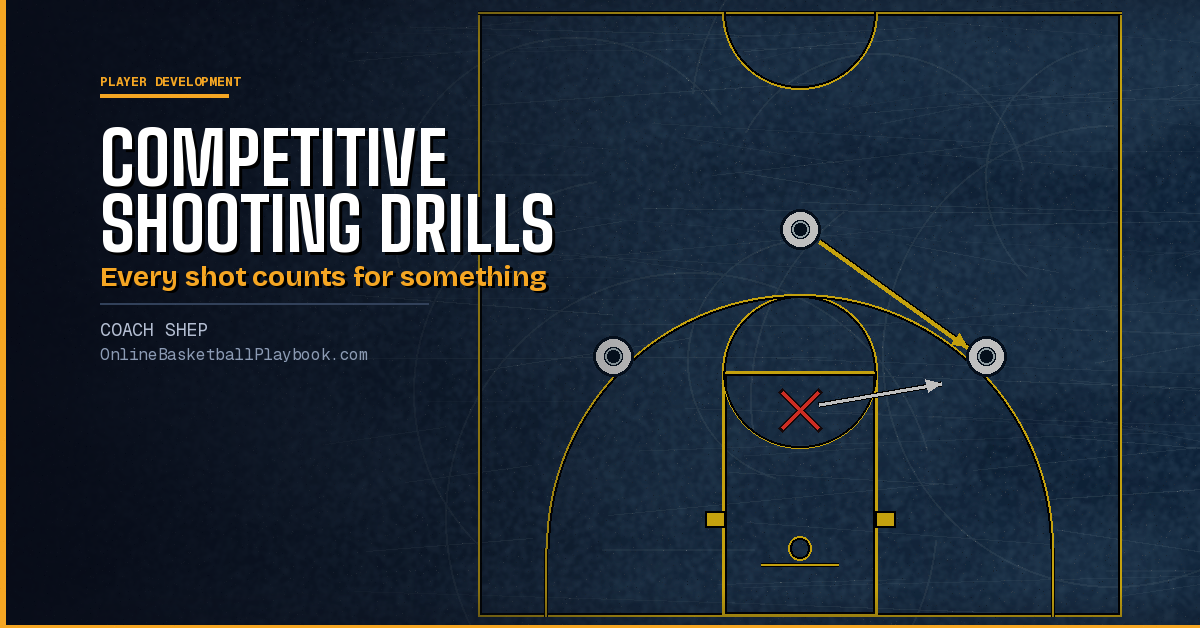
Competitive shooting drills give every shot a consequence: a streak that resets, a clock that runs out, a pro who scores on your misses, or a record on the wall with someone else's name on it. The shot is the same one a player takes in a warm-up line. What changes is that a miss now costs something, and that is the feeling a shooter carries into a game.
The full drill menu by level is on basketball shooting drills, the form that every one of these drills assumes is on basketball shooting form, and the scoring formats for every other kind of drill are on competitive basketball drills. All of them sit in the player development section.
Why Competitive Shooting Drills Keep Score
A shooting drill becomes a competitive drill the moment a miss can cost the shooter something. The pressure tools are short:
- A clock. A number of baskets in 20 or 30 seconds, or a target in two, three or four minutes.
- A streak. Makes in a row, with the count going back to zero on a miss.
- Elimination. A player is out after a couple of misses in a row.
- An opponent. A partner, a group, a defender, or an imaginary pro who scores on every miss.
- A record. The shooter's own best, or the best mark in the program.
Bob Knight called free shooting the worst thing a player can do in a gym. He wants players in groups of five, with a chart, stepping into every shot. Jay Wright's rule for the same drills is that every rep builds a good habit or a bad one, so a sloppy drill is worse than no drill at all.
Pick the count before the first ball goes up, and keep it the same until the players beat it.
Streak Drills
A streak drill makes the shooter string makes together, so the last shot of a streak feels like a free throw with the game on the line. Pick the streak by how long the shooter has to stay at one spot:
- Four in a row at five spots. The shooter needs four straight makes at each of five spots and goes back to the close shot on a miss.
- Two in a row at five spots. Two straight makes at each spot in under two minutes. Two misses in a row send the shooter back a spot.
- Three to move, two to run. Three makes in a row moves the shooter to the next spot, and two misses in a row means he runs.
- Streak shooting. A minute and a half, three makes in a row to advance, and the record is the spot number and the makes in a row at the buzzer.
- Game Winner. Seven spots, two in a row to move on, and two in a row twice at the last spot before coming back. The goal is 28 makes in under 2:00 from mid-range and 2:20 from three.
- Evans. Shoot at a spot until two misses in a row, then move. Over five spots, 100 makes is good, 120 is elite and a program high is 124. Shaka Smart's Texas record is 219 over seven spots.
The M Drill turns the streak into rounds: one make at each of five spots in a minute, then two at each in 1:30, three in 1:45 and four in 2:00. A shooter who does not finish a round in time is done.
Start the streak short, lengthen it as the shooter grows, and never let a miss slide.
Timed Targets
A timed drill asks for a number of makes before the clock runs out, so the shooter learns to set up quick and still shoot with rhythm.

- 3-minute shooting by makes. Six spots, 30 seconds each, back and forth. Shaka Smart's sheet needs 100 makes, and the record is 157.
- 3-minute shooting by points. Six spots, alternating 15-footers worth 2 and threes worth 3. The goal is 100 points, and a program high is 131.
- 59 seconds. 15 threes in 59 seconds, catch and shoot, never the same spot twice in a row.
- Star shooting. Two and a half minutes, five spots in a star, one point per make and a move after every make. It is credited to Mark Few's Gonzaga program.
- 80 in four minutes. Two groups, all threes, one minute at each spot (top of the key, corner, wing). The passer calls the receiver's name and hits the hand target.
- The team runs if short. Four spots, 80 makes, 20 from each spot, and the team runs if it falls under 80.
- Full-court threes. Rick Pitino's three-player drill runs down and back for two minutes, passing and shooting threes at each end. The team needs 10 to 15 makes or it does extra running.
Players also need makes on tired legs. Shaka Smart puts 100 Makes, catch-and-shoot threes around the arc and back, at the end of the workout so the shooter has to keep his shot discipline while fatigued. His Spurs 100 sends the shooter sprinting to a new spot before every one of 100 shots.
More three-point targets are on three-point shooting drills. Post the target before the clock starts, and raise it once the group beats it.
Beat the Pro and Plus or Minus Games
These games give the shooter an opponent even when he is alone in the gym. A miss is not just a miss, it is a point for the other side.
- Beat the Pro to 20. Each make is 1 point for the shooter and each miss is 2 for the pro. First to 20 wins, moving spot to spot or around the arc.
- Make 11 before you miss 6. Start with a free throw, then shoot mid-range jumpers elbow to elbow. A make is 1 for the shooter and a miss is 2 for the pro.
- Beat the Pro by four. Eleven perimeter spots set to the shooter's range. A make is +1, +4 beats the pro and -4 means the pro wins.
- Beat the Pro to 10 with three shots. Steve Fisher plays it around the horn with a one-dribble layup, a three and a two at each spot.
- Make 5 before you miss 3. Fisher's three-man group (shooter, passer, rebounder) with two balls goes around the horn and wins by finishing.
Plus and minus games keep a running total and stop at a line:
- Plus 1, minus 2. The shooter picks a target. Each make is +1 and each miss is -2, and reaching the negative of the target ends the drill with a penalty. Good shooters aim for +12 and great ones +15.
- Stop at +8 or -4. Two minutes of two-point shots, +1 a make and -1 a miss, ending at +8 or -4.
- Stop at +3 or -6. The same game from three.
A minus 2 for a miss makes a player choose his shot and his range. Let him feel that before the game does.
Points for the Right Shot
Pay more for the shot the coach wants and still count the others, so the score teaches shot selection as well as making.
- 32-point shooting. Five spots, three shots at each: a clean three is 3, a shot fake and one-dribble jumper is 2, and a layup is 1. Two free throws at the end make 32 possible. Free-throw games of their own are on free throw drills.
- 44-point game. Seven spots, each with a three (3 points), a shot fake and one-dribble pull-up (2) and a drive to a layup (1). Two free throws finish it, and the goal is 35 of 44.
- Personal best. Four trips around the horn with a three, a one-dribble jumper and a layup at each spot (3, 2 and 1), plus 10 free throws after the second trip and 10 after the last. The maximum is 140, in about two minutes.
- Fewest attempts. Make 7 at each of 7 spots as the coach passes, in as few attempts as possible, and record it.
- Twenty. Jay Wright and John Beilein run the same game: shoot until you miss, 1 point inside the arc and 2 outside, never the same spot twice.
- 21. Billy Donovan pays 3 for a three, 2 for a ball-fake pull-up and 1 for a layup, with no shot from the same spot twice and no same shot twice in a row.
Whatever the point values, post them before the drill so the shooter knows which shot the coach wants most.
Shooting Against a Defender
Live shooting drills put a closeout in front of the shooter and let a made-shot scoreboard grade both sides. In this family the defense is always one player short, so the closeout and the scramble are graded by makes, not by the coach's eye.

- 2-on-1. Split teams at both ends. The coach passes to either shooter and the lone defender must close out and contest the shot or the pass. A made three is +1 and a foul drawn is +1, with a three-minute clock and the higher two-end total winning.
- 3-on-2. Both defenders start inside the lane, X1 inbounds to any shooter and the defense scrambles to contest or steal. A stop flips possession, with the same scoring and clock.
- 4-on-3. The extra defender inbounds, a stop flips possession, and the higher total after a four-minute clock wins.

A spot drill can grow toward the same pressure. Once players own star shooting, add a defender who contests, a pass and a ball screen before the catch, or a dribble hand-off before the shot. How to close out on the other side of these drills is on closeout and recover.
Shooters who only ever shoot against air are surprised by the first closeout of the season. Do not let that happen.
Partner and Group Games
Group games put a passer and a rebounder in the drill and make the whole group own the score.

- Olympic shooting. Jay Wright's drill uses two shooters and a passer in 30-second windows. The shooter follows his own shot, the passer moves to an open angle, jump stops and throws a two-handed pass, and every loose ball is recovered with a jump stop, head up and a pivot. The cue is set up quick and shoot slow.
- One ball, two players. Shoot, get your own rebound and pass to your partner for a catch-and-shoot three. Count the pair's makes in 5 or 10 minutes, minus 1 for every extra bounce of the ball.
- Seven of 10 in 30 seconds. John Beilein's Michigan standard: 10 shots and 7 makes in 30 seconds off a down screen and a flare. If the group falls short, the shooters run.
Put the passer's job in the score too. A bad pass costs the group a shot, and everyone in the group knows it.
Get the next coaching guide in your inbox
One email when a new guide or diagram set goes up. Free.
Records, Charts and Shooting Licenses
Scores only build a shooting culture if somebody writes them down. The simplest tool is a record board: players set a new mark, erase the old one and write their own name, and the staff can post its own drills there too.
- Post the record. Shaka Smart's sheet lists 157 in 3-minute shooting and 219 in Evans next to each drill so players know the number to beat.
- Chart every shot. Billy Donovan charts every shot in individual work and posts the totals for the day and the season. His reasons: he did not take any of those shots, and the staff is there to help players improve.
- Let managers keep it. Eddie Sutton had managers chart supervised shooting and post the results after practice.
- Groups of five with a chart. Bob Knight's answer to free shooting. Charting game shots is on game shooting and charting.
A shooting license ties the green light in games to a made-shot standard in practice:
- 50 threes in five minutes. One ball and one rebounder. A player who misses the goal is limited in games, to a set number of shots or only wide-open ones, and the license has to be renewed during the season.
- A preseason qualifying list. John Beilein's 2007 Michigan players had to meet 15 goals before fall practice, among them 50 threes in five minutes. A shooting drill asked every player, bigs included, for 7 of 10 mid-range jumpers around a screen in 30 seconds, then 12 of 20 threes in 59 seconds. Missing the standard meant no green light in games and running.
- 60 in five minutes, renewed. Beilein's later license is 60 makes in five minutes with one rebounder, mixing three threes in a row with a 17-footer, and the goal has to be hit again through the year.
Post the board where players walk past it every day. A record nobody sees is not a record.
Questions Coaches Ask
What are competitive shooting drills?
Shooting drills with a score, a clock, an opponent or a record attached, so a miss costs the shooter something. Common formats are streaks, timed targets, Beat the Pro, plus and minus games and live shooting against a closeout.
What is Beat the Pro in basketball?
A one-player shooting game against an imaginary pro. Each make is 1 point for the shooter and each miss is 2 for the pro, and the first to 20 wins. To play it to a margin, +4 for the shooter wins and -4 means the pro wins.
How do you make shooting practice more competitive?
Add a clock, a streak that resets on a miss, a partner or group score, or a defender who closes out. Chart the result and post the best marks on a record board.
What is a good score in 3-minute shooting?
It depends on how it is scored. Counting makes at six spots, Shaka Smart's sheet asks for 100 and lists a record of 157. Counting points with alternating 15-footers and threes, the goal is 100 points and a program high is 131.
Are competitive shooting drills good for youth players?
Yes, with a closer range and shorter targets. Form comes first, and the youth games are on fun basketball drills and in the youth section of basketball shooting drills.
Want every diagram on the site?
OBP Pro members get the full diagram files for every guide on the site, ready for a practice binder or a scouting report. $9 a month. Or draw your own version free in the play drawer.
See what OBP Pro includesMore Player Development Guides
- How to Protect the Ball: Ball Security and Fewer Turnovers
- Basketball IQ: What It Is and How to Teach It
Back to Basketball Shooting Form and every Player Development page.
Keep Building
Related breakdowns
Basketball Shooting Form: Step-by-Step Mechanics
Basketball shooting form step by step, from the ready stance and grip to release and follow-through, with drill progressions and where coaches disagree.
Basketball Shooting Drills for Every Level
Basketball shooting drills for every level, from form work and youth games to team competitions and free throws, each with a score or a consequence.
How to Fix Common Shooting Errors: Read the Miss First
How to fix common shooting errors: read what the ball does on the rim, find the cause, apply one correction, and coach the shooter through the dip.