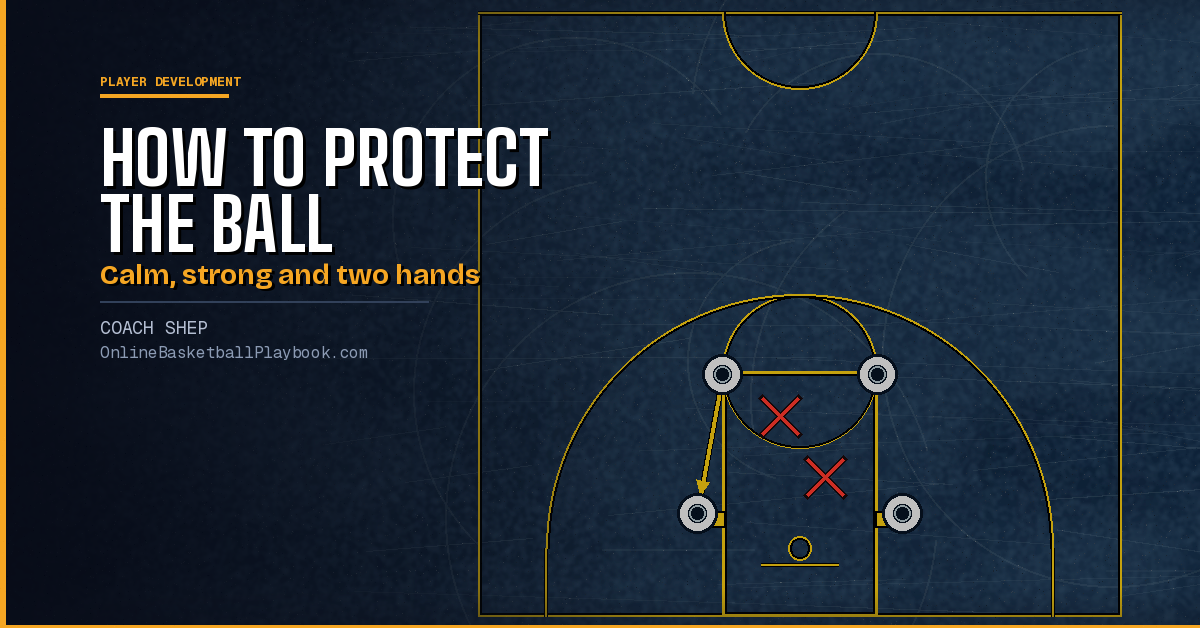
How to protect the ball is a skill question, not a toughness speech. Don Meyer's word for it was sureness: holding, passing, catching and dribbling with calm control while a defense reaches, pressures and traps. Coaches who build it treat it as a teachable skill and drill the exact moments when the ball gets lost.
The definition of a turnover and how it is counted is on what is a turnover in basketball. The dribble work underneath this page is on basketball dribbling drills, the team side of beating pressure is on press break basketball, and every skill page sits in the player development section.
Where Turnovers Start
Most turnovers come from three moments, and those three moments are what to drill:
- Starting or stopping the dribble. Jump stop and stride stop mistakes are the most common.
- Passing off a live dribble. The handler picks the ball up under pressure and throws it away.
- Passing and catching. A rushed pass, a pass into the defense or a dropped catch.
Sort them on film by skill and setting, or by kind of error:
- By skill and by setting. Ball handling, passing and receiving, traveling, offensive fouls and rule violations, then where they happen: against a press, in transition or in the half court.
- By kind of error. Physical, mental or both. Teach the player which one it was so he becomes the analyst of his own turnovers instead of making excuses.
The cost is why it matters. A turnover can cost four points, the shot you gave up plus the shot you never got. Coaches set the standard as a rate:
- Under 10 percent of possessions. The normal target for turnovers divided by possessions.
- 15 to 20 percent for a running team. Acceptable for an up-tempo team only if more transition layups offset it.
- Two assists for every turnover. A ball security target for a point guard.
Count the turnovers by where they started, and next week's drills will pick themselves.
Keep the Ball Strong
A ball held loose and in front of the body gets slapped away. Keep it strong and moving:
- Rip and sweep. Rip or sweep the ball above the head or below the knee while the defender reaches, and stay ball strong.
- Ball on the hip. When trapped, get low and square to the trap with the ball on the hip, away from the defenders.
- Down, not over the head. Hubie Brown's rule: if the dribble is lost, take the ball down rather than over your head. Rip-and-sweep drills work it both high and low, so pick the rule you teach.
- Two hands at the rim. Against a beaten defender on your hip or a help defender reaching in from the gap, bring the ball over the top with both hands. The full move is on ball protection finish move.
Rip it, chin it, sweep it, but never just hold it out where a defender can reach it.
Catch It Safely
Catch with two hands and move to the ball. What the receiver does in the instant of the catch varies:
- Jump stop on every catch. Square the feet and shoulders to the passer and meet the pass.
- Square the defender. Get to triple threat at once and win the first 12 inches, so the defender cannot force a backward pivot.
- Rip on the catch. In the 3 on 3 ball toughness drill a catch earns no point unless the receiver rips or sweeps the ball.
- Catch in triple threat and see the floor. Do not put the head down and start dribbling.
The receiver shows a hand target and waits until the ball handler sees him before he cuts. Footwork for the catch is on basketball pivot footwork and the triple threat position.
A catch is not finished until the ball is secure and the eyes are up.
Make the Sure Pass
See the defense first, then pass away from it. Most bad passes come from rushing, so the rules are about patience and simplicity:
- The sure pass. Choose the easy, high-percentage pass over a coin flip.
- Two hands. Two-handed passes are dropped and spun off target less often.
- Feet on the floor. No jump passes.
- Never off the dribble into a reach. Hubie Brown says never pass off the dribble into a reaching defender.
- Fake to throw. A head, shoulder or pass fake frees the receiver. Keep fakes short.
- Outside hand. Pass to the receiver's outside hand so a deflection goes off the defense.
- Air over bounce against a press. A bounce pass is easier to intercept against a trap.
- Straight lines. Looping passes get jumped by defenders playing the lanes.
Angles matter as much as the pass. John Chaney said flat passes on a 180-degree line are a problem, so receivers make V-cuts into the defense to give the passer a 45-degree angle. Against good defense or a trap, Hubie Brown wants a short pass and a long pass available every time. More passing work is on basketball passing drills.
The best pass is the one that gets caught. Throw that one.
Dribble With a Reason
Every dribble should have a job. There are six reasons to put the ball on the floor:
- Advance the ball up the floor.
- Drive to the basket.
- Get open for a shot.
- Open a passing lane.
- Escape a trap.
- Kill the clock late in a game.
Tighten it further:
- Two-count. Hold the ball no longer than a two-count, and dribble only to score at the rim, open a better passing angle or get out of trouble.
- Two bounces to the middle. Hubie Brown gets from the wing or the top of the key to the middle in two bounces, turning the ball and his head so he never loses sight of the rim.
- Give it up and get it back. Against a quick-handed defender, pass to the other guard and get it back instead of going one on one with him.
- Body between. Bring the ball up with your body between it and the defender.
If a player cannot say why he is dribbling, the ball should already be gone.
Stay Off the Lines
The sideline and the baseline act as extra defenders. Most half-court turnovers happen within three feet of one of them, so stay off them:
- Attack the elbow seam. A wing drives toward the elbow, not down the baseline.
- Never pick it up on the baseline. A player who has dribbled baseline with nowhere to go back-dribbles out instead of stopping there.
- Avoid the corners. Corners, an inbound too close to the baseline, and bringing the ball across half court into a corner are the danger zones.
- Respect the half-court line. The favorite trapping spots are where the handler cannot retreat or pass back across the half-court line.
- Never stop between two defenders. Clear the line between them.
Stay in the middle of the floor until you have a reason to leave it.
How to Protect the Ball in a Trap
When the trap arrives, face it. Get low, square up and keep the ball on the hip. The common mistake is standing up and pivoting away, which lets the trappers squeeze in from behind and takes away both vision and the pivot.

The teammates' job is the three-outlet rule: a double team needs three outlets, one in the middle, one in the center court area and one on the sideline. The handler's escapes:
- Back up and cross. Dribble hard backward, then make a quick, hard crossover, between the legs or behind the back at the trapping defender's shoulder.
- Split the trap. When a gap opens between the two trappers, stay low and step through it.
- Take an outside leg. With a little room along the sideline, step the lead foot around one defender's outside foot and dribble out, protecting the ball with the body.


If he is truly stuck, as in a corner against the baseline, work down this order:
- Pass first. Get rid of it before any closely guarded count. Which levels count and for how long is on 5 seconds rule basketball.
- Pivot into contact. Pivot legally into a trapper to draw the foul.
- Off a leg, last. Only as a last resort, throw the ball hard off a defender's leg.
As long as he does not swing an elbow, contact with trappers is rarely called an offensive foul, so he should not fear it.
Coaches split on what comes first against the trap:
- Keep the dribble and step back. Retreat dribble, then counter. Hubie Brown's rule against a trap is keep your dribble and step back.
- Attack the pressure. Go at it rather than away from it, with passing and catching as the first stage of beating a press.
- Pass before it sets. Throw before the trap closes, and once it is set, fake and then pass without panic.
The count matters too. The backcourt count is 10 seconds in NFHS and NCAA men's and women's play and 8 seconds in the NBA and FIBA. The count by level is on 10 second rule basketball. Drill an audible count during backcourt work so players learn how long it really is. How the defense sets these traps is on trapping in basketball.
A trap is only as bad as the handler's posture. Low, square and eyes up beats it most of the time.
Ball Security Drills
Pick a few drills and repeat them all season, in groups of two or three so nobody hides. Introduce each skill in two minutes or less, move it straight into a game-like setting, then make it a competition.

- 1 on 1 ball toughness. Rip and sweep while a defender fouls and reaches, then pass to the coach on target when he calls your name. Switch after a good pass.
- 12-second drill. Four seconds holding the ball with rips and sweeps, four seconds dribbling with one hand, four seconds picking it up and ripping again, on the coach's calls. It teaches how long 12 seconds is with the ball.
- Dribble weave. Coaches stand in as cones and foul the dribbler's hands through a crossover, a hesitation and a between-the-legs move, head up. Against a trap, work the hesitation or the pull-back crossover at the outside leg.
- Partner pivot. Pivot to protect the ball for 15 seconds while a partner tries to knock it away, eyes up and back straight.
- 1 on 1 maintain the dribble. Keep the dribble alive inside a circle for 15 seconds while the defender pressures with his hands.
- 1 on 2, no dribble. The handler cannot dribble and pivots to protect the ball against two defenders.

- 4 on 2. Ten passes with no bounce passes, and every catch ripped or landed on two feet.
- 3 on 3 ball toughness. A point per completed pass, and a pass only scores when the catcher rips or sweeps the ball. Play to 10 passes, a turnover ends the possession, and the loser runs the difference, a down and back per point.
- 3 on 4. One point per completed pass, starting with a closeout trap in the middle. On a turnover the passes made become the score.
- Trap drill. Two on two with firm, flat chest passes. On the coach's "trap" call the ball handler waits for the trap, then has pivots and one dribble to pass.
- Catch and rip. The pass goes to the corner and two defenders trap while it is in the air. The catcher rips through to the hip and passes out without jumping.
- Find the receiver. Speed dribble, jump stop and reverse pivot while the partner sprints to either corner, so the passer has to locate him before throwing.
More pressure drills are on drills to teach press break. Few drills, done well, every day. That is how sureness gets built.
Counting and Pricing Turnovers
Decide before the season how practice will count turnovers and what one costs, so players know the rule.
- A rack of 15 balls. One ball comes off the rack per turnover. Once the rack is empty, every player runs a sprint per turnover for the rest of practice.
- Two balls in the rack. Don Meyer keeps two balls in the rack and sets a consequence at three team turnovers.
- A turnover chart. John Chaney's 2010 clinic chart scored each player: a turnover -4, an offensive or defensive lapse -6, a missed layup -5, against +5 for catching and creating, +3 for a steal or an assist and +2 for a rebound. Daily negative totals flag a problem.
- No penalty for full effort. A turnover made with full effort and focus gets a correction of the read, not a punishment.
How the coach responds counts as much as the price. Stay calm, lead instead of blame and do not scream, because screaming shatters confidence. Make sure the player knows why it happened, then move on to the next play. The first job after any turnover is a sprint back, because a turnover only hurts if the opponent scores off it. More ways to score practice are on competitive basketball drills.
Name the price before practice, then correct the read every time.
Get the next coaching guide in your inbox
One email when a new guide or diagram set goes up. Free.
Questions Coaches Ask
How do you protect the ball in basketball?
Keep it strong with rips and sweeps, catch with two hands, make the sure pass after seeing the defense, dribble only with a reason, and stay off the sideline, the baseline and the corners. When trapped, get low, square up and keep the ball on your hip.
What is ball toughness?
Sureness with the ball under pressure: holding, passing, catching and dribbling with calm control while a defense reaches and traps. It is taught with small-group drills like 1 on 1 ball toughness, 4 on 2 and 3 on 3 ball toughness.
How do you reduce turnovers in basketball?
Drill the three moments turnovers start (the stop, the pass off a live dribble and the catch), count turnovers as a share of possessions, and attach a known cost in practice while correcting full-effort mistakes instead of punishing them.
What should a player do when trapped?
Face the trap low and square with the ball on the hip, look for the three outlets, and use an escape: back up and cross, step through a gap between trappers who are not knee to knee, or take an outside leg along the sideline.
Want every diagram on the site?
OBP Pro members get the full diagram files for every guide on the site, ready for a practice binder or a scouting report. $9 a month. Or draw your own version free in the play drawer.
See what OBP Pro includesMore Player Development Guides
Back to Basketball Dribbling Drills and every Player Development page.
Keep Building
Related breakdowns
Basketball Dribbling Drills: Beginner to Advanced
Basketball dribbling drills from beginner to advanced. Stationary series, moving drills, two-ball work and pressure drills, with how to run each block.
Basketball Shooting Form: Step-by-Step Mechanics
Basketball shooting form step by step, from the ready stance and grip to release and follow-through, with drill progressions and where coaches disagree.
Basketball Shooting Drills for Every Level
Basketball shooting drills for every level, from form work and youth games to team competitions and free throws, each with a score or a consequence.