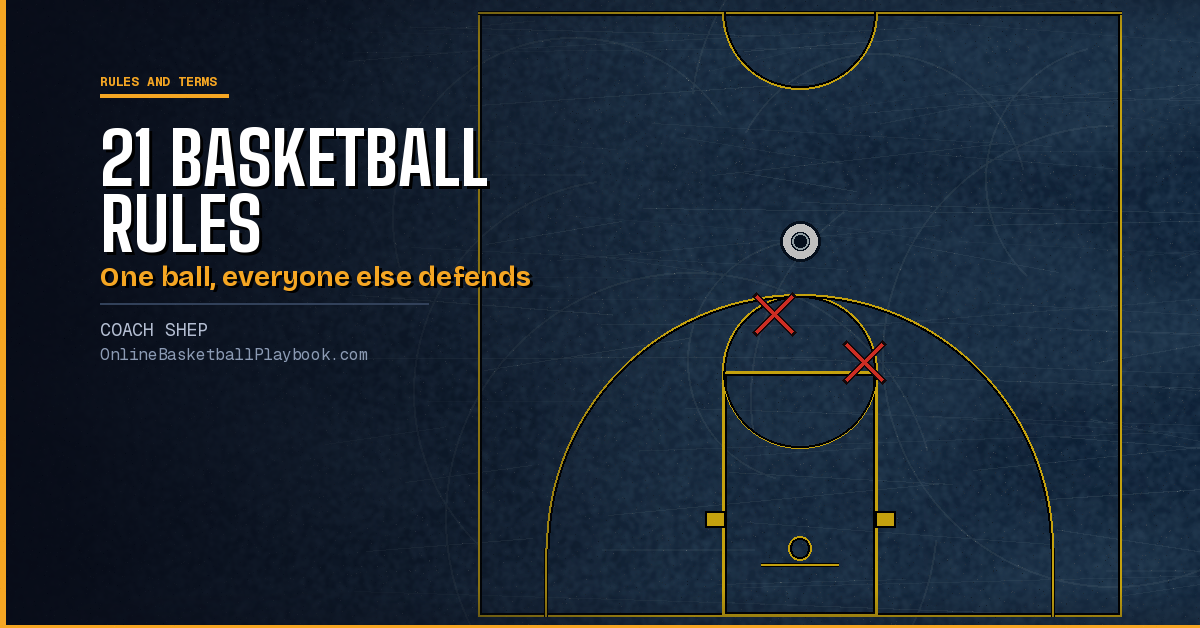
21 basketball rules are simple. Three or more players share one basket and one ball, and nobody is on a team. The player with the ball tries to score while everyone else defends him. Baskets count their normal value, a basket earns free throws, and the first player to 21 points wins. 21 is played for fun at the park or after school, and players call their own fouls. The rules for the real game are on basketball rules for beginners.
21 Basketball Rules, Step by Step
- Players. Three is the usual number, and it plays well with three or four. You need a half court and one ball.
- First possession. Decided by a free throw, a race to make a three or rock-paper-scissors.
- Starting a possession. The player with the ball starts each possession at the top of the arc. Everyone else defends him, and they can work together to stop him.
- Scoring. Normal values: 3 points behind the arc, 2 inside it, 1 for a free throw. Each player keeps his own score.
- After a basket. The scorer goes to the free-throw line. A make earns one more shot, and two made free throws is the most he can get. Then he takes the ball out at the top of the arc for a new possession.
- After a miss. Everyone crashes the boards. A shooter who gets his own rebound can shoot again straight away. Anyone else who gets it must clear it behind the three-point line first.
- Winning. The first player to reach 21 points wins.

Who Gets the Ball First
Three ways are common. One player shoots a free throw: if he makes it he has the ball, and if he misses, whoever gets the rebound has the first possession. Or players take turns shooting threes, and the first one to make it starts with the ball. Or play rock-paper-scissors.
Scoring and Free Throws
Every basket counts what it would count in a game, 3 or 2, and every made free throw counts 1. Each player keeps track of his own score.
A basket in 21 earns free throws. A player who scores goes to the free-throw line while the others get into rebounding position. If he makes the free throw, he shoots another. Two made free throws is the limit. After that, he takes the ball out at the top of the arc and starts a new possession. If he misses either free throw, the ball is live and whoever rebounds it has to clear it before he can shoot.

So a three followed by two made free throws is worth 5 points on one trip. Free throw form and routines are on free throw shooting.
Rebounds and Clearing the Ball
On a missed shot everyone goes after the rebound. If the shooter gets it, he can shoot again right away, without taking it back. If a defender gets it, he has to dribble it outside the three-point line before he can attack the rim or shoot. That defender is now the player trying to score, and the others guard him.

The same clearing rule applies on every other change of possession: a turnover, a block, a steal or a missed free throw. Box-out technique for those scrambles is on box out basketball.
Fouls
Players call their own fouls. A foul gives the ball to the player on offense at the top of the key. If the group fouls too much, add a free throw: the player who was fouled shoots one each time.
Get the next coaching guide in your inbox
One email when a new guide or diagram set goes up. Free.
Other Versions of 21
The name 21 covers more than the playground game. Coaches use it for a game with five players at each of three baskets and for shooting workouts with no defender or a token one. Settle which one you are playing before you start.
| Version | Players | Points | Key rules |
|---|---|---|---|
| Playground 21 | Three or four | 3 and 2 for baskets, 1 per free throw | Up to two made free throws after a basket, defenders clear the ball behind the three-point line, players call their own fouls, first to 21 |
| Three-basket 21 | Five at each of three baskets | 2 for a basket, plus three free throws | One player tries to score on the other four. After he makes his three free throws he checks the ball up and attacks again for 2 more. Anyone who rebounds a miss gets the chance to score. Played to 21. |
| Billy Donovan's shooting 21 | One player | 3 for a three, 2 for a pull-up after a ball fake, 1 for a layup | He moves around the perimeter and cannot shoot from the same spot twice or take the same shot twice in a row. He goes all the way to 21. |
| Exactly-21 shooting game | One shooter, a coach as a token defender | 3 for a three, 2 for a one-dribble pull-up, 1 for a one-dribble layup | He starts under the basket after every shot, cuts hard to the three-point line and catches the ball. No same shot twice in a row, and the score must reach exactly 21. |


21 Cone Shooting is a different game with the same number. Two teams shoot from matched spots and each make earns a cone from a pile of 21, so the team with the most cones wins. It is on fun basketball games.
21 in Practice
Teams rarely run playground 21 in practice. Players run it themselves. It is like 1-on-1 with more than one defender, so it works a player's scoring against several defenders at once, and there are versions for every age and level. Three-basket 21 runs at three baskets at once, and the shooting version sits inside an individual perimeter workout.
Other games players run themselves are HORSE, knockout and around the world. For one defender against one scorer, see 1-on-1 basketball, and for scored shooting work, basketball shooting drills and basketball drills and games for kids.
Questions People Ask
How do you play 21 in basketball?
One player with the ball tries to score against everyone else. Baskets count 2 or 3, a basket earns up to two made free throws, a defender who gets the ball must take it behind the three-point line before he can score, and the first player to 21 wins.
How many free throws do you get in 21?
After a basket, you keep shooting free throws as long as you make them, up to two makes. A miss is a live ball.
How many players can play 21?
Three is the usual number and three or four is a good fit. Three-basket 21 puts five players at each basket.
Do you have to clear the ball in 21?
Yes, after any change of possession: a defensive rebound, a missed free throw, a turnover, a steal or a block. The shooter's own offensive rebound can go straight back up.
Do you have to get exactly 21?
Not in the playground game, where the first player to reach 21 wins. One shooting-drill version of 21 does require exactly 21.
Want every diagram, printable?
OBP Pro members get the full diagram files for every drill and rules situation on this page, ready for a practice binder. $9 a month. Or draw your own version free in the play drawer.
See what OBP Pro includesMore Guides From This Batch
- Pack Line Defense Drills: Closeouts, Shell, Post and Scored Games
- 3x3 Basketball Rules: FIBA Scoring, Clock, Check-Ball and Fouls
- Middle School Basketball Rules: Quarters, Ball and State Changes
Back to Basketball Rules for Beginners and every Rules and Terms page.
Keep Building
Related breakdowns
Basketball Rules for Beginners: The Basic Rules of the Game
Basketball rules for beginners in plain words: scoring, the clock, moving with the ball, time limits, out of bounds, fouls and free throws, with a quiz.
Middle School Basketball Rules: Quarters, Ball and State Changes
Middle school basketball rules: who writes them, quarter length, ball size, shot clock and running clock by state, and the high school rules middle schoolers play.
3x3 Basketball Rules: FIBA Scoring, Clock, Check-Ball and Fouls
3x3 basketball rules from the FIBA rulebook: teams, scoring, the 21-point win, the 12-second clock, check-ball, clearing the ball, fouls and penalties.