Basketball hoop height by age, in USA Basketball's youth guidelines as adapted by Canada Basketball, is 8 feet for ages 5 to 8 (it can drop to 6 feet for 5 and 6 year olds), 9 feet for ages 9 to 11 and the full 10 feet from age 12 up. The same age bands scale the ball, the court and the free throw and three-point lines to each age. This page gives those bands, then the youth game rules that go with it, then the other published versions, which do not all agree.
These are recommendations for the people who run basketball programs. Organizations and gyms may not always be able to raise or lower a basket, redraw lines or run a shot clock, and the guidelines suggest adjusting where that is the case. Your league or state association has the final word.
Basketball Hoop Height by Age: The Chart
These are the equipment and court numbers by age from USA Basketball's youth guidelines, in the version Canada Basketball adapted with permission.
| Age | Basket height | Ball size | Court size | 3-point line | Free throw line |
|---|---|---|---|---|---|
| 5-6 | 8 ft (2.4 m), can go down to 6 ft (1.8 m) | Size 5 (27.5 in), girls and boys | 50 x 42 ft (15.2 x 12.8 m) | None | 14 ft (4.3 m) |
| 7-8 | 8 ft (2.4 m) | Size 5 (27.5 in), girls and boys | 50 x 42 ft (15.2 x 12.8 m) | None | 14 ft (4.3 m) |
| 9-11 | 9 ft (2.7 m) | Size 6 (28.5 in), girls and boys | 74 x 50 ft (22.5 x 15.2 m) | None | 14 ft (4.3 m) |
| 12-14 | 10 ft (3 m) | Girls size 6 (28.5 in), boys size 7 (29.5 in) | 84 x 50 ft (25.6 x 15.2 m) | 19 ft 9 in (6 m) | 15 ft (4.6 m) |
| 15-18 | 10 ft (3 m) | Girls size 6 (28.5 in), boys size 7 (29.5 in) | 94 x 50 ft (28.6 x 15.2 m) | 22 ft 2 in (6.8 m) | 15 ft (4.6 m) |
Notes that go with these age bands:
- Three-point line. For ages 5 to 11 an arc may be painted on the floor, but every basket made from behind it counts 2 points, so the distance does not apply. For older players the guidelines prefer a 22 ft 2 in arc, and where a gym does not have one, the next line shorter than that.
- Free throws. Ages 5 to 11 shoot 14 feet out from the basket, to build sound form and make more of them.
- Lower baskets. The same reason is given for the 8 and 9 foot baskets: proper shooting form and more chances to score.
- Small court. The 50 x 42 ft court for ages 5 to 8 is a cross-court game played sideways across a full-size court.
- Small-sided games. Canada Basketball adds a recommendation of 3-a-side and 4-a-side games at every age, above all for players 11 and younger, for more touches.
Ball sizes in more detail are on basketball sizes, and full court measurements are on basketball court dimensions. Ideas for small-sided play are on reasons to use small-sided games.
How Tall Is a Middle School Basketball Hoop?
Ten feet, the standard height. In the USA Basketball age bands, 12 to 14 year olds play on a 10 foot basket, girls with a size 6 ball and boys with a size 7, a 15 foot free throw line, a 19 ft 9 in three-point arc and an 84 x 50 ft court. Canada Basketball's Youth Rules Guidelines also put U13 to U14 at 10 feet.
For school games, check your state association. The state-by-state picture is on middle school basketball rules.
Hoop Height in Each Version
Four published versions set basket heights for young players. They agree on 10 feet as the end point and differ on when kids get there.
| Version | Lowered baskets | 10 ft basket |
|---|---|---|
| USA Basketball age bands (as adapted by Canada Basketball) | 8 ft for ages 5 to 8 (6 ft allowed at 5-6), 9 ft for ages 9 to 11 | From age 12 |
| Canada Basketball Youth Rules Guidelines | 8 ft for U7-U8, 9 ft for U9-U10 | From U11-U12 |
| FIBA mini-basketball options | 6 ft for U6, 8 ft for U10, and baskets lowered to between 6 and 8 ft for ages 5 to 7 | The standard height |
| Canada Basketball Mini-Basket rules (2015) | 8 ft for 3 v 3 (ages 9 and under) | 4 v 4 (ages 11 and under) plays at 9 or 10 ft by development level, and is also listed simply at 10 ft |
The FIBA options include one for gyms where the basket cannot move: award points when a shot touches the ring, the board or the net.
Youth Basketball Rules by Age: Game Format
The same USA Basketball age bands come with game rules for each age. These are the format rules.
| Age | Game length | Between quarters | Extra time | Scoring | Start of game |
|---|---|---|---|---|---|
| 5-6 | 4 x 8 min | 1 min | None | Free throw 1, every field goal 2, no threes | Coin flip, throw-in at half court |
| 7-8 | 4 x 8 min | 1 min | 2 min | Free throw 1, every field goal 2, no threes | Coin flip, throw-in at half court |
| 9-11 | 4 x 8 min | 1 min | 2 min | Free throw 1, every field goal 2, no threes | Coin flip, throw-in at half court |
| 12-14 | 4 x 8 min | 1 min | 4 min | Threes count 3 | Jump ball |
| 15-18 | 4 x 10 min | 2 min | 5 min | Threes count 3 | Jump ball |
- No threes through age 11. A shot from behind the arc still counts, but only for 2. The guidelines say this keeps young players shooting from a range that suits their development.
- Coin flip. For ages 5 to 11 the coin flip replaces the jump ball because children differ so much in height and coordination. Alternating possession follows.
- Timeouts. Ages 5 to 14 get two 60-second timeouts in each half. Ages 15 to 18 get two before halftime and three after it, and may use no more than two once the 4th quarter is down to its last 2 minutes. Each extra period adds one at every age, and a timeout not used in one period cannot be saved for the next.
Adult timeout rules by level are on basketball timeout rules.
Shot Clock, Backcourt Count and Clock Stops
| Age | Backcourt count | Shot clock | 5 seconds closely guarded | Clock stops |
|---|---|---|---|---|
| 5-6 | None | None | None | Any dead ball |
| 7-8 | None | None | None | Any dead ball |
| 9-11 | 10 sec | None | Only while holding the ball | Any dead ball |
| 12-14 | 10 sec | 30 sec, full reset on any rebound and any foul | Only while holding the ball | Any dead ball, plus after a made basket late in the 4th (last 2 minutes) and in extra time |
| 15-18 | 8 sec | 24 sec, see below | Only while holding the ball | Any dead ball, plus after a made basket late in the 4th (last 2 minutes) and in extra time |
The 24-second clock for ages 15 to 18 resets to 14 on an offensive rebound and to a full 24 on a backcourt foul. On a frontcourt foul it keeps running from where it stopped if it shows more than 14, and goes to 14 if it shows less.
Other rules in the same set:
- Free throw time. 10 seconds for ages 5 to 11, 8 seconds for 12 to 14 and 5 seconds for 15 to 18. At every age, three offensive players (the shooter counts as one) and three defenders may take lane spots.
- Substitutions. Through age 11, either team may sub while the clock is stopped. From 12, subs come on any dead ball and before the first free throw or after a made last one. Late in the 4th (last 2 minutes) and in extra time, the team that did not score may sub after a basket, and the scoring team may then sub too.
- Ball after a timeout. From age 12, a timeout late in the 4th (last 2 minutes) or in extra time moves the throw-in to the offense's frontcourt, opposite the scorer's table. Younger ages do not advance the ball.
The guidelines explain the backcourt rule. With no count for ages 5 to 8, a coach can talk to players before they reach half court. The count then goes to 10 seconds for 9 to 14 and 8 seconds for the oldest group. The adult versions are on backcourt violation and basketball shot clock rules.
Defense, Pressing and Playing Time
| Age | Playing time | Set defense | Pressing | Double teams | Stealing from a dribbler |
|---|---|---|---|---|---|
| 5-6 | Equal | Player-to-player only | Not allowed | Not allowed | Not allowed |
| 7-8 | Equal | Player-to-player only | Not allowed | Not allowed | Not allowed |
| 9-11 | Equal for the first three quarters, coach's call in the 4th and extra periods | Player-to-player only | Player-to-player may go full court in the 4th and extra time. A team up by 25 or more may not defend past half court. | Not allowed | Coach's discretion |
| 12-14 | Coach's discretion | All allowed | Allowed. A team up by 25 or more may not press. | Allowed, coach's discretion | Coach's discretion |
| 15-18 | Coach's discretion | All allowed | Allowed | Allowed, coach's discretion | Coach's discretion |
The reasons the guidelines give:
- Player-to-player only through 11. It keeps players moving and builds guarding skill on and off the ball.
- No press through 8. Children learn to move with and without the ball in the half court first. At 9 to 11 the full-court man in the 4th lets them get used to full-court defense without learning zone presses.
- No double teams through 11, because of the gaps in skill and size at those ages.
- No steals from the dribbler through 8, so ball-handlers can build their dribbling and their confidence.
How to teach man-to-man to young teams is on teaching man to man defense in youth basketball, and when to add a press is on how to teach a press to youth teams.
Canada Basketball's Youth Rules Guidelines
Canada Basketball also publishes its own Youth Rules Guidelines, built on its long-term development model. It uses U-age bands and splits most of them into recreational and competitive play. It differs from the USA Basketball age bands above in several places. Its own notes do not match its table on one point. The notes recommend a lower basket up to age 11 (the 7 to 8 and 9 to 11 groups), while the table puts U11-U12 at 10 feet.
| Group | Ball | Basket | Court | 3-point line | Free throw |
|---|---|---|---|---|---|
| U7-U8 | Size 5 | 8 ft | Half court or cross-court | No | Not used |
| U9-U10 rec and comp | Size 5 | 9 ft | Cross-court | No | 14 ft |
| U11-U12 rec | Size 6 | 10 ft | Cross-court | Yes, shortest line in the gym | 15 ft |
| U11-U12 comp | Size 6 | 10 ft | Full court | Yes, shortest line in the gym | 15 ft |
| U13-U14 rec | Girls 6, boys 7 | 10 ft | Full court | Yes, shortest line in the gym | 15 ft |
| U13-U14 comp | Girls 6, boys 7 | 10 ft | Full court | Yes, FIBA 22 ft 2 in | 15 ft |
| Group | Scoring | Players a side | Game clock | Playing time |
|---|---|---|---|---|
| U7-U8 | No scorekeeping or standings | 3 v 3 or 4 v 4 | League's choice | Equal |
| U9-U10 rec | Score resets each quarter, no standings, field goals 2, no threes | 4 v 4 or 5 v 5 | 4 x 8 min | Equal |
| U9-U10 comp | Running score, free throw 1, field goal 2, no threes | 4 v 4 or 5 v 5 | 4 x 8 min, 3 min overtime | Equal in quarters 1 to 3 |
| U11-U12 rec | Score resets each quarter, threes count 3 | 4 v 4 or 5 v 5 | 4 x 8 min | Equal |
| U11-U12 comp | Running score, threes count 3 | 5 v 5 | 4 x 8 min, 5 min overtime | Every player must play |
| U13-U14 rec | Running score, threes count 3 | 4 v 4 or 5 v 5 | 4 x 10 min, 5 min overtime | Equal in quarters 1 to 3 |
| U13-U14 comp | Running score, threes count 3 | 5 v 5 | 4 x 10 min, 5 min overtime | Every player must play |
| Group | Set defense | Full-court press | Double teams | Screens | Steals from the ball handler |
|---|---|---|---|---|---|
| U7-U8 | Player-to-player only | No defense before half court | No | No | No |
| U9-U10 rec | Player-to-player only | No defense before half court | No | No | Yes |
| U9-U10 comp | Player-to-player only | No defense before half court | No | Off-ball screens only | Yes |
| U11-U12 rec | Player-to-player only | No defense before half court | No | Off-ball screens only | Yes |
| U11-U12 comp | Player-to-player only | Yes, with half-court pickup only after a 20 point lead | Yes | Yes | Yes |
| U13-U14 rec | All allowed | Yes, with half-court pickup only after a 20 point lead | Yes | Yes | Yes |
| U13-U14 comp | All allowed | Yes | Yes | Yes | Yes |
Where the two sets of age bands differ:
| Rule | USA Basketball age bands | Canada Basketball Youth Rules Guidelines |
|---|---|---|
| 10 ft basket | From age 12 | From U11-U12 |
| Ball for ages 9 to 10 | Size 6 (9 to 11 band) | Size 5 (U9-U10) |
| Three-pointers | From age 12 | From U11-U12 |
| Steals from the dribbler | Not allowed through 8, coach's discretion from 9 | Not allowed at U7-U8, allowed from U9 |
| Big-lead pressing rule | 25 points | 20 points |
| Screens | No limit listed | None at U7-U8 and U9-U10 rec, off-ball only at U9-U10 comp and U11-U12 rec |
More from the Youth Rules Guidelines:
- Timing rules. The full set (3 seconds in the key, 5 seconds to inbound, 5 seconds closely guarded, 8 seconds to the frontcourt, a 24-second shot clock) is off at U7-U8 and left to a referee or game leader at U9-U10 rec. U9-U10 comp and U11-U12 rec call only the 5 and 8 second rules, with the 24 and the 3 in the key guided by the referee. The full set applies from U11-U12 comp.
- Zone. The guidelines say zone can become more suitable around ages 13 to 14, as a progression that adds to strong player-to-player habits.
- Game days. From U9-U10 comp up, no more than 2 games a day with at least one game of rest between them.
How man-to-man and zone compare is on man-to-man vs zone defense.
FIBA Mini-Basketball Options
FIBA's mini-basketball coaching material suggests a menu of rule changes for young players' competitions. These are suggestions, not FIBA's official rules, and the material does not expect a league to use all of them at once.
- Basket. Standard is 10 ft (3.05 m). Lower it to 8 ft (2.43 m) for under 10 and 6 ft (1.83 m) for under 6. If it cannot be lowered, consider points for touching the ring, the board or the net.
- Ball. Size 5 for under 12, a softer size 5 for under 8 and size 3 for under 6.
- Court. Under 8 plays across the court where baskets hang on the sides. If that cannot be done, a half-court game with a portable basket set at half way also works, and lets more games run at once. A single-basket half-court game costs players the change from offense to defense, so it is not preferred unless it is needed to fit more games in.
- Playing time. Every player plays in at least each half. Options include a forced sub halfway through each quarter, taking off a player once he scores 10 (he may come back) and no fouling out at 5 fouls.
- Scoring options. Threes count 2 (or 1, or nothing), shots from inside the key may count 3, and a basket after 5 passes may count 3.
- Defense and clock. No zone until under 16. No shot clock until under 14, and at under 14 it starts only once the offense has the ball in its frontcourt, for 32 seconds at most. A "no double team" option allows one defender on the ball.
- Violations at under 10. Call travelling and illegal dribbles sparingly. The referee can explain the footwork and give the ball back to the same team.
The adult FIBA game against high school rules is on FIBA vs NFHS rules.
Mini-Basket 3 v 3 and 4 v 4
Canada Basketball's 2015 Mini-Basket rules set two small-sided competitions for players 11 and under. Both use player-to-player defense.
| Rule | Mini-Basket 3 v 3 | Mini-Basket 4 v 4 |
|---|---|---|
| Ages | 9 and under | 11 and under |
| Court | Half court, 15 x 11 m (49.2 x 36.1 ft) | Crosscourt, 15 x 28 m (49.2 x 91.9 ft) |
| Basket | 8 ft | 9 or 10 ft by development level (also listed simply at 10 ft) |
| Ball | Size 3 or 5 by development level | Size 5 |
| Free throw line | 4.5 m (14.8 ft) from the end line | 5.8 m (19 ft) from the end line |
| Game | 10 minutes | 12 minutes |
| Roster | 4 players | 6 players |
| Score | None kept | 2 and 3 point baskets, 1 for a free throw, mercy rule at 20 points |
| Shot clock | None, but the official may give a stalling team 15 seconds | 24 seconds where the gym has one, otherwise the official counts off the final 5 seconds as a warning |
| Substitutions | Every 2 minutes at a dead ball | Every 3 minutes at a dead ball |
Adult half-court rules are on 3x3 basketball rules.
One Provincial Association's U10 to U12 Mini-Rules
One Canadian provincial association adopted FIBA mini-rules for U10 to U12 and added a no-zone rule. Some of its rules cover U10 only and some cover U10 to U12, and each is labelled below.
U10 to U12
- No zone. Once the ball crosses half court, the man on the ball pressures it. On the ball side a defender stays about an arm's length from his player. A weak-side defender sits just off the edge of the key. Defenders move with their own player, not with the ball.
- Help and switches. One helper may come only after the ball handler has beaten his man, and players switch only after being beaten. No double teams.
- Game length. 32 minutes in eight 4-minute shifts, and a player may play shifts back to back. Equal time is enforced in shifts 1 to 7 for U10 and U11, and in shifts 1 to 3 and 5 to 7 for U12. Shift 8 (and shift 4 at U12) is open subbing.
- Minimum shifts. With a 10 or 11 player roster at U10 and U11, everyone plays at least 3 shifts with at least one in each half. With 12 players, at least 2. At U12, 3 shifts with a 10 player roster and 2 with 11 or 12. Open-subbing shifts do not count.
- Enforcement. The officials give warnings or no-zone technical fouls, or both.
U10 only
- One pass or two passes away. A defender one pass from the ball must be within an arm's length. Two passes away he may sit in help, but outside the key.
- When help is legal. The ball handler has beaten his man once his head, shoulders and feet have cleared that defender's back foot. Then one helper may come, and the helper or the beaten defender recovers so two players never guard the ball.
- No double teams or traps anywhere on the floor. Defenders may switch, as long as each stays about an arm's length from the player he picks up.
- When the rule is off. Once a shot goes up (the defense may rebound from anywhere), after an offensive rebound until the offense sets up again, and when the offense spreads out in an extreme isolation set to empty the help side.
- Penalty. The site convener gives one warning. After that, each infraction is a team technical: the offense shoots two and keeps the ball at half court.
- Weak-side post. A defender guarding a post on the weak-side block may stand inside the key, one arm's length from his man, as long as he stays outside the charge circle.
- Repeat offenders. A coach whose team draws three or more team technicals for person-to-person infractions in one game is reported to the provincial association and reviewed under its fair play policy.
Full-court pressure: two U10 versions and the U11-U12 rule
| Version | Rule |
|---|---|
| U10, 15 point limit | Full-court player-to-player is allowed, with a defender on the inbounder. A team up 15 or more points cannot press. When the other team has the ball in its own backcourt, the leading team drops back over half court and lets it dribble across. If it is too slow, the official stops play and gives the offense the ball out of bounds at that spot. |
| U10, shift 8 only | Full-court player-to-player is allowed during shift 8 only. |
| U11-U12 | Full-court player-to-player is allowed all game, until the pressing team leads by 15. |
Ideas for man-to-man at these ages are on best defense for youth basketball.
Big Leads: 15, 20 or 25 Points
| Version | Lead | What changes |
|---|---|---|
| USA Basketball age bands, 9-11 | 25 | The leading team may not defend past half court |
| USA Basketball age bands, 12-14 | 25 | The leading team may not press |
| Canada Basketball Youth Rules Guidelines, U11-U12 comp and U13-U14 rec | 20 | Half-court pickup |
| Mini-Basket 4 v 4 | 20 | Mercy rule. The leading team is declared the winner, and the rest of the game is played with no score kept, with players swapped between teams or with changed point values. |
| Provincial mini-rules, U11-U12 | 15 | Full-court pressure ends |
| Provincial mini-rules, U10 (15 point version) | 15 | No press. The leading team drops back over half court. |
In the other U10 version, full-court pressure is allowed only in shift 8 whatever the score. Coaching the youngest teams through all of this is on coaching youth basketball, and the adult rules from the ground up are on basketball rules for beginners.
Questions Coaches Ask
What height should a basketball hoop be for a 10 year old?
9 feet in the USA Basketball age bands (9 to 11) and in Canada Basketball's Youth Rules Guidelines (U9-U10). FIBA's mini-basketball options lower the basket to 8 feet for under 10, which covers players younger than 10.
How tall is a middle school basketball hoop?
10 feet. The USA Basketball age bands put 12 to 14 year olds on a 10 foot basket with a 15 foot free throw line. For school league rules, check your state association.
What height is a basketball hoop for 8 year olds?
8 feet in the USA Basketball age bands (7 to 8) and in Canada Basketball's Youth Rules Guidelines (U7-U8).
At what age do kids play on a 10 foot hoop?
Age 12 in the USA Basketball age bands. Canada Basketball's Youth Rules Guidelines start at U11-U12.
What size basketball does each age use?
In the USA Basketball age bands: size 5 through age 8, size 6 for 9 to 11, then girls use a size 6 and boys a size 7 from 12. The full guide is on basketball sizes.
Do three-pointers count in youth basketball?
Not through age 11 in the USA Basketball age bands, where every field goal counts 2. Canada Basketball's Youth Rules Guidelines count threes from U11-U12.
Can you play zone in youth basketball?
Not at the younger ages in these guidelines. The USA Basketball age bands allow only player-to-player through age 11. Canada Basketball's guidelines hold it through U11-U12, and FIBA's mini-basketball options suggest no zone until under 16. Your league sets its own rule.
Get the next coaching guide in your inbox
One email when a new guide or diagram set goes up. Free.
Want the printable playbook packs?
Playbook packs: zone attack, press break, press defense, out of bounds, quick hitters, practice plans and the youth turnover cure, each a printable PDF. Or draw your own version free in PlayDraw.
See the playbook packsRelated Guides
Back to Basketball Rules and Regulations and every Rules and Terms page.
Keep Building
Related breakdowns
Average NBA Player Height
The average NBA player is 6 feet 7 inches and 216 pounds. See how height and weight have changed by season since 1951-52.
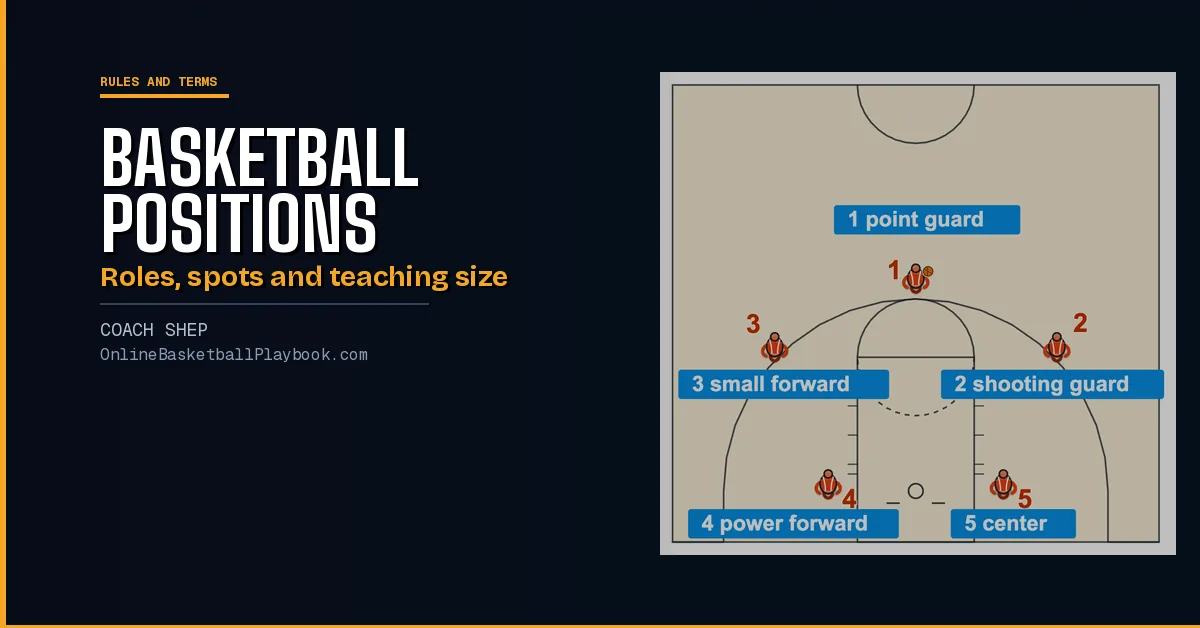
Basketball Positions Explained: 1-5, Roles and Size
Basketball positions 1 through 5 explained for coaches: roles, ideal teaching size, spots on the floor, and when to go positionless.
Dunk Calculator: Can You Dunk?
Free dunk calculator from height, standing reach and vertical jump. See how close you are to a regulation 10 ft rim and what to train next.