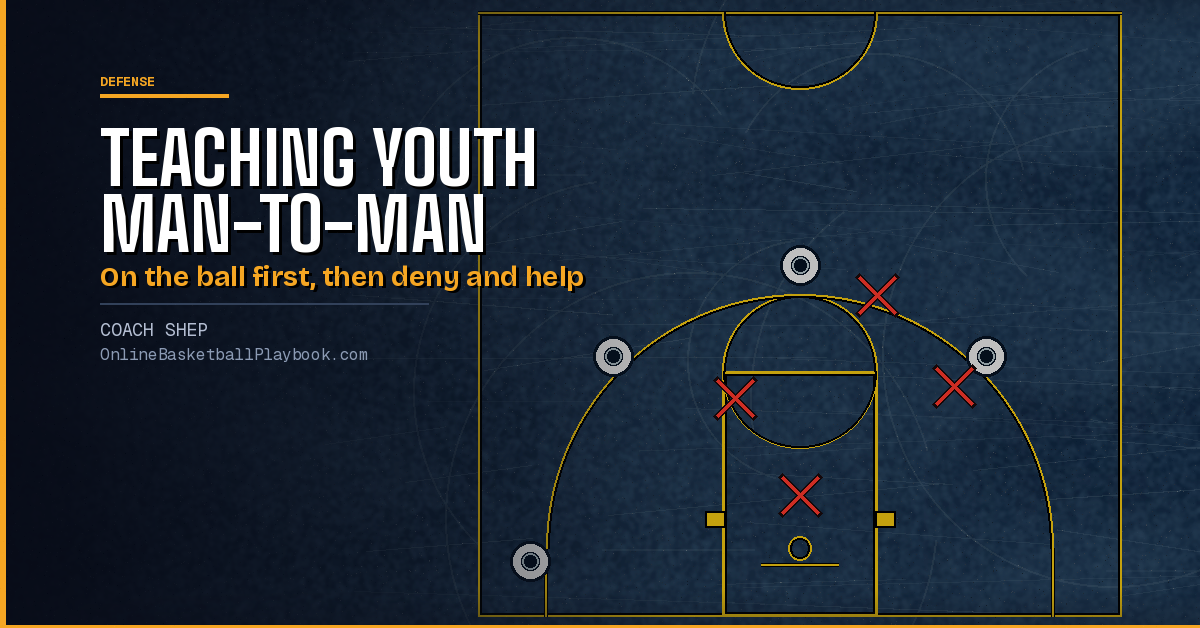
Teaching man to man defense in youth basketball is a question of order. The full defense, with denial, help side, rotations and screens, is on man-to-man defense. Young players cannot take all of it at once, so youth programs and development models build it in layers: guard the ball, then see the ball and your man, then deny and help, then rotate. This page lays out what to teach first at each age, the cues that work with children, and where coaches disagree about zones.
Why Youth Programs Teach Man-to-Man First
Many youth leagues and national development models write man-to-man into the rules. League rules for young players often require player-to-player defense and ban zones and full-court presses, and league rules at under-10 to under-12 can make person-to-person defense a rule, with a forfeit penalty. Asked of more than a thousand coaches when non-man defenses should begin, the near-unanimous answer was junior varsity, about age 15 or 16.
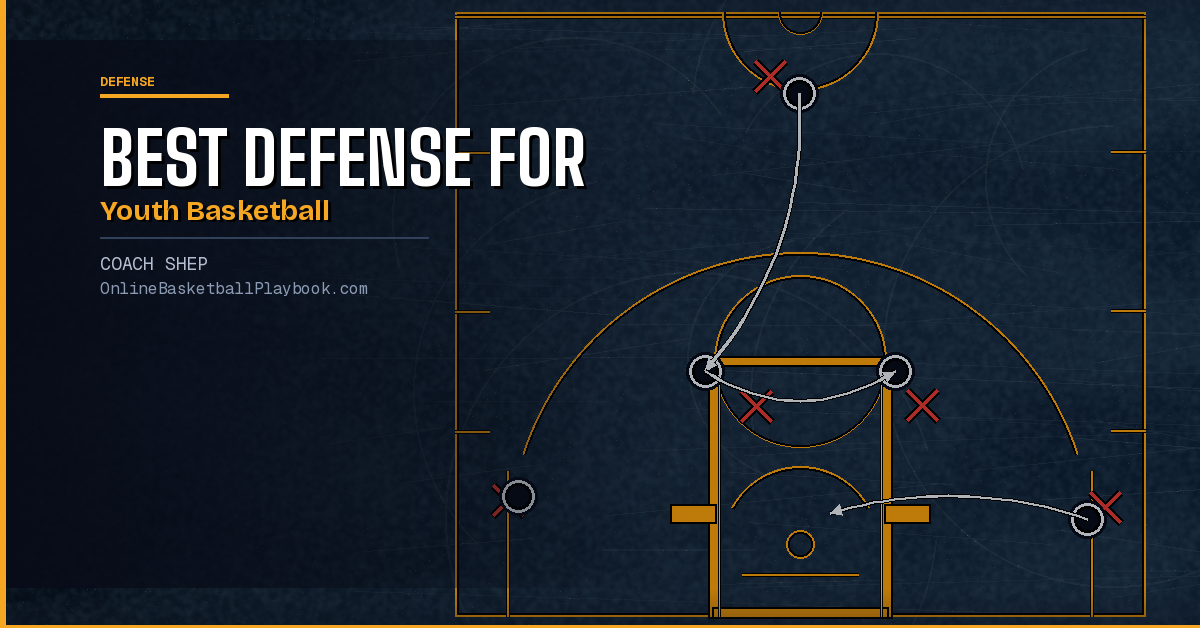
The argument against youth zones is a list of habits a zone-only player never builds: on-ball defense, staying engaged instead of watching, closeouts, accountability for one player, talking, guarding different spots, help decisions, rotations, defending screens, and bigs guarding the ball. A zone also slows the other team's development, because cuts, screens and passing under pressure rarely happen against it. Ettore Messina makes the same point at a higher level: a zone is only as good as the man fundamentals underneath it. The full comparison is on man-to-man vs zone defense, and the choice of a youth defense is on best defense for youth basketball.
Teaching Man to Man Defense in Youth Basketball by Age
The age bands below come from youth manuals, club guides and national development models. Each line is one stage plan, so read across them as options, not one fixed order.
| Age | What is taught | What is held back |
|---|---|---|
| 4 to 5 | Cold defense only: stand about two arm lengths off and stay with your player | Trying to take the ball |
| 6 to 7 | Start cold, then warm defense | Trying to take the ball |
| 6 to 8 | The pistol cue: one finger at the ball, one at your player, and move as the ball moves | Full-court defense, double-teams above the free-throw line |
| 8 to 9 | Player-to-player defense only, defense on and off the ball later in the season, boxing out. Offense skills come first at this age in one season plan | Presses, taking charges |
| Under 10 | Begin man defense | |
| Grades 1 to 5 | On-ball defense only, and protect the paint | Deny and help side |
| Around 6th grade | On-ball, deny and help side together | Zones |
| Under 12 | Two-on-two defensive triangles | Full-court man defense until shell, help and rotation are understood |
| 7th grade | Defensive stance, slides and help-side basics | Presses |
| 8th grade | Help-side rotation, and presses are added | |
| Under 14 | Help and recover |
A national long-term athlete development model sets the stages by age and sex. In its learn-to-train stage (boys 9 to 12, girls 8 to 11) game rules call for player-to-player defense. In the next stage (boys 12 to 16, girls 11 to 15) there are no zone defenses or zone presses in the early phase, and the defensive ideas taught are influencing the ball, denial, help, rotate and recover. Zones and presses enter near the end of that stage.
The common thread is the order: the ball first, then the ball and your man, then denial and help, then rotations. Coaching young players in general is covered on coaching youth basketball.
Cold, Warm and Hot: How Hard to Guard
The three-level version sets how hard a defender may guard in practice games.
- Cold (cooperative). About two arm lengths away and passive. Ages 4 to 5 use only this.
- Warm (active). About one and a half arm lengths away, with active hands and feet but no attempt to take the ball. Ages 6 to 7 start cold and move to warm.
- Hot (competitive). The defender tries to intercept or take the ball. Used in practice games for older players.
The arm's-length version for grades 3 to 8 sets on-ball pressure at one arm's length.

The First Team Cue: Pistols
The first team-defense idea many youth coaches teach is the pistol. Each defender away from the ball points one finger at the ball and one at his own player, so he can see both, and moves every time the ball moves. Children aged 6 to 8 can use it on their own. It is the simplest form of the ball-you-man position, explained in full on ball-you-man defense.
Youth manuals keep team defense at this stage to the basics: see the ball, and stand in the man-you-ball pistol stance. The stance itself is on defensive stance, and the footwork on basketball defensive footwork.

Adding Deny and Help Side
Around sixth grade, or under-12 level, youth programs add the off-ball jobs, named by how many passes the defender's player is from the ball.
- On the ball. Pressure at about one arm's length.
- One pass away. Deny the pass. One version puts the defender's outside shoulder on his player's inside shoulder. In any version, one pass away you must be able to stop the drive and still close out to your man. The farther your man is from the ball, the closer you can be to the ball, because the pass is longer. Do not sag so far that you cannot recover on one pass. The scouting report moves it. Against a non-shooter you can play closer to the ball, and against a good shooter closer to your man.
- Two passes away. Help side, with one foot in the lane. Another version puts both feet in the lane.
- Three passes away. On the line from basket to basket, down the middle of the floor.
A help-side line rule one guide teaches: with the ball above the free-throw line, one foot in the lane, and with the ball below it, one foot on or straddling the help-side line. Youth teams also learn to pack the paint, because that is where most youth scoring happens. The help rules in full are on help defense principles, and the deny-or-pack choice for older teams on pack line vs pressure man-to-man.

Get the next coaching guide in your inbox
One email when a new guide or diagram set goes up. Free.
A Rule-by-Rule Ladder
A rule-by-rule ladder for grade 5 and up teaches man-to-man one rule at a time, each rule its own drill:
- Mirror the ball.
- Jump to the ball. The pass decides the jump.
- One pass away is deny: defend your man and a half.
- Two and three passes away are help side, with a recover.
- Drop to the level of the ball.
- Bump all cutters.
- Defend the give and go by staying up and on the line.
The nine-rule version builds the defense from nine rules: ball pressure at one arm's length, ball-side denial, help side with both feet in the lane, jump to the ball on the pass, dead front the post at or below the free-throw line extended, stop the ball reversal, sink to the level of the ball on the help side, block out and outlet, and constant talk. Its stated goal for each possession is a turnover or a jump shot off the dribble, and one shot only.
One install runs the same direction: the first week on stance, footwork and on-ball defense only, then two-player denial, then five-player rotation. Close-outs in a 4-on-4 come only after team defense, split-line help and denial have been taught.

How Much Practice Time
The 90 and 120-minute split divides a 90-minute practice for grades 3 to 5 into 45 minutes of fundamentals, 20 of defense, 20 of offense and 5 of flex time. Grades 6 to 8 get 120 minutes: 60 of fundamentals, 25 of defense, 25 of offense and 10 of flex. The 80/20 split puts man-to-man at 80 to 90 percent of defensive time and a zone at 10 to 20 percent for teams that use one.
The drills that carry the teaching:
- 4-on-4 shell with a jump to the ball on every pass, and a 2-on-2 help drill where a skip pass sends the help defender sprinting to the rim line. See shell drill basketball.
- Defensive footwork such as pushing off the trail leg, mirror defense and a hip turn (a small hop and quarter turn) taught in place of a drop step, with a crossover step for the first one or two steps when the dribbler gets a step.
- Scoring games where only stops count, so the defense has something to win. More drills by stage are on man to man defense drills, and closeout work on closeout and recover.
Zones, Presses and Where Coaches Differ
Not every youth coach agrees on when a zone can come in.
| Version | Zones | Presses |
|---|---|---|
| Man only before high school | Compulsory half-court man before high school, and no partial rules such as a zone only when down ten | Wait for junior varsity age |
| Man first, simple zone by 8th grade | A packed 2-3 may win more middle school games, but fundamentals and man come first, with a simple 2-3 allowed by 8th grade | A man-to-man full-court press without traps for older youth, where leagues allow pressing |
| Man first, zone in one practice | Once players know pressure man-to-man, a zone can be taught in one practice. No junk defenses such as box-and-one with young players | Trapping taught after man |
| Development-stage model | No zones in the early phase of the 11 to 16 stage, added near its end | No zone presses in the early phase |
Where a press is allowed, one suggested for older youth teams is Ralph Miller's full-court man-to-man pressure: everyone pressures man-to-man without trapping or gambling, and everyone sprints back to the paint the moment the ball gets past the pressure. A no-press rule for 5th and 6th grade bars pressing at that level altogether. When older teams are ready for zones, start with types of defense in basketball.
Questions Coaches Ask
How do you teach man to man defense to youth players?
In layers. Start with guarding the ball and staying between your player and the basket, then teach players to see the ball and their man with the pistol cue, then add denial one pass away and help side two passes away, usually around age 11 or 12, then rotations and shell work.
At what age should kids learn help defense?
Several youth programs add deny and help side around sixth grade or the under-12 level. Younger players learn on-ball defense and the pistol cue first.
Should youth basketball teams play zone?
Many leagues and development models say no before high school, and coaches asked about it put the start of zones at junior varsity age. Some coaches allow a simple 2-3 by 8th grade once man-to-man is taught.
What is pistol defense in youth basketball?
A cue for off-ball defenders: point one finger at the ball and one at your player, so you can see both, and move every time the ball moves. It is the youngest form of ball-you-man positioning.
How far off should a youth defender play?
It depends on the level the coach calls. Cold defense is about two arm lengths off, warm about one and a half, and hot pressures the ball. On-ball pressure is set at one arm's length in the grades 3 to 8 version.
Want every diagram, printable?
OBP Pro members get the full diagram files for every drill, screen and teaching progression on this page, ready for a practice binder. $9 a month. Or draw your own version free in the play drawer.
See what OBP Pro includesMore Guides From This Batch
- Tips for Basketball Tryouts: How to Prepare and Stand Out
- HORSE Basketball Rules: How to Play the Shooting Game
- Basketball Hesitation Dribble: How to Do the Hesi Move
- Back Screen Basketball: How to Set, Use and Defend It
- Basketball Referee Signals: Foul Signals and Calls by Level
Back to Man-to-Man Defense and every Defense page.
Keep Building
Related breakdowns
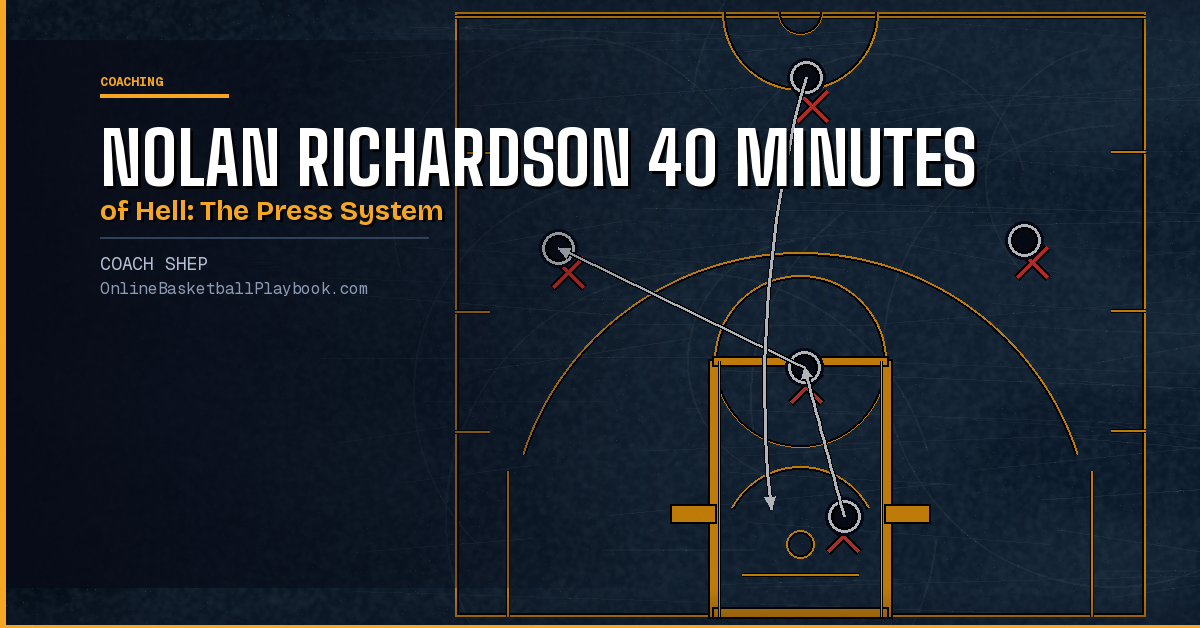
Nolan Richardson 40 Minutes of Hell: Teaching the Full-Court Press
Nolan Richardson 40 Minutes of Hell: Teaching the Full-Court Press
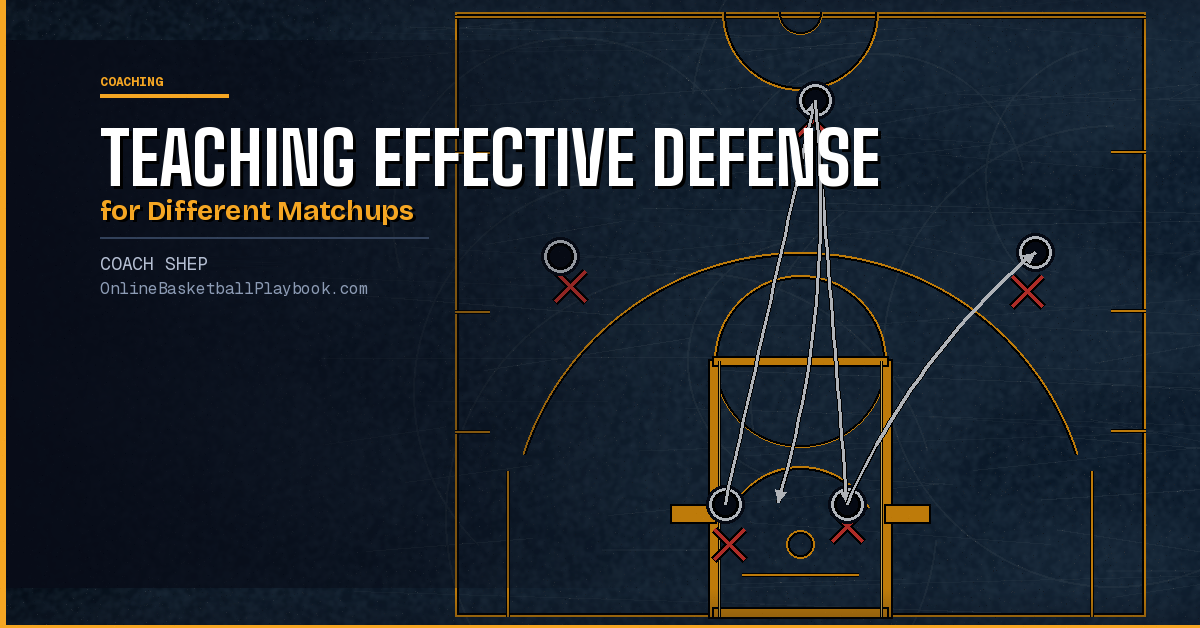
Teaching Effective Defensive Strategies for Different Matchups
Teaching Effective Defensive Strategies for Different Matchups