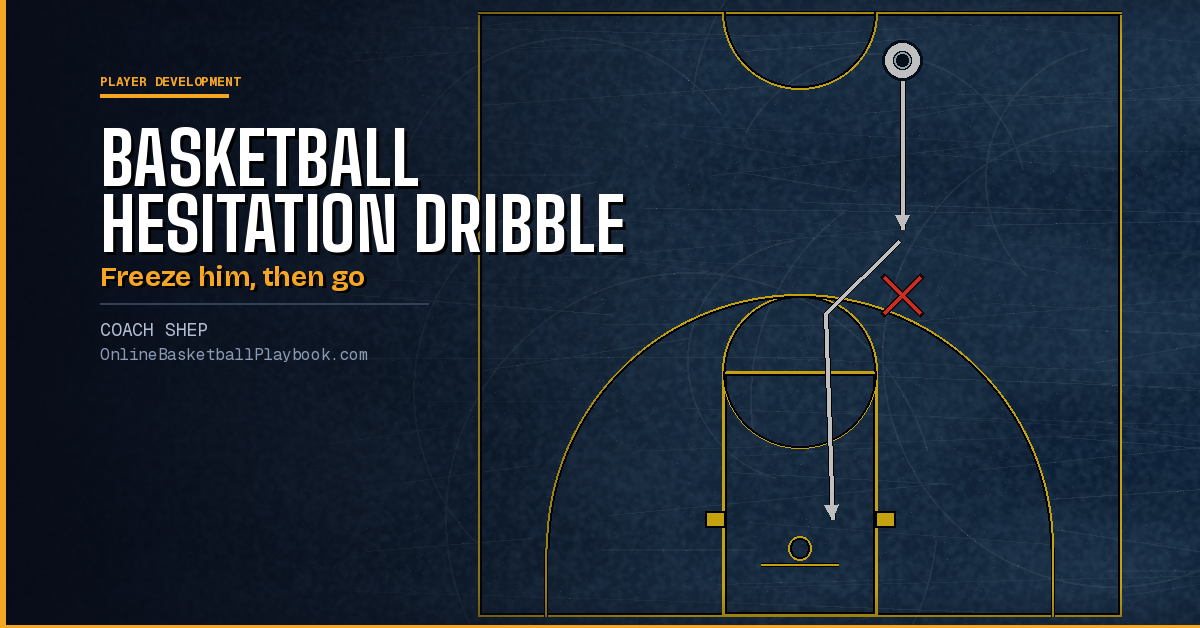
The basketball hesitation dribble, the hesi, is a change of pace, not a change of direction. The dribbler comes at the defender with speed, slows down for a split second as if he is about to stop, and when the defender slows down with him, explodes past with the same hand. It is a straight-line move, used most in the open court to get to the rim or to set up a teammate. This page covers the hesitation dribble move step by step, how to sell it, when to use it, the counters that come out of it and the drills that build it. The hesitation used to set up a jump shot has its own page, the hesitation pull-up shot.
What the Hesitation Dribble Is
Most dribble moves change the ball's direction. The crossover takes the ball to the other hand, and the in-and-out fakes that switch. The hesitation keeps the ball in the same hand and changes speed instead. Its job is to freeze the defender and make him lean, so the dribbler can go by him while his weight is wrong. It is also called the rocker or rocker step, because of the rocking motion of the feet.
Coaches list it among the basic moves. A four-move menu runs crossover, hesitation, in-and-out and S move. A five-move menu adds a "when" to each, and the hesitation's job there is to get a defender to lean forward. The full menu of moves is on basketball dribbling drills and crossover basketball.
How to Do the Basketball Hesitation Dribble
The steps for a right-handed dribbler:
- Attack at speed. Speed dribble with the right hand straight at the defender.
- Stop short. As you near him, stop suddenly by putting your inside foot forward, here the left foot.
- Rock back. Rock your weight back onto your outside foot, the right foot. Rock the shoulders and head back too, so it looks as if you are stopping your dribble. Keep the dribble alive.
- Explode. As the defender relaxes or moves in on you, push hard off the right foot with a quick forward step and go back to the speed dribble, past him on your right-hand side and straight to the rim.
The half-second version times the stop at about half a second, a pause as if you are about to cross the ball to the other hand, before you explode past with the same hand.
Two cues run through the teaching. Keep the hand on top of the ball, because a hand that gets under it is a carry. And keep the eyes up, on the rim. The carry rule is explained on what is a carry in basketball.

Selling the Hesitation
The defender has to believe the dribbler is about to stop. When he sees the dribbler slow down, he slows down too, to stay in good position, and that is the moment he loses his momentum. Ways to sell it:
- Raise the body slightly, as if coming out of the drive.
- Look up at the rim as if you are about to shoot.
- Look up at a teammate as if you are about to pass.
- Rock the head and shoulders back while the feet stop.
Use one or a combination. Set it up with a power dribble or two in the same direction first, so the defender is already moving when you slow down.
Kinds of Hesitation
The stop itself can be made several ways. Hesitations are taught as the hop, the two-foot hop, the hitch and the gallop, alongside the rocker described above, inside foot forward and rock back. A related move is the stutter, where the feet piston in place for a moment, and one cue for it is to drive the inside shoulder low on the defender's hip. A drill for the stutter is in the drills section below.
When to Use It
- In the open court. The hesitation is a move for approaching a defender in the open court, often in transition.
- When the defender is coming forward. The move makes a defender lean forward. Against a defender already moving backward, the five-move list calls for the crossover instead.
- To move the help. A one-dribble rule allows a single dribble from the three-point line to the basket, unless the dribbler hesitates first to take the help out of the play.
- Late in the clock or against a slower defender. The hesitation pull-up is framed as a late-clock tool and a weapon against a speed mismatch.
Make the move early.

What Comes Out of It
The hesitation is a threat because of what can follow it. Each counter answers a different reaction from the defender.
| Defender's reaction | Counter |
|---|---|
| Leans forward, eases up or steps in | Go by with the same hand, the basic hesitation |
| Moves backward | Hesitation and crossover: cross to the other hand and go hard the other way |
| Does not bite | The in-and-out: bring the ball toward the middle of your body as if crossing, then push it back out and keep going the same way |
| Backs off to stop the drive | Hesitation pull-up: pull up for the jump shot |
The pull-up only works if the dribbler is a real threat to do both, blow by or shoot. Shooting off the dribble is covered on shooting off the dribble, and the shot fake that does the same job from a catch on basketball shot fake.

Get the next coaching guide in your inbox
One email when a new guide or diagram set goes up. Free.
Hesitating Against a Ball Screen
The hesitation is also a pick-and-roll read. Thad Matta's answer to a normal hedge is to hesitate the hedger. The same read is taught off a pin-down when the big shows: catch first and do not dribble right away, then put the ball on the floor, hesitate as the big recovers and attack once he is recovering. Ball-screen coverages and their answers are on how to attack every ball screen coverage and pick and roll.

Hesitation Dribble Drills
One teaching order is a token defender first, then a passive one, then a live one.
- Dribble moves drill. Two lines, a ball for each player. An assistant stands at the arc at each end as a token, stationary defender. The player starts at the half-court sideline, dribbles at the token defender, makes the move the coach called, here the hesitation, and finishes with a layup. He rebounds, dribbles to the opposite corner and makes another move up the sideline. Run it right-handed, then face the lines the other way and repeat left-handed.
- Chair or cone drills. Chairs at the elbows, a move at each chair (crossover, spin, behind the back or hesitation), then a layup or a shot. A tight-chairs version runs the crossover, the in-and-out, the hesitation, behind the back and between the legs in that order.
- Sideline progression. Ten moves across the floor on the coach's call, the hesitation among them.
- Stutter drill. Players dribble across the floor. On the whistle at the one-third mark they stop and stutter dribble in place, legs pistoning, bent at the waist with the knees bent, for a five count. Again at two-thirds, then finish. Once they know the marks, drop the whistle.
- Half-court drives with a defender. Sean Miller starts a defender one step above the NBA three-point line and the player in triple threat. Move one is the hesitation, with the hand on top of the ball and the eyes on the rim. Move two is the inside-out, made early, and move three a crossover with a change of pace.
- Chair series with finishes. Another chair series attaches a finish to each move at the chair: a hesitation into a jump stop and a hook shot, for example.
Most of these drills finish every move with a shot or a layup. More ball-handling work is on ball handling drills and ball-handling and dribbling workout, and for young players on youth basketball dribbling drills.

Common Mistakes
- Carrying the ball. The hand gets under the ball during the pause. Keep it on top.
- Stopping the dribble. The move only looks like a stop. Picking up the ball ends it.
- No sell. A slow-down with no change in the body or eyes does not move the defender.
- Making it too late. Make the move early, with room to go by.
- Drifting sideways after it. Go straight to the rim after the move, north and south.
Questions Coaches Ask
What is a hesitation dribble in basketball?
A change-of-pace move. The dribbler at speed slows down for a split second as if he is about to stop, then explodes past the defender with the same hand when the defender slows down too.
How do you do a hesitation dribble move?
Speed dribble at the defender, stop suddenly with your inside foot forward, rock back onto your outside foot with your head and shoulders, keep the dribble alive with your hand on top of the ball, then push off the back foot and speed dribble past him.
Is a hesitation dribble a carry?
Not if the hand stays on top of the ball. A hand that gets under the ball during the pause can be called a carry.
What is the difference between a hesitation and a crossover?
The hesitation changes speed and keeps the ball in the same hand. The crossover changes direction by moving the ball to the other hand. The two are often combined, a hesitation and then a crossover.
When should you use the hesitation dribble?
Against a defender who is coming forward, often in the open court, to make him lean. It also works to move a help defender, against a hedge on a ball screen, and late in the clock as a setup for a pull-up.
Want every diagram, printable?
OBP Pro members get the full diagram files for every drill, screen and teaching progression on this page, ready for a practice binder. $9 a month. Or draw your own version free in the play drawer.
See what OBP Pro includesMore Guides From This Batch
- Tips for Basketball Tryouts: How to Prepare and Stand Out
- HORSE Basketball Rules: How to Play the Shooting Game
- Teaching Man to Man Defense in Youth Basketball, by Age
- Back Screen Basketball: How to Set, Use and Defend It
- Basketball Referee Signals: Foul Signals and Calls by Level
Back to Dribbling Drills and every Player Development page.
Keep Building
Related breakdowns
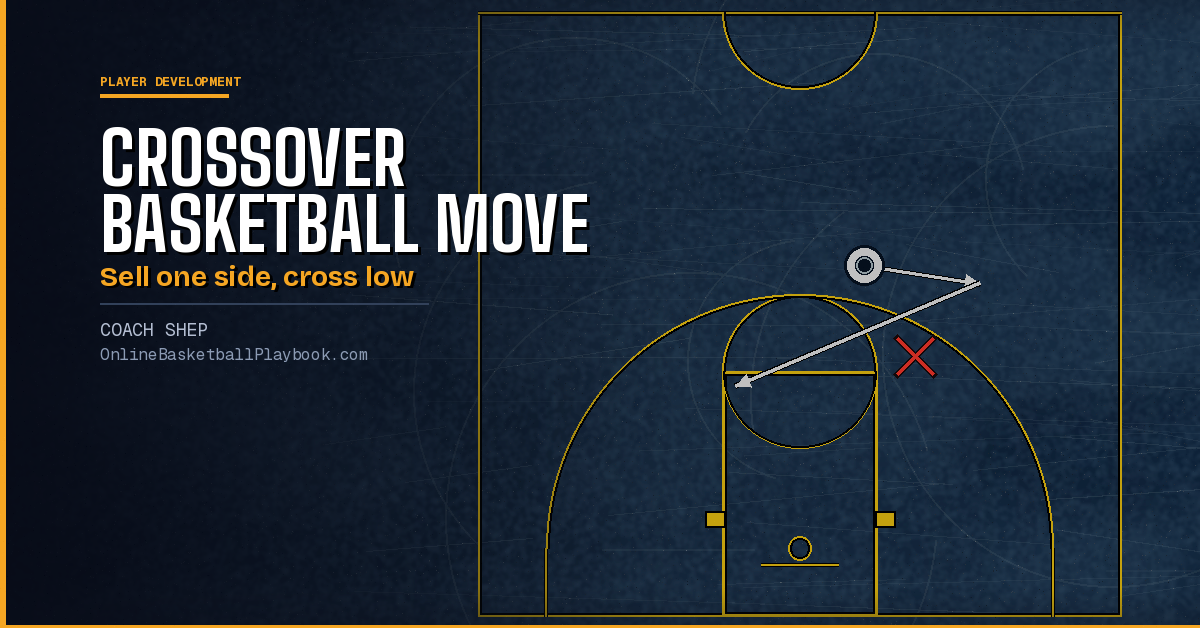
Crossover Basketball Move: How to Do It and Teach It
How to teach the crossover in basketball: the four steps, change of pace, footwork after the cross, the in and out counter, the read that follows and drills.
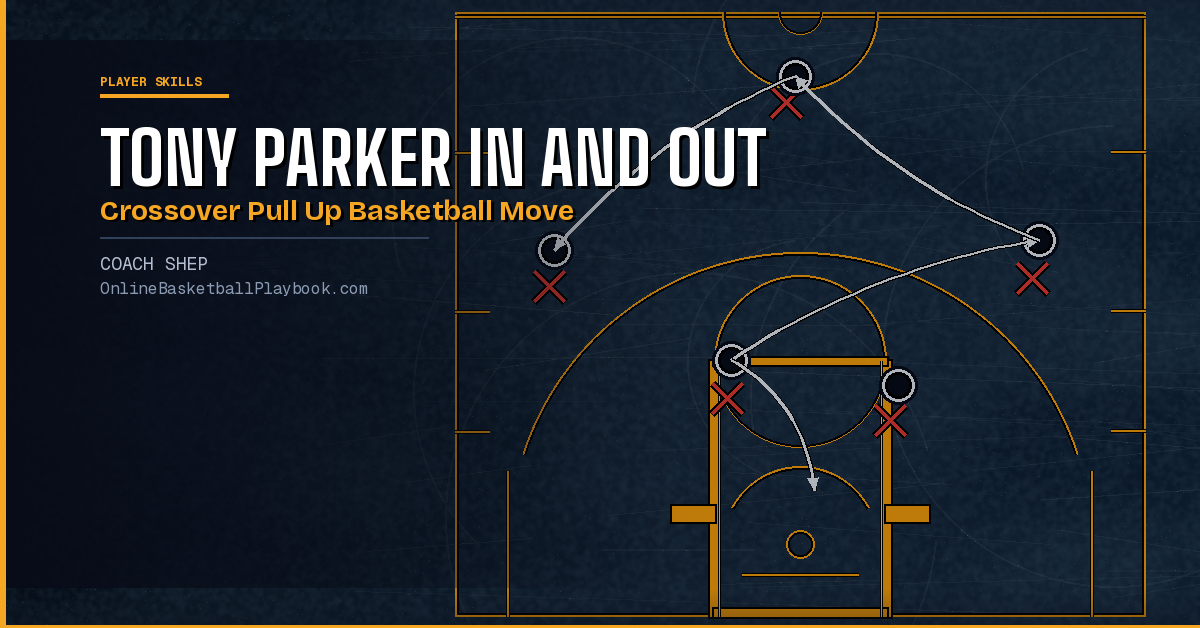
Tony Parker In and Out Crossover Pull Up Basketball Move
Tony Parker In and Out Crossover Pull Up Basketball Move
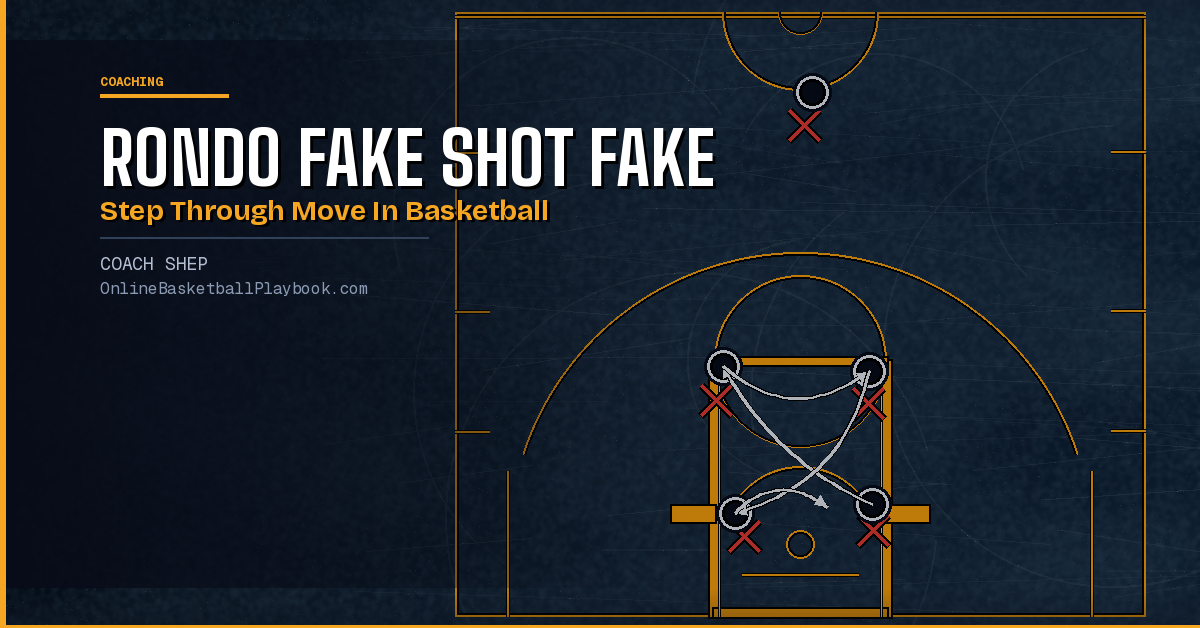
How to Do a Rondo Fake Shot Fake Step Through Move in Basketball
How to Do a Rondo Fake Shot Fake Step Through Move in Basketball