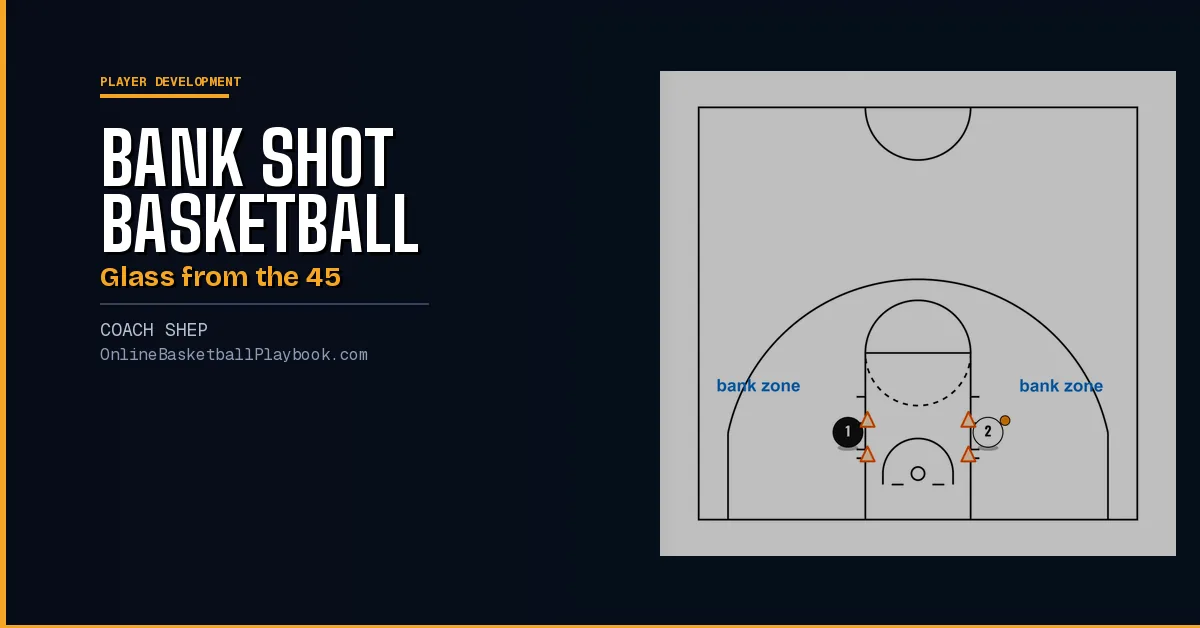
A bank shot in basketball is a shot that hits the backboard first and drops into the basket off it. It works best from about a 45 degree angle to the board and close to the rim, and a layup off the glass is the first one most players learn. This guide covers where on the floor the glass helps, where to aim on the backboard, how to shoot a bank shot, bank finishes in traffic, the drills that build it and why so many players leave it out of their game.
The straight-on jump shot and its aim point, the back of the rim, are on the rim aiming guide, which also has a short bank shot section. The shot itself, from stance to follow-through, is on basketball shooting form.
Bank Shot Basketball: Why the Glass Helps
Two versions of the backboard's origin are told:
- A wall against the crowd. Fans in a balcony or on a running track above the basket reached out and knocked shots away, so a board went up between them and the basket. Players soon learned to judge its angle and score off it.
- A catcher for misses. The board went up to keep missed shots in play so players were not chasing the ball after every miss.
John Wooden taught his UCLA players to use the glass in post play and above all on the fast break. He held that a 5 to 10 foot bank from the 45 off the break, made at about 75 to 80 percent, was close to as good as a layup.
The reasons coaches give for using the backboard:
- Traffic and big men. The glass gives a shooter a target he trusts in a crowd, over a bigger defender and on a drive that carries too much speed.
- Harder drives. The board soaks up part of the force on the ball, so a player can attack the rim harder and still make a high percentage shot.
- Over long arms. A bank shot has to be released a bit higher than a normal jump shot so it meets the board on the way down. Those extra inches can be enough to clear a shot blocker's hand.
- A new angle. Defenders are taught to stay between the shooter and the rim and to contest the straight line to it. Aiming at the board shifts the target and makes the shot harder to contest.
- The basket as a shield. A post player who banks the ball on the baseline side of the board uses the rim as a partial shield when weak-side help comes across the lane.
- Contact. When a hard foul is coming in the low post, the carom angle holds steady even when the shooter puts a bit more or less force on the ball. Bumping and pushing inside also make a soft swish harder, and the bank leaves more room for error.
- Power moves. A quick pivot and power move creates body rotation that is hard to control, and the board softens the shot.
Know which of these fits your players, then build the shot from there.
Where on the Floor to Use the Backboard
The bank zone sits at about 45 degrees to the backboard, along the lane line from the block up to the hash mark above it.

- Block to the hash mark. The 45 degree angle falls in the stretch of the lane line between the block and the hash mark above it. The angle opens wider as the shooter moves away from the basket.
- See the rim past the board. If the shooter can see the rim sticking out past the back part of the board, he can bank it. That check lands on the same stretch, from the block to the hash mark above it.
- Between 30 and 60 degrees. Call a shot from dead center a 90 degree bank and a shot from the baseline side, where no carom can find the basket, a 0 degree bank. On that scale, 30 to 60 degrees is the best range. Banking from straight on is discouraged, since the ball tends to bounce back out over the front of the rim.
The distance limit is where the versions split most.
| Version | Angle | How far out |
|---|---|---|
| Automatic bank rule | 45 degrees | Every such shot from 10 feet in goes off the glass, which removes the choice |
| Fast break bank | 45 degrees off the break | 5 to 10 feet |
| Five-spot workout | 45 degrees | Glass at 5 feet. At 12 feet the glass is no longer needed |
| 70 percent ladder | 30 to 60 degrees | Few shooters bank on purpose from more than 13 feet |
| Fifteen-foot limit | About 45 degrees | Easiest inside 15 feet |
A wing bank set runs 20 bank shots from the wing angle at about 15 feet, switching sides after each shot. Choose one distance limit and use the same words for it at every practice.
Where to Aim on the Backboard
Most backboards carry a painted box just above the rim, and every aim point here is set from it. If a board has no box, the shooter has to estimate where it would be.
| Version | Aim point | Detail |
|---|---|---|
| Inside the box | A spot just inside the painted box, above the rim | The ball meets the box while it is falling. The follow-through points at a line above the box to give the shot a high arc. |
| Near top corner | The box's top corner on the shooter's side | Used from the 45 degree angle. From other angles the shooter adjusts a little. |
| Layup corner | Close to the box's top outside corner | For a layup close to the basket. On the right side that is the upper right corner as the shooter faces it, on the left side the upper left. Hitting near the corner is enough. |
The near corner and the outside corner name the same spot, the box's top corner nearest the shooter's side of the floor.
On a regulation backboard the painted box is 24 inches wide and 18 inches high. The rim is 18 inches across on the inside and sits 6 inches out from the board.
The aim point moves with the shot. The ball comes off the glass in a straight line set by its speed and the angle of the shot. The wider the angle, the farther outside the box the ball has to hit, and a soft, high-arching shot can bank in from inside the box.
Teach one aim point first, then show players how arc and angle move it.
How to Shoot a Bank Shot
The cues for a shot off the glass:
- Hit the glass on the way down. A shot without enough arc hits the board on the way up, skips off and misses toward the weak side. One teaching rhyme for it is "Up, Down, Kiss, In."
- A little higher. Release the ball a touch higher than a normal jump shot so it can come down onto the board.
- Soft touch. Even on a hard drive, kiss the ball off the glass as softly as you can. The board absorbs some force, but not all of it.
- Backspin only. Put the same light backspin on the ball as on a jump shot. Side spin or a diagonal spin adds force you do not want and costs accuracy.
- Sit and shoot from the pocket. Don Meyer's cues for shooting off the backboard were to sit and shoot, keep the ball in the shooting pocket instead of dipping it, and hit the board with the ball on its way down.
- Swish, never short. Meyer wanted bank shots to swish and never come up short, and his cue for every shot was the back half of the basket.
Coaches split on where the eyes go:
- Hard focus on the board. Pick the spot on the backboard early and hold the eyes on it until the ball reaches the basket, never following the flight of the ball.
- Wide focus. On a bank shot, widen the focus to take in both the rim and the backboard, so the body can read the angle and the speed it needs.
Whichever cue you choose, use the same words on every rep.
Bank Finishes and Layups
The layup is the first bank shot most players learn. Close to the basket on the right side, a shot that hits near the upper right corner of the box drops in, and the same holds on the left side with the left corner. Full layup technique is on basketball layups and how to do a layup.
- Opposite-side layup for form. Stand flat-footed opposite the shooting hand, on the rim's far side, and lay the ball in with the dominant hand, targeting the top outside corner of the box. A flared elbow sends the ball into the rim, so the drill forces the elbow in and the hands into place.
- Pull-up bank on the break. On a fast break against one defender who is waiting for the layup, a pull-up bank from about six feet gives the shooter an open shot and avoids a charge. If the defender steps up to stop it, the shooter fakes and drives past. On a hard drive the forward momentum carries the ball into the board, which suits the bank. More on running the break is on fast break basketball drills.
- Post moves. Bank the shot after a quick pivot and power move, use the baseline side of the board against weak-side help, and use the rim and the board together on a reverse spin or a duck under. Post footwork is on basketball post moves.
- English on hard shots. A player who uses the glass a lot learns to put extra spin on the ball. That is not normally a trait you want on a shot, but it helps a skilled finisher who is grabbed or fouled near the rim.
- Backboard pass. With no other passing angle on the break, a player can throw the ball off the glass to a trailing big for the follow. It is a lower percentage play.
- Tip it to keep it alive. On a rebound you cannot control, keep the ball alive by tipping it against the board, to yourself or a teammate, instead of straight up. It is easier to control the second touch that way, and teams drill it with several taps off the board before the put-back.
Finishing work that sticks to the glass includes the Mikan drill, which builds touch off the backboard with no dribble, alternating baby hooks off the board from each side. It is on the Mikan drill. A finishing circuit can run two baby banks with each hand between its hooks and floaters. Other finishes are on finishing at the rim.
Bank Shot Drills
These drills start close and move out, and most of them count makes, not attempts.
Toss and Bank Warm-Up
The player starts under the basket and tosses the ball high so it bounces at a spot outside the lane between the right block and the hash mark above it. He runs to it, catches with a jump stop and his back to the basket, front turns on his left foot toward the baseline and faces the rim at about 45 degrees. He jabs with his right foot, shows a shot fake, then shoots the bank jump shot aimed at the top near corner of the box. Then he does it on the left side, pivoting on the right foot. He records makes out of 10 from each side, and after five in a row from both sides he moves out to 9 feet.

Block to Block
The player stands on one block, drops low and touches the ball to the floor, then rises into a bank shot. He rebounds and moves in rhythm to the other block to do the same. Every shot is a bank, and the drill ends at 20 makes from either side.

Three-Line Bank and Swish Race
A team drill with three lines. Two lines start at the blocks and angle out from the lane, and one line stands in the middle. The side lines shoot off the backboard and want swishes off the glass, with the ball already dropping as it meets the board. The middle line wants swishes that touch neither the board nor the rim. Each shooter gets his rebound, hands the ball off, runs to half court and rotates to the left. The goal is 60 makes as a team inside 2 minutes.

Distance Ladder at the 45
A five-spot workout starts 5 feet from the basket. The player makes 5 just outside each block and 5 from straight in front. Then he moves to a 45 degree spot on each side, still 5 feet out, and makes 5 from each using the glass. He repeats the five spots at 8 to 10 feet and again at 12 feet, where the 45 degree shots no longer need the glass. A 70 percent ladder holds the bank shooter at no more than 6 feet until he hits 70 percent or better, then moves him to 7 to 10 feet, then 11 to 13 feet at the same standard.

More Bank Shot Drills
- Three-spot bank series. Three players (a shooter, a passer and a rebounder) and two balls. Every shooter gets 45 attempts, split into three sets of 15, and every attempt is a 45 degree bank. The second set adds a sprint out to the arc and back down to the block before the catch, and the third set is a bounce-bounce-shoot from the left side with the ball kept high.
- Circle shots. The player shoots off the glass while moving in a half circle around the basket about 6 feet from the rim, goes all the way around, then shoots his way back to the start.
- Wing bank shots. 20 bank shots from the wing angle at about 15 feet, switching sides of the floor after each shot.
- Young shooters. A shooting game for young players puts its spots at the 45 degree angle so they get used to the board.
More shooting work is on basketball shooting drills and competitive shooting drills. Count makes from both sides, then move back one step.
Why Players Skip the Glass
Two reasons explain why players stopped using the backboard: they do not understand how to use it, and they do not practice it. Only a handful of players shoot the bank shot consistently. Many players who had never used the backboard outside of layups became good bank shooters after one summer of practice.
Coaches do not agree on when to teach it.
- Bank from the start. A youth shooting game puts its spots at 45 degrees so young players get used to the board from their first shots.
- Layups first, banks later. A bank can go in without much arc, so young shooters drift into flat banks and build a low-arc habit that is hard to fix. In this view beginners bank only on layups, and the bank shot comes once a good arc is in place. Outside banking can also blur the target choice at game speed, and the practice time goes to the shots that make up most attempts.
Whichever view you take, check that the ball meets the board on its way down. Fixing a flat shot is on how to fix common shooting errors.
Questions Coaches Ask
What is a bank shot in basketball?
A shot that hits the backboard first and goes into the basket off it. It is most often taken from about 45 degrees to the board and close to the rim, and a layup off the glass is one.
How do you shoot a bank shot?
Use your jump shot form, aim at the box above the rim near its top corner on your side, release a little higher than usual and hit the board while the ball is coming down. Keep a light backspin and a soft touch.
Where do you aim on a bank shot?
Two versions are taught. One aims just inside the small box above the rim, and the other aims at the box's top corner on the shooter's side. The wider the angle, the farther out from the box the ball has to hit.
When should you use the backboard in basketball?
From about a 45 degree angle and close in. One rule makes every 45 degree shot inside 10 feet a bank shot, and other versions stretch the zone to 13 or 15 feet. Banking from straight on usually kicks the ball back out over the front rim.
Is a bank shot easier than a regular shot?
From about 45 degrees and close in, it is a high percentage shot. The board absorbs some force, so it forgives a hard drive or a bump, and John Wooden valued a short 45 degree bank almost like a layup. From straight on, the ball tends to kick back out over the front rim.
Why don't players use the backboard more?
Coaches point to two causes: players do not know how to use it and do not practice it. Some coaches also hold off on bank shots for beginners so they do not learn a flat shot.
Every diagram on this page uses the symbols on how to read a basketball play diagram.
Get the next coaching guide in your inbox
One email when a new guide or diagram set goes up. Free.
Want the printable playbook packs?
Playbook packs: zone attack, press break, press defense, out of bounds, quick hitters, practice plans and the youth turnover cure, each a printable PDF. Or draw your own version free in PlayDraw.
See the playbook packsRelated Guides
Back to Basketball Shooting Form and every Player Development page.
Keep Building
Related breakdowns
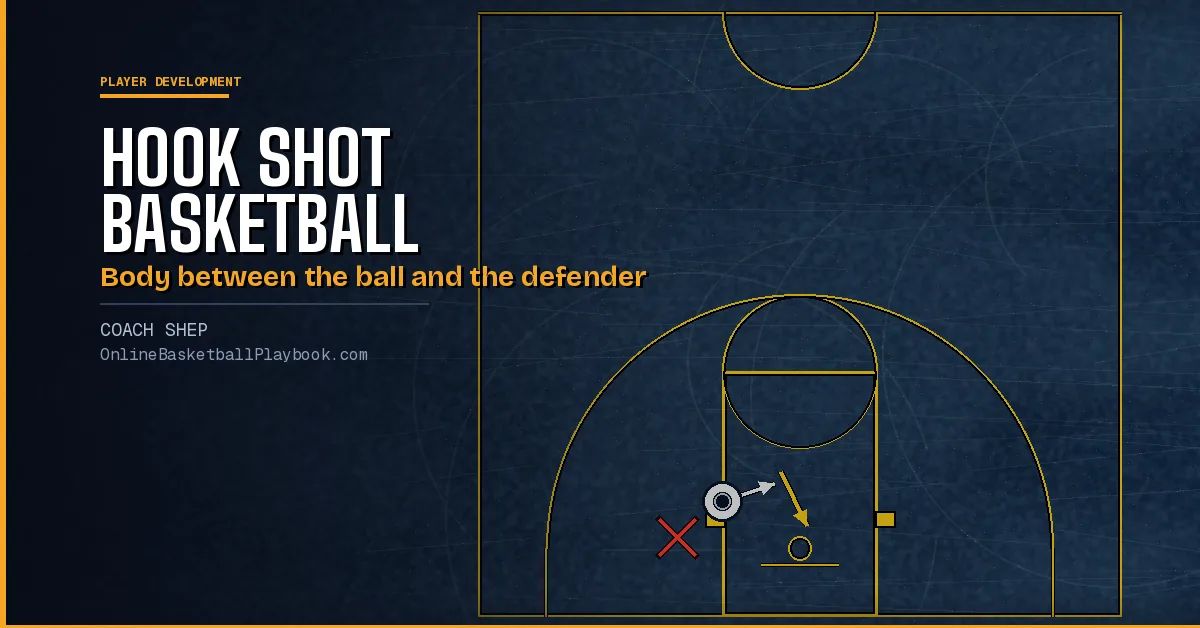
Hook Shot Basketball: How to Do It and How to Teach It
Hook shot basketball for post players and coaches: the classic hook, sky hook and jump hook, the footwork steps, when to use it, the pivot foot rules and drills.
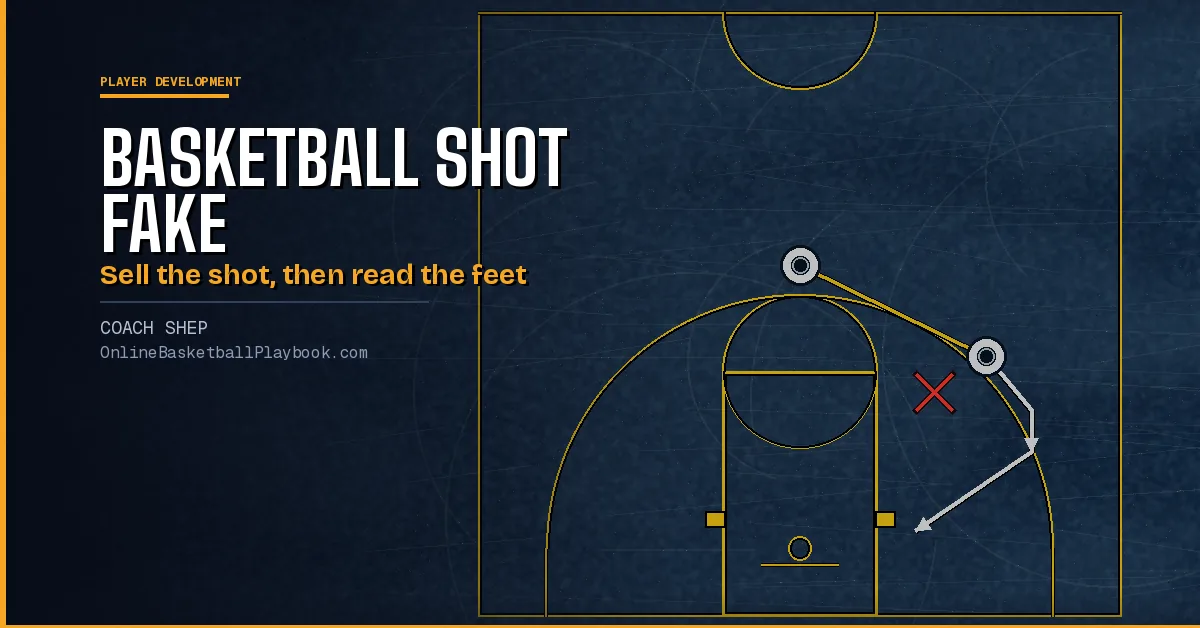
Basketball Shot Fake (Pump Fake): How to Do It and Teach It
The basketball shot fake, also called the pump fake, works when it looks like the real shot. The mechanics, the pivot foot footwork, the read and the drills.
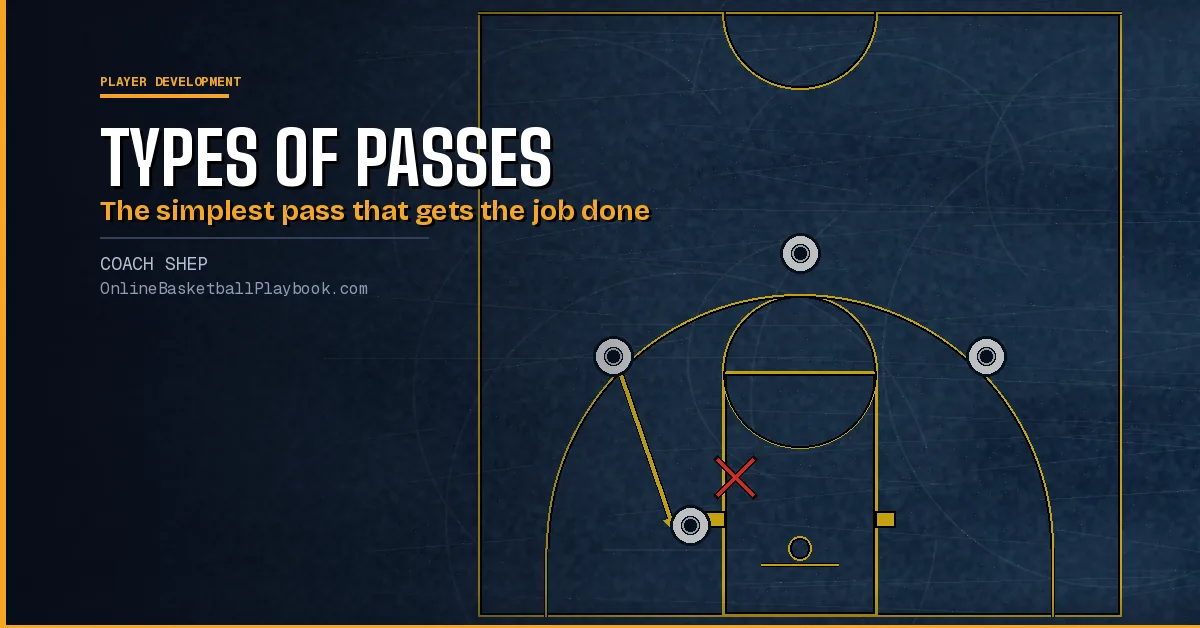
Types of Passes in Basketball: When to Use Each One
Types of passes in basketball: the chest, bounce, overhead and baseball passes, one-hand and post passes, named passes like the skip and pocket, and when each fits.