Basketball cone drills use cones, pylons or flat markers to mark where a player turns, stops, makes a move or comes off a screen. This guide sorts basketball drills with cones into four groups: agility and footwork grids, ball handling around cones, cone shooting and conditioning drills, and pylon games for young players. Each drill gives the setup, the action and its coaching points.
The timed cone tests (lane agility, the 5-10-5, zig-zag sprints and the sprinting figure 8) and the cone reaction drill are on basketball agility drills. Closeout cones and cone races are on basketball speed and agility drills, and cone relays for small children are on youth basketball dribbling drills. This page adds the drills those guides do not cover.
Agility and Footwork Grids
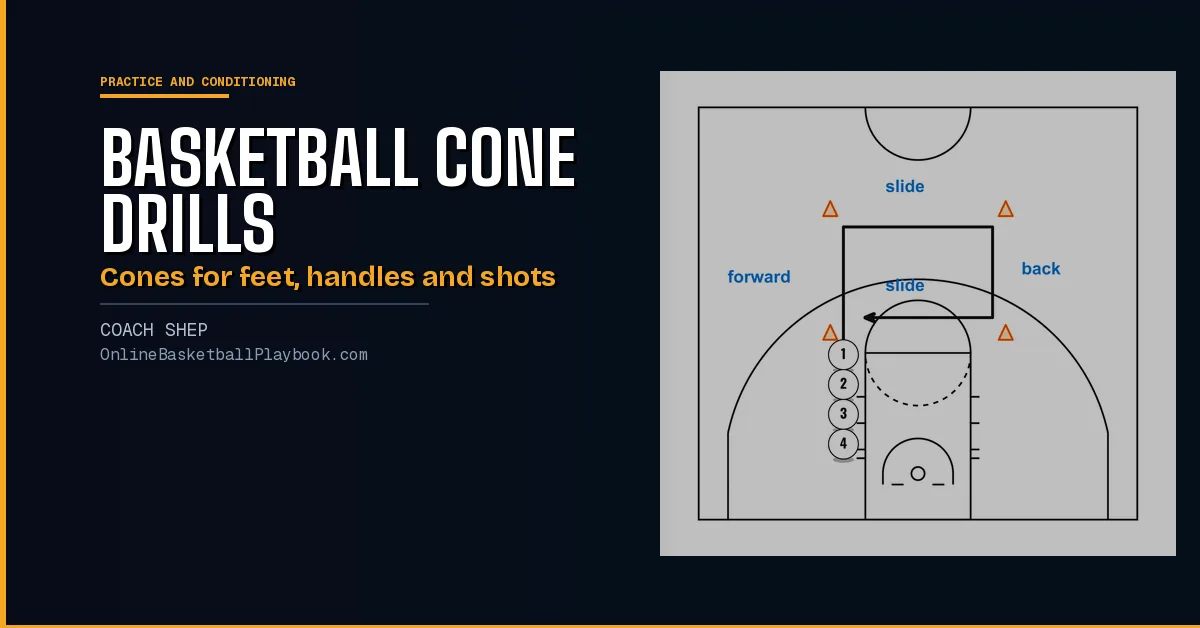
The Pylon Grid
Setup. Four pylons make a square. With no pylons, use shoes or chairs, or use the lane at a basket as the grid. About four players to a grid works well. Players can each start at their own pylon or line up behind one starting pylon.
Action. Players move around the square in four planes: forward, sliding sideways to the right, backward and sliding sideways to the left. Then the same square carries one skill after another.
- Mixed movement. Forward with skips, gallops, bounds or hops. Sideways with slides, skips, carioca or hops. Backward with gallops or drop steps. Young players can move like a bear, a kangaroo or an inchworm, or move tall, small, wide and narrow.
- Speed changes. Walk, jog and run, changing pace at a set point on the square, and the same while moving sideways.
- Direction changes. Sharp, controlled 90 degree cuts at each corner. The next time around, start the other way.
- Circle the pylon. Run hard at a pylon, stutter the feet and circle it, going inside first one time and outside first the next.
- Diagonal cuts. Cut corner to corner, forward, sideways or backward. Paths cross in the middle, so players must talk as they go through.
- Stops. Players find four ways to stop: a 1-2 stop with the left foot forward, a 1-2 stop with the right foot forward, a two-foot stop and stutter steps.
Coaching points. Teach players to watch for when to start and stop. Add the ball only after they have some control of the movement. To load the stop, give each pylon a task (a push-up, a squat, a hop over the pylon), add the ball, have them work the four pivots (front and back on each foot) or run a figure-eight ball handling drill. Footwork for stops and pivots is on basketball pivot footwork.

Figure of Eight With a Ball Drop
Setup. Partners share two flat markers, which are easier to step over than tall pylons. One partner works and the other counts and holds a ball.
Action. The drill builds in three stages.
- Footwork. The player does three figures of eight around the markers with short, choppy steps, moving forward, sideways and backward.
- Ball drop. When the partner lets the ball go, the player bursts out of the pattern and must catch it before it bounces twice. A finish at the basket can be added after the catch.
- Dribble. Now the player dribbles through the same footwork, and the partner makes sure his eyes stay up. The partner can show ten fingers to call for the ball, or can point for the player to explode that way.
Coaching points. Watch for long bounds or jumps over the markers. The key is an explosive first step out of the pattern and a catch on balance.

The Ickey Shuffle Between Markers
The same three stages work with a lateral pattern. The player begins beside the markers, not between them. His near foot steps sideways and the outside foot follows. Then the first foot lands beyond the second marker, and the trailing foot comes up but stays off the floor. That makes two steps inside the markers and one outside. The pattern teaches planting the outside foot and pushing off. Good ball handlers work up to a single sharp crossover across the body in the middle of each shuffle. Any of these partner drills can lead straight into layups, shooting or one-on-one.
Quick Feet Into a Catch
Setup. Five cones in a row along the free-throw line extended, from near the sideline toward the lane. A coach with a ball stands on the other wing.
Action. The player works through the cones with quick feet in a low stance, the way a cornerback moves. As he comes out, the coach throws an early pass. He can take a jump shot, a one-dribble jump shot or a layup.

More footwork work is on basketball footwork drills. Keep the reps short so every one is at full speed.
Ball Handling Drills Around Cones
Stationary and two-ball work is on ball handling drills, and the moves themselves are on the basketball dribble moves guide. These drills put the moves on the move.
Three Cones Across Half Court
Setup. Three big cones staggered across the floor at half court. The line starts on one sideline.
Action. The first player walks the ball to the first cone, dribbling right-handed, and makes the move three times there. He explodes to the next cone, makes three more, then explodes to the last cone and the far sideline. The next player starts when the first one reaches the third cone.
- Progression. Start with a straight crossover. Next comes a between-the-legs with the front foot alternating, then a behind-the-back with a rock. Last, mix all three, one per cone, in any order. Three at each spot.
- Double moves. Make a combination move at each cone, explode, and make a different one at each of the next two. Inside-out, inside-out can be added.

Tight Cones
Setup. Small cones set close together across the floor.
Action. The player dribble walks to the first cone, takes one gather dribble, makes the move and goes on to the next cone. The next player starts once the first has cleared the last cone. Work one move per round in this order: straight crossover first, between the legs second, behind the back third. The last round mixes all three in any order.
Inside-out version. The cones sit in two sets of three. Every cone gets an inside-out. The right-hand set is worked with the right hand, the left-hand set with the left.
Coaching points. Move the ball fast at each cone but do not run. The speed belongs to the ball, not the feet. The off-ball foot steps in past the cone while the ball stays outside it. A version with six chairs in two rows is on 50 basketball dribbling drills.
Baseline to the Far Rim
Setup. Cones up the floor and every player on the baseline holding a ball.
Action. Each player dribbles to a cone, makes a move and goes on to the next. At the end he circles a cone and attacks the far rim, with a move at half court and at the three-point line before the layup. The moves are the inside-out, crossover, behind the back and between the legs.
Coaching points. After a crossover, step sideways so both feet clear the cone, since in a game the player has to get past a much wider body than a cone. Keep the hips down from cone to cone with the ball below the knees, and the crossovers get quicker.
Two-Cone Drive
Setup. Cones or chairs (or a defender) at two spots: level with the 28 foot mark on the sideline and at the elbow. The coach stands in front of the rim.
Action. The player starts near half court with the ball and changes direction at the first cone, dribbles to the second and changes direction again, then finishes at the basket with the coach contesting. In a variation he makes one change of direction at a cone, then pulls up for a one or two dribble jump shot at the free-throw line. Run it for a set number of reps or for time.

More Ball Handling Drills With Cones
- Corner to the middle cone. From a corner, left hand on the ball, sprint dribble to a cone at mid-floor and change direction there with a combination, a behind the back, a crossover or a between the legs. Next, sprint dribble to the corner on the half court side, turn, and repeat back to the start. Next time, change direction the other way. Up to four players can run it.
- Random cones. For 30 seconds, go from cone to cone in no set order with any move.
- Around the cone to a layup. Start on the baseline with the left hand, dribble around a cone and finish with a layup. On the other side, go around the cone with the left hand, then add a change of direction before the layup.
- Chair layup relay. Two lines on the baseline. From a triple threat move, the first player dribbles at a chair or cone, uses the called move to get around it, scores with a strong layup at the far basket and stays in that line. The next player goes as soon as the player in front makes his move at mid-court. Switch sides after 4 to 5 minutes. The standard is 30 made layups in 2 minutes.
- Six-spot spin series. Six chairs or cones down the floor. Speed dribble to the first spot and spin, then go to each spot in turn with continuous crossovers, inside-outs, hesitations, behind the backs and combinations, spinning at every spot and driving for a layup at the end. The right hand works the trip down and the left hand the trip back, three times each. A two-ball version uses pound, alternating, sliding and crossover dribbles. Coaches hold up numbers for the players to call out so their heads stay up.
- Zig-zag finish. Each player starts on the baseline with a ball and pushes up the floor in 4 to 5 hard dribbles, pivots, gives the ball to the coach and sprints to take a return pass and drive for a layup. He rebounds his own shot and works back through zig-zag cones, progressing through a crossover, a behind the back, a between the legs, a spin and an in-and-out on later trips.
Pick one move per trip, and make it at game speed before adding the next.
Cone Shooting and Conditioning Drills
In these drills the cone stands in for a screen. A player curls, fades, flashes or zipper cuts around it, so one shooter and a passer can work on shots off screens. The coach needs a rebounder and has to move as the passing angle changes. Coaches can add a dribble to any of these shots to make them harder. Reading real screens is on basketball shooting off screens.
Curl Off the Baseline Cone
Setup. Cones near both short corners on the baseline and on both wings. The coach passes from the top of the key.
Action. Four shots in order:
- From under the rim, curl off a baseline cone for a jump shot.
- Sprint to the opposite cone for a curl three.
- Jog under the rim, stop for a moment to change speed, then sprint to the baseline for a jump shot.
- Sprint to the opposite cone for another curl three.
Coaching points. On the two baseline jump shots, pivot on the inside foot.

Change of Speed and the Fade
The player curls off the baseline cone for the first shot. For the second he walks under the rim, then bursts off a cone in the middle of the lane, straight up the gut. For the third he walks to the elbow area and fades off the cone there in a defensive slide, opening up so the sideline is behind him, while the coach skips the pass to the wing. The change from a walk to a sprint is the point.
Pop or Cut at the Elbow Cone
The player sprints to a cone at the elbow. As he gets there the coach shouts either "pop" or "cut." He answers by planting hard and pushing off into whichever one was called.
Screen Reads With Cones
- Zipper, fade and stagger. The player zipper cuts for a three at the top of the key, comes off a fade screen and tracks down the pass, and uses a stagger of two cones for a jumper, a one-dribble jumper or a layup.
- Walk him into the screen. From any spot, the player walks his imaginary defender into the cone and fades to the corner for a three. He walks him toward the rim and comes off the cone for a curl jump shot. He walks under the rim and sprints right behind the cone for a step-back three.
- Top three, then a layup. Two coaches and three players. Player 1 starts under the rim, sprints out to catch a coach's pass up top and shoots the three, then dives down the lane, where player 2 feeds him for a layup and rebounds it. The next round, the pass comes from the other coach and player 3. Repeat for the set number of reps.
Dribble Through, Then Shoot
The player dribbles through cones from half court with a low crossover, a step-through or a hesitation, two-foot jump stops and chest passes to the coach. He then sprints to a cone and fades for a jump shot, or jogs under the rim and sprints off a cone for a jump shot. Combinations: fade then curl, a one-dribble jumper then a fade, a fade then a one-dribble jumper.

Post Cone Drills
- Two-coach post series. The post steps to the ball for a jump shot and curls baseline off a cone for another. Then he steps into the lane and pops out beyond the arc for a three. Last he sprints to the first coach, catches, spins and either scores at the rim or turns the spin into a jump shot.
- Flash and cut. Cut off a cone for a jump shot in the free-throw area, flash to the near lane line for a jump shot, and step into the lane then cut sharply up the middle for a three, using a cheat step.
- Seal and spin. Sprint along the baseline for a curl jump shot. Get into a defender on the block, spin and seal for a layup. Move up the lane, reverse pivot on the outside foot and shoot, or use one dribble.
Drive, Finish, Then Cut
The player starts near half court with the ball and drives at a cone or chair, makes a change of direction move and finishes at the basket or pulls up. He rebounds, scores any miss, gets the ball back to the coach up top, then goes to the block and L cuts to the wing to catch and either shoot or work a triple threat move.
More shooting work is on basketball shooting drills and catch and shoot basketball. Run every cut at game speed.
Pylon Games for Young Players
The same four-pylon grid runs games for children. Three ideas drive them: use simple props to help teach, load the drill instead of changing it, and make practice read like a book. Grid size matters. A bigger space adds conditioning, and a smaller one helps the defense and shortens passes. Balance work and rest, since more players in a drill means more rest and less work, and too many standing players lose focus.
- Mirror-mirror. A leader moves back and forth, with or without a ball, and tries to make his partner overrun him in one direction.
- Read the chest. The leader tries to step through between the pylons, and the defender tries to get his chest in front of him to stop the move. It teaches faking, defensive stance and reading another player, with or without the ball.
- Mirror shuffle. The leader shuffles side to side with a partner mirroring him. When he sees an edge he sprints around an end pylon and tries to pick up a ball before he is tagged. Explain a safe tag first (no pushes or slaps), and add a time limit if a player stands still. Loads: a different starting movement, a dribble around the pylon and out the other side before the tag, or picking up the ball to play one-on-one at a basket.
- Dribble tag. One player is it and times how long it takes to tag the other three, or the tagged player becomes it, or everyone tries to bat every other ball out of the square. A tagged player can do a task and come back (score a layup, do a figure eight with the ball), take over as it, or stand frozen, legs apart, until a teammate dribbles a ball through them. Elimination is not a good option.
- Dribble pass. While one player speed dribbles laps around the grid, the rest count the passes they complete before he finishes, or count his laps until they reach a set number of passes. Loads: mix the passes, dribble two balls, pass two or three balls. It helps players learn to manage their own speed and effort.
- Advanced dribble tag. Everyone has a ball. One player chases his partner while the other two dribble in place, and the player being chased can use them as screens. It makes players keep their heads up, change speed and direction, fake and protect the ball.
- Double team. Two players try to trap the dribbler, who decides when to pass or pick up the ball. If the defenders get it they go to offense.
- Pass, cut and fill. A player passes, cuts to the center and stops, and the others fill the open pylons. The receiver pivots to face the middle and passes again. Later players learn to pass to the spot, not the player, and to add a fake away before the cut.
- Relay pass. Add a defender in the middle of the grid. After a pass the passer cuts to the middle while the defender tries to deny him, and the player without the ball fills the empty pylon. The two perimeter players decide who has the better passing angle to the cutter. Load it by making the middle player catch a pass from all three perimeter players, who move to open relay angles. Next stage: the ball handler starts with his back to the play and pivots when the coach calls a teammate's name, and that player cuts to the middle. It teaches passing angles and sealing.
- 4 on 2. Two defenders work together to keep the ball out of the middle, and they may not double-team the middle player. A smaller grid makes it harder and forces pass fakes and relay passes.
- Keep away. Score it by passes completed, or by passes in a set time. Older players may screen, and a bigger space makes it easier for the offense. Loads: a 1-second rule, where the ball handler must pass or dribble within a second, and allowing double teams.
More games for this age are on basketball drills and games for kids and basketball practice drills for youth. Keep every child moving and keep each game short.
To fit these drills into a session, see practice plans and basketball warm-up drills. How coaches weigh planned cone courses against reaction drills is on basketball agility drills.
Questions Coaches Ask
What are cone drills in basketball?
Drills that use cones, pylons or markers as turning points, stand-in defenders, stand-in screens or stop spots. They cover footwork grids, dribble moves at each cone, shooting off a cone as if it were a screen, and grid games for young players.
What are good basketball drills with cones?
A four-cone grid for movement and stops, a figure of eight with a ball drop, three cones across half court for dribble moves, a two-cone drive to the rim, and a curl off a baseline cone for shooting.
How do you set up cones for basketball drills?
It depends on the cone's job. Use a square of four for grid work, a row along the free-throw line extended for quick feet, cones staggered across half court for dribble moves, and cones at the short corners and wings for shooting off a stand-in screen.
Can you do basketball cone drills alone?
Yes for most of the dribbling drills, such as three cones across, tight cones and the random cone pattern. The shooting drills need a passer and a rebounder, and the ball drop, the quick-feet catch and the games need a partner or a coach.
What can I use if I don't have cones?
Shoes or chairs work, and the lane at a basket can serve as a ready-made grid. Some dribbling drills use chairs in place of cones.
Every diagram on this page uses the symbols on how to read a basketball play diagram.
Get the next coaching guide in your inbox
One email when a new guide or diagram set goes up. Free.
Want the printable playbook packs?
Playbook packs: zone attack, press break, press defense, out of bounds, quick hitters, practice plans and the youth turnover cure, each a printable PDF. Or draw your own version free in PlayDraw.
See the playbook packsRelated Guides
Back to Practice Plans and every Practice and Conditioning page.
Keep Building
Related breakdowns
Basketball Agility Drills: Cone, Reaction and Ladder Drills
Basketball agility drills from timed cone tests to reaction, mirror and ladder drills and defensive circuits, with schedules and where coaches differ.
Basketball Practice Structure: Segment Order and Time Budgets
Basketball practice structure from the opening drill to the last whistle: segment orders, time budgets, the daily core, rest and the week around it.
Basketball Conditioning Drills for Teams: Runs, Games and Tests
Basketball conditioning drills in three styles, timed runs, conditioning inside skill drills and scored games, with the tests and yearly plans coaches use.