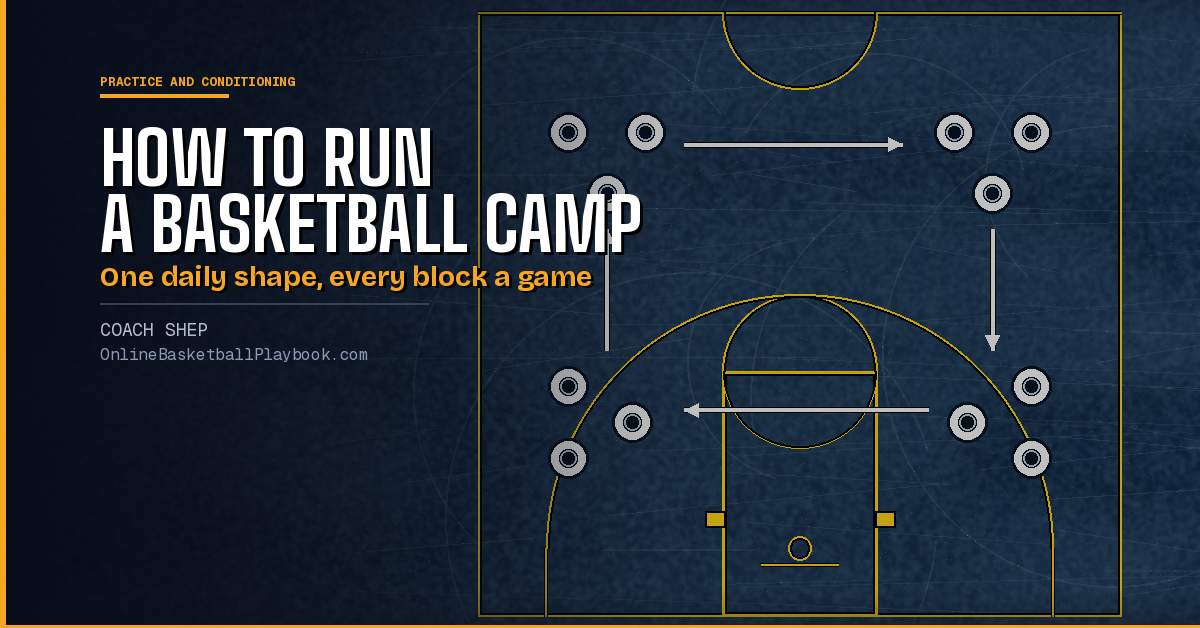
How to run a basketball camp comes down to a few decisions made before the first camper walks in: the goals and the age group, one daily template, stations or small-sided games, how each block competes, who staffs it and how the day closes. This page is the camps hub for the practice and conditioning section. It sets out the schedule shapes camp directors use, the station and game models, contests and awards, staffing and safety, and where directors disagree. The games and drills themselves sit on the guides linked from each section.
How to Run a Basketball Camp: Goals and Ages First
Start with written goals before anything else: skill development, team building, fun and engagement, and access for families whatever their budget. Then it names an age range and a skill level, and only then picks dates and a facility that do not clash with school or local events and have enough court space, equipment and parking.
The age decides most of the rest. The youth material is consistent on the core:
- Ages 6 to 8. This age is short on attention and able to handle one task at a time. Its answer is short, clear directions, a ball for every child, several short activities and water breaks. Spend no more than 5 minutes on one skill with young children. One version teaches movement first (balance, running, stopping, jumping), then basketball skills, then the simplest decisions.
- Ages 5 to 14, team play. A ladder for team play inside a session: 3 on 3 half court at ages 5 to 6, the 4 on 4 shell at 7 to 8, a controlled 5 on 5 at 9 to 12, and a controlled half-court 5 on 5 at 13 to 14.
- Equipment by age. One version uses 8-foot rims for ages 7 to 8, 9 feet for 9 to 11 and 10 feet from 12. Two others use the 28.5 inch ball for younger players.
- Ages 12 to 17. The multi-day clinic is built for players this age who already have basic instruction.
The test of a good youth season is a child who picks basketball when given a free choice. The full youth teaching rules are on coaching youth basketball, and first-week skills are on basketball drills for beginners.
Basketball Camp Schedule Shapes
Camp directors fix one shape and repeat it. Five versions:
- Version 1, a games-based module. Tip-Off, a Competition Ladder when used, Warm-Up, Game Time, Off-Court, Buzzer Beater, Final Buzzer, the same order across all ten modules of the NBA Basketball School curriculum.
- Version 2, station day. Four teaching stations a day, 20 minutes each, then competition.
- Version 3, Saturday camp. A circle demonstration, ball handling, passing, pivots and jump stops, dribble moves, shooting at every basket, layup footwork, small-group competitions and a closing scrimmage, in that order every week.
- Version 4, age-band plan. A 10-minute warm-up, three to five skill blocks of 5 to 10 minutes, a 3 on 3 or 4 on 4 team drill, a shooting contest or free throws, and announcements.
- Version 5, themed sessions. One four-day development camp runs nine timed sessions, each with its own subject (ball handling, individual defense, the fast break, post play, extended and half-court defense, ball screens, zones, review and scrimmage) and each opening with the same dynamic stretch.
The NBA Basketball School day opens with a Tip-Off capped at five minutes. It covers water, bathrooms, rules and the day's expectations, and every camper gets a physical greeting, a high five, fist bump or handshake, which the curriculum calls non-negotiable. Warm-up ideas for the first block are on basketball warm-up drills.
Block length. The rule is 5 to 10 minutes per drill, then move on when time is up, because the longer a drill runs the worse it usually gets. Stations in the station-day version run 20 minutes. Warm-up games in the games-based module run 10 minutes each and its game activities typically 16 to 24 minutes. The Saturday camp runs 90 minutes per group with a 30-minute gap between groups.
Stations and the Rotation Model
In the station model, teaching at stations is the core of the day. Each coach is a stationmaster who has to prepare a lesson plan, and the menu runs passing, ball handling, shooting, rebounding, footwork, defense and conditioning.

Demonstrate, then rotate. The Saturday camp sits the whole group down to watch a skill taught once, with varsity players demonstrating in the middle of the circle. Then the group splits into small groups rotating through every basket, with an assistant at each hoop.

A card for every station. Each station card carries a drill name and two to four teaching cues, ending in a game condition. Every NBA Basketball School activity card lists time, space, equipment, a description, loads, scoring, the staff role, key concepts and guiding questions.
Rotating the shot. A shooting circuit rotates catch-and-shoot, one dribble and shoot, and one dribble and a layup, so every camper hits all three in one period. More station-ready drills are on fun basketball drills.
Small-Sided Games and Loads
The games model makes every block a small-sided game with constraints. In the NBA Basketball School version, warm-ups are tag and knockout games, never stretching in lines, and each module's Game Time mixes 1 on 1 to 4 on 4 games and, in nine of the ten modules, ends in a 5 on 5 capstone. Why small games teach well is on reasons to use small-sided games.
Loads. Every activity in that curriculum ships with 5 to 10 loads, extra rules that raise the difficulty. Two loads are applied before switching games, and each card carries a dial-back load for younger players. Both offense and defense score on nearly every activity, so a stop is worth points too. The lava load bans catching in the paint except on a cut, which teaches spacing without a set offense.

Adding the defender. Add defense in stages: a defender who only offers a foot, then a semi-active one, then full speed, with 1 on 2 for the most advanced. The games model plays live from the first block and sets difficulty with loads. A one-day camp runs a morning of footwork and pick and roll breakdown, then an afternoon of live 1 on 1 up to 4 on 4.
Games for younger campers. These games run with any number of kids: Sharks and Minnows with the sharks dribbling on the weak hand, Dribble and Shoot Reaction, Steal the Bacon, 3 Basket Knockout, Three Basket 21, 2 on 2 Challenge, Relay Dribble and Team Shootout. The full menu is on basketball drills and games for kids.

Get the next coaching guide in your inbox
One email when a new guide or diagram set goes up. Free.
Contests, Awards and the Close
Camp directors put a score on nearly every block. The versions:
- A competition ladder. One format a day: 1 on 1, 2 on 2, 3 on 3, a free throw challenge or a 3-point contest.
- Shooting races. The Saturday camp closes with shooting competitions, first to 7 baskets, and the losers do 5 push-ups with the coaches.
- Stops only. One shell drill scores only on a defensive stop, first to 7.
- Live games to finish. End with 1 on 1 under a two-dribble limit where the scorer stays on, then 4 on 4 in the half court to 21 with fouls worth a point.
- Counting wins and losses. Campers count the 1 on 1s they won and lost, and why.

A tournament inside the camp. One bracket runs 27 teams with a two-game minimum per team in three and a half hours. The 3 on 3 rules: four players a team, three on the floor and one sub, dead-ball subs only, games to 12 (15 in the semis and final), no shot clock, one 30-second timeout and jump balls to the defense. Another version runs a no-dribble tournament for passing and movement without the ball, and a situation tournament of time, score and foul scenarios. More scored games are on fun basketball games and competitive basketball drills.
The close. The NBA Basketball School closes by having each camper write three answers in a notebook: what did you do well, what did you learn today, what do you want to improve. The last block must be something players enjoy, never a punishing drill. End the week with an awards ceremony, then surveys and staff observation to plan the next camp.
Staffing, Safety and Paperwork
Staff. Hire coaches with real playing or coaching experience and certifications, run an orientation on goals and schedule, train staff on emergency procedures, and assign roles such as coaching an age group or handling registration. The Saturday camp puts an assistant at every basket and has varsity players demonstrate. The multi-day clinic recruits local varsity players as assistants and role models. How clinics for coaches run is on basketball coaching clinics.
Safety. Have a written emergency plan, staff CPR and first-aid certification, regular facility checks, clean water and healthy snacks all day, a medical waiver and emergency contact form for every camper, and health policies sent to families in advance. The multi-day clinic adds practice jerseys for scrimmages and a break when players tire.
Sign-ups. Market early with flyers, social media and school and club partners, offer early-registration discounts or referral incentives, collect forms, waivers and fees online, and have camper kits and equipment ready before day one.
A Sample Camp Session
A youth camp day runs 50 minutes in four blocks, each with a game or a score:
| Block | Minutes | What happens |
|---|---|---|
| Tag-game opener | 10 | A tag game to open |
| Ball-handling competition | 15 | Six scored variations of 2 minutes each |
| Pass-and-follow square | 10 | Passing in a square, following the pass |
| 2 on 2 by zones | 15 | 2 on 2 across four full-court zones |
The schedule shapes above, plus the multi-day clinic, side by side:
| Version | Blocks | Block length | Group |
|---|---|---|---|
| Games-based module | Tip-Off, a Competition Ladder when used, warm-up games, Game Time usually ending in 5 on 5, Off-Court, reflection | Warm-up games 10 min, activities 16 to 24 | Youth, ten modules |
| Station day | Four stations, then competition | 20 min per station | Placed by talent, drafted into balanced teams |
| Saturday camp | Demo, handling, passing, footwork, shooting, layups, contests, scrimmage | 90 min per group | Grades 1 to 3, then 4 to 6 |
| Multi-day clinic | 20 min ball handling every day, then the other blocks in a changing order | 20 min fixed opener | Ages 12 to 17 |
| Age-band plan | Warm-up, 3 to 5 skill blocks, team drill, contest, announcements | 5 to 10 min drills | Bands from 5 to 14 |
| Themed sessions | One subject per session | Timed drills | Four-day development camp |
Why a Program Runs a Camp
Coaches give three reasons. As a feeder, a high school program runs an annual summer camp in its own gym beside coaches' clinics for local youth teams and a 7th and 8th grade program, with fundamentals and man-to-man taught early so the pipeline fits the varsity. As a fundraiser, camps sit under fundraising, though one version prefers free day camps for elementary students. As a test, one version uses team camps as a place to test a new role for a player or a new offense. The parent's side of the decision is on why camp is a good decision for your child.
Where Camp Directors Split
Stations
Teaching stations are the core of the day, with a stationmaster and a lesson plan at each one and competition after.
Games
Every block is a small-sided game with constraints, difficulty is set by loads, and warm-ups are games, never lines.
Tag and knockout. One view names knockout and dribble tag as games that train nothing, because a camper who only plays games ends up under-skilled. The NBA Basketball School runs knockout and tag as its warm-ups, with loads attached, and a skill can be built into each tag and knockout format.
One theme or the full menu. Some camps give each session one theme. The Saturday camp runs the same full sequence every week, and the multi-day clinic opens every day with 20 minutes of ball handling, then changes the order of the rest to hold interest.
Grouping. Version 1 groups by grade, 1st to 3rd graders at 8:00 and 4th to 6th at 10:00. Version 2 places campers by talent, then drafts balanced teams. Version 3 groups by growth stage, not age. Version 4 mixes guards and bigs on purpose in the same pick and roll session.
Questions Coaches Ask
How do you run a basketball camp?
Set goals and an age range first, then fix one daily template, choose stations or small-sided games, score nearly every block, staff it with experienced coaches and older players, and write the safety plan before day one.
What does a basketball camp schedule look like?
It depends on the version: four 20-minute stations then competition, a fixed games-based module, or a warm-up, three to five short skill blocks, a team drill and a contest.
What drills work at a basketball camp?
Station drills with two to four cues each, small-sided games with added rules, shooting races, 1 on 1 with a dribble limit, and games such as Sharks and Minnows for younger campers.
How long should each camp drill run?
5 to 10 minutes per drill. Station camps run 20-minute stations, and game activities in one curriculum run 16 to 24 minutes.
Want every diagram, printable?
OBP Pro members get the full diagram files for every drill and setup on this page, ready for a practice binder or a staff meeting. $9 a month. Or draw your own version free in the play drawer.
See what OBP Pro includesMore Coaching Hubs
- Competitive Basketball Drills: Scoring, Stakes and Formats
- How to Build a Basketball Program: Identity, Staff and Culture
- Basketball Leadership: Captains, Accountability and Toughness
- Basketball Scouting: How to Scout a Team and Build the Report
Back to every Practice and Conditioning page.
Keep Building
Related breakdowns
Basketball Speed and Agility Drills: Sprints, Starts and Stops
Basketball speed and agility drills for teams and players: short sprints, starts and stops, court drills with cones, an eight-week summer plan and how to dose rest.
Fun Basketball Games for Practice: Scored Games for Any Team
Fun basketball games for practice at any level: shooting games, defense-only scoring, rebounding contests and passing games, with scoring rules and records.
Basketball Warm-Up Drills for Practice, Games and Youth Teams
Basketball warm up drills from dynamic movement and ball work to layup, closeout and shooting lines, with warm-up lengths and the static stretching debate.