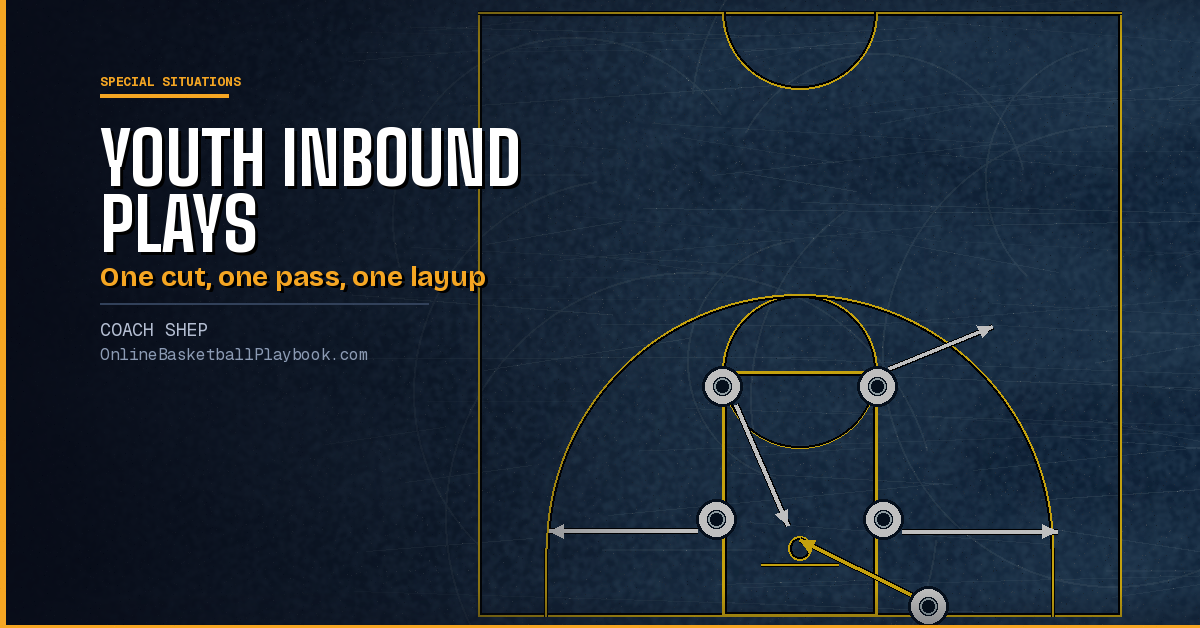
Youth basketball inbound plays should do two things: get the ball in safely and, when the defense loses track of a cutter, get one pass and an open layup. Complex plays with several screens and a pop-out three can work at higher levels, but they are too hard for youth players.
This page gives a young team a small, simple package: two one-pass baseline plays from the box and the line, a box play with a safety built in, the automatic reads that sit under every play, how to choose the inbounder and start the play, two answers for a zone, the rules that cost youth teams the ball and how many plays to carry. The full library of baseline and sideline plays for older teams is on basketball inbound plays.
Rules for Youth Basketball Inbound Plays
A youth inbound play is judged by whether young players can run it, not by how good it looks on a clipboard. The rules that keep a youth package simple:
- One pass, one layup. Build each baseline play to get one pass and an open layup.
- Everyone else goes away. Every player cuts away from the basket except the one cutting for the layup, so the defense is pulled off the scorer.
- Few shapes. Fourteen simple baseline plays can be built from just two starting shapes, a box and a stack, plus a flat look with two posts low. Choose plays that start from the same shape as your base offense. Running several calls from one shape keeps the defense from reading the play from the setup.
- Few plays. Carry three or four plays in total for a youth team. Four suits a grade school or middle school team.
- Primary first. Do not show players the second options until they are good at the first ones.
- Screen angle. Set the screen on the defender's back or hip so he cannot slip under it, and never face the direction you are about to cut or screen.
Keep the plays short and run them hard.
The Box Play: One Cut, One Pass
The box puts two players on the elbows and two on the blocks. In the one-pass version for young teams, the 4 always inbounds, and the play is called by name, "Box" plus the name of the player who will score. The called player must start on one of the elbows.

- The slap. Everyone cuts hard when 4 slaps the ball.
- The cut. 1 may take a step back or outside first, then cuts directly to the basket, not in a circle.
- The inbounder's eyes. 4 looks hard to the outside, not at the lane, so his defender hedges toward the near corner.
- The finish. 1 squares up with no dribble, takes a 45-degree angle and uses the backboard.
- If 1 is not open. 4 has 3 and 2 on the strong side and 5 on the weak side.
Who to call: name the player whose defender is not sagging or watching the ball.
Call the name, slap the ball, and cut straight, never in a circle.
The Line Play
The line puts four players straddling the free-throw line, chests to the ball, with 4 inbounding again.

- The cutters away. On the slap, 1, 3 and 5 cut hard away toward center court.
- The scorer. 2 may take one step back toward center court, then goes straight to the basket for the layup.
- Let them squeeze. Let the defenders squeeze between the players in the line.
- No curve. The scorer's cut is straight, never curved.
Rep the timing until all four leave on the slap together.
Two More One-Pass Plays
The same youth package adds two plays built the same way, one pass to a layup:
- Weak-side stack. Four players stack on the weak side and the called player must be the 5. On the slap all four cut hard to the other side of the lane, but 5 goes about a step early, touches the far lane line and cuts directly back off 3's hip. He must reach that lane line to catch his defender on what becomes a three-player screen. The inbounder ball fakes outside to make his defender reach, and 5 catches with no dribble and lays it off the glass.
- Post as a tree. A strong-side stack in line with the ball, with the 5 at the top as a "tree trunk." 3 cuts to the strong corner and 2 to the weak corner as second options. 1 looks like he is cutting back, then uses the 5 as a stationary tree and swings around him to the basket. Going inside-out or outside-in both work.
Four plays is a good number for a grade school or middle school team. Learn them well.
Box Wide and the Safety
Box Wide adds a shot on the arc and a safety. In Box Wide, the post players start wide on the blocks before the screen, which gives a better screening angle. The play works because the post defender is often reluctant to step out and guard the perimeter.

Build a safety into every baseline play, usually a player deep near the top of the key, because opponents scout the first option as the season goes on. More box plays are on box set inbound plays, and stack plays on stack inbound plays.
Every play has a safety. Name him before the ball is handed over.
The Automatic Reads
Under every call sit a few reads the players make on their own, signaled with eye contact and body language rather than a shout:
- Back turned. A player whose defender watches the ball with his back turned cuts straight to the basket.
- Nobody on the inbounder. If the inbounder is left unguarded, he passes in and cuts right back for a return pass, a give and go.
- Face-up defender. If a defender faces up on his man but keeps his back to the passer, throw the lob over him.

The reads beat a defender who is not paying attention. Teach the players to look before the slap.
Choosing the Inbounder and Starting the Play
The inbounder is playing five against four with a five-second count from a fixed spot (the movement rules by level are in the rules section below), so he has to see the whole floor and throw sharp, crisp passes, never a one-handed or soft bounce pass. Choose him for passing and quick reads, sometimes with the size to see over defenders. The youth package above keeps it simple: the 4 always inbounds.
Coaches split on how the play starts:
- The slap. Everyone cuts hard when the inbounder slaps the ball.
- No slap. The official hands the ball to the inbounder to start the count, so a slap wastes time. The action starts the instant the ball is handed over.
- A player's call. A screener yells "go" and the play starts on his word.
For a just-get-it-in situation, run a baseline play with your best free-throw shooters on the floor rather than risk a five-second count. Late-game choices are on basketball clock management.
Pick one start and use it on every play, so nobody leaves early.
Against a Zone
When the other team sits in a 2-3 zone under your basket, the youth zone plays share one idea: use a cut or a screen to pull a low zone defender out of the paint, then attack the gap he leaves.
- Stack and pull. Stack on the ball-side lane line up near the elbow, not too low. The best shooter cuts to the corner calling for the ball, which pulls the low defender out. The 5 screens the middle defender and the 4 slides into the gap. The inbounder reads the low defender: if he follows the shooter, pass inside, and if he stays, the shooter is open in the corner.
- Screen the middle, pull to the short corner. The strong post screens the middle defender while the other post cuts around the screen to the short corner calling for the ball, pulling the low defender out. The screener then seals inside for the pass and a power layup.
- Shooters on the blocks. Start the best shooters on the blocks and split them to the corners, with two posts stacked near the free-throw line. Once the corner players pull the low defenders out, the posts cut around the middle defender to the blocks.
A box play can work against a 2-3 as well when the down screen goes on the zone's outside low defender instead of a man. More zone answers are on inbound plays against a zone.
Pull a low defender out, then cut to where he was.
Get the next coaching guide in your inbox
One email when a new guide or diagram set goes up. Free.
Rules That Cost Youth Teams the Ball
Two rules decide youth inbound plays more than any scheme. Know which ones your league uses:
- Five seconds to release. NCAA men and women, the NBA and FIBA all give the thrower-in five seconds to release the ball. The NBA counts from when he receives and controls it. For high school, check your state association rulebook.
- Three seconds on a throw-in. In NCAA men's and women's rules, the three-second rule is not in effect while a team has the ball for a throw-in, so a post can stand in the lane before the catch. NFHS, NBA and FIBA were not checked for this page, so check your own rulebook.
- Running the baseline. After a made basket, NCAA, NBA and FIBA rules let the thrower-in move along the end line. For high school, check your state association rulebook.
The count by level is on 5 seconds rule basketball. Teach the count in the first week, before the first play.
How Many Plays and How to Practice Them
Keep the menu small enough to run well:
- Three or four in total. Three or four plays for a youth team, matched to the base offense's shape.
- A short mix. A couple of baseline plays against man, a play or two against a zone and one sideline play.
- Plays as the reserve. A base offense that teaches decisions comes first, with plays as a score-now option.
- A counter for later. Install a play, and once the defense has seen it, install the counter that fakes the same action and cuts the other way.
Practice against defenders. A play that only works five against nobody in practice tends to fail in games. Two youth sideline plays, an elbow-screen cut to a layup and a zipper pick-and-roll, are on basketball inbound plays, and the screens behind every play are on basketball screens. The rest of coaching a young team is on coaching youth basketball, and every situation page is on the situations hub.
Run few plays and run them well. That is the whole youth package.
Questions Coaches Ask
What are good inbound plays for youth basketball?
Simple one-pass plays from a box or a line, where everyone cuts away from the basket except one player who cuts straight to the rim for a layup. Add one box play with a safety near the top of the key.
How many inbound plays should a youth team have?
Three or four in total. A couple of baseline plays against man, one or two against a zone and one sideline play cover a season.
Who should inbound the ball in youth basketball?
A good passer who reads the defense and decides quickly, sometimes with the size to see over defenders. The one-pass youth plays keep the same player, the 4, as the inbounder every time.
Should the inbounder slap the ball?
Coaches split. The slap tells everyone to cut at once. Skipping it saves time, because the count starts when the official hands over the ball.
How do you run an inbound play against a 2-3 zone?
Pull a low defender out of the paint with a corner cut or a screen, then hit the player who cuts into the gap he leaves.
Want every diagram on the site?
OBP Pro members get the full diagram files for every guide on the site, ready for a practice binder or a scouting report. $9 a month. Or draw your own version free in the play drawer.
See what OBP Pro includesMore Pressure, Inbounds and Guard Guides
- When Not to Press: Bad Reasons, Thin Benches, Poised Guards
- Deny the Inbound or Concede the Catch: Two Schools
- Fouling When Trailing: When, Who and How by Time and Score
- Guard Workout: Handles, Reads and Finishing You Can Print
- Passing Against Pressure: Beat the Trap, the Deny and the Press
Back to Basketball Inbound Plays and every Special Situations page.
Keep Building
Related breakdowns
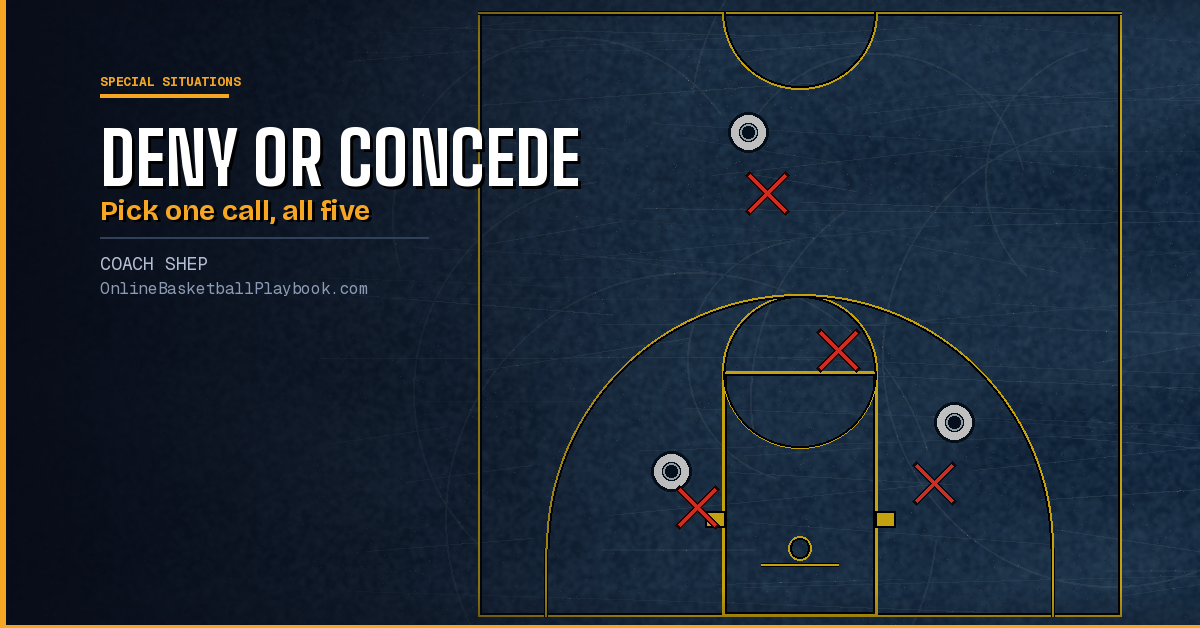
Deny the Inbound or Concede the Catch: Two Schools
Deny the inbound pass or concede the catch and protect the rim? Both schools of inbounds defense, the middle ways, what each risks and how to choose your call.
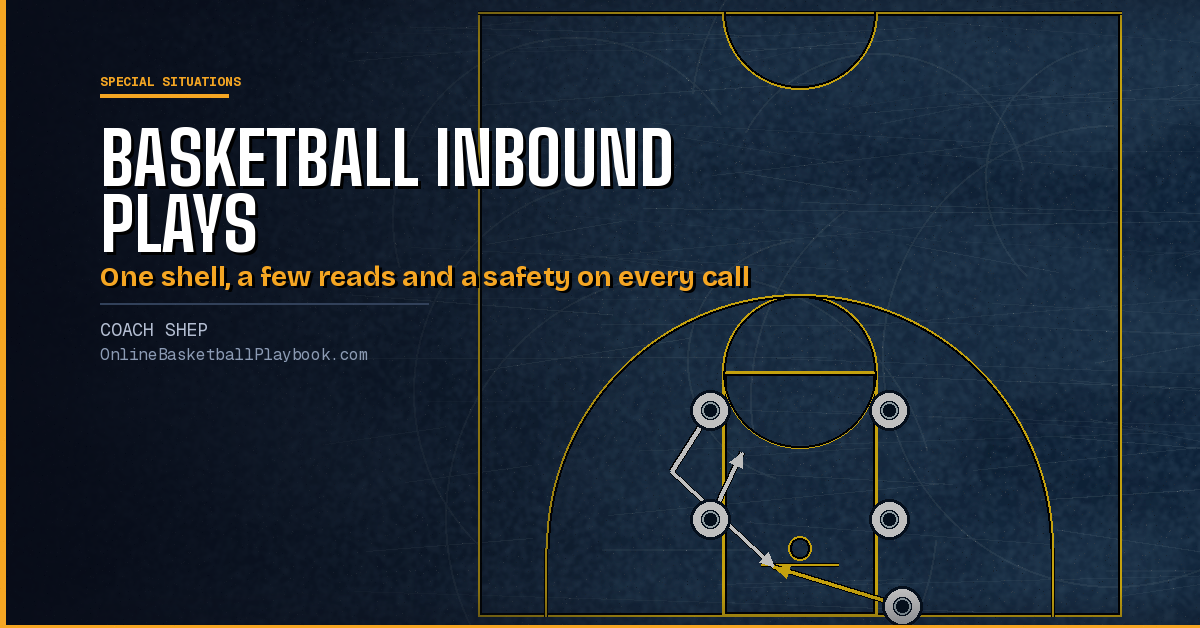
Basketball Inbound Plays: Baseline and Sideline Sets to Run
Basketball inbound plays for baseline and sideline throw-ins, with six drawn sets, simple plays for youth teams, zone looks and where coaches disagree.
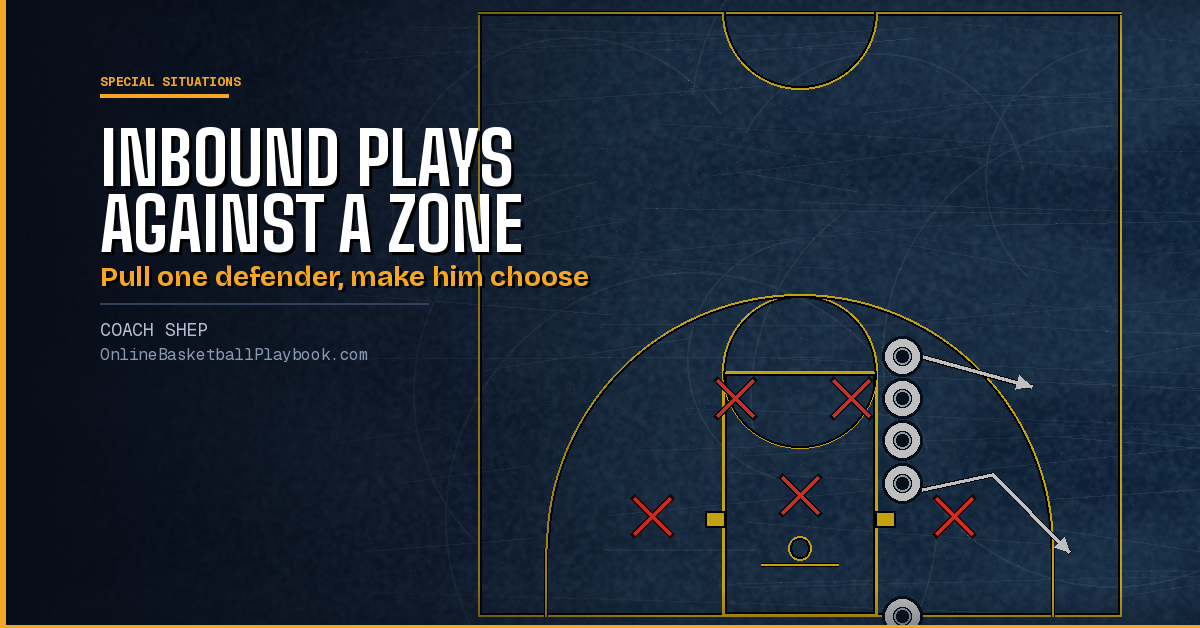
Inbound Plays Against a Zone: Baseline and Sideline Sets
Inbound plays against a zone from the baseline and sideline: the read, the stack near the elbow, short-corner pulls, split cuts, two-part sets and sideline answers.